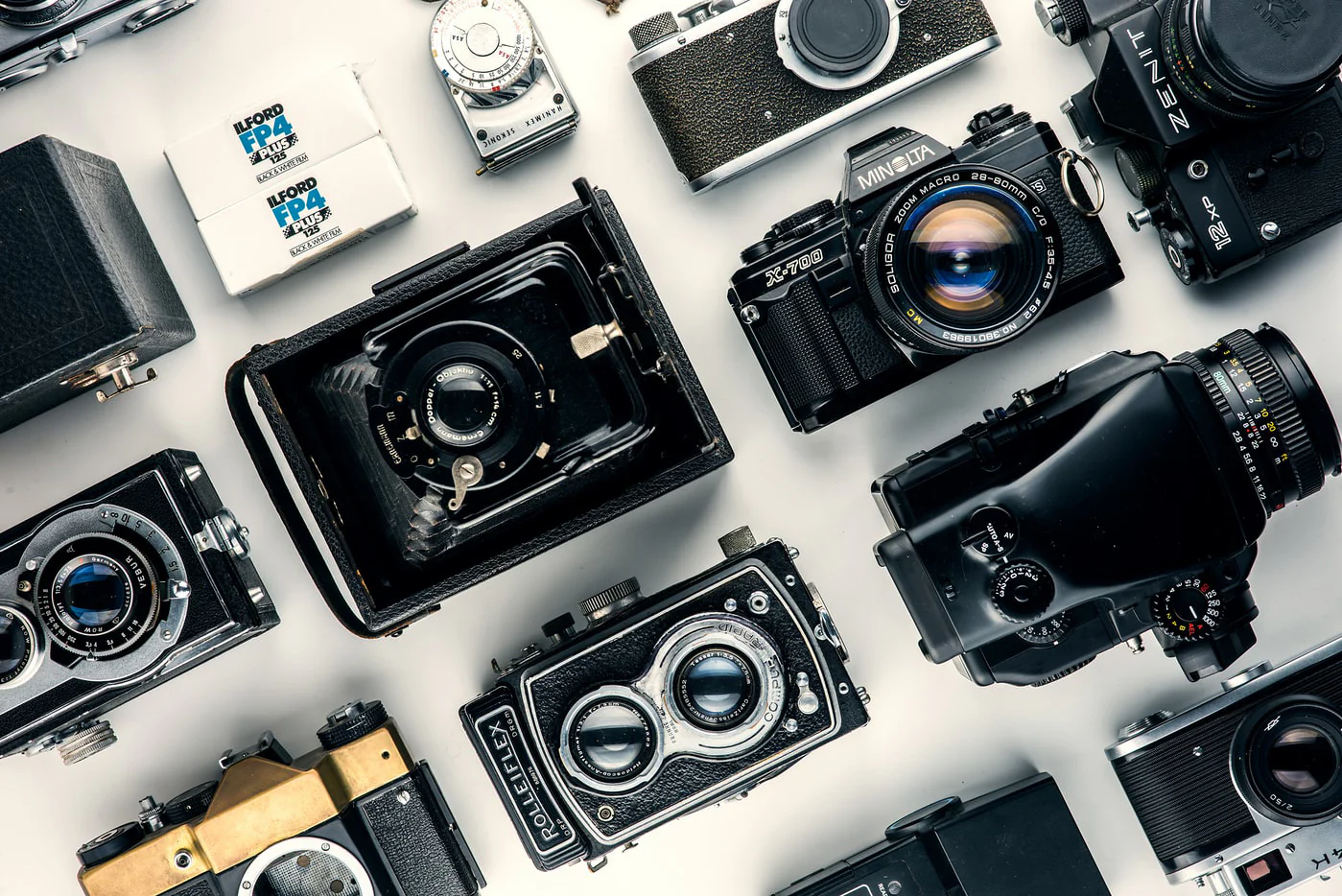
Cameras
Two hundred years of the camera, and the footage it gave us. From Niépce's eight-hour window in 1826 and Muybridge's galloping horse to the Lumière train, the moon-landing broadcast, the camcorder, the first digital frame, and the film studio everyone now carries in a pocket. The devices that captured the world, shown beside what they captured.
A chronological documentary of 728 moments spanning 1700–2026 on Loreline.
Curated by Olivier · last updated 2026-09-20
Eras
- Photographic Processes, How a picture was fixed before film. The camera obscura, Niépce's heliograph and Daguerre's mirror-polished plate, Talbot's paper negative, wet collodion carried into the field in a portable darkroom, tintypes made while you waited, and the stereoscope that put two slightly different views into one apparent solid.
- Motion Studies, Proving what the eye cannot catch. Muybridge's twenty-four tripwired cameras settling a bet about a galloping horse, the zoopraxiscope, Marey's chronophotographic gun, and Harold Edgerton's microsecond flash freezing a bullet through an apple and a drop of milk into a crown.
- Early Cinema, The first decade of moving pictures. Edison's Kinetoscope and the tar-paper Black Maria, the Lumières' cinématographe and the workers leaving the factory, Méliès painting a rocket into the moon's eye, the magic lantern that preceded all of it, and the actualities audiences watched simply because they moved.
- Kodak, George Eastman's bet that anyone could take a picture. The 1888 Kodak sold loaded and returned to the factory for developing, the one-dollar Brownie that put a camera in a child's hands, the Instamatic cartridge, Super 8, and the yellow box that meant film for a century.
- Leica & 35mm, The camera you could carry. Oskar Barnack's Leica built around cine film, the 35mm frame that became the standard, the Rolleiflex held at the waist, the Nikon F and the system camera, the machines that made candid photography physically possible.
- Colour Film, Getting the world's colours onto a plate. Prokudin-Gorsky's three exposures through three filters across the Russian Empire, the Lumières' Autochrome and its potato-starch grains, Kinemacolor, Technicolor's three-strip beam splitter, and Kodachrome, which held its colour for seventy years.
- Polaroid, A picture in sixty seconds. Edwin Land's daughter asking why she had to wait, the peel-apart print, the SX-70 folding to the size of a wallet, the whirr and the developing square, and the chemistry that made a darkroom unnecessary.
- Home Movies, Ordinary life, shot by the people living it. 8mm and 16mm reels, the Bolex, birthdays and holidays and back gardens, the projector and the bedsheet screen, and the accidental historical record that home footage turned out to be.
- Photojournalism, The camera as witness. Brady's teams photographing the American Civil War dead, the Speed Graphic and the press pack, the Hindenburg burning on newsreel, D-Day shot by combat cameramen, Iwo Jima, and the images that changed what the public would accept.
- Television Cameras, Live pictures down a wire. Farnsworth and Zworykin, the iconoscope and the image orthicon, the RCA TK studio cameras, the BBC's outside broadcasts, and the machines that made an event visible everywhere at the moment it happened.
- Videotape, Recording the picture instead of transmitting it. Ampex's quadruplex and the end of the kinescope, U-matic, the Betamax and VHS war, MiniDV, and the tape formats that decided what got kept.
- Camcorders, The camera that recorded onto tape in your hand. The Portapak that put video in the hands of artists and activists, the Betamovie, the Handycam, Video8 and Hi8, Nam June Paik, and the moment amateur footage started ending up on the news.
- Space Cameras, Cameras sent where people mostly cannot go. The V-2 films at the edge of the atmosphere, the Hasselblads carried to the Moon, Earthrise, Mariner and Viking and the Voyagers, and the first photographs taken of another planet's surface.
- Digital Cameras, The end of film. Steve Sasson's 1975 Kodak prototype recording to cassette, the CCD, Sony's Mavica, the QuickTake, the JPEG, the DSLR that professionals finally accepted, and mirrorless cameras removing the last moving part.
- Cinema Cameras, What films are shot on now. ARRI's Alexa, the RED, Blackmagic putting cinema sensors within reach, the underwater rigs Cousteau's crews built, and the digital bodies that pushed celluloid out of the industry that invented it.
- Phone Cameras, A camera in every pocket. The first camera phones, the iPhone, the Pixel and the Galaxy, computational photography stacking dozens of frames into one, the selfie, Instagram, and the fact that most photographs ever taken were taken this way.
- GoPro, The camera you strap to something. Nick Woodman's surf housing, the HERO line, helmet and board and dashboard mounts, Red Bull Stratos, 360 rigs and Insta360, and point-of-view footage as its own genre.
- Drones, The camera that flies itself. DJI's Phantom, Mavic and Avata, FPV racing rigs, the aerial shot that used to need a helicopter, and the regulation that arrived once everyone had one.
- Surveillance Cameras, Cameras that watch without a photographer. CCTV, the Trojan Room coffee webcam, the doorbell camera, police body cams, automatic number-plate readers, and the argument about who is holding the footage.
- - Camera obscura (1700) (1 of 4). Camera obscura, the camera itself, 1700. In the first age of photography, exposures took hours and every image was a small miracle of chemistry and light.
- - Camera obscura (1700) (2 of 4). Camera obscura, the camera itself, 1700. In the first age of photography, exposures took hours and every image was a small miracle of chemistry and light.
- - Camera obscura (1700) (3 of 4). Camera obscura, the camera itself, 1700. In the first age of photography, exposures took hours and every image was a small miracle of chemistry and light.
- - Camera obscura (1700) (4 of 4). Camera obscura, the camera itself, 1700. In the first age of photography, exposures took hours and every image was a small miracle of chemistry and light.
- - Niépce's first photograph (1826). Niépce's first photograph, an image made in 1826. In the first age of photography, exposures took hours and every image was a small miracle of chemistry and light.
- - Niépce's first photograph (1826) (1826) (1 of 4). Enhanced version by the Swiss, Helmut Gersheim (1913-1995) performed ca. 1952 of Niépce's View from the Window at Le Gras, (Harry Ransom Humanities Research Center, University of Texas, Austin) the first successful permanent photograph created by Nicéphore Niépce in 1826 or 1827, in Saint-Loup-de-Varennes.
- - Niépce's first photograph (1826) (1826) (2 of 4). Niépce's first photograph (1826), an image made in 1826. In the first age of photography, exposures took hours and every image was a small miracle of chemistry and light.
- - Niépce's first photograph (1826) (1826) (3 of 4). Niépce's first photograph (1826), an image made in 1826. In the first age of photography, exposures took hours and every image was a small miracle of chemistry and light.
- - Niépce's first photograph (1826) (1826) (4 of 4). Niépce's first photograph (1826), an image made in 1826. In the first age of photography, exposures took hours and every image was a small miracle of chemistry and light.
- - First photo of a human (1838) (1838) (1 of 4). This is "Boulevard du Temple", the first ever photograph of a person. The photo was taken by Louis Daguerre in late 1838 or early 1839 in Paris. It is of a busy street, but because exposure time was over ten minutes, the city traffic was moving too much to appear.
- - First photo of a human (1838) (1838) (2 of 4). Boulevard du Temple, Paris, 3rd arrondissement, Daguerreotype. Made in 1838 by inventor Louis Daguerre, this is believed to be the earliest photograph showing a living person.
- - First photo of a human (1838) (1838) (3 of 4). Boulevard du Temple, Paris, IIIe arrondissement, Daguerreotype. The first surviving picture of a living person, taken in 1838 or possibly 1837. The image shows a busy street, but due to exposure time of more than ten minutes, the traffic was moving too much fast to appear.
- - First photo of a human (1838) (1838) (4 of 4). First photo of a human (1838), an image made in 1838. In the first age of photography, exposures took hours and every image was a small miracle of chemistry and light.
- - The daguerreotype camera (1839) (1 of 4). Patient: Francis Manuel. According to Rowley (2022), the view captures an exploratory and intervention surgery for a young Portuguese sailor's diseased fibula. Although Manuel was Townsend's patient, Warren was the lead surgeon who prosecuted the operation on July 3, 1847.
- - The daguerreotype camera (1839) (2 of 4). I was asked if I had any good pictures of cased images, and realised that the existing images I had online of this wonderful piece - www.flickr.com/photos/whatsthatpicture/sets/7215762621801... - did not show it in its case, so this is just rectifying that omission.
- - The daguerreotype camera (1839) (3 of 4). The daguerreotype camera, the camera itself, 1839. In the first age of photography, exposures took hours and every image was a small miracle of chemistry and light.
- - The daguerreotype camera (1839) (4 of 4). Exhibit in the Tekniska museet, Stockholm, Sweden. This work is old enough so that it is in the public domain. Photography was permitted in the museum without restriction.
- - Bayard's staged photo (1840) (1840) (1 of 4). Bayard's staged photo (1840), an image made in 1840. In the first age of photography, exposures took hours and every image was a small miracle of chemistry and light.
- - Bayard's staged photo (1840) (1840) (2 of 4). Bayard's staged photo (1840), an image made in 1840. In the first age of photography, exposures took hours and every image was a small miracle of chemistry and light.
- - Bayard's staged photo (1840) (1840) (3 of 4). Bayard's staged photo (1840), an image made in 1840. In the first age of photography, exposures took hours and every image was a small miracle of chemistry and light.
- - Bayard's staged photo (1840) (1840) (4 of 4). Bayard's staged photo (1840), an image made in 1840. In the first age of photography, exposures took hours and every image was a small miracle of chemistry and light.
- - Talbot's calotype negative (1843) (1 of 4). Talbot's calotype negative, an image made in 1843. In the first age of photography, exposures took hours and every image was a small miracle of chemistry and light.
- - Talbot's calotype negative (1843) (2 of 4). Westbound view from a window of the hotel "Russischer Hof" at the Zeil towards the Hauptwache, calotype.Notice: Talbot's original print is most likely mirror-sided. Hence, for comparison this at 180° horizontally rotated image had been created (however the original description was not mirrored).
- - Talbot's calotype negative (1843) (3 of 4). Talbot's calotype negative, an image made in 1843. In the first age of photography, exposures took hours and every image was a small miracle of chemistry and light.
- - Talbot's calotype (1843) (1 of 3). Talbot's calotype, an image made in 1843. In the first age of photography, exposures took hours and every image was a small miracle of chemistry and light.
- - Talbot's calotype (1843) (2 of 3). Talbot's calotype, an image made in 1843. In the first age of photography, exposures took hours and every image was a small miracle of chemistry and light.
- - Talbot's calotype negative (1843) (4 of 4). John Moffat (Scottish, 1819–1894). William Henry Fox Talbot, 1864. Carbon print, printed 1948 by Harold White. George Eastman Museum, gift of Mrs. Alden Scott Boyer.
- - Talbot's calotype (1843) (3 of 3). Talbot's calotype, an image made in 1843. In the first age of photography, exposures took hours and every image was a small miracle of chemistry and light.
- - Early daguerreotype portrait (1845) (1 of 4). Early daguerreotype portrait, an image made in 1845. In the first age of photography, exposures took hours and every image was a small miracle of chemistry and light.
- - Early daguerreotype portrait (1845) (2 of 4). Early daguerreotype portrait, an image made in 1845. In the first age of photography, exposures took hours and every image was a small miracle of chemistry and light.
- - Early daguerreotype portrait (1845) (3 of 4). Early daguerreotype portrait, an image made in 1845. In the first age of photography, exposures took hours and every image was a small miracle of chemistry and light.
- - Early daguerreotype portrait (1845) (4 of 4). Early daguerreotype portrait, an image made in 1845. In the first age of photography, exposures took hours and every image was a small miracle of chemistry and light.
- - First photo of the moon (1851). First Astronomical Photograph - John W. Draper's Moon Daguerreotype. It was taken on March 26, 1840 from the rooftop observatory at New York University.
- - First photo of the moon (1851). First photo of the moon, an image made in 1851. In the first age of photography, exposures took hours and every image was a small miracle of chemistry and light.
- - Nadar's portraits (1860) (1 of 4). Nadar's portraits, an image made in 1860. In the first age of photography, exposures took hours and every image was a small miracle of chemistry and light.
- - The stereoscope (1860). Appears In: Rainforth, Selden Irwin, 1879-1960. Stereoscopic skin clinic Image Description: Image of a handheld stereoscope, made of copper, wood, and iron hinges with glass lenses and felt lining included in the box with viewing cards. Stereoscopic skin clinic. NLM Hidden treasure p.
- - Nadar's portraits (1860) (2 of 4). Nadar's portraits, an image made in 1860. In the first age of photography, exposures took hours and every image was a small miracle of chemistry and light.
- - The stereoscope (1860). From Cincinnati Public Library: "Children viewing images from the Library’s stereograph collection at Old Main. Prior to the advent of motion pictures, stereographs were a popular form of entertainment. Stereographs were created by placing two slight variations of the same scene side-by-side on a card.
- - Nadar's portraits (1860) (3 of 4). Nadar's portraits, an image made in 1860. In the first age of photography, exposures took hours and every image was a small miracle of chemistry and light.
- - Nadar's portraits (1860) (4 of 4). Nadar's portraits, an image made in 1860. In the first age of photography, exposures took hours and every image was a small miracle of chemistry and light.
- - First colour photo (Maxwell 1861) (1861). First colour photo (Maxwell 1861), an image made in 1861. In the first age of photography, exposures took hours and every image was a small miracle of chemistry and light.
- - Civil War photography (Brady) (1863) (1 of 4). Wet collodion negative portrait of Rear Adm. David D. Porter, officer of the Federal Navy, by the Brady National Photographic Art Gallery. Restoration by Adam Cuerden, of the usual "remove dust and other damage, and repair the edges" sort.
- - Civil War photography (Brady) (1863) (2 of 4). Civil War era locomotive and clerestory-roofed passenger cars (cropped from Civil War locomotive and clerestory-roofed passenger cars at junction (Mathew Brady photo).jpg).The image has been cropped and distracting background removed to more clearly illustrate an early example of clerestory roofs in railroad passenger...
- - Civil War photography (Brady) (1863) (3 of 4). Civil War photography (Brady), an image made in 1863. In the first age of photography, exposures took hours and every image was a small miracle of chemistry and light.
- - Civil War photography (Brady) (1863) (4 of 4). From the Civil War photographic album of Louis Philippe d'Orleans Comte de Paris. Various Photographers including Mathew Brady, c. 1862 – The Stephan Loewentheil Family Photography Collection, Cornell University.
- - Early landscape photography (1865) (1 of 4). Early landscape photography, an image made in 1865. In the first age of photography, exposures took hours and every image was a small miracle of chemistry and light.
- - Early landscape photography (1865) (2 of 4). Early landscape photography, an image made in 1865. In the first age of photography, exposures took hours and every image was a small miracle of chemistry and light.
- - Early landscape photography (1865) (3 of 4). Early landscape photography, an image made in 1865. In the first age of photography, exposures took hours and every image was a small miracle of chemistry and light.
- - Early landscape photography (1865) (4 of 4). Early landscape photography, an image made in 1865. In the first age of photography, exposures took hours and every image was a small miracle of chemistry and light.
- - A tintype (1870) (1 of 4). A tintype, an image made in 1870. In the first age of photography, exposures took hours and every image was a small miracle of chemistry and light.
…and 678 more moments.
Full text archive: /loreline-text/cameras.md