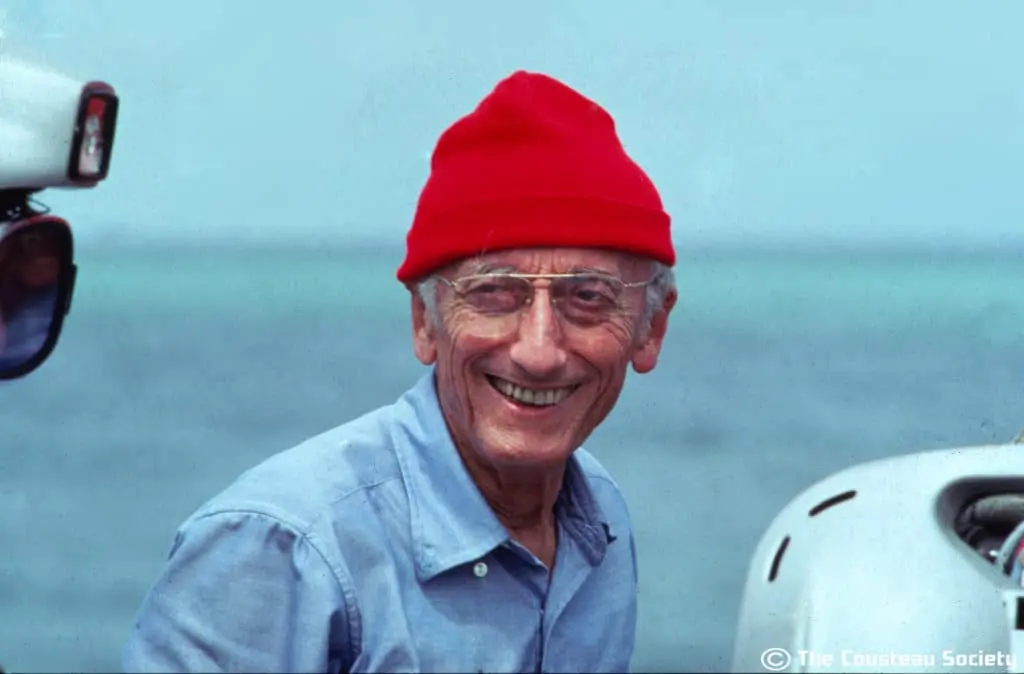
Jacques Cousteau
A naval officer who failed to become a pilot because he broke both arms in a car crash in 1935, and who spent the rest of his life underwater instead. With Emile Gagnan, an engineer who had been adapting regulators to run cars on wood gas, Cousteau made breathing at depth ordinary. He then did something rarer: he made the sea legible to people who would never dive, through the Calypso, three Academy Awards including one for a fiction film about a goldfish, and a television series that invented the grammar every nature documentary still uses. The same man surveyed the seabed for oil companies, blew up a reef and killed sharks on camera for The Silent World, was accused by his own wartime superior of claiming credit for operations he had abandoned, and sued his son a year before he died. This archive carries the apparatus, the ships and habitats, the films and the series, the conservation campaigns that helped win the Antarctic mineral ban, and the criticism, without deciding for you which of these is the real one.
A chronological documentary of 554 moments spanning 1910–2026 on Loreline.
Curated by Olivier · last updated 2026-09-20
- - A fin whale hauled up at an Icelandic whaling station, before 1910. A fin whale being hauled ashore at Ellefsen's whaling station in Mjoafjordur. Photograph made before July 1910.
- - The front of the Oceanographic Museum of Monaco, 1910. The principal facade of the museum Cousteau would run for three decades. The image dates from the year of his birth.
- - Maurice Fernez, inventor of the free-swimming diving mask. Maurice Fernez, whose surface-supplied mask and nose clip freed the diver from the helmet. Cousteau's first underwater experience in 1936 was through a pair of Fernez goggles lent to him by Philippe Tailliez.
- - Maurice Fernez preparing to dive with his apparatus, 1912. Fernez, at left, readying his breathing device in 1912. The Fernez system supplied air from the surface through a hose, with no cylinder.
- - Fernez demonstrating his breathing apparatus. Maurice Fernez preparing a public demonstration of his diving apparatus.
- - The Oceanographic Museum of Monaco from the sea, 1913. The sea facade of the Oceanographic Museum of Monaco, founded by Prince Albert I. Cousteau was its director from 1957 to 1988.
- - The cetacean hall of the Oceanographic Museum of Monaco, 1913. The whale skeleton gallery at Monaco, built from Prince Albert I's expeditions. Cousteau directed this institution from 1957 to 1988.
- - Underwater filming for Universal, reported in 1916. A New York Tribune feature of 30 July 1916 on men filming beneath the sea. Underwater cinema existed well before Cousteau; what he brought was a portable air supply and a mass audience.
- - Cadets of the Ecole navale on parade. Officer cadets of the French Naval Academy parading. Cousteau entered the school in 1930 and was commissioned as a gunnery officer in 1933.
- - Officer cadets reviewed at the Ecole navale. Ecole navale cadets passed in review at Brest. Cousteau joined the school in 1930 and left the navy in 1949 as a capitaine de corvette, not a captain as is often written.
- - Commandant Yves Le Prieur with his diving apparatus, 1926. Yves Le Prieur at the Tourelles swimming pool in August 1926. His set was genuinely self-contained but used constant flow, not a demand valve: air ran continuously and the diver worked a tap by hand, so dive times were very short. That distinction is what the Cousteau-Gagnan regulator resolved.
- - The Fernez-Le Prieur diving apparatus at the Salon nautique, 1926. The Fernez-Le Prieur set shown at the Paris boat show in 1926. Fernez and Le Prieur patented a hand-controlled constant-flow regulator with a full face mask that year, seventeen years before the Aqua-Lung.
- - Entrance to the Oceanographic Museum of Monaco, 1927. The museum entrance photographed in 1927, three decades before Cousteau took charge of it.
- - An oxygen rescue helmet, 1928. A rescue oxygen helmet photographed for the press in 1928, part of the crowded field of French breathing apparatus that preceded the Aqua-Lung.
- - The cruiser Jeanne d'Arc launched at Saint-Nazaire, 1930. The launch of the school cruiser Jeanne d'Arc on 14 February 1930. Cousteau entered the Ecole navale that year and made his world training cruise aboard her, filming with a camera he had bought as a teenager. Press photograph from the Agence Rol.
- - The Jeanne d'Arc enters the water at Saint-Nazaire. A second press frame of the Jeanne d'Arc launch in February 1930.
- - Emile Gagnan, the engineer who built the regulator. Emile Gagnan (1900-1979), the Air Liquide high-pressure gas engineer who miniaturised the demand regulator. He is routinely reduced to a footnote in the Cousteau story despite having built the mechanism.
- - Standard diving dress in a naval museum. A complete set of standard diving dress at the Museum of the Polish Navy. Helmet, corselet, weighted boots and air line: the equipment that defined diving before 1943.
- - A pneumatic chamber at the Le Bourget medical service, 1931. A pressure chamber used for aviation medicine at Le Bourget. Decompression physiology, developed for divers and airmen alike, is what set the depth limits Cousteau's teams worked against.
- - Italian helmet divers Franceschi, Gianni and Bargellini, 1931. Three Italian helmet divers photographed in 1931. Heavy standard dress was still the professional norm when Cousteau began diving.
- - The Jeanne d'Arc at Vancouver, 1935. The French school cruiser Jeanne d'Arc at Vancouver in January 1935. The ship carried each year's Ecole navale class around the world.
- - The training cruiser Jeanne d'Arc in port. The Jeanne d'Arc alongside at Vancouver in January 1935. The annual world cruise took each Ecole navale class through the Pacific and the Far East.
- - A US Navy Mark V diving helmet. A Mark V helmet by the Morse Diving Equipment Company, the standard US Navy hard-hat rig from 1916 into the 1980s. Dated to the object's service era, not to the modern photograph of it.
- - Jacques-Yves Cousteau - Par 18 m de fond (1942). Par dix-huit metres de fond, shot in 1941 at the Embiez islands in the Var entirely on breath-hold, before the Aqua-Lung existed. Tailliez wrote the commentary, Dumas played the lead, and the waterproof camera housing was built by the engineer Leon Veche. It is the first French underwater film.
- - A 1942 French diving apparatus. A wartime French diving set held by the departmental firefighters museum at Osny. Georges Commeinhes patented a working demand-valve scuba set in 1937 and 1942 and reached 53 metres, the strongest counter-example to Cousteau's claim of priority. He was killed at Strasbourg in 1944.
- - Jacques-Yves Cousteau - Epaves (1943). Epaves, the first film shot with the Aqua-Lung. A screening for Admiral Lemonnier secured navy backing. French sources record that the 1942 and 1943 films were shot, in their phrase, under the surveillance and with the agreement of the Kriegsmarine.
- - EPAVE (1943) - Jacques Yves Cousteau. Epave, 1943. The film exists because the Aqua-Lung had just been built, and it is the first demonstration of what the apparatus made possible on camera.
- - Early Aqua Lung Prototypes in use by Cousteau. Archive film 33721. Archive film of early Aqua-Lung prototypes in use by Cousteau. The 1943 set paired a demand valve with compressed-air cylinders, giving the diver air only when he inhaled.
- - The Cousteau-Gagnan Aqua-Lung, triple cylinder set. A surviving Cousteau-Gagnan Aqua-Lung with its triple cylinder set and box, originally sold as the scaphandre autonome. A modern museum photograph of a 1940s object, dated to the object.
- - Aqua-Lung cylinder set and packaging, detail. A second view of a preserved Cousteau-Gagnan set. The demand valve was Emile Gagnan's miniaturisation, built in bakelite in 1942 to meter wood gas into car engines during the petrol requisition, not for diving.
- - A Siebe Gorman set above a Cousteau-Gagnan Aqua-Lung. The British Siebe Gorman self-contained compressed air apparatus displayed above a Cousteau-Gagnan set. The comparison shows that the Aqua-Lung was one of several contemporaneous designs, not a solitary invention.
- - The Cousteau-Gagnan regulator on display at Espalion. The demand valve of the scaphandre autonome invented by Cousteau and Emile Gagnan, exhibited at the Musee du Scaphandre in Espalion, Rouquayrol's home town. A museum record photograph of the 1940s device.
- - US Navy underwater demolition team recovery, 1945. Recovery of an underwater demolition team swimmer by rubber boat. Wartime combat swimming, in France and America alike, ran in parallel with the development of autonomous diving. Public domain as a US federal work.
- - A US Navy diver at the Washington diving school. Navy diver Harold Weisbrod at the Navy Diving School in Washington. Public domain as a US federal work. The precise year is not given in the source record.
- - Student divers at the Deep Sea Diving School, Naval Gun Factory. Trainees at the US Navy Deep Sea Diving School in Washington. Public domain as a US federal work.
- - Signing the International Convention for the Regulation of Whaling, 1946. The signing of the whaling convention in Washington on 2 December 1946, which created the International Whaling Commission. Public domain as a US federal work.
- - EARLY JACQUES COUSTEAU FILM "SILENT LANDSCAPES" 1947 AQUA-LUNG DOCUMENTARY 61824. Silent Landscapes, an early Aqua-Lung documentary. Cousteau's filmography dates Paysages du silence to 1944 in some listings and 1947 in others.
- - Jacques-Yves Cousteau - Paysages du Silence (1947). Paysages du silence. Cousteau's filmography dates the film to 1944 in some listings and 1947 in others; this print carries the later date.
- - Underwater television camera controls aboard USS Coucal at Bikini, 1947. Control apparatus for an underwater television camera aboard the submarine rescue ship Coucal at Bikini Atoll on 23 August 1947, surveying the sunken test fleet. Public domain as a US federal work.
- - The Mousquemers in 1948. Cousteau with the diving group later called the Mousquemers. Philippe Tailliez coined that name retroactively in 1975; it was not what the group called itself at the time, and there were four members including Leon Veche.
- - Jacques Piroux and Dimitri Rebikoff, underwater archaeology, 1950s. Doctor Jacques Piroux and the engineer Dimitri Rebikoff, contemporaries of Cousteau working on underwater archaeology and imaging on the French coast.
- - EARLY JACQUES COUSTEAU FILM A TOUR OF A REEF SHARKS 61814. An early Cousteau reef and shark film. Cousteau bought a cine camera as a teenager and filmed the Jeanne d'Arc world cruise in 1930-33, a decade before he could breathe underwater: he was a film-maker who learned to dive.
- - Vintage scuba frogwoman running out of air, Hans Hass Movie. Vintage footage of Lotte Hass diving, from the Hans Hass films. She was among the first women to appear as an underwater performer on film.
- - A frogman's self-contained diving set at Espalion. An early autonomous diving set displayed at the Musee du Scaphandre in Espalion. Museum photograph of a mid-century apparatus.
- - " TEN FATHOMS DEEP " 1952 JACQUES-YVES COUSTEAU EARLY SCUBA DIVING FILM 20172. Ten Fathoms Deep, an early Cousteau scuba film from 1952, made in the years the Calypso was working oil survey contracts in the Persian Gulf.
- - Hans Hass Under the Red Sea Orginal English Version (1952) Classic Full Movie. Under the Red Sea in full. Hass used rebreathers rather than the open-circuit demand valve, a genuinely different machine.
- - A scuba diver photographing an amphora field, 1953. A diver in autonomous apparatus photographing amphorae at the Titan wreck in spring 1953. This is what the Aqua-Lung made possible: archaeology conducted by a swimming diver rather than a man in a helmet on an air line.
- - Pottery from the Grand Congloue wreck, 210 to 180 BC. Tableware recovered from the Grand Congloue wreck off Marseille, dated 210 to 180 BC. The Calypso worked this site from 1952, an early and contested campaign: archaeologists later criticised the excavation's method and record-keeping.
- - A helmet diver descending at Amsterdam, 1953. A diver in standard dress going into the water at the Rokin in Amsterdam on 14 April 1953. Helmet diving was still ordinary working practice while the Aqua-Lung was reaching the market.
- - Amphorae from the wreck of the Titan, 1954. Amphorae recorded at the Titan wreck site in 1954. The Calypso's own excavation at Grand Congloue near Marseille, begun in 1952, was among the first underwater archaeology campaigns to use autonomous divers.
…and 504 more moments.
Full text archive: /loreline-text/jacques-cousteau.md