SS Atlantic Conveyor
1982
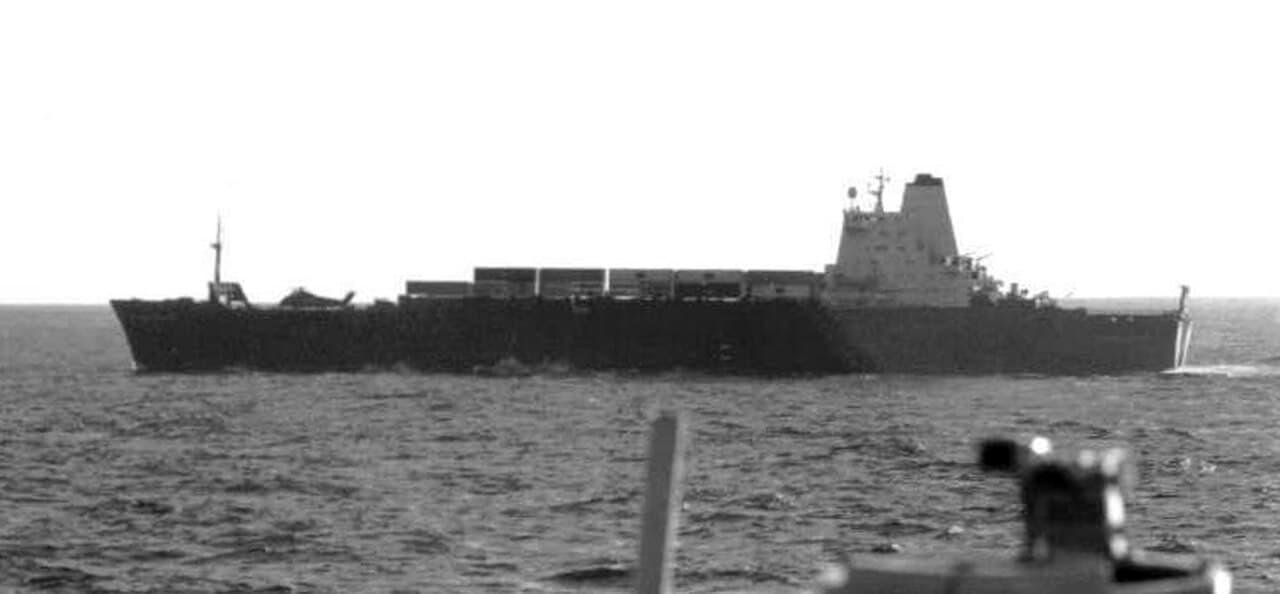
Falklands, two Exocets, the helicopters lost Location: South Atlantic, ~90 nmi NE of the Falklands · Coordinates: 50.55°S 56.33°W · Casualties: 12 · Survivors: 150 · Depth: 200 m · Cause: anti-ship missile — Struck by two AM-39 Exocet missiles fired by Argentine Super Étendards at 19:41 on 25 May 1982. Burned through the night with her cargo of helicopters still aboard, including six Wessex, three Chinooks, and a flight's worth of Lynx. The loss of the heavy-lift aircraft forced British troops to march overland across the Falklands. · Fate: sank 28 May 1982 · Type: roll-on/roll-off container ship · requisitioned · Tonnage: 14,946 tons · Crew: 162 · Flag: United Kingdom · Cunard (STUFT) · Launched: 1969 Cunard roll-on container ship, requisitioned as a STUFT (Ship Taken Up From Trade) to carry the British task force's heavy-lift helicopters to the Falklands. Struck by two AM-39 Exocets off the Falklands on the evening of 25 May 1982, the same day HMS Coventry was bombed. Her cargo of Wessex, Chinooks, and Lynx helicopters burned on her decks. The loss of the heavy-lift aircraft forced 3 Commando Brigade to march overland across East Falkland, the 'yomp' that entered British military mythology. 12 dead, including Captain Ian North, Merchant Navy. The Vessel The SS Atlantic Conveyor (Cunard hull 131) was a roll-on/roll-off container ship of the Cunard Line, built at the Swan Hunter yard on the Tyne and commissioned on 20 April 1970. She was 213 metres long, 14,946 gross tons, and had been designed for the Cunard Atlantic container service between Liverpool and New York. Her specific configuration included full drive-through ro-ro vehicle capacity, three cargo holds for containers, and a reinforced upper deck designed for the carriage of heavy military vehicles on Cunard's occasional NATO-exercise contracts. At the outbreak of the Falklands War on 2 April 1982 Atlantic Conveyor was at sea, inbound from the United States to Liverpool. She was requisitioned under the STUFT programme (Ships Taken Up From Trade) on 14 April 1982 and diverted to the British naval yard at Devonport for urgent conversion to the specific role required by the Falklands task force: the carriage of RAF Harrier and Royal Navy Sea Harrier fighter reinforcements and of the heavy-lift helicopters needed for the subsequent ground campaign. Her conversion was completed in the extraordinarily compressed period of nine days between 14 and 22 April 1982. Her forward cargo hold was reconfigured as a hangar for the 12 Harriers; her upper deck was adapted as a flight deck with crash barriers and arrestor gear; her after cargo holds were adapted for the carriage of four Chinook heavy-lift helicopters (the British Army's principal heavy-lift platform) plus vehicles, fuel, The Disaster On 25 May 1982 (Argentine National Day), the Argentine Naval Aviation conducted its final major Exocet strike against the British task force. Two Argentine Navy Super Étendard aircraft, carrying one Exocet AM-39 missile each, were vectored to a position that would allow them to engage the British carrier HMS Hermes from the northwest. The Argentine strike had been planned for several days; its execution on 25 May 1982 had been selected to coincide with Argentine National Day for morale and propaganda purposes. At 19:40 on 25 May 1982 the two Super Étendards approached the main British task force from the north-northwest. They released their Exocets at a range of approximately 40 kilometres from the British formation. The two Exocets were tracked by Royal Navy radar systems and engaged by the air-defence ships of the task force (HMS Hermes, HMS Invincible, and the escorting Type 42 destroyers and Type 22 frigates). The British defensive systems produced a substantial amount of chaff (radar-reflective foil) in the path of the incoming missiles. The chaff successfully decoyed the two Exocets away from their intended primary targets (HMS Hermes and HMS Invincible). The two Exocets, redirected by the chaff clouds, acquired HMS Atlantic Conveyor as their final target. Both missiles struck her in quick succession: the first at 19:41, entering her port side and detonating in her cargo holds; the second at 19:42, entering her port side further aft and detonating in her engineering spa
Source: naufragia.app
Part of Shipwrecks · Watch in the documentary