HMS Sheffield
1982
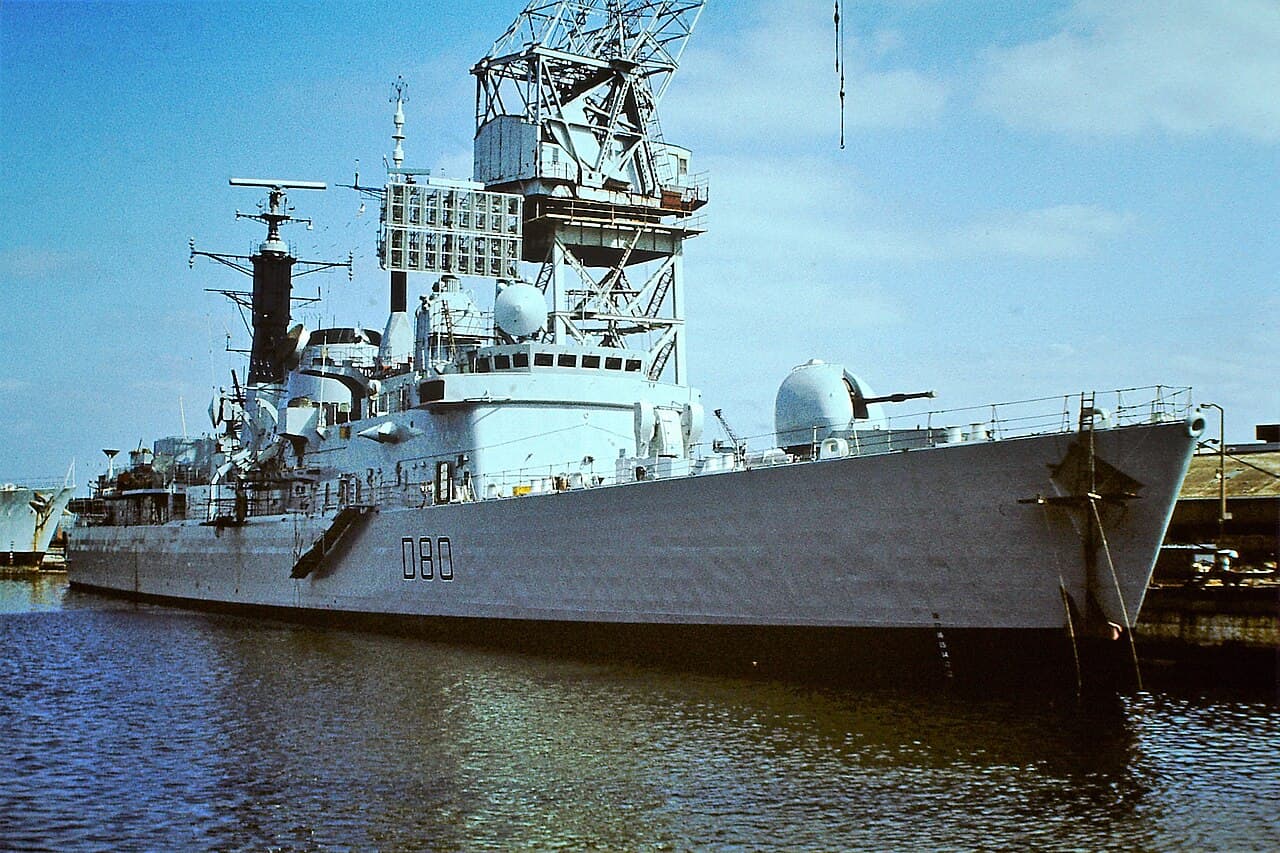
Falklands, an Exocet, aluminium burned Location: South Atlantic, 70 nmi SE of Port Stanley · Coordinates: 52.10°S 55.10°W · Casualties: 20 · Survivors: 260 · Depth: 100 m · Cause: anti-ship missile — Struck amidships by an AM-39 Exocet missile fired by an Argentine Super Étendard at 14:03 on 4 May 1982. The warhead did not detonate but the rocket motor's remaining fuel burned; her aluminium superstructure caught fire and spread uncontrollably. Abandoned after six hours; she sank under tow on 10 May. · Fate: scuttled under tow · protected · Type: destroyer · Type 42 · Tonnage: 4,100 tons · Crew: 281 · Flag: United Kingdom · Launched: 1971 Royal Navy Type 42 destroyer, on radar picket duty for the British carrier task group off the Falklands. Struck amidships by an AM-39 Exocet from an Argentine Super Étendard at 14:03 on 4 May 1982. The warhead did not detonate but the aluminium superstructure caught fire from the residual rocket fuel and could not be contained. 20 dead, the first British warship lost to enemy action since 1945. Her loss exposed a critical flaw in the aluminium superstructures of Royal Navy frigates and destroyers. The Vessel HMS Sheffield (D80) was a Type 42 guided-missile destroyer of the Royal Navy, commissioned at Vickers Shipbuilding and Engineering at Barrow-in-Furness on 16 February 1975. She was 125 metres long, 4,100 tons full load, armed with a Sea Dart surface-to-air missile system (with 22 Sea Dart rounds), a single 4.5-inch automatic gun, and two triple torpedo tubes. Her designed speed was 30 knots on twin Rolls-Royce Olympus gas turbines. The Type 42 was the Royal Navy's principal post-Cold War destroyer type, designed for fleet air defence around the Invincible-class aircraft carriers. The class had originally been designed to the South African specification that had produced HMS Sheffield and her sisters; fourteen Type 42 destroyers were built between 1971 and 1985 for the Royal Navy, with further examples built for Argentina (ARA Hercules and ARA Santísima Trinidad) under pre-1982 contracts. The class has been widely cited as an example of late Cold War warship design compromising on armour protection and damage-control capacity in favour of reduced displacement and reduced crew. Her specific vulnerability, identified in later post-Falklands analysis, was her reliance on aluminium superstructure over a steel hull. The aluminium alloys used in her superstructure (principally 5456 marine aluminium and its successors) were structurally effective against conventional gunfire threats but were highly combustible when ignited by residual aviation or rocket-propellant fuel. Her class's d The Disaster At 13:56 on 4 May 1982 two Argentine Navy Super Étendard strike aircraft, carrying one Exocet AM-39 missile each, released their weapons at a range of approximately 40 kilometres from HMS Sheffield. The Super Étendards had taken off from the Argentine naval air station at Río Grande on the Argentine Patagonian coast approximately 45 minutes earlier. Their approach had been designed to exploit a gap in the British radar coverage that Argentine intelligence had identified earlier in the campaign. The first Exocet was tracked by HMS Glasgow's radar system at a range of 23 kilometres. Glasgow transmitted the warning to Sheffield through the task force data link. Sheffield's combat information centre received the warning at 14:02 on 4 May 1982. The interval between the warning and the missile's arrival was approximately 80 seconds. Sheffield's anti-air defences, which had been in standard readiness rather than at full action stations, could not be brought to full effectiveness in the available time. The single Exocet that struck Sheffield arrived at 14:04 on 4 May 1982. It impacted her starboard side amidships, penetrating her hull above the waterline at Frame 86. The warhead did not detonate on impact; however, the missile's residual rocket-propellant fuel (approximately 30 kilograms of unused solid propellant) ignited the aluminium superstructure immediately surrounding the impact point. The resulting fire spread through Sheffield's compartments at a rate that her damage-control
Source: naufragia.app
Part of Shipwrecks · Watch in the documentary