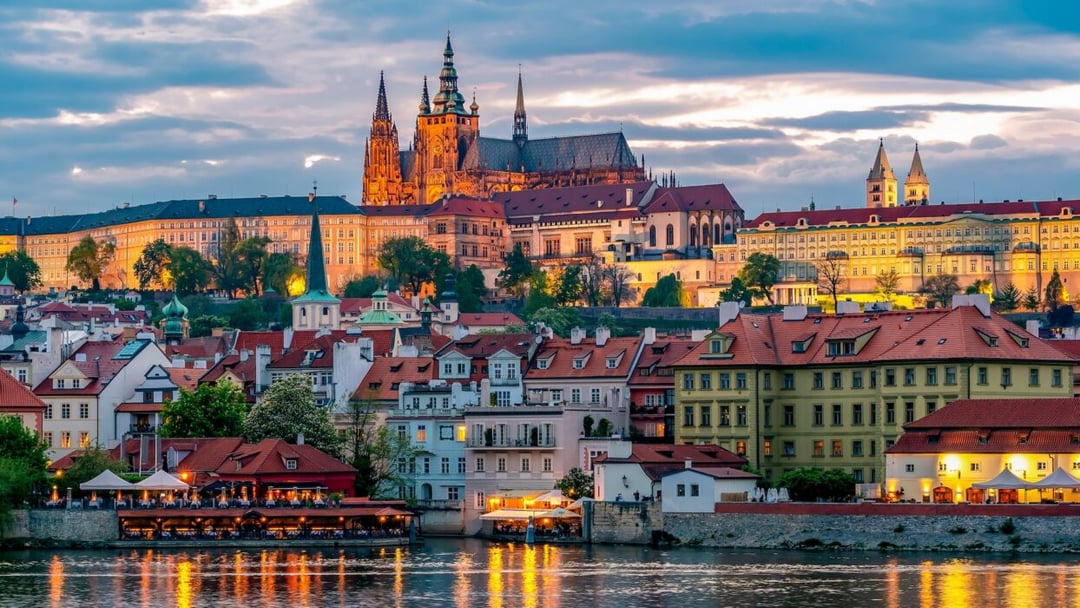
Prague's story
An illuminated chronicle of Prague, beside the Vltava, from Bořivoj's hilltop fortress in the ninth century to the Velvet Republic. Built from Chronica Pragensia by Ludwig Vonmesser (https://prague-oracle.vercel.app/) with thematic regrouping into city-lore segments. 135 folios → 135 scenes.
A chronological documentary of 133 moments spanning 870–2025 on Loreline.
last updated 2026-07-21
Eras
- Foundation & dynasties — Founding moments, ruling dynasties, regime changes, coronations.
- Sacred Prague — Saints, churches, monasteries, religious history. Hus, the bishopric, baroque counter-reformation.
- Learning & enlightenment — University, libraries, scholars, scientists, Mozart, theatre, opera, music. Court of astronomers and alchemists.
- Defenestrations & uprisings — The city is famous for revolts and people thrown from windows. Hussite wars, White Mountain, 1848, 1968.
- Art & architecture — Bridges, cathedrals, baroque palaces, paintings, sculpture, urbanism.
- Modern history — First Republic, interwar Prague, the Czech-Slovak experiment. Masaryk era.
- Occupation & resistance — Nazi protectorate, WWII, communist rule, dissent, samizdat, Charter 77, Prague Spring.
- Velvet Republic — Post-1989: the Velvet Revolution, Havel, EU, modern Prague.
- Figures of Prague — Biographical folios: Kafka, Rudolf II, Charles IV, Mozart, Masaryk, Havel — individuals whose story is woven into the city.
- Legends & myths — Golem, alchemists, Faust, prophecies, Bohemian-magical Prague.
- — The Founding of Prague Castle. Hradčany ridge above the Vltava, the long limestone spine on which Bořivoj raised his timber palisade. Place: Hradčany hill, above the Vltava ford Figures: Bořivoj I, first Christian duke of the Přemyslids · Saint Methodius (baptizes him) Before the castle there is a hill, and beneath the hill a ford where the merchant roads from Regensburg, Kiev, and Kraków cross the Vltava. The Přemyslid dukes have ruled the basin for perhaps two generations, from a wooden fort at Levý Hradec, four river-miles upstream. Around the year 870, Duke Bořivoj I moves the seat south, to the long limestone ridge that the Slavs call Hradčany: the place of the fortress. He builds in timber: a palisade, a stone-walled enclosure for the prince's hall, a small church to the Virgin. He is the first Christian duke of his line. Methodius, archbishop of Moravia, has baptized him not long before.
- — The Baptism of Bořivoj. Karel Javůrek's 1858 painting of Methodius baptizing Bořivoj and Ludmila at Svatopluk's Moravian court. Place: The court of Svatopluk, Great Moravia (probably Velehrad) Figures: Bořivoj I, duke of the Czechs · Svatopluk I, ruler of Great Moravia · Saint Methodius, archbishop, who performs the baptism · Ludmila, Bořivoj's wife, baptized with him Bořivoj is a tributary duke. The Czech basin pays its dues south to Great Moravia, the Slavic federation that runs from Nitra to the Sudeten foothills. Around the year 883 he comes to Svatopluk's court for a feast. He is, by Christian's Legend, made to sit on the floor like a pagan while the baptized eat at the table. Methodius, the Byzantine archbishop of Moravia, leans in and explains the protocol: receive Christ, sit on the bench. Bořivoj receives Christ. So does Ludmila his wife. The chronicle does not tell us how much of the catechism either of them understood, in a Slavonic liturgy newly invented for exactly this purpose. They are sent home with a priest, Kaich, who founds a small wooden church to Saint Clement at Levý Hradec, four river-miles upstream of the future Prague.
- — The Martyrdom of Saint Wenceslas. Folio 18v of the Wolfenbüttel Codex (before 1006), illuminating Gumpold's Legend of Saint Wenceslas. Place: The church door at Stará Boleslav, on the Elbe north of Prague Figures: Václav I (Saint Wenceslas), duke of Bohemia · Boleslav I, his younger brother · Drahomíra, their mother · the assassins Tira, Česta, and Hněvsa Václav has been raised by his grandmother Ludmila and educated, by the standards of a tenth-century Bohemian court, well. He reads Latin and Slavonic. He founds the rotunda of Saint Vitus on the castle hill (the small predecessor of every later cathedral on the same spot) and imports relics from Saxony to consecrate it. He pays tribute to Henry the Fowler at Worms in 929 (some chronicles say 935) to keep the Saxons off his borders, and is given an arm of Saint Vitus in return. He is, by all accounts, devout and conciliatory. Both qualities have their enemies. His younger brother Boleslav has been given the appanage of the Elbe lands, with a seat at Stará Boleslav. He keeps a war-band. He is older, in a sense his brother is not. He resents the tribute, the Saxon connection, and the priests.
- — The Founding of the Bishopric of Prague. Mlada hands the crosier to Dětmar, first bishop of Prague (c. 974); panel from the sarcophagus of Vratislav I. Place: Imperial diet at Quedlinburg; see at Prague Castle Figures: Boleslav II the Pious, duke of Bohemia · Emperor Otto I · Pope Benedict VI · Mlada, sister of Boleslav, who carries the petition to Rome · Dětmar (Thietmar), first bishop, Saxon Benedictine Since the baptism of Bořivoj, the Czech lands have been ecclesiastical territory of the bishop of Regensburg, four hundred kilometers south down the Danube. The arrangement is administratively absurd and politically dangerous: every Bohemian priest is a Bavarian appointment. Boleslav II, son of the brother-killer and grandnephew of the saint, wants his own bishop. He sends his sister Mlada to Rome around 967. She returns a nun and an abbess, with a papal letter of recommendation. The matter waits on imperial consent, which means Otto I, which means the diet at Quedlinburg at Easter 973. Otto agrees. The diocese is carved out of Regensburg. It is placed under the metropolitan of Mainz, three hundred kilometers west, an improvement of distance and a worsening of language: the Czechs will now answer to Germans speaking a different German.
- — The Martyrdom of Saint Adalbert. Mihály Kovács, Saint Adalbert (1855), oil on canvas; the bishop who walked unarmed into the Prussian marshes. Place: The Sambian coast, eastern Baltic (pagan Prussia) Figures: Vojtěch (Adalbert), second bishop of Prague · Bolesław I Chrobry of Poland, his patron and sponsor · Radim Gaudentius, his half-brother and companion · the Sambian Prussians, his killers Vojtěch is from the Slavník clan, the Přemyslids' last domestic rival, lords of Libice on the Elbe. He is educated at Magdeburg under the same Adalbert who confirms him, and takes the master's name. He is consecrated second bishop of Prague in 982 at the age of twenty-six. The diocese disappoints him. The priests are married, the laity is half-pagan, the duke (Boleslav II) tolerates Jewish slave-traders in the lower town. He leaves twice. Both times the pope sends him back. In 995 the Přemyslids slaughter most of the Slavník family at Libice while Vojtěch is in Rome. He does not return to Prague. He goes north instead, to Bolesław Chrobry of Poland, who has cause to support any enemy of the duke at Prague Castle and the piety to mean it. Bolesław outfits him for a mission to the heathen Prussians of the Baltic.
- — The Translation of Adalbert's Relics. Břetislav I in the Romanesque Znojmo rotunda fresco cycle (1134), the duke who carried Adalbert's bones home. Place: Gniezno, then the Saint Vitus rotunda at Prague Castle Figures: Břetislav I, duke of Bohemia · Severus, bishop of Prague · Mieszko II Lambert of Poland (lately deceased) · the body of Saint Adalbert, contested Poland is in collapse. Mieszko II is dead, the pagan reaction has burned monasteries, and the Czech duke Břetislav I sees his moment. In the summer of 1039 he marches north, sacks Poznań, takes Gniezno, and goes straight to the archbishop's church to collect the relics of Saint Adalbert. Bishop Severus stands beside him. The Czech party fasts for three days first, to be worthy of the body they are about to seize. Cosmas, who is delighted to tell this story eighty years later, does not call it a theft. He calls it a translation. They take Adalbert. They also take the bodies of the Five Martyred Brothers (Italian and Polish hermits killed in 1003), the relics of Adalbert's half-brother Gaudentius, and a great deal of ecclesiastical plate. The reliquaries are loaded onto wagons. The party turns home.
- — The Crowning of Vratislav II. Vratislav II crowned, in the Znojmo rotunda Přemyslid cycle (1134), the first king of Bohemia ad personam. Place: Cathedral of Mainz; coronation repeated at Prague Figures: Vratislav II, duke and now king of Bohemia · Emperor Henry IV · Egilbert, archbishop of Trier (who crowns him) · Jaromír-Gebhard, his brother and bishop of Prague (who does not approve) Vratislav II has been the most useful ally Henry IV has had during the Investiture Controversy. He has lent troops, lent siege engines, lent the formidable Bohemian crossbow contingent. He has fought for the emperor in Saxony and ridden with him to Rome to install the antipope Clement III. The reward, agreed at the diet of Mainz at Easter 1085, is a royal title: Vratislav, hitherto duke, is to be king. Not hereditary king. Personal king, for his life only. The diet of Mainz so decrees and the emperor crowns him there on 15 June 1085. He is crowned again, with greater ceremony, on returning to Prague. His brother Jaromír, bishop of Prague, refuses to officiate. The brothers have feuded for two decades. Archbishop Egilbert of Trier travels east to do the honors.
- — Libuše Prophesies the City. Josef Mathauser, Libuše Prophesies the Glory of Prague; the canonical 19th c. image of the city's founding myth. Place: The rock of Vyšehrad, above the Vltava Figures: Libuše, daughter of Krok, judge and seeress · Přemysl the Ploughman, her chosen husband · Cosmas of Prague, the chronicler who writes it down two centuries later The story belongs to Cosmas of Prague, dean of the cathedral chapter, who writes it down around 1119 in the first book of his Chronica Boemorum. By his own admission he is committing peasant memory to Latin. Libuše is the youngest of three daughters of the judge Krok. She judges in his place. The men of the tribe come to resent a woman's verdicts and demand a duke. She climbs the rock of Vyšehrad on the right bank of the Vltava and falls into prophecy. She sees a fortress whose glory will touch the stars. She instructs her envoys to follow her horse, which will lead them to a ploughman at his furrow. They find Přemysl in the fields at Stadice. He unyokes his oxen, eats bread from his ploughshare, and rides back with them to be made duke.
- — The Golden Bull of Sicily. itself: parchment, Latin, gold seal; the charter that makes Bohemia a hereditary kingdom. Place: Basel, the imperial chancery Figures: Emperor Frederick II (newly elected, still in his Sicilian title) · Přemysl Otakar I, king of Bohemia · the imperial chancery, drafting in Latin Frederick II is seventeen, has just crossed the Alps from Palermo, and needs Bohemian votes and Bohemian troops to consolidate his election against Otto IV. Přemysl Otakar I has backed him from the moment Innocent III did. At Basel on 26 September 1212 the new emperor issues, under a golden seal, three charters at once: the Golden Bull of Sicily proper for Přemysl Otakar, a companion bull for his brother Vladislav Jindřich the margrave of Moravia, and a charter for the bishop of Prague. The bull is short. It guarantees in seven articles that the kingship of Bohemia, granted personally to Přemysl Otakar in 1198, will descend by hereditary right; that the king of Bohemia is a prince-elector of the empire and one of the seven who choose its emperors; that the king alone presents the bishop of Prague to the emperor for investiture; that the kingdom is exempt from imperial campaigns except those near its borders; and that within his lands the king of Bohemia rules without imperial interference.
- — The Battle of the Marchfeld. Mór Than, The Meeting of Ladislas IV and Rudolf of Habsburg on the Marchfeld (1873); the battle that killed Otakar II. Place: Dürnkrut and Jedenspeigen, on the Marchfeld plain north of Vienna Figures: Přemysl Otakar II, king of Bohemia, called Iron and Golden · Rudolf I of Habsburg, king of the Romans · Ladislaus IV of Hungary, allied with Rudolf · Milota of Dědice, Czech commander accused (probably unfairly) of treason Přemysl Otakar II inherits the kingdom in 1253 and within fifteen years has stitched together a personal dominion stretching from the Sudetes to the Adriatic: Bohemia, Moravia, Austria, Styria, Carinthia, Carniola, parts of Friuli. He founds towns from Český Krumlov to Marchegg. He stands for election as king of the Romans in 1273 and loses to a minor Swabian count, Rudolf of Habsburg, whom no one has heard of and whom the electors prefer for that reason. Přemysl Otakar refuses to do homage. Rudolf strips him of the Alpine duchies. War follows. By August 1278 Přemysl Otakar has assembled an army of perhaps fifteen thousand: Bohemian and Moravian heavy cavalry, Polish and Brandenburg auxiliaries, Silesian crossbowmen. Rudolf, with Hungarian cavalry from Ladislaus IV, fields about as many, with the advantage of Cuman horse archers from the Hungarian plain.
- — The Polish Crown of Wenceslas II. Wenceslas II enthroned, miniature from the Codex Manesse (c. 1305-1340); king of Bohemia and now of Poland. Place: Cathedral of Gniezno Figures: Wenceslas II, king of Bohemia and now Poland · Archbishop Jakub Świnka of Gniezno, who crowns him · Władysław the Elbow-High, dispossessed and exiled · the Cistercians of Zbraslav, the king's monastery near Prague Wenceslas II is twenty-nine. He has rebuilt his father's kingdom (the part of it that did not go to Vienna in 1278) and added to it. He mints the Prague groschen, the silver coin that becomes Central Europe's currency for the next two centuries, struck from the new silver of Kutná Hora. He founds the Cistercian monastery of Zbraslav, where he means to be buried. He inherits, in 1296, a claim to the Polish throne by his betrothal to Richeza, daughter of the murdered Przemysł II. In 1300 the Polish nobles invite him to make the claim good. He marches in unopposed. Władysław the Elbow-High, his rival, flees south. Archbishop Jakub Świnka, who has the right to crown a king of Poland and the only one to do so, crowns Wenceslas at Gniezno cathedral. The act restores the Polish crown, vacant since 1296. It also unites Bohemia and Poland under one sovereign for the first time.
- — The Murder of Wenceslas III. Wenceslas III departing Hungary, miniature from the Chronicon Pictum (c. 1358); within months he would be dead in Olomouc. Place: Deanery house, Olomouc Figures: Wenceslas III, last male Přemyslid · an unknown assassin Wenceslas III is seventeen. He wears the crown of Bohemia by birth, the crown of Hungary by inheritance (briefly), and the crown of Poland by his father's last conquest. He has come to Olomouc in the summer of 1306 to muster an army; the Poles are restive, and Władysław the Elbow-High will not stay defeated. On the afternoon of August 4, the king is resting in the deanery. The day is hot. He has loosened his armor.
- — John of Luxembourg Crowned. Bust of John of Luxembourg, the rex peregrinus, in the triforium of St Vitus Cathedral, Prague. Place: St Vitus Basilica, Prague Castle Figures: John of Luxembourg, King of Bohemia · Eliška Přemyslovna, his queen and sister of the murdered Wenceslas III · Peter of Aspelt, archbishop of Mainz, officiating From the August afternoon of 1306, when a dagger ends Wenceslas III in an Olomouc deanery, the Bohemian throne is contested for four and a half years. Rudolf of Habsburg holds it for a year and dies. Henry of Carinthia holds it twice and is twice expelled. The nobility, the burghers, and the bishop of Prague Jan IV of Dražice all want a king they can manage. None of the local candidates can manage them in return. In August 1310, the Emperor Henry VII proposes his fourteen-year-old son. The Bohemian estates accept. The boy is betrothed at Speyer to Eliška Přemyslovna, eighteen, the last available daughter of the old line. Bohemia is to be ruled by marriage to a foreigner who has never seen it.
- — Charles Returns from Paris. Charles IV in 1365, the only known portrait painted in his lifetime, by Andrea di Bonaiuto in Florence. Place: Prague Castle and the Old Town Figures: Charles, margrave of Moravia, future Charles IV · Blanche of Valois, his queen · Pierre de Rosières (the future Clement VI), tutor at the French court He is sent to Paris in 1323, aged seven, by an absentee father and a court that has no place for him. He is baptized Václav, after the Bohemian saint; at confirmation in France he takes the name of his godfather and uncle, Charles IV of France, and is called Charles for the rest of his life. His tutor is the Benedictine Pierre de Rosières, who will become Pope Clement VI and crown him King of the Romans twenty-three years later. He is educated in Latin, French, Italian, and German. He marries Blanche of Valois at fourteen. In 1330 he is sent to govern Luxembourg, then to the Italian campaigns where his father is trying to extract money from Lombardy. By 1333 he is seventeen, scarred from a poisoned dish at Pavia, and is summoned back to a Bohemia that the chroniclers describe as desolata et destructa: ruined and depopulated, its castles pawned, its nobles in open faction.
- — St Vitus Cornerstone. St Vitus Cathedral, begun under Matthias of Arras in 1344 and completed only in 1929. Place: Prague Castle, on the site of the Romanesque basilica of Spytihněv II Figures: Charles, margrave of Moravia · John of Luxembourg, king · Arnošt of Pardubice, archbishop · Matthias of Arras, first master builder Charles brings Matthias of Arras back with him from the papal court in 1342. Matthias is French, has worked at the new cathedrals of Narbonne and Rodez, and brings with him the vocabulary of the High Gothic of southern France: three-story elevation, polygonal apse, ambulatory with radiating chapels. He designs the choir of the new St Vitus on the model of Narbonne, with eight chapels around the apse. On November 21, 1344, the cornerstone is laid. Archbishop Arnošt presides. The blind king and his son both attend. Beneš of Weitmile records the day in a single dry sentence: positus est primus lapis, the first stone has been placed. Matthias builds for eight years and dies in 1352 without having reached the level of the triforium. The choir is roofed in temporary timber.
- — Prague Becomes an Archbishopric. Charles IV kneels before the Virgin in the votive panel of Archbishop Jan Očko of Vlašim. Place: Avignon (bull issued); Prague Castle (proclamation) Figures: Pope Clement VI · Charles, margrave of Moravia · Arnošt of Pardubice, first archbishop of Prague · John of Luxembourg, attending the ceremony Since 973 the bishopric of Prague has been a suffragan of the archbishop of Mainz. For three and a half centuries the German metropolitan has confirmed Bohemian bishops, received Bohemian appeals, and taken Bohemian fees. Charles, who has been negotiating in Avignon throughout 1343 and into 1344, will not have it any longer. His tutor sits on the throne of Peter. The price is supportable. On April 30, 1344, Clement VI issues the bull Ex super eminenti. The bishopric of Prague is raised to a metropolitan see. The bishoprics of Olomouc and the newly erected Litomyšl are made its suffragans. The Bohemian church is, ecclesiastically, a province of its own. The archbishop is given the right to crown the kings of Bohemia, ending the politics by which a Mainz coronation could be withheld in a bad year.
- — John the Blind at Crécy. The Battle of Crécy, where John of Luxembourg charged blind into the English line, in a Froissart manuscript illumination. Place: A wheatfield east of the village of Crécy-en-Ponthieu, Picardy Figures: John of Luxembourg, king of Bohemia, blind ten years · Edward the Black Prince, sixteen, his opposite number · Philip VI of France, his brother-in-law and host John has been blind since 1336, ten years before the battle. The cause is uncertain; chroniclers blame an ophthalmia caught on a Lithuanian crusade, surgeons blame each other, modern medicine guesses a syphilitic lesion or chronic uveitis. He continues, blind, to fight everywhere. He has spent the spring of 1346 in Prague arranging the election of his son Charles as King of the Romans against the deposed Wittelsbach. By July he is in northern France, leading three hundred Bohemian and Luxembourg knights for his French brother-in-law. The English have crossed the Somme. The French host is twice their size and undisciplined. The Genoese crossbowmen go in first, their bowstrings wet from a sudden storm, and are cut down by Welsh longbowmen on the rise. The French chivalry charges them from behind in confusion. Toward evening, with the line breaking, the fifty-year-old blind king has his closest knights tie the reins of their horses to his, so that he may ride straight, and they ride into the English line.
- — Charles IV founds the University. The Karolinum, seat of Charles University, the first university north of the Alps and east of Paris. Place: Karolinum, Old Town Figures: Charles IV, King of Bohemia, Holy Roman Emperor · Arnošt of Pardubice, first archbishop of Prague Charles IV is raised at the French court, educated by the future Pope Clement VI, crowned King of the Romans at Bonn in 1346, and King of Bohemia at home a year later. He speaks five languages. He has decided that his hereditary kingdom shall be the heart of his empire, not a province of it. Prague will become its capital, its theological seat, and its school. On April 7, 1348, with papal bull and royal charter in hand, he founds the studium generale at Prague: four faculties (arts, theology, law, medicine), four nations (Bohemian, Bavarian, Polish, Saxon), and the right to confer degrees recognized across Christendom. It is the first university north of the Alps and east of the Rhine.
- — The Founding of the New Town. Karlovo náměstí, Charles's vast cattle market at the heart of the New Town, founded 8 March 1348. Place: South and east of the Old Town walls, around the orchards and vineyards of the right bank Figures: Charles IV, King of Bohemia (newly crowned) · the burghers of the Old Town · unnamed surveyors of the royal chancery Three weeks before he founds the university, Charles issues the foundation charter of Nové Město on March 8, 1348. The new walled district is 360 hectares, three times the area of the Old Town, attached to it on the south and east. It is laid out on parchment before a single house is built: three vast market squares (one for horses, one for cattle, one for hay), arterial streets up to twenty-seven meters wide, and zoned quarters for trades the Old Town has expelled. The horse market becomes Wenceslas Square. The cattle market becomes Charles Square; at 80,000 square meters it is the largest medieval public square in Europe and remains so. The hay market becomes Senovážné Square. The walls run from Vyšehrad north to the Vltava, enclosing what is essentially a planned city dropped beside an existing one.
- — Karlštejn Founded. Karlštejn Castle, the imperial treasury for the Bohemian and Holy Roman regalia, on its limestone spur above the Berounka. Place: A limestone spur above the Berounka valley, thirty kilometers southwest of Prague Figures: Charles IV · Arnošt of Pardubice, archbishop (lays the cornerstone) · Matthias of Arras, master builder (initial design) · Petr Parléř (later, the Chapel of the Holy Cross) · Master Theodoric, panel painter Karlštejn is the third great foundation of Charles's miracle year. The university opens in April, the New Town in March, the Karlštejn cornerstone is laid on June 10. The site is a limestone outcrop above the Berounka, defensible on three sides and a day's ride from Prague. It is conceived from the beginning not as a residence but as a treasury. Charles is consolidating the relics and regalia of his empire and they need a vault. Three towers rise in stepped sequence up the ridge, theologically as well as physically: the residential Imperial Palace at the foot, the Marian Tower (with the Church of the Virgin and a private chapel of St Catherine) in the middle, and at the summit the Great Tower with the Chapel of the Holy Cross. The whole castle is a reliquary translated into stone.
- — Charles IV Crowned Emperor. Charles IV in the relic scenes of the Chapel of St Catherine at Karlštejn, painted within a decade of his Roman coronation. Place: St Peter's Basilica, Rome Figures: Charles IV · Cardinal Pierre de Colombier, papal legate (the Pope is at Avignon) · Anna of Schweidnitz, the new empress · Francesco Petrarca, observing Crécy was 26 August 1346 and the Bonn coronation was 26 November 1346 — that is three months after Crécy, not two., with the Aachen coronation following only in 1349 once he had the actual regalia in hand. By 1355 he is methodically completing the triple coronation tradition. He receives the Iron Crown of Lombardy at Milan on the way south in January, performed by the archbishop of Milan in Sant'Ambrogio, because he has not bothered to fight the Visconti for control of Pavia. Anna of Schweidnitz was Charles IV's THIRD wife, not his second. (1: Blanche of Valois m.1329 d.1348; 2: Anna of the Palatinate m.1349 d.1353; 3: Anna of Schweidnitz m.1353 d.1362; 4: Elizabeth of Pomerania m.1363). Pope Innocent VI is in Avignon and will not be moving. He sends Cardinal Pierre de Colombier with full authority. The agreement Charles has signed with the curia is severe: he will enter Rome on the morning of his coronation and leave by sundown of the same day. He is not to camp in the city; not to interfere in the Papal States; not to receive petitions; not to invest officials. He signs.
- — The Golden Bull of 1356. Detail of the original Golden Bull of 1356, the constitutional charter of the Holy Roman Empire for the next 450 years. Place: Promulgated in two parts: at the Diet of Nuremberg (10 January 1356) and the Diet of Metz (25 December 1356) Figures: Charles IV · the seven prince-electors (the archbishops of Mainz, Cologne, and Trier; the count palatine of the Rhine; the duke of Saxony; the margrave of Brandenburg; the king of Bohemia, who is Charles himself) For two and a half centuries the German throne has been contested by ambiguous procedures and double elections. There is no settled list of electors, no settled majority rule, no settled procedure for what happens when a candidate wins narrowly. Charles, who came to his own throne through such a disputed election, intends to close the question forever. The Diet of Nuremberg in January 1356 passes the first twenty-three chapters; the Diet of Metz the following Christmas adds the last eight. The whole is sealed with the imperial golden bulla from which the document takes its name. The seven electors are fixed: three ecclesiastical (Mainz, Cologne, Trier) and four lay (Bohemia, the Rhenish Palatinate, Saxony-Wittenberg, Brandenburg). The election shall be by majority. The electors' territories are made indivisible by inheritance, immune from imperial jurisdiction, possessed of regalian rights to mint coin and try capital cases. The King of Bohemia is named the senior lay elector, with the office of imperial cupbearer and precedence at every diet.
- — Charles Bridge: the Cornerstone. Charles Bridge from the Lesser Town tower, the stone bridge laid at 5:31 AM on 9 July 1357 by Charles IV. Place: Old Town bridge tower, east bank of the Vltava Figures: Charles IV · Petr Parléř, master builder (succeeds Otto in 1357) Charles IV is a believer, deeply, in the harmonic powers of numbers. The cornerstone of his new stone bridge across the Vltava (the old Judith Bridge collapsed in the floods of 1342) is laid at a moment chosen by his astronomers: year 1357, ninth month, ninth day, at five hours, thirty-one minutes, a palindrome rising and falling in odd integers. The chronicle does not record the weather, but does record the king present, the archbishop present, and the cornerstone blessed. Peter Parler was brought to Prague from Schwäbisch Gmünd, not Cologne. He was born and apprenticed in Schwäbisch Gmünd; his father worked in Cologne earlier in his career, but Peter himself came to Prague from Schwäbisch Gmünd in 1356. The companion folio st-vitus-cornerstone correctly states Schwäbisch Gmünd; this folio contradicts it. He will build it in red sandstone for forty-five years. It will be the only bridge across the river for the next four and a half centuries.
- — Charles IV Dies. Petr Parléř's portrait bust of Charles IV in the triforium of St Vitus, cut within a few years of the emperor's death. Place: Prague Castle, the Old Royal Palace Figures: Charles IV, in his sixty-third year · Wenceslas IV, his elder son and successor, age seventeen · Sigismund of Luxembourg, his younger son, age ten · Arnošt of Pardubice (long dead) and Petr Parléř, the survivors Charles is sixty-two. He has reigned thirty-two years as King of the Romans, thirty-one as King of Bohemia, twenty-three as emperor. The choir of St Vitus has been consecrated in 1370 with him present. The new Hungarian succession is arranged through the marriage of his daughter Mary to Sigismund. The Bohemian succession has been arranged a decade in advance: Wenceslas IV was crowned King of Bohemia in his father's lifetime, in 1363 at the age of two, and elected King of the Romans in 1376 at fifteen, to make the transition impossible to contest. In late autumn 1378 Charles falls from his horse during a hunt and breaks his femur. The wound becomes infected. He is brought back to Prague Castle and lies in the Old Royal Palace through November. Wenceslas is at his bedside. Sigismund is brought from his apanage in Brandenburg. The court chaplain reads the office of the dying.
- — The Decree of Kutná Hora. 18 January 1409, which gave the Czech nation three votes at the university to the foreigners' one. Place: The royal mining town of Kutná Hora, sixty-five kilometers east of Prague Figures: Wenceslas IV, king · Jan Hus, master of arts and preacher at the Bethlehem Chapel · Jeroným of Prague, ally of Hus · the four nationes of the Charles University: Bohemian, Bavarian, Polish, Saxon Charles's foundation of 1348 gave the university four nationes, each with one vote in matters of governance, doctrinal positions, and the election of the rector. The four nations are notional rather than ethnic: Bohemian (in practice Czech-speaking and Polish-speaking masters of Slavic origin), Bavarian, Polish (mostly Silesian Germans), and Saxon. Three of the four nations are by 1409 effectively German-speaking. On any disputed question (the philosophy of Wycliffe, the policy of the Pisan council, the orthodoxy of Hus's preaching at the Bethlehem Chapel), the Germans outvote the Bohemians three to one. Wenceslas IV needs the university to back his support for the Council of Pisa, which is trying to end the Schism by deposing both rival popes. The German nations support neither pope's deposition. Hus and the Bohemian nation support Pisa. The king finds himself outvoted in his own foundation.
- — The Astronomical Clock. The Prague Orloj on the south wall of the Old Town Hall, first installed in 1410 by Mikuláš of Kadaň. Place: South wall, Old Town Hall, Staroměstské náměstí Figures: Mikuláš of Kadaň, clockmaker · Jan Šindel, court astronomer of King Wenceslas IV The lower dial is added later (1490s, by Master Hanuš, often confused in legend with the original builder). The upper dial, the astronomical one, dates from 1410. It is the work of Mikuláš of Kadaň, a clockmaker, in collaboration with Jan Šindel, professor of mathematics and astronomy at the still-young Charles University. It shows four times at once: Old Czech time (sunset reset to zero); German hours (the 24-hour clock); Babylonian hours (variable, from sunrise); and sidereal time. The sun and moon ride a zodiac belt. It is the oldest astronomical clock still operating in the world.
- — Jan Hus Burned at Konstanz. Jan Hus at the Council of Konstanz, refusing to recant, in Václav Brožík's monumental canvas of 1883. Place: A meadow outside the walls of Konstanz, on the German shore of the Bodensee Figures: Jan Hus, priest, magister, sometime rector of the Charles University · Sigismund of Luxembourg, King of the Romans (Charles's younger son) · the assembled fathers of the Council of Konstanz · Jeroným of Prague, who will follow him to the stake a year later Hus has been preaching at the Bethlehem Chapel in the Old Town for thirteen years, in Czech, to standing crowds of two thousand. He preaches communion under both kinds, vernacular scripture, the Wycliffite position that the church is the body of the predestined and the pope is not necessarily its head. He has been excommunicated three times. He has refused to recant. In 1414 the Council of Konstanz convenes, the largest church gathering of the Middle Ages, to end the Schism and reform the church. Sigismund of Luxembourg, Charles's younger son and now King of the Romans, presides. He issues Hus a safe-conduct, salvus conductus, an imperial guarantee of free travel to and from the council. Hus arrives in Konstanz on November 3, 1414. He is arrested on November 28 and held in the Dominican prison on an island in the lake. The council declares the safe-conduct void on the ground that no temporal prince may extend protection to a heretic against the church. Sigismund, who could have insisted, does not.
- — The First Defenestration. Jan Želivský's procession storms the New Town Hall and hurls seven councillors from the windows, 30 July 1419. Place: New Town Hall, Charles Square Figures: Jan Želivský, Hussite preacher · seven anti-Hussite councillors (thrown out) Jan Hus, priest and rector of the university, was burned at Konstanz on July 6, 1415, having traveled there under the Emperor Sigismund's safe-conduct. The Bohemian church divides almost immediately. By 1419 Prague is a city of two confessions, in which the cup (communion under both kinds, sub utraque specie) has become the symbol of one party and the heresy of another. On July 30, 1419, the radical preacher Jan Želivský leads a procession out of the Church of Our Lady of the Snows. They are carrying the monstrance. They are going to the New Town Hall to demand the release of Hussite prisoners. Someone in the hall throws a stone at the procession. Some accounts say it strikes the monstrance.
- — The Four Articles of Prague. Satan sells indulgences: the Jena Codex satirises the Roman abuses that the Four Articles of Prague set out to abolish. Place: Prague, drafted in council during the siege Figures: Masters of Charles University (Utraquist) · the priests of Tábor (radical) · Jakoubek of Stříbro, theorist of the lay chalice By the summer of 1420 the Hussite movement is two movements. The Prague masters, schooled at the university Charles IV founded, want a reformed Bohemian church inside Latin Christendom. The Taborites, gathered around Žižka and the priest Mikuláš of Pelhřimov in their hilltop fortress in southern Bohemia, want the Bible alone, no purgatory, no saints, no images, and a return any day now of Christ in person. The two wings need a single platform if the crusade outside the walls is to be answered. They produce one. The Four Articles of Prague are issued in July 1420, drafted by Jakoubek of Stříbro and the university circle, accepted (with reservations) by the Taborite preachers. They are short enough to copy onto a wall. They will be the negotiating position of the Czech reformers for the next sixteen years.
- — The Battle of Vítkov Hill. Žižka's outnumbered Hussites break Sigismund's crusader cavalry on the slopes of Vítkov, 14 July 1420. Place: Vítkov Hill, east of the New Town walls Figures: Jan Žižka of Trocnov, Hussite hejtman (one-eyed) · Sigismund of Luxembourg, King of the Romans · the Prague militia · the first anti-Hussite crusade Pope Martin V proclaims a crusade against the Hussite heretics in March 1420. Sigismund of Luxembourg, brother of the dead Wenceslas IV and the man who let Hus burn at Konstanz five years before, arrives at the head of an imperial host. Estimates run from twenty thousand to over a hundred thousand depending on the chronicler's loyalty; the modern guess is around thirty thousand mixed German, Hungarian, and Bohemian Catholic troops. By mid-July they are encamped on the heights above Prague, ready to relieve the loyalist garrison still holding the Castle and Vyšehrad. Jan Žižka, by now hejtman of the radical Tábor brotherhood, has fortified Vítkov, the long whaleback ridge east of the New Town. The position guards the road by which supplies enter Hussite Prague from the east. If Sigismund takes the hill, the city starves. Žižka has lost one eye long before, in private war; he will lose the second in 1421 at the siege of Rábí. He has perhaps nine thousand men, most of them peasants, women among them, armed with flails, pikes, hooks, and the war wagons (vozová hradba) that he has turned from a transport into a tactic.
- — Sigismund Crowned King of Bohemia. Sigismund of Luxembourg, crowned King of Bohemia in St Vitus on 28 July 1420 over a city that refused to recognise him. Place: Cathedral of Saint Vitus, Prague Castle Figures: Sigismund of Luxembourg, King of the Romans · Konrad of Vechta, archbishop of Prague (Catholic, briefly) · the loyalist garrison of Hradčany Two weeks after the rout at Vítkov, with the New Town in Hussite hands and the city refusing his entry through any open gate, Sigismund has himself crowned King of Bohemia in St Vitus. The cathedral is still half-finished; Petr Parléř's choir has stood since the 1380s, but the nave is unroofed and the south tower bare. Archbishop Konrad of Vechta places the Crown of Saint Wenceslas on Sigismund's head. The congregation is small: the Catholic garrison of the Castle, a few loyalist nobles, the foreign envoys still in Sigismund's camp. Outside the cathedral, three quarters of Prague holds the chalice. The coronation is legal under Bohemian custom (Sigismund is Wenceslas IV's brother and named heir; the rites are observed; the regalia are present). It is also, in practical terms, theatre.
- — Žižka Dies at Přibyslav. Jan Žižka of Trocnov dies of plague before the walls of Přibyslav, 11 October 1424, undefeated in the field. Place: Hussite camp before Přibyslav, Bohemian-Moravian Highlands Figures: Jan Žižka of Trocnov (now Žižka of the Chalice), hejtman of the Orphans · Prokop the Bald, his successor in the field Žižka loses his second eye at the siege of Rábí in 1421, struck by an arrow or a sliver of splintered timber depending on the chronicler. From that day he commands from a wagon, with junior officers reading him the disposition of the field and a drummer relaying his signals. He fights for three more years, against crusaders, against the Prague Utraquists when they grow too moderate for him, against the Catholic Rosenbergs in the south. He has never lost a battle. Kutná Hora 1421, Německý Brod 1422, Hořice 1423, Malešov 1424: each time the wagon fortress (vozová hradba) opens at the right moment, the cannon and crossbows fire from inside, the flails come over the top, the heavy cavalry breaks and runs. By autumn 1424 he is besieging Přibyslav, a small Catholic-held town in the Highlands. The bubonic plague (or perhaps a carbuncle, the chroniclers disagree) takes him in camp on October 11.
- — The Battle of Lipany. Utraquist and Catholic nobles destroy the radical Taborite and Orphan field armies at Lipany, 30 May 1434. Place: Open ground near the village of Lipany, east of Český Brod, thirty miles east of Prague Figures: Prokop the Bald (Prokop Holý), captain of the Taborites · Prokůpek, captain of the Orphans · Diviš Bořek of Miletínek, commander of the Utraquist-Catholic league Fifteen years of war have changed the country. The Utraquist nobility (moderate, in possession of seized church lands, increasingly willing to deal with Sigismund) finds itself permanently in the field beside the Taborite and Orphan field armies, whose raids have grown into a way of life. By 1434 the moderates have decided that the radicals must be broken before a settlement with Rome is possible. They make common cause with the Catholic Bohemian lords. The Prague Utraquists send their militia. On May 30 the two Hussite field armies, perhaps ten thousand men, encamp in a wagon-fortress on the slope above Lipany. The league army of around twenty-five thousand draws up against them. Prokop has the better position; he has Žižka's tactics; he has done this before.
- — The Compactata of Basel. The Compactata are proclaimed at Jihlava, 5 July 1436: Rome concedes the chalice to the laity in Bohemia and Moravia. Place: Market square, Jihlava (Iglau), Moravia Figures: Sigismund of Luxembourg, claimant since 1419 · Jan Rokycana, elected Utraquist archbishop of Prague · the legates of the Council of Basel The Council of Basel, which opens in 1431 partly to deal with the Hussite problem, has been negotiating with a Bohemian delegation since 1433. Prokop the Bald himself comes to Basel that winter and is received with grudging respect. The talks survive his death at Lipany because the moderates who replace him want a settlement even more than he did. On July 5, 1436, in the market square of Jihlava, the Compactata are sworn. They concede, in narrowly negotiated language, the lay chalice to Bohemia and Moravia. Communion sub utraque specie may be administered to adults and children in the lands of the Bohemian crown, by priests in communion with Rome. Free preaching is allowed in approved form. Confiscated church lands are tacitly recognized, not undone. Mortal sin is left to the ordinary courts. The Four Articles survive in the Compactata as ghosts of themselves, but they survive.
- — George of Poděbrady Elected King. The Bohemian estates elect George of Poděbrady king at the Old Town Hall, 2 March 1458: the only Hussite to wear the crown. Place: Old Town Hall, Staroměstské náměstí, Prague Figures: Jiří z Poděbrad (George of Poděbrady), regent of Bohemia · Jan Rokycana, Utraquist archbishop-elect · the Czech Diet George of Poděbrady was fourteen years old at Lipany, fighting on the Utraquist league side that broke the radicals. He has spent the twenty-four years since rising through the Utraquist nobility: regent of Bohemia from 1452, effective ruler under the boy-king Ladislaus Posthumous, manager of a country that has been ungovernable for a generation. Ladislaus dies in Prague on 23 November 1457, seventeen years old, almost certainly of either leukemia or bubonic plague (the modern skeletal examination ruled out poison; the contemporary rumor is wrong). The Diet meets in the Old Town Hall, the same hall whose Astronomical Clock has been counting four kinds of hour for forty-seven years. On March 2, 1458, after eight ballots, the lords elect George of Poděbrady king of Bohemia. The Catholic lords vote for him too, holding their noses; the Utraquists shout for him; a Catholic peasant girl, the chronicler Eschenloer notes with some bewilderment, is present at the coronation. An Utraquist priest celebrates the mass. The communion is offered in both kinds and in one.
- — George's European Peace Proposal. Mucha's Slav Epic: George of Poděbrady refuses obedience to the legate and stakes Bohemia on a treaty league of Christian princes. Place: Royal chancery, Prague Castle · embassies to Paris, Buda, Kraków, Venice Figures: George of Poděbrady, King of Bohemia · Antonio Marini of Grenoble, his French diplomat · Lev of Rožmitál, his brother-in-law and ambassador · Louis XI of France · Casimir IV of Poland Under threat of crusade, surrounded by a Europe that questions his right to rule, George of Poděbrady commissions a diplomatic project of remarkable ambition. Antonio Marini, a Grenoble-born adventurer in Czech service, drafts the Tractatus pacis toti Christianitati fiendae (Treaty for establishing peace throughout Christendom) between 1462 and 1464. It proposes a permanent league of Christian European princes, governed by an assembly of envoys meeting in rotating capitals, with a common court to arbitrate disputes, a common treasury for shared defense (against the Ottomans), and a binding promise to refer all conflicts between members to the assembly before any resort to arms. Crucially, the papacy is excluded from the structure. The pope is recognized only in spiritual matters; the political authority of Christendom is vested in a federation of secular princes. For a Hussite king under threat of papal crusade, this is not subtle.
- — Vladislaus II Jagiellon Crowned. Folio of the Filipec Pontifical used at the coronation of Vladislaus II Jagiellon in St Vitus, 22 August 1471. Place: Cathedral of Saint Vitus, Prague Castle Figures: Vladislaus II Jagiellon, son of King Casimir IV of Poland · Beneš of Veitmile, administrator of the see (the archbishopric still vacant) · the Czech Diet (Utraquist majority) George of Poděbrady dies in March 1471. He has spent his last years arranging the succession in a way calculated to preserve the kingdom's confessional settlement: not his own sons, who could not hold the country, but a foreign prince capable of standing up to Matthias Corvinus and willing to swear to the Compactata. The Czech Diet, on his recommendation, offers the crown to Vladislaus, the fifteen-year-old eldest son of Casimir IV of Poland. Vladislaus is crowned in St Vitus on August 22, 1471. He is reasonable, slow, deeply Catholic by personal inclination, and, in office, scrupulously protective of the Utraquist settlement he has sworn to defend. The chroniclers call him král Dobře, King Bene, after his habit of agreeing to whatever was put before him with the Czech word dobře: very well. The historians are kinder; he keeps the peace for forty-five years between two confessions that elsewhere in Europe are about to start murdering each other in earnest.
- — Vladislav Hall Completed. Benedikt Ried's late-Gothic ribbed vault soars over the Vladislav Hall, completed 1502, the largest secular hall in central Europe. Place: Royal palace, Prague Castle Figures: Benedikt Ried of Piesting, royal architect · Vladislaus II Jagiellon, patron · the masons of the Prague lodge Benedikt Ried begins work on the royal palace at Prague Castle in 1493, replacing the burned-out hall of the old Přemyslid residence. He finishes the throne room nine years later, in 1502. The Vladislav Hall is sixty-two meters long, sixteen wide, thirteen high, and supports a single unbroken vault across the entire span. There are no internal columns. The five double bays are spanned by intersecting ribs that branch, curl, and return on themselves in patterns that have nothing to do with the structural geometry beneath. The ribs are decoration. The vault is held up by the wall buttresses, in a way that the vaults of Beauvais and Cologne, with their forests of soaring shafts, do not need to pretend. The windows are something else entirely. Tall, rectangular, framed by pilasters and pediments, they are the earliest Renaissance windows in Central Europe, set into a thoroughly Gothic stone shell. Ried has clearly seen Italian work, or seen drawings of it. He grafts the new ornament onto the old structure with the deliberate confidence of someone who does not believe the two are incompatible.
- — The Battle of Mohács. Searchers find the drowned body of King Louis II Jagiellon after Mohács, 29 August 1526: Bohemia passes to the Habsburgs. Place: Mohács plain, southern Hungary, and the Csele creek nearby Figures: Louis II Jagiellon, King of Bohemia and Hungary (twenty years old, drowns) · Suleiman the Magnificent, Sultan of the Ottomans · Pál Tomori, archbishop of Kalocsa and Hungarian commander (killed) · Ferdinand of Habsburg, Louis's brother-in-law, in Vienna Louis II Jagiellon is twenty years old in the summer of 1526. He has been king of Bohemia and Hungary since he was ten. The Bohemian estates, mostly, leave him alone; the Hungarian estates, less so. Suleiman the Magnificent crosses the Sava in July with perhaps seventy thousand men. Louis can raise barely twenty-five thousand; the Czech reinforcements, called up too late, are still marching across Moravia when the armies meet on the Mohács plain south of Buda on August 29. The battle lasts an hour and a half. The Hungarian cavalry charges twice and breaks the Ottoman first line; the Ottoman artillery, several hundred guns chained together, breaks the Hungarian cavalry on its return. Pál Tomori, the archbishop commanding, is killed. Most of the Hungarian episcopate dies on the field. Some fourteen thousand Hungarians, including Louis, are dead or fleeing by sunset.
- — Ferdinand I Elected King of Bohemia. Ferdinand I, Holy Roman Emperor and the first Habsburg elected King of Bohemia. Portrait by Hans Bocksberger the Elder, mid 16th century (cropped). Place: Old Town Hall, Prague Figures: Ferdinand I of Habsburg, Archduke of Austria · Anna Jagiellon, his wife and the dynastic claim · Louis II, drowned at Mohács two months earlier On 29 August 1526, the twenty-year-old Louis II Jagiellon, king of Bohemia and Hungary, drowns in a marsh fleeing the Ottoman field at Mohács. He leaves no son. The Bohemian crown becomes a vacancy in a season when half of Christendom needs a king. Ferdinand of Habsburg, younger brother of Charles V, has the strongest claim: his wife Anna is Louis's sister, and there are old Habsburg-Jagiellon treaties of mutual succession to wave around. He also has Austrian troops, a Spanish brother, and the willingness to spend. The Bohemian Diet assembles in October at the Old Town Hall to choose.
- — The Great Malá Strana Fire. Contemporary 1541 broadsheet by Heynrich Steyer depicting the fire that consumed Malá Strana, Hradčany, and the Bohemian Land Rolls. The wind drives the flames uphill toward the castle. Place: Malá Strana, Hradčany, Prague Castle Figures: Ferdinand I, in absentia · the burghers of the Lesser Town · the archivists of the Land Rolls (too late) On the afternoon of 2 June 1541, a fire breaks out in a Malá Strana house (the chronicles disagree on which one) and the June wind takes it uphill. Within hours it is in Hradčany. By evening half of the Lesser Town, the castle's western wing, the cathedral of St Vitus (still half-built since Parléř), and the deanery archive are burning together. The most consequential loss is the Bohemian Land Rolls, the medieval property register of the kingdom, kept since the thirteenth century in the Castle. Two and a half centuries of deeds, dowries, mortgages, and noble pedigrees go up in a single Tuesday.
- — Jesuits Arrive at the Klementinum. The Klementinum from Mariánské náměstí. The Jesuit complex grew on the site of the former Dominican house of St Clement after Ferdinand I summoned the Society of Jesus to Prague in 1556. Place: Former Dominican house of St Clement, Old Town Figures: Ferdinand I, who summons them · Petr Canisius, Jesuit provincial · twelve fathers led by Ursmar Goisson Ferdinand I has decided that Bohemia, more than half Utraquist and a great deal of it openly Lutheran, requires a discipline. He writes to Ignatius of Loyola in Rome. The general sends Petr Canisius north with twelve fathers. They cross into the city on 18 April 1556 and take possession on 21 April of the abandoned Dominican house at St Clement on the riverbank, vacant since the Hussite Wars. Within a year they open a school. Within five years it has two hundred pupils, including sons of Protestant nobles who want the Latin. The Society's pedagogical genius (free, rigorous, theatrical) is the wedge that will split the next generation of the Bohemian elite from their parents' confession.
- — Rudolf II Moves the Imperial Court to Prague. Rudolf II, Holy Roman Emperor, painted by his court artist Hans von Aachen around 1606 to 1608. The Rudolfine court that drew Tycho, Kepler, Arcimboldo, and Spranger to Hradčany. Place: Prague Castle, Hradčany Figures: Rudolf II, Holy Roman Emperor · Giuseppe Arcimboldo, court painter · Bartholomeus Spranger, court painter · John Dee and Edward Kelley, English magi (arrive 1584) · Tadeáš Hájek, court physician and astronomer Rudolf II is melancholic, brilliant, multilingual, possibly schizoaffective, and entirely uninterested in Vienna. He has been emperor since 1576. In 1583 he packs the court, the archives, the camel from the menagerie, and the lion (named Otakar, presented by the Sultan), and moves the seat of the Holy Roman Empire to Prague. He will not leave for the remaining twenty-nine years of his life. Prague becomes, for the second time in two and a half centuries, the imperial capital. Charles IV's old Karlštejn-and-cathedral programme is replaced by something stranger: a court of cabinets of curiosities, alchemical laboratories in the Powder Tower, painters whose subject is metamorphosis, and an emperor who receives audiences in slippered silence.
- — Tycho Brahe Arrives in Prague. Tycho Brahe, Imperial Mathematician from 1599. The brass prosthetic nose, replacing the one he lost in a 1566 duel, is visible in most portraits. Place: Benátky nad Jizerou (briefly), then the Curtius house in Hradčany Figures: Tycho Brahe, Imperial Mathematician · Rudolf II, patron · Franz Tengnagel, son-in-law and assistant Tycho Brahe is fifty-two, the greatest observational astronomer alive, and recently homeless. He has lost Uraniborg, the island observatory on Hven that the late King Frederick II of Denmark built for him, to the new King Christian IV, who does not see why one nobleman should hold a quarter of the royal budget. Tycho leaves with his data, his prosthetic nose (long described as silver and gold, but 2012 chemical analysis showed it was brass; replacement for the original lost in a 1566 duel over a mathematical formula), and three wagonloads of brass instruments. Rudolf II, who collects everything else extraordinary, collects Tycho. He grants him the castle at Benátky nad Jizerou, fifty kilometers northeast of Prague, with an income of three thousand florins and the title Caesarean Mathematician. The instruments are installed by autumn.
- — The Death of Tycho Brahe. Tycho Brahe's tomb in the Týn Church on Old Town Square, where he was buried with imperial honours by Rudolf II eleven days after his death. Place: The Curtius house, Hradčany; buried at the Týn Church Figures: Tycho Brahe · Johannes Kepler, present at the deathbed · Peter Vok of Rožmberk, at whose banquet Tycho fell ill On 13 October 1601 Tycho dines at the house of Peter Vok of Rožmberk in Hradčany. He drinks generously. He is fifty-four and does not, by the etiquette of the imperial court, rise from the table before his host. By the time the meal ends his bladder will not empty. He is carried home in pain. Eleven days of agony follow. Kepler is at the bedside and keeps notes. Modern forensics, including a 2010 exhumation at the Týn Church, finds elevated mercury in the moustache hair. Whether self-administered (Tycho practiced iatrochemistry on himself), accidental (his apothecary supplies were not clean), or poisoned by an enemy (the literature has nominated several, including Kepler) is still argued. Probably the first.
- — The Letter of Majesty. Rudolf II's Letter of Majesty, 9 July 1609. The single document by which the Habsburg crown conceded religious liberty to the Bohemian Estates. Torn up by Ferdinand II after White Mountain. Place: Prague Castle Figures: Rudolf II, signing under duress · Matthias, his brother, the rival · Václav Budovec of Budov, Protestant Estates leader By 1609 Rudolf II is a paranoid recluse at the castle, increasingly displaced by his ambitious younger brother Matthias, who has already seized Hungary, Austria, and Moravia. Rudolf has only Bohemia left, and Bohemia is restive: the Protestant Estates (Utraquists, Lutherans, the Bohemian Brethren) want their religious freedoms in writing. The Estates assemble in Prague in May. They draw up a document. They mass armed retainers in the streets. Rudolf, who has stalled for eight months, signs on 9 July. The Majestätsbrief, the Letter of Majesty, guarantees Protestants the right to build churches on royal and noble lands, run their own consistory, and operate the lower university. A defensor of twenty-four men is to enforce it.
- — The Second Defenestration. Contemporary 1618 broadsheet, Wahrhafftige Zeitung aus Prag, showing the defenestration of Slavata, Martinic, and Fabricius from the eastern window of Prague Castle. Place: Bohemian Chancellery, Prague Castle, third-floor window of the eastern wing Figures: Heinrich Matthias von Thurn, Protestant leader · Jaroslav Bořita of Martinice, regent (thrown) · Vilém Slavata of Chlum, regent (thrown) · Filip Fabricius, secretary (thrown) Rudolf II had signed a Letter of Majesty in 1609 guaranteeing Bohemian Protestants the right to build churches. His successor Matthias and the future Ferdinand II read it narrowly. Two Protestant churches at Hroby and Broumov are closed. The Protestant Estates, meeting in May 1618, draw up a list of grievances and a list of those responsible: Martinice and Slavata, both Catholic regents, both at the Castle. On the morning of May 23, a delegation led by Count Thurn climbs to the chancellery. There is shouting, an attempt at justification, and then, around nine o'clock, the act.
- — The Battle of White Mountain. Pieter Snayers, The Battle of White Mountain. The Catholic League and Imperial forces under Tilly and Bucquoy break the Bohemian army in under two hours on the chalky plateau west of Prague. Place: Bílá hora, the chalk plateau west of Prague Figures: Christian of Anhalt, Protestant commander · Maximilian I of Bavaria, Catholic League · Johann Tserclaes, Count of Tilly · Frederick V, the Winter King, dining at the castle when it began The Protestant army of the Bohemian Estates and Frederick V (Elector Palatine, elected king of Bohemia in November 1619 in defiance of the Habsburgs) takes the ridge of the White Mountain on the morning of 8 November 1620. Christian of Anhalt commands twenty-one thousand men, ill-paid, mostly Bohemian and German Protestant, with some Hungarian and Dutch contingents. They have built a thin earthwork. They expect the Catholic army to assault uphill. Tilly and Maximilian arrive with twenty-five thousand men of the Catholic League and the imperial army, well-paid and recently confessed. Around midday Maximilian, against Tilly's caution, orders the attack. The Bohemian center collapses in the first volley. The Hungarian cavalry flees. The Moravian infantry, alone, stands and is annihilated. The battle lasts under two hours.
- — The Twenty-Seven Executions. Contemporary 1621 broadsheet engraving of the executions of the twenty-seven leaders of the Bohemian Revolt on Old Town Square, the scaffold, the rows of waiting condemned, and Mydlář the executioner at work. Place: Old Town Square, before the Town Hall Figures: Jan Mydlář, executioner · Jan Jessenius, rector of Charles University · Václav Budovec of Budov, Protestant elder · Kryštof Harant of Polžice, composer, courtier, and traveler The verdicts of the Extraordinary Tribunal are read in late April 1621. Twenty-seven directors of the Bohemian Revolt are condemned: twenty-four nobles (Lutheran, Utraquist, Brethren) and three burghers of the Old Town. They are held in the White Tower of the castle through May while their estates are inventoried. On the morning of 21 June, the scaffold is built on the Old Town Square in front of the Town Hall, draped in black. The first prisoner is brought out at five a.m. Cannon are positioned at every street into the square. Jesuit fathers offer last rites; some are accepted. The crowd is silent. The executioner Jan Mydlář, who keeps a careful diary, will use four different swords across the four hours; he replaces each as it dulls.
- — Wallenstein Assassinated. Anonymous 17th century copper engraving of the murder of Albrecht von Wallenstein at Eger (Cheb), 25 February 1634. The Irish dragoon Walter Devereux pins him with a partisan in his nightshirt. Place: Cheb (Eger), western Bohemia; his palace stands in Malá Strana, Prague Figures: Albrecht Václav Eusebius z Valdštejna (Wallenstein) · Walter Devereux, Irish dragoon captain · Ferdinand II, who signed the order in Vienna Wallenstein, born Protestant in northern Bohemia, converts in 1606, marries a wealthy widow, marries another, and emerges from the White Mountain confiscations as the largest single beneficiary in the kingdom. He buys sixty-four estates at fire-sale prices, mints his own coin (debased; he is fined), and assembles a private duchy in Friedland. From 1623 he assembles, in Malá Strana, the first secular palace of monumental scale in Prague: twenty-three houses demolished, a Sala Terrena and pleasure garden carved in, five courtyards, a riding school. It is finished in 1630. He moves in for a single year. The Emperor needs him in the field: Ferdinand II has lost Magdeburg, lost Tilly, lost the north. Wallenstein takes the army back, fights Gustavus Adolphus to a Swedish tactical victory at Lützen in November 1632 (Gustavus dies on the field; Wallenstein withdraws in good order to Bohemia), but spends 1633 negotiating with Saxony, France, and Sweden simultaneously. The Emperor concludes he is treating.
- — The Swedish Siege of 1648. Karel Škréta, detail of the siege of Prague at the Horská Brána, 1648. Škréta painted the defence of the Old Town from inside it; the canvas is itself a Bohemian-baroque founding document. Place: Hradčany and Malá Strana (held by Sweden); Old Town and New Town (held by Prague) Figures: Hans Christoff von Königsmarck, Swedish field marshal · Rudolph Colloredo, imperial commander on the right bank · the Prague student militia · the Jewish defenders of the Old Town walls On the night of 25 July 1648, a force of three thousand Swedes under Königsmarck, guided by a former imperial colonel familiar with the castle's drainage, climbs in through a culvert below the Strahov monastery. By dawn they hold Hradčany and Malá Strana. The Rudolfine collections, what survives of them, are inventoried by Swedish officers within the week and shipped down the Elbe in autumn convoys. Königsmarck takes Arcimboldo's heads, Dürer's Rose Garlands, sixteen Titians, the Codex Argenteus (the silver Bible of Ulfilas), Tycho's mechanical celestial globe, the prosthetic-armor bronze of the emperor Rudolf, and a great deal else. The Codex Argenteus reaches Uppsala. Several Titians do not: the Stockholm-bound flotilla loses three ships off Bornholm in 1659.
- — The Marian Column Erected. The Marian Column on Old Town Square, raised in 1650 as a Habsburg-Catholic thank-offering for the city's deliverance from the Swedish siege, torn down in November 1918, and restored 2020. Place: Old Town Square Figures: Ferdinand III, who vowed it · Johann Georg Bendl, sculptor · Franz Anton Lothar Pikl, who toppled it in 1918 Ferdinand III, present in Prague during the Swedish siege of 1648, vowed a column to the Immaculate Conception if the right bank held. It held. The column is consecrated on 13 July 1650, in the Old Town Square, fifteen meters from the spot where Mydlář had set up his scaffold twenty-nine years earlier. The Virgin in gilt bronze stands atop a sandstone column; four angels at the base spear demons named for plague, war, hunger, and heresy. It becomes the centerpiece of Counter-Reformation public ritual in Prague. The Corpus Christi procession passes it; the bishop blesses it annually; in famine years children are paraded around its base. It is also a meridian: the noon shadow on its plinth marked the city's true south until the eighteenth century.
- — St John Nepomuk on the Bridge. The bronze statue of St John of Nepomuk on Charles Bridge, cast in Nuremberg by Wolfgang Hieronymus Heroldt from Jan Brokoff's wooden model (Matthias Rauchmiller's clay design), set in place 1683. The first sculpture on the bridge. Place: Charles Bridge, the eighth pier from the Old Town end Figures: Matthias Rauchmiller, designer · Jan Brokoff, who carved the wooden model from which the bronze was cast · Matthias of Wunschwitz, donor In 1683, the three-hundredth anniversary of John Nepomuk's traditional martyrdom (1383, the more reliable date is 1393), a bronze statue is set on the eighth pier of the Charles Bridge. It is designed by the Tyrolean Matthias Rauchmiller, modeled in clay in Vienna, and cast in Norimberk by Wolf Hieronymus Heroldt. It depicts Nepomuk with five stars circling his head (for the five Latin letters of tacui, I was silent) and a crucifix in his arms. It is the first statue on the bridge. The bridge has been bare stone for three hundred and twenty-six years. Within forty-one years there will be thirty more, all Baroque, all donated by religious orders, noble families, or guilds in expiation for something. The bridge becomes, in effect, an open-air sermon, walked daily by everyone crossing the Vltava.
- — John Nepomuk Canonized. St John of Nepomuk, the seal of the confessional kept under torture. Baroque devotional image, the saint with his five-star halo, drowned in the Vltava in 1393, canonised by Benedict XIII in 1729. Place: St Peter's, Rome; the celebration at St Vitus, Prague Figures: Pope Benedict XIII · Charles VI, Holy Roman Emperor and king of Bohemia · the relic of the tongue, enshrined in silver John Nepomuk's cause has run since 1715, urged by the Bohemian clergy, the Habsburg court, and the Jesuits, who supply the documents. The Roman Sacred Congregation requires proof of two miracles and, crucially, an incorrupt relic. The tomb in St Vitus is opened on 15 April 1719 in the presence of seven witnesses, including the imperial physician. A reddish, fibrous mass the size of a small fist is found in the position of the skull's mouth and identified as the saint's incorrupt tongue. Benedict XIII canonizes Nepomuk on 19 March 1729, the third Sunday in Lent. The mass at St Vitus that summer lasts five days. A new chapel is built around the tomb; a silver casket of two tons of bullion (donated by the empress Eleonora Magdalena's bequest) encloses the relic. Bohemia has its first native saint canonized in a century and a half.
- — The French-Bavarian Occupation. Charles Albert of Bavaria as Holy Roman Emperor Charles VII. Workshop of Georges Desmarées, Munich Residenz. He was crowned King of Bohemia at St Vitus on 19 December 1741, the first non-Habsburg to wear the Bohemian crown in two centuries. Place: Prague Castle, St Vitus Cathedral, the city walls Figures: Maurice de Saxe, marshal · Charles Albert of Bavaria (Charles VII, Holy Roman Emperor) · Maria Theresa of Austria · Prince Lobkowitz, besieging Austrian commander Maria Theresa has been on the throne for thirteen months. Half of Europe has decided that a Habsburg daughter cannot inherit; the Pragmatic Sanction is dead the moment her father is buried. Frederick II takes Silesia in December 1740. By autumn 1741, a French army under Belle-Isle, a Bavarian army under the elector Charles Albert, and a Saxon contingent under Rutowsky converge on Prague. The Austrian garrison is small. On the night of 25–26 November, Maurice de Saxe sends grenadiers up scaling ladders against the New Town walls near the Špitálské gate. The escalade succeeds before dawn. By morning the city is held by three foreign armies sharing the same billet. Belle-Isle writes to Versailles that Prague has fallen presque sans coup férir, almost without a blow.
- — Maria Theresa Expels the Jews. The Jewish Town Hall (Židovská radnice) on Maiselova street in Josefov. Its rococo façade and Hebrew clock-face survived the 1744 expulsion that emptied the surrounding quarter; two-thirds of the community returned by 1748 under the Toleranzsteuer. Place: Josefov (Jewish Town), Prague Figures: Maria Theresa of Austria · Frederick II of Prussia (intervenes) · the merchant houses of London, Amsterdam, and Venice (intervene) · roughly ten thousand expelled Six months after the Habsburgs recover Prague from the French and Bavarians, Maria Theresa signs a decree of expulsion. All Jews are to leave Prague by the end of January 1745 and the Czech lands by the following summer. The stated grounds: collaboration with the French. The grounds are not credible; the Jewish community had been bled by all sides of the occupation. The queen's biographers describe her antisemitism as personal and immovable. Her father had tolerated; she will not. Ten thousand people leave the Jewish Town in the depth of a Central European winter. The Altneuschul, the Maisel and Pinkas synagogues, the Old Jewish Cemetery, are closed. Property is confiscated or sold below value to Christian neighbors. The community that traced itself in Prague to the tenth century empties almost overnight.
- — Battle of Prague. Prussians before Prague, 1757. Hugo Schüllinger, illustration for the Obrázkové dějiny národa českého (Illustrated History of the Czech Nation), 1893. Schwerin falls in the morning, the Austrians break by afternoon, and Frederick II settles into a six-week bombardment of the city. Place: Plain east of Prague, between Šterboholy and Hloubětín; subsequent siege of the city Figures: Frederick II of Prussia · Field Marshal Kurt von Schwerin (killed) · Prince Charles of Lorraine, Austrian commander · Field Marshal Leopold von Daun, relieving force Frederick II enters Bohemia in April 1757 with four armies on converging axes, intending to knock Austria out of the war in a single campaign. On 6 May he meets Prince Charles of Lorraine east of Prague with sixty-four thousand men. The Austrian line is anchored on a ridge near Šterboholy. The Prussian flank attack stalls in marshy ground; Schwerin grabs a regimental colour and leads the second line in person. He is killed by canister shot within minutes. Frederick takes the field by nightfall at a cost of fourteen thousand casualties to the Austrians' thirteen thousand. It is the largest battle in the western theatre of the war to that point, larger than anything Marlborough fought. Forty thousand men lie dead or wounded across six kilometres. The surviving Austrian army does not retreat south; it falls back into Prague.
- — The Patent of Toleration. First page of the Patent of Toleration, promulgated by Joseph II at Vienna on 13 October 1781. Lutherans, Calvinists, and the Orthodox are granted private worship throughout the Habsburg lands; a second patent in 1782 extends limited rights to the Jews. Place: Promulgated at Vienna; effective throughout Bohemia and the Habsburg lands Figures: Joseph II, sole ruler since the death of Maria Theresa in November 1780 · Cardinal Migazzi, archbishop of Vienna (opposes) · the Lutheran and Reformed congregations of Bohemia and Moravia Maria Theresa dies in November 1780. Joseph II has been co-regent for fifteen years and has chafed at every restraint. Within eleven months he issues the Toleranzpatent: Lutherans, Calvinists, and Orthodox Christians may worship privately, build prayer houses (without bells, without street-facing entrances, without towers, the cosmetic concessions to Rome), and hold civil office in the Habsburg lands. It is the first time since the Battle of White Mountain in 1620 that any confession but Catholicism has legal standing in Bohemia. The hidden Protestant communities of the Bohemian-Moravian highlands, who have kept their German Bibles in haylofts for one hundred and sixty years, declare themselves within weeks. By 1782 there are seventy-eight registered Lutheran or Reformed congregations in the Czech lands.
- — The Dissolution of the Monasteries. Strahov Monastery on Hradčany, viewed from Úvoz street. The Premonstratensian house survived Joseph II's Aufhebung by reclassifying itself as a teaching foundation; hundreds of contemplative cloisters in Bohemia and Moravia did not, and their libraries flowed down to the Klementinum. Place: Bohemia and Moravia; the Klementinum, the Strahov, the Servite house at Na Slupi, hundreds of provincial cloisters Figures: Joseph II · Gottfried van Swieten, presiding over the Klementinum library reform · the abbots and abbesses of the contemplative orders Joseph II distinguishes between religious houses that teach, heal, or preach (which he keeps) and contemplative houses (which he closes as unproductive). The criterion is utility, measured against the welfare of the state. By the decree of January 1782, the Carthusians, the Camaldolese, the Capuchin nuns, the Poor Clares, and most Benedictine and Cistercian houses fall within the dissolved category. In Bohemia, roughly half of all religious houses are suppressed within five years. About six hundred buildings change use. The proceeds, in theory, fund a Religion Fund for parish stipends and new parishes. In practice they fund the army and the civil service. The Strahov Premonstratensian abbey above Hradčany survives by reinventing itself as a scholarly institution within weeks of the decree, transferring valuable manuscripts from suppressed houses into its library and emphasizing teaching.
- — The Estates Theatre Opens. The Estates Theatre (Stavovské divadlo) on Železná street, Old Town. Built 1781–83 by Anton Haffenecker for Count Nostitz, opened 21 April 1783 with Lessing's Emilia Galotti, and still operating on its original stage. One of the few European theatres of its century never to have burned down. Place: Stavovské divadlo (then Gräflich Nostitzsches Nationaltheater), Železná street, Old Town Figures: Count Franz Anton von Nostitz-Rieneck, patron · Anton Haffenecker, architect · Gotthold Ephraim Lessing (the opening play, posthumous) · Pasquale Bondini, impresario from 1784 Count Nostitz, a Bohemian aristocrat with the means and the taste, pays for the theatre out of his own pocket: fifty-eight thousand gulden, raised entirely from his estates. Haffenecker designs a Neoclassical box of severe restraint, in keeping with Joseph's reign: pale yellow facade, plain pilasters, no exterior statuary. Inside, four tiers of boxes line a horseshoe; the acoustics are calculated against the Italian opera houses that Nostitz has visited. It opens on 21 April 1783 with Lessing's Emilia Galotti, performed by a German troupe. The choice is deliberate: Lessing has been dead two years, and the play is the keystone of the German bourgeois tragedy, the genre Nostitz wishes to plant in his city. Joseph II approves by letter from Vienna and does not attend.
- — The Bouda Theatre. Václav Thám, dramatist and director of the Vlastenské divadlo. In July 1786 he opened a wooden booth (bouda) on the Horse Market, the first stage in Prague to perform in Czech for paying audiences. The structure stood five years. Place: Horse Market (now Wenceslas Square), Prague New Town Figures: Václav Thám, dramatist and director · Karel Hynek Thám, his brother, philologist · the journeyman actors of the Vlastenské divadlo company The Patriotic Theatre, Vlastenské divadlo, opens in July 1786 in a hastily timbered building on what is then the Horse Market (Koňský trh), at the foot of the long sloping square that will be renamed for Saint Wenceslas in 1848. Prague calls it Bouda, the Shed. The walls are pine, the roof is leaky, the auditorium holds about nine hundred at a press. It is the first permanent stage in Bohemia to play in Czech. Václav Thám, a twenty-one-year-old playwright who has been agitating for Czech-language theatre since his student days at the Klementinum, is the driving force. The repertoire is mixed: translations of Schiller and Shakespeare, original Czech historical plays (Thám's own Břetislav a Jitka), German comedies in alternation. On Czech evenings the audience is bricklayers, journeymen, women from the Vinohrady villages who would not be seated in the Nostitz house, and a thin layer of patriots from the university.
- — Mozart premieres Don Giovanni. Unfinished portrait of Wolfgang Amadeus Mozart by his brother-in-law Joseph Lange, 1782 or 1789. The composer's widow Constanze thought it the best likeness ever made. He was thirty-one at the Estates Theatre podium on 29 October 1787, conducting the world premiere of Don Giovanni. Place: Estates Theatre (Stavovské divadlo), Old Town Figures: Wolfgang Amadeus Mozart, conducting · Lorenzo Da Ponte, librettist · Pasquale Bondini, impresario · Teresa Saporiti, the first Donna Anna Mozart writes in a letter from Prague in January 1787, after Le nozze di Figaro has played there to delirium while Vienna grows bored: here they talk of nothing but Figaro, here they play nothing but Figaro, sing nothing but Figaro. The impresario Bondini commissions a new opera on the spot. The fee is one hundred ducats and the city's enthusiasm. He returns in October with Da Ponte's libretto and most of an opera. Most. Not all. The overture is famously written the night before the premiere, or the morning of, depending on the witness. Constanze keeps him awake with coffee and ghost stories. Copyists transcribe the parts wet.
- — Joseph II Dies. Joseph II on his deathbed, 20 February 1790, by Georg Conräder. Österreichische Galerie Belvedere. He dies at forty-eight, having spent the last winter rescinding most of his own reforms in the face of Hungarian and Belgian revolt. Place: Hofburg, Vienna; news reaches Prague within four days Figures: Joseph II, aged 48 · Leopold II, his brother and successor · the Hungarian Diet, in open revolt over the language decree Joseph dies at forty-eight, ten years after his mother. He has issued, by the count of his secretaries, more than six thousand decrees: religious toleration, monastic dissolution, civil marriage, the abolition of serfdom in 1781, the abolition of the death penalty in 1787 (the second in modern Europe, the year after his brother Leopold's Tuscany), the German-language decree for the entire monarchy in 1784. He has redrawn parish boundaries, opened cemeteries outside city walls (Prague's old churchyards are emptied accordingly in 1784, the bones moved to Olšany), and tried to ban reusable coffins. He has done in a decade what his mother declined to attempt in forty years. By the time he dies, most of it is failing. The Hungarian nobility refuses to administer his decrees. The Austrian Netherlands have revolted (the Brabant Revolution of 1789). The Bohemian peasants, freed from serfdom, are confused about what their rights actually are. The war against the Turks, which he led in person in 1788, has gone badly. He has tuberculosis. He coughs blood into linen handkerchiefs through the autumn of 1789.
- — The Prague Conservatoire. The Rudolfinum, on the right bank of the Vltava. The Prague Conservatoire, founded in April 1811 at the Convent of the Knights of the Cross, moved here in 1885 and remained until 1946. The Dvořák Hall has stood at the heart of Czech musical training for more than a century. Place: Originally at the Convent of the Knights of the Cross; later at the Rudolfinum after 1885 Figures: Count Johann Joseph von Pachta and the Bohemian musical nobility (founders of the Verein) · Bedřich Diviš Weber, first director · Carl Maria von Weber, director of the Estates Theatre opera 1813–1816 (related to but distinct from Bedřich Diviš) Six Bohemian noblemen, all amateur musicians, found the Verein zur Beförderung der Tonkunst in Böhmen in spring 1810 with the explicit goal of opening a conservatoire. The state will not fund it. The Habsburg treasury is empty from the Napoleonic wars (the Austrian state has formally defaulted on 20 February 1811, two months before the conservatoire opens). The aristocracy pays. The Lobkowicz, Kinský, Sternberg, Pachta, Clam-Gallas, and Nostitz families subscribe. On 24 April 1811 the Prague Conservatoire opens with twenty-one pupils studying string instruments. It is six years ahead of the Vienna Conservatoire (1817), eighteen ahead of London's Royal Academy (1822), and seventy-four ahead of any Czech-language school in the city. The first director, Bedřich Diviš Weber (Friedrich Dionys Weber, in the German press) sets the curriculum on Italian conservatoire models: chamber playing first, theory second, solo performance third.
- — Palacký begins the Czech history. František Palacký, historiographer of the Bohemian Estates. Portrait by Jan Vilímek, late 19th c. In 1836 he publishes the first German volume of his Geschichte von Böhmen; the Czech edition follows from 1848 onward and becomes the founding text of the National Revival. Place: Prague (the Bohemian Museum, the Sternberg Palace); the volume is printed in Prague, the German edition first Figures: František Palacký, historiographer of the Bohemian Estates · Pavel Josef Šafařík, philologist and collaborator · Josef Jungmann, lexicographer (whose Czech-German dictionary, completed 1839, supplies the prose vehicle) Palacký is appointed historiographer of the Bohemian Estates in 1831, with a stipend, an archive pass, and a commission to write a complete history of the Czech lands. He works in German, because the Estates are still German-speaking and because there is, in 1831, almost no Czech historical prose vocabulary. The first volume, Geschichte von Böhmen, appears in 1836 and covers the pre-Christian and Přemyslid centuries to 1197. He has read every chronicle from Cosmas onward in the original. He has read the archives at Wittingau (Třeboň) and at Český Krumlov. He is thirty-eight. Five more volumes will follow over the next thirty-one years, taking the story to 1526 (he stops at the Habsburg accession, as if at a moral cliff). From 1848 onward Palacký rewrites the work in Czech as Dějiny národu českého v Čechách a v Moravě. Both editions are read; the Czech edition is read more.
- — The First Railway to Prague. Jan Perner, Czech engineer who surveyed the Olomouc–Prague stretch of the Kaiser Ferdinand Northern Railway. He rode the inaugural train into Prague on 20 August 1845 and was killed at Choceň the following month, struck while leaning from a carriage in a tunnel. Place: Bohemian State Station (now Masaryk Station / Masarykovo nádraží), New Town Figures: Jan Perner, Czech engineer, chief surveyor of the Olomouc-Prague section (killed in a service accident at Choceň in September 1845) · Archduke Stephen, viceroy of Bohemia, on the inaugural train · Anton von Negrelli, project engineer The Kaiser-Ferdinand-Nordbahn has been creeping north from Vienna since 1837. The Olomouc spur reaches the Moravian capital in 1841. The Prague extension, two hundred and fifty kilometres across rising Bohemian terrain, is the harder piece: three viaducts, eighteen significant cuttings, the long tunnel at Třebovice. Jan Perner, a thirty-year-old engineer from Bratčice, supervises the western half. Drop or rephrase the Negrelli Viaduct reference: the Negrelli Viaduct (1,100 m, then Europe's longest railway bridge) did not open until 1 June 1850, almost five years after the line began running. The 1845 line entered Prague from the east and terminated at the new Bohemian State Station (now Masaryk Station) without crossing the Vltava; the Negrelli Viaduct was built later to extend across the river toward Bubny/Holešovice. The first scheduled train pulls into the Bohemian State Station at 1:15 in the afternoon. Archduke Stephen and a delegation of the Bohemian Estates disembark; a brass band plays the imperial anthem; the assembled crowd is reportedly larger than the one that greeted Ferdinand I's coronation as King of Bohemia in 1836. Within forty-eight hours, regular passenger and freight service to Olomouc and onward to Vienna is operating. The journey from Prague to Vienna, which has taken three to four days by mail coach, now takes about sixteen hours.
- — The June Uprising. Barricades across the Old Town, June 1848, period lithograph Place: Barricades across the Old Town and Lesser Town; Field Marshal's batteries on Letná and Hradčany Figures: Alfred I, Prince of Windischgrätz, commanding · Karel Sabina and the radical students · the Slavic Congress (in session) The first pan-Slav congress in history is meeting in Prague at the Žofín island hall, delegates arriving from Bohemia, Moravia, Poland, Croatia, Slovenia, and Galicia. František Palacký presides. The mood across Europe is the mood of 1848: Vienna has had its March, Paris its February, and Prague has just had a partial constitutional concession from the new emperor Ferdinand. On Whitsun Monday, June 12, students and radicals hold an open-air mass on Wenceslas Square, then march. By afternoon there are barricades. Field Marshal Alfred I, Prince of Windischgrätz, commands the garrison from the Lesser Town. He withdraws his troops across the river, takes them up to Letná plain and the Hradčany ridge, and trains the imperial guns on the city below. Five days of intermittent shelling follow.
- — Smetana returns from Gothenburg. Bedřich Smetana, studio portrait, Library of Congress copy Place: Prague, returning from Gothenburg, Sweden Figures: Bedřich Smetana, composer · the audience of a city in which Czech opera is suddenly possible Smetana leaves Prague for Gothenburg in 1856, conducting choirs and giving piano recitals in a Hanseatic town that pays him properly and asks no political questions. The October Diploma of 1860 and the February Patent of 1861 begin to thaw the Bach absolutism that drove him out. The empire concedes constitutional life. Czech-language theatre, Czech-language music, Czech-language publishing all become things that can be done in public again. He returns in May 1861. He is thirty-seven. He has been writing piano études and tone poems. He has not yet written an opera.
- — The Provisional Theatre opens. The Provisional Theatre, period view by Bohumil Roubalík Place: Vltava embankment, Prague New Town Figures: Ignác Vojtěch Ullmann, architect · the committee for a National Theatre (still campaigning) The Czech-language theatre committee has been raising money for a permanent National Theatre since the 1840s. Every famine, every reaction, every bureaucratic delay pushes the building further into the future. By 1862 the campaign is twenty years old and the country needs a stage now, not eventually. The Provisional Theatre, Prozatímní divadlo, is built on the Vltava embankment in six months on a strip of land donated by the city. It seats eight hundred. The architect, Ignác Ullmann, designs a neo-Renaissance box with the proportions of a large concert hall. It opens on November 18, 1862, with a prologue by Vítězslav Hálek and Cherubini's overture to The Water Carrier. The German Estates Theatre, where Mozart had his Don Giovanni seventy-five years earlier, continues unaffected on its corner of the Old Town. Two stages, two languages, one city.
- — The Bartered Bride premieres. Prodaná nevěsta, piano score cover, 1909 edition Place: Provisional Theatre, Vltava embankment Figures: Bedřich Smetana, conducting · Karel Sabina, librettist · the audience, half of which will be Prussian soldiers within the month Smetana finishes the first version of Prodaná nevěsta in early 1866. It is short, in two acts, with spoken dialogue rather than recitative. Karel Sabina's libretto is a village comedy: a girl is sold by her father in advance to the wealthy Mícha family; she loves a stranger named Jeník; the stranger turns out to be the older Mícha son, returned in disguise; the contract was binding only in its strict letter, and he is the man named in it. Everyone is satisfied. The premiere on May 30, 1866 is received politely. The house is not full. Four days later, on June 3, Austria declares war on Prussia. Within a fortnight Prussian forces are advancing through Bohemia. The opera plays twice, then closes.
- — National Theatre cornerstone. The National Theatre seen from the west, period view before the 1881 fire Place: Embankment of the Vltava, beside the Provisional Theatre Figures: František Palacký, historian, laying the first stone · Josef Zítek, architect · 150,000 spectators The cornerstone is quarried from the hill of Říp in central Bohemia. In Cosmas's chronicle, this is where the forefather Čech climbs and surveys the land and tells his people they have arrived. The stone is transported the forty miles to Prague by carriage, escorted by villagers at every stop. On May 16, 1868, it is laid with hammers struck in turn by Palacký, Smetana, Karel Sladkovský, and a sequence of regional patriots, each adding a blow. A hundred and fifty thousand people watch. The population of Prague at the time is around 160,000. Pamphlets and pull-quotes are read out. The architect, Josef Zítek, has won the design competition with a neo-Renaissance scheme drawn from Italian models, golden roof above sandstone walls, Apollo and the Muses on the loggia.
- — National Theatre burns. The National Theatre burning, August 1881, contemporary depiction Place: Národní třída embankment Figures: Josef Schulz, architect (rebuild) · the city's fire brigades · the public subscription, opening again the next morning The National Theatre opens on June 11, 1881, with Smetana's Libuše, composed nine years earlier for exactly this occasion. Eleven performances follow that summer. Workmen return after the gala to finish the lightning conductor on the roof, which the rush to opening had left half-installed. They work with open braziers in the August heat. The auditorium is locked beneath them. At 4 p.m. on August 12, smoke is seen rising from above the cupola. The brigades arrive within fifteen minutes, but the Vltava taps have low pressure and the auditorium ceiling has just been finished in seasoned spruce. The fire reaches the gas mains by six. By eleven that night the roof has fallen in. By dawn the building is a sandstone shell open to the sky.
- — Dvořák returns from America. Antonín Dvořák, photographic portrait, 1901 Place: Returning to Prague from New York City via Hamburg Figures: Antonín Dvořák, composer · Jeannette Thurber, founder of the National Conservatory in New York (loses him) · the Prague Conservatoire (gets him back) Jeannette Thurber, philanthropist and founder of the National Conservatory of Music in New York, recruits Dvořák in 1891 with a salary of fifteen thousand dollars, twenty-five times his Prague pay. He arrives at the conservatory at 126–128 East 17th Street in September 1892. He teaches Black and women students alongside white and male, which is the institution's policy and a condition Dvořák accepts without comment. He writes the Ninth Symphony (From the New World), the F major String Quartet (the American), and most of the Cello Concerto in B minor. He spends two summers in the Czech-speaking village of Spillville, Iowa. He learns about the Hiawatha legend. He listens to spirituals sung by his student Harry T. Burleigh. His program note on the Ninth Symphony says the work draws on the spirit, not the literal melodies, of African-American and Native American music. The premiere at Carnegie Hall in December 1893 is a sensation.
- — The Badeni language riots. The Badeni riots in Prague, 1897, contemporary illustration Place: Wenceslas Square, Old Town, the German Casino on Příkopy, the Jewish quarter Figures: Count Kazimierz Badeni, Austrian prime minister · German students of the Charles-Ferdinand University (rioting) · Czech counter-rioters · Field Marshal-Lieutenant Eduard Klobus, declaring martial law In April 1897 Count Badeni issues language ordinances for Bohemia and Moravia: from 1901, every civil servant in the Bohemian crown lands must be competent in both Czech and German. In practice this advantages Czechs, who are mostly bilingual already, over German speakers, who often are not. Bohemian Germans take the ordinances as the moment the empire stopped being theirs. Protests in Graz, Vienna, and the Sudeten towns escalate through the autumn. The Reichsrat is paralyzed. On November 28, Emperor Franz Joseph dismisses Badeni. The decision reaches Prague that evening. Within hours, German students celebrating in the German Casino on Příkopy are met by Czech counter-demonstrators.
- — Kafka begins publishing. Franz Kafka, 1906, studio portrait Place: Editorial office of Hyperion, Munich (the journal); Assicurazioni Generali, Prague (the day job in spring 1908). Kafka did not join the Workers' Accident Insurance Institute for the Kingdom of Bohemia until mid-July 1908, several months after the Hyperion publication. Figures: Franz Kafka, lawyer and clerk · Franz Blei, editor of Hyperion · Max Brod, friend, editor, eventual literary executor (against instruction) In the spring of 1908, the Munich literary review Hyperion publishes eight short prose pieces by Franz Kafka, twenty-four, doctor of laws of the German Charles-Ferdinand University, then employed at Assicurazioni Generali (the Workers' Accident Insurance Institute post he would hold for the rest of his life began in mid-July 1908). The pieces are later collected in his first book, Betrachtung (Contemplation, 1912). They are slight, observational, dreamlike: a passenger looking out a tram window; a man at his desk distrusting his clothes. He has been writing since adolescence and showing his work only to Max Brod, fellow Prague German-Jewish writer, who has been pushing him to publish. The Hyperion appearance is the first time Kafka's prose reaches print under his name.
- — Hašek's first Švejk sketches. Jaroslav Hašek, photographic portrait Place: Editorial offices of Karikatury magazine, Prague Figures: Jaroslav Hašek, satirist, anarchist, bohemian regular of U Kalicha · Josef Lada, illustrator (later) · the unnamed soldier Švejk, in his first appearance On May 22, 1911, the satirical magazine Karikatury publishes the first of a series of short pieces by Jaroslav Hašek featuring a guileless or guile-disguising Czech soldier named Švejk. There are five sketches in the cycle, more in subsequent magazines through 1912. The character is broadly drawn: he agrees with everything, salutes everyone, executes orders with such pedantic literalism that the chain of command breaks under him. Hašek at twenty-eight is a published satirist of some four hundred short pieces, a former anarchist, a former founder of the satirical Party of Moderate Progress within the Bounds of the Law, and an alcoholic. He writes in cafés, often U Kalicha at the corner of Na Bojišti, where Švejk in the eventual novel also drinks.
- — Masaryk Returns to Prague. Czechoslovak legionnaires escort President Masaryk through Prague on 21 December 1918, his first day in the capital after four years in exile. Place: Wilson Station (Wilsonovo nádraží), Vinohrady · Prague Castle Figures: Tomáš Garrigue Masaryk, first president · Charlotte Garrigue Masaryková · Karel Kramář, prime minister · the welcoming crowd Masaryk left Prague in December 1914, a 64-year-old professor of philosophy with a notebook and a small fund of émigré money. He has spent the war in Geneva, Paris, London, Petrograd, Tokyo, and Washington, organizing legions out of Czech prisoners of war and lobbying Allied governments for a state that did not yet exist. The Czechoslovak Legion in Siberia, 50,000 strong, has been his improbable diplomatic instrument; he leaves Vladivostok in April 1918, crosses the Pacific, the United States, the Atlantic, Italy, and finally enters the new Republic by train through Slovakia. On December 20 he reaches Břeclav, on the Moravian border. The route to Prague is lined with crowds at every station. He is 68 years old. He has not seen his city for four years and one week.
- — The Republic is Declared. Prague, 28 October 1918. The news of Habsburg collapse reaches the streets and the Czechoslovak state enters into life by acclamation. Place: Municipal House (Obecní dům), náměstí Republiky Figures: Antonín Švehla · Alois Rašín · František Soukup · Jiří Stříbrný · Vavro Šrobár (the Men of October) · Tomáš Garrigue Masaryk, in absentia The Municipal House has been open since 1912, an Art Nouveau confection wedged against the Powder Gate where the royal route once began. On the morning of October 28, 1918, news reaches Prague that Vienna has accepted the Fourteen Points; the Habsburg monarchy is, in writing, prepared to grant autonomy to its peoples. The crowd reads acceptance as collapse and acts accordingly. By afternoon, the five members of the National Committee available in Prague (Švehla, Rašín, Soukup, Stříbrný, and the Slovak Šrobár, who happens to be in town) draft and sign the first law of the new state. It begins: Samostatný stát československý vstoupil v život. The independent Czechoslovak state has entered into life. They sign on Municipal House letterhead. There is, as yet, no other.
- — Rašín's Currency Reform. Alois Rašín, Minister of Finance, who in February 1919 sealed the borders, stamped the kronen, and built the koruna in a single week. Place: Ministry of Finance, Letenská street · the closed borders Figures: Alois Rašín, Minister of Finance · Vilém Pospíšil, head of the Banking Office · the customs and border guards By February 1919 the Austro-Hungarian crown is dying in real time. Currency is fleeing the rump Austrian state into the new successor countries, who are flooded with paper they cannot back. Rašín, finance minister and one of the Men of October, decides on a sealed operation. The cabinet authorizes him on February 25. At midnight on February 26, the borders close for ten days. Mail, telegraphs, and rail traffic in foreign currency are suspended. Within Czechoslovakia, citizens must present all Austro-Hungarian banknotes to a state office; half the value is exchanged for stamped notes, the other half retained as a forced loan. Stamps are paper adhesive labels, glued to each banknote and franked. Only stamped notes will remain legal tender. The work proceeds in post offices, schoolrooms, and town halls across the country, simultaneously.
- — The February Constitution. The opening of the first elected Czechoslovak parliament, the institutional successor to the Revolutionary National Assembly that ratified the constitution on 29 February 1920. Place: Revolutionary National Assembly, Rudolfinum Figures: Alfréd Meissner, drafter · Jiří Hoetzel, drafter · Antonín Švehla · the Revolutionary Assembly (256 deputies, no Germans or Magyars seated) The Revolutionary National Assembly, seated in the Rudolfinum on the Vltava embankment (its concert hall converted for the purpose), has been working since November 1918 with a provisional constitution of fourteen articles. By February 1920 a permanent text is ready. The drafting is led by Jiří Hoetzel of the Charles University law faculty, with revisions by the Social Democrat Alfréd Meissner. They borrow from the French Third Republic, the American federal system, and the Weimar draft then nearing completion in Germany. The vote is taken on February 29, a leap day, a date that will not recur for four years. Some deputies note this aloud; nobody changes their vote because of it.
- — Čapek's R.U.R. and the Word Robot. Photograph from the original 1921 staging of Rossumovi Univerzální Roboti at the National Theatre, the play that introduced the word robot to the world. Place: National Theatre (Národní divadlo), Národní třída Figures: Karel Čapek, playwright · Josef Čapek, painter and brother (coiner) · Vojta Novák, director · Bedřich Karen, the first Domin Karel Čapek, 31, has drafted a play about an island factory that manufactures artificial humans, sells them as labor across the world, watches them rebel, and witnesses the extinction of the species that built them. He has a problem with the noun. He tries laboři, from Latin, and finds it wooden. He asks his brother Josef, painter and Cubist, at work in the next room. Josef, brush in hand, mutters roboti, from robota: the old Slavic word for the forced corvée labor a serf owed his lord. Karel writes it down. It is among the most successful neologisms of the twentieth century. The play, Rossumovi univerzální roboti, is published in November 1920. Hradec Králové stages a provincial premiere on January 2, 1921. The National Theatre in Prague follows on January 25, directed by Vojta Novák with sets by Bedřich Feuerstein.
- — The Assassination of Rašín. The state funeral of Alois Rašín, his catafalque in front of the National Museum on Wenceslas Square, February 1923. Place: Žitná street 10, in front of Rašín's apartment · Vinohrady Hospital Figures: Alois Rašín, Minister of Finance · Josef Šoupal, 19-year-old anarchist communist · Karel Engliš, his successor On the morning of January 5, 1923, Rašín leaves his apartment on Žitná street to walk to the Ministry, three blocks away. He has been Minister of Finance again since October 1922, in the second Švehla cabinet, and has been pushing a hard deflationary line that has already cost twenty thousand jobs. Outside the front door, a young man steps from the doorway opposite and fires three times with a revolver. Two bullets hit the spine. The shooter is Josef Šoupal, 19, son of a Brno carpenter, briefly a member of the Communist Party and currently of an anarchist circle who have decided that capitalism must lose its leader. He is arrested on the spot. The minister is carried back into the building and then to Vinohrady Hospital. He is paralyzed from the waist down.
- — Devětsil Dissolves. Toyen (Marie Čermínová) and Karel Teige in 1925, at the height of the Devětsil years, before Poetism gave way to Surrealism and the group disbanded. Place: Mánes Union of Fine Arts, Smíchov embankment · the magazine ReD Figures: Karel Teige, theorist · Vítězslav Nezval, poet · Jaroslav Seifert, poet · Toyen (Marie Čermínová) · Jindřich Štyrský · Konstantin Biebl · Vladislav Vančura Devětsil (the name a plant, butterbur, but read by the founders as nine forces) is founded in October 1920 in the Union café on Perštýn by a group of writers and painters aged between 17 and 24. Their first manifesto demands proletarian art; within two years they have inverted themselves into Poetism, an aesthetic of joy, circus, jazz, neon, and the picture-poem. Karel Teige is the theorist; Nezval, Seifert, and Biebl are the poets; Toyen and Štyrský are the painters; the architecture wing includes Jaromír Krejcar and Bedřich Feuerstein. Through the 1920s they publish Disk, Pásmo, and from 1927 ReD (Revue Devětsilu), in which Czech avant-garde meets the Bauhaus, the Soviet Constructivists, the French Surrealists. Le Corbusier prints in ReD; so do El Lissitzky, Hannes Meyer, and Walter Gropius.
- — The Death of Masaryk. From the memorial volume Památce presidenta Osvoboditele, published on the death of Tomáš Garrigue Masaryk, 14 September 1937. Place: Lány Castle, Central Bohemia · Vladislav Hall, Prague Castle Figures: Tomáš Garrigue Masaryk, 87 · Edvard Beneš, his successor · Alice Masaryková · Jan Masaryk Masaryk has lived at Lány, the country residence west of Prague, since his stroke in May 1934. He resigned the presidency in December 1935 and named Beneš his successor in a public letter: he knows the world, and the world knows him. Through 1936 he reads, dictates to his daughter Alice, receives a small circle (Čapek, Beneš, the Slovak philosopher Štefan Osuský). He is 87 and frail and clear. On the night of September 13–14, 1937, he develops pneumonia. He dies at 3:29 a.m. on September 14, with Alice and Jan at the bedside. The news goes out at 5 a.m. The radio announcers cannot finish reading it.
- — The Munich Agreement. Chamberlain, Daladier, Hitler, and Mussolini at the Führerbau in Munich, 29 September 1938. Czechoslovakia had no seat at the table. Place: Führerbau, Munich · Czernin Palace, Prague Figures: Neville Chamberlain · Édouard Daladier · Adolf Hitler · Benito Mussolini · Edvard Beneš, in Prague · Vojtěch Mastný and Hubert Masařík, Czechoslovak observers Chamberlain arrives in Munich on the morning of September 29 in his third visit to Hitler in fifteen days. Daladier comes from Paris, Mussolini from Rome with a draft text prepared by the German Foreign Ministry the night before. The four leaders convene at the Führerbau on Königsplatz at 12:45 p.m. The Czechoslovak observers Mastný and Masařík are not admitted to the meeting. They are kept in a hotel, then in an adjacent room, briefed only on the outcome. Negotiations break for dinner, resume, break again. At 1:30 a.m. on September 30 the four leaders sign. The Sudetenland passes to Germany: 11,000 square miles, 28 percent of Czechoslovak territory, 3.5 million inhabitants (of whom 700,000 are Czech-speaking), most of the country's coal, most of its border fortifications, the Škoda works at Plzeň within easy striking distance of the new frontier.
- — The May Mobilization. Czechoslovak troops at the Sudeten border during the partial mobilization of May 1938, the army the country built and then was not allowed to use. Place: the Sudeten border districts · General Staff, Prague Figures: Edvard Beneš, President · Ludvík Krejčí, Chief of the General Staff · Konrad Henlein, leader of the Sudetendeutsche Partei · Lord Runciman, British mediator (arrives August) On the evening of May 20, 1938, Czechoslovak military intelligence reports unusual Wehrmacht movements near the Saxon border. The reports turn out to be wrong, or at least exaggerated; the German formations are exercise concentrations, not invasion preparations. The cabinet does not wait to find out. By midnight the general staff has issued partial mobilization orders. Through the night and the following day, 174,000 reservists report to their units. The Czechoslovak army, the eighth-largest in Europe in 1938, occupies its prepared border fortifications: a continuous concrete line from the Ore Mountains to the Carpathians. The diplomatic effect is immediate. Berlin denies any intention to invade. London and Paris pat themselves on the back for having prevented a war. The Czechoslovak public, briefed by radio through the morning of the 21st, mobilizes too: queues at recruiting offices, blackouts, a sense (briefly) that the army would hold.
- — The Liberated Theatre. Jiří Voskovec and Jan Werich, the comic dyad whose Osvobozené divadlo defined Prague's interwar political cabaret. Place: Umělecká beseda hall, Vodičkova street · later Adria Palace Figures: Jiří Voskovec · Jan Werich · Jaroslav Ježek, composer (from 1929) · Jindřich Honzl, director Voskovec is 21, just back from a lycée in Dijon. Werich is 21, his classmate at the Prague law faculty. They write a sketch revue called Vest Pocket Revue in 1926; they perform it themselves in the spring of 1927 in a hall borrowed from the Umělecká beseda artists' society on Vodičkova street. The hall holds three hundred. The reviews are extraordinary. By autumn they have a name (Osvobozené divadlo, the Liberated Theatre, lifted from the Soviet avant-garde directors but emptied of doctrine) and a permanent company under the directorship of Jindřich Honzl. By 1929 they have Jaroslav Ježek at the piano, a 23-year-old jazz composer trained at the conservatory, half-deaf and nearly blind, who will write more than sixty songs for them in ten years. This photograph dates from 1938.
- — The Closure of the Czech Universities. Jan Opletal, medical student, photographed around 1934. Shot during the 28 October 1939 demonstrations, his funeral on 15 November triggered the closure of the Czech universities two days later. Place: Ruzyně barracks; the streets of Prague; Sachsenhausen Figures: Jan Opletal, medical student (shot 28 October, died 11 November) · nine student leaders, executed at Ruzyně · 1,200 students deported to Sachsenhausen October 28, 1939 is the twenty-first anniversary of Czechoslovak independence. Demonstrations break out across Prague despite the German ban. A young medical student, Jan Opletal, is shot in the abdomen on Žitná street. He dies on November 11. His funeral procession on November 15 turns into a vast silent demonstration: thousands of students walk behind the coffin from the Pathology Institute to Wilson Station, where the body is sent home to Moravia. Berlin, watching, decides on a response disproportionate by design. Hitler personally orders reprisal. K. H. Frank, State Secretary, signs the operational directive late on November 16.
- — The Wehrmacht enters Prague. Prague Germans greet the arrival of the Wehrmacht, 15 March 1939. Place: Wenceslas Square, Hradčany, the border crossings of northern Bohemia Figures: Adolf Hitler, in the presidential apartment by evening · Emil Hácha, President, signing under threat · Konstantin von Neurath, named first Reichsprotektor · the citizens on the sidewalks It is snowing heavily at the German border before dawn. The motorized columns of the Wehrmacht cross at first light. Roads are slick; some trucks slide into ditches and are pushed out by their own infantry. There is no resistance. By six in the morning the leading units are in Hradec Králové; by noon they are on Wenceslas Square. Citizens come out and stand on the sidewalks. Some weep openly. Others raise two fingers to make a V, palm inward, an inverted victory salute taught by no one in particular. A few spit on the cobbles when the staff cars pass. The newsreels (German) record cheering crowds; the photographs taken by Czech photographers, later, record faces stiff with grief. Praha pláče, Prague is weeping, is the line that survives.
- — Heydrich arrives in Prague. Reinhard Heydrich, official SS portrait, 1940. Named Acting Reichsprotektor of Bohemia and Moravia in September 1941. Place: Černín Palace, Hradčany Figures: Reinhard Heydrich, Acting Reichsprotektor · Konstantin von Neurath, removed · Alois Eliáš, Protectorate Prime Minister, arrested the same day Reinhard Heydrich is thirty-seven. He is chief of the Reich Main Security Office (RSHA), deputy of Himmler in the SS, and five months earlier, at Wannsee preparations and through his Einsatzgruppen orders in the East, he has been made the architect of the Final Solution. Goebbels writes privately in his diary that Heydrich is der gefährlichste Mann des Dritten Reichs: the most dangerous man of the Third Reich. Hitler sends him to Prague because Neurath has been too lenient and the Czech resistance has been too productive. Heydrich arrives by train on the morning of September 27, 1941, takes residence at the Černín Palace, and signs the first execution orders before lunch.
- — Heydrich is ambushed in Libeň. Heydrich's Mercedes 320 Cabriolet B at the hairpin curve in Libeň, after the ambush of 27 May 1942. Place: The hairpin curve at Kirchmayer Boulevard (today V Holešovičkách), Libeň Figures: Jozef Gabčík, Slovak paratrooper · Jan Kubiš, Czech paratrooper · Josef Valčík, lookout · Heydrich, in an open Mercedes 320 Cabriolet B Gabčík and Kubiš parachuted into a snowy field outside Plzeň on the night of December 28, 1941. They have lived for five months in safe houses in Prague, fed by the families Moravec, Novák, and Khodl, briefed by the resistance, supplied with British weapons: a Sten Mk II submachine gun, two No. 73 anti-tank grenades, pistols. They have studied the route Heydrich's chauffeur Klein drives every morning from the villa at Panenské Břežany to the Castle: down the hill, around a sharp bend at Libeň, where the car must slow to nearly a walking pace. Heydrich is overconfident. He rides in an open-topped car with no escort. He has been recalled to Berlin to receive a new posting in France. May 27 is meant to be one of his last days in Prague.
- — The Red Cross at Theresienstadt. Filming of the propaganda production directed by prisoner Kurt Gerron at Theresienstadt, 1944, made for the Red Cross visit and afterward. Place: Terezín (Theresienstadt) Figures: Maurice Rossel, ICRC delegate · Hans Günther, SS commandant of the Central Office for Jewish Emigration in Prague · Paul Eppstein, Judenältester (executed three months later) · Kurt Gerron, film director and prisoner By spring 1944 the Danish Red Cross and the International Committee of the Red Cross have been asking, repeatedly, to inspect the camp where Danish Jews deported in October 1943 are held. Berlin agrees, with conditions. Months of preparation begin. The operation is called Verschönerung: beautification. Three to five thousand prisoners are deported to Auschwitz to relieve overcrowding. Fresh paint goes on the facades. Window boxes appear. A fake cafe opens on the main square, with sheet music on the piano. A fake shop window displays goods. A children's playground is built. The football pitch hosts a match. Brundibár, the children's opera, is rehearsed once more. A bandstand goes up. The route the delegation will walk is timed to the minute. Verdi's Requiem is performed by inmate choirs that the SS film, then deport.
- — The Prague Uprising. Citizens building a barricade during the Prague Uprising, May 1945. Place: Czech Radio building (Vinohradská 12); Old Town Square; Charles Bridge; barricades across the city Figures: The Czech National Council (Albert Pražák, Josef Smrkovský) · General Karel Kutlvašr, military commander · General Andrei Vlasov's ROA, briefly helping · SS-Gruppenführer Carl von Pückler-Burghauss, holding the German command On the morning of May 5, with the war in Europe effectively over (Hitler dead five days, Berlin fallen two), Czech announcers at the radio building on Vinohradská street begin broadcasting in Czech only, without the German parallel. SS units inside try to seize the studios. At 12:33 p.m. the announcer Zdeněk Mančal broadcasts: Voláme českou policii, voláme český rozhlas, voláme všechny Čechy!, We call the Czech police, we call Czech radio, we call all Czechs. By nightfall there are 1,600 barricades across the city, built from cobbles, streetcar rails, overturned trams, mattresses, wardrobes, and beer barrels. German road signs come down. Swastikas are torn from buildings. The Wehrmacht commander in Bohemia, Ferdinand Schörner, has 900,000 troops in Army Group Centre still under arms and orders them to fight through the city to reach American lines.
- — Soviet tanks down Letná. Red Army T-34 tanks of Konev's 1st Ukrainian Front in Prague, 9 May 1945. Place: Letná plain; Czech Bridge; Old Town Square; the suburbs Figures: Marshal Ivan Konev, 1st Ukrainian Front · Lieutenant Ivan Goncharenko, first tank into the centre (killed at Manesův most) · Andrei Vlasov, captured 12 May · Edvard Beneš, returning from London via Moscow on 16 May Konev's tanks have driven from Berlin in five days, 350 kilometers across Saxony and northern Bohemia, fueled and crewed past exhaustion. The lead T-34 of the 63rd Tank Brigade enters Prague from the north before dawn on May 9. By six in the morning Soviet armor is on Letná plain, where the giant statue of Stalin will rise five years later and stand for seven. Citizens come out with lilac. The trees are in full bloom; the photographs of liberation across Prague are photographs of tankmen covered in lilac sprigs. Lieutenant Goncharenko's tank, leading the column toward Old Town, is hit by a Panzerfaust at the Manesův Bridge. He is killed; his crew survives. He is the first Soviet officially buried in Prague liberation cemetery.
- — Victorious February. Klement Gottwald in 1949. The communist leader who took the balcony at the Kinský Palace on 25 February 1948. Place: Balcony of the Kinský Palace, Old Town Square Figures: Klement Gottwald, Communist Party leader · Edvard Beneš, President · Jan Masaryk, Foreign Minister (still alive, briefly) On February 20, twelve non-communist ministers resign in protest at the communist takeover of the Interior Ministry, expecting Beneš to refuse the resignations and trigger a new election. They have miscalculated. The communists control the police, the radio, the trade unions, and the People's Militia, who are armed and on the street within hours. Beneš, sixty-three, ailing, the only major politician who survived both the war and Munich, hesitates. For five days Prague is paralyzed. Students march from the Faculty of Law to the Castle in support of the President; they are turned back by police. The non-communist parties cannot agree on a counter-move. The factories vote, under militia supervision, for the workers' programme. On February 25, Beneš accepts the resignations and signs Gottwald's new all-communist cabinet. The Republic falls without a shot.
- — Jan Masaryk falls from a Czernín window. Jan Masaryk, son of the founder-president, who fell from the Czernín Palace window on 10 March 1948. Place: Inner courtyard of the Czernín Palace, Hradčany Figures: Jan Masaryk, Foreign Minister, son of TGM · the investigating policemen of 1948, 1968, 1993, 2003 Jan Masaryk, sixty-one, son of the founder-president Tomáš Garrigue Masaryk, has remained at the Foreign Ministry through the February coup, the only non-communist of consequence to stay. He explains, to friends who ask why, that he wants to keep one Czech face in the cabinet that the West will still recognize. He has flown to London, Washington, Paris through the war as foreign minister in exile; he is half American (his mother was Charlotte Garrigue of Brooklyn); he speaks the English of P. G. Wodehouse. The communists need him for the same reason he says he stays. On the night of March 9, his apartment on the top floor of the Czernín Palace, the foreign ministry, is locked from inside. At 6:25 a.m. his body is found in pyjamas in the inner courtyard, forty feet below his bathroom window.
- — The Slánský Trial. The 1952 show trial of Rudolf Slánský and thirteen co-defendants. Eleven were hanged on 3 December. Place: Pankrác Prison courtroom · Ruzyně interrogation cells Figures: Rudolf Slánský, former General Secretary of the Communist Party · Vladimír Clementis, former Foreign Minister · Otto Šling, Otto Fischl, Bedřich Geminder, and ten others Rudolf Slánský is, until November 1951, the second man in the Czechoslovak state, General Secretary of the Communist Party, organizer of the February coup. He is also Jewish. After Stalin's break with Tito and Israel, Moscow needs a Czechoslovak parallel to the Hungarian Rajk trial and the Bulgarian Kostov trial. Soviet advisors arrive in Prague in autumn 1949 and select their candidates. Slánský is arrested in November 1951, Clementis with him. The fourteen defendants are held at Ruzyně for a year of vyšetřování: continuous interrogation, sleep deprivation in three-hour cycles, beatings. Confessions are written, memorized, re-written, rehearsed. The script names the accused as Trotskyist-Titoist-Zionist conspirators. Eleven of the fourteen are Jewish. The indictment specifies this.
- — Stalin on Letná. The Stalin Monument on Letná Plain, 1955. Otakar Švec's granite group was the largest statue of Stalin ever built. Place: Letná plain, above the Vltava, north bank Figures: Otakar Švec, sculptor (deceased three weeks prior) · Jiří Štursa and Vlasta Štursová, architects · Antonín Zápotocký, President Otakar Švec wins the 1949 competition for the Prague Stalin monument with a maquette he intends to be provisional. He is talented, unpolitical, the son of a confectioner. The commission is a curse. For five and a half years he works on a granite figure thirty meters tall (fifteen meters of figure, fifteen meters of pedestal), the largest sculpted representation of Stalin ever built anywhere. Behind Stalin he places eight representative Czechs and Soviets in a tight line: worker, peasant soldier, woman, partisan. The composition is meant to be Lenin's vanguard. Praguers, looking up from the Old Town across the river, immediately read the queue as a different thing. They call it fronta na maso, the meat queue. The figures behind Stalin are not following him; they are waiting their turn. The joke is repeated everywhere and is impossible to suppress because it is silently visible from half the city. This photograph dates from 1960.
- — Letná Blown Up. The demolition of the Stalin Monument, 1962. Eight hundred kilograms of explosives reduced the largest Stalin in the world to gravel. Place: Letná plain, above the Vltava Figures: Antonín Novotný, First Secretary · the demolition crew of the Konstruktiva enterprise · 800 kilograms of dynamite Khrushchev's 1956 secret speech reaches Prague late. Novotný, who has built his career on the Slánský trial, resists de-Stalinization for as long as Moscow tolerates it. By 1961 Stalin's body has been removed from the Lenin mausoleum on Red Square; cities across the bloc are rebranding. The Czechoslovak Politburo finally votes in summer 1962 to remove the Letná monument. The order is to do it quietly. Quietly is not possible. The figure is thirty meters of granite anchored into a concrete core; nothing short of dynamite will shift it. The demolition is staged over five weeks across October and the first week of November, in carefully spaced charges so the central plinth survives. Each blast brings out a crowd along the Vltava embankment to watch.
- — The Prague Spring. Soviet T-55 tanks on the streets of Prague, 21 August 1968. The intervention ended the reform programme of Alexander Dubček. Place: Wenceslas Square, Czechoslovak Radio building, the streets of the Old and New Towns Figures: Alexander Dubček, First Secretary · Ludvík Svoboda, President · Leonid Brezhnev, in Moscow · the Warsaw Pact armies (Soviet, Polish, East German, Hungarian, Bulgarian) Dubček is elected First Secretary in January 1968. By April the Action Programme is published: press freedom, freedom of assembly, freedom to travel, market correctives to a planned economy, federalization with Slovakia. The phrase is socialism with a human face. Writers publish openly. Students argue in cafés. The June manifesto Two Thousand Words, drafted by Ludvík Vaculík, is signed by seventy intellectuals and read aloud in factories. Moscow watches with growing alarm. Warsaw Pact maneuvers stage on the border through July. Brezhnev meets Dubček at Čierna nad Tisou and Bratislava in early August. Dubček returns to Prague believing he has bought time.
- — Normalization. Gustáv Husák, who replaced Dubček on 17 April 1969 and presided over twenty years of normalization. Place: Central Committee plenum, Old Town · workplaces and party cells across the Republic Figures: Gustáv Husák, incoming First Secretary · Alexander Dubček, outgoing · Vasil Biľak, hardliner co-author of the 1968 letter of invitation Eight months after the tanks, the Soviets get the leadership they want. Husák, a Slovak communist imprisoned by his own party in the 1950s and rehabilitated by Dubček, replaces Dubček as First Secretary on 17 April 1969. Dubček is sent first to Ankara as ambassador (a clean exile) and then home to a forestry job near Bratislava. He will not appear in Prague again until November 1989. The new programme is called normalizace. The word is everywhere within weeks: in Rudé právo, in factory meetings, on the radio. It means the restoration of normal conditions; what it does is reverse every reform of the previous fifteen months in sequence, censorship reimposed, federalization frozen, the borders sealed.
- — Jan Palach. student of philosophy, in his university identification photograph. He set himself on fire at the top of Wenceslas Square on 16 January 1969. Place: Top of Wenceslas Square, in front of the National Museum Figures: Jan Palach, twenty, student of history and political economics at Charles University · Libuše Palachová, his mother · Doctor Jaroslava Moserová, his attending physician at the burn unit Five months after the invasion, the city is settling into something the regime will call konsolidace: the press resumes its old voice, the borders close, the new normalization apparatus assembles itself. Jan Palach, a twenty-year-old student of history and political economy in his second year at Charles University, writes a letter signed torch number one. He has organized, with two friends, a pact: each of them in turn will set himself on fire until the regime restores press freedom and bans the distribution of the Soviet newspaper Zprávy. On the afternoon of January 16, 1969, he walks from the steps of the National Museum to the fountain near the statue of Saint Wenceslas, douses his clothes in ether and petrol, and lights himself. A passing tram conductor smothers him with his coat. Palach is conscious. He dictates his demands to Moserová in the burn unit. He dies on January 19.
- — Jan Patočka dies. Jan Patočka in 1971. The philosopher and Charter 77 spokesman died on 13 March 1977 after an eleven-hour StB interrogation. Place: Strahov Hospital, Prague · the funeral, Břevnov cemetery, four days later Figures: Jan Patočka, sixty-nine, phenomenologist, Husserl's last Prague student, first Charter 77 spokesperson · the StB interrogators, unnamed Jan Patočka has been the most distinguished of the Charter spokespersons because he is the most distinguished of the signers. He attended Husserl's lectures in Freiburg in 1933, defended his Habilitation under Heidegger in 1939, and was Husserl's last regular interlocutor in Prague before the master's exile. Twice (1948, 1972) he was barred from Czech universities. He lectured for thirty years in apartments and in his own kitchen, the so-called bytové semináře: apartment seminars. Through January and February 1977 he is interrogated repeatedly. Re-check the chronology. Standard accounts and Wikipedia place the eleven (or ten) hour interrogation on 3 March 1977 (the same day, or the day after, the van der Stoel meeting on 1 March), not 11 March. Wikipedia (Jan Patočka): held by police for ten hours on 3 March; fell ill the same evening; hospitalized; brief improvement; relapsed and died on 13 March. The corpus has the meeting on March 3 and the interrogation on March 11, which is the inverse of the better-attested sequence.
- — Havel imprisoned. Václav Havel, playwright and VONS co-founder. He served almost four years in Hermanice and Plzeň-Bory after the 1979 trial. Place: Ruzyně remand prison · Heřmanice labor camp, Ostrava · Plzeň-Bory prison Figures: Václav Havel, playwright · Petr Uhl, Otta Bednářová, Václav Benda, the VONS co-defendants · Olga Havlová, his wife, recipient of the letters In April 1978, Havel and ten others found VONS, the Committee for the Defense of the Unjustly Persecuted, an offshoot of Charter 77 that publishes case-by-case reports of political arrests. By 1979 the committee has issued 156 reports. The regime, having tolerated Charter 77 as a symbolic abstraction, will not tolerate a registry of named victims. On 29 May 1979 the StB arrest ten VONS members. Six are tried that October. Havel, charged with subversion of the Republic, draws four and a half years. He has just finished the essay Moc bezmocných, the power of the powerless, written in late 1978 in expectation of arrest. The essay describes a greengrocer who hangs the sign workers of the world, unite in his window without thought; the act of describing it accurately, Havel argues, is already the act of refusing the system. It will circulate in samizdat and translation through the 1980s, the central dissident text of the period.
- — The Velvet Revolution. Letná Plain, 25 November 1989. Half a million Czechs and Slovaks gather above the city. Dubček spoke; the crowd jingled their keys. Place: Národní třída, Wenceslas Square, Letná plain, Civic Forum (Laterna Magika theatre) Figures: Václav Havel, playwright and dissident · Alexander Dubček, returning · Marián Čalfa, prime minister · the student march of November 17 On the evening of November 17, 1989, an officially permitted student march commemorating the Nazi closure of Czech universities fifty years earlier turns, on Národní třída, against the regime. The white-helmeted riot police, the bílé přilby, beat the marchers against the shopfronts. Around two hundred students are injured. A rumor (false) circulates that a student has been killed. The rumor is enough. Within forty-eight hours, Civic Forum is founded in the dressing rooms of the Laterna Magika theatre. Václav Havel, just out of prison again, is its inevitable face. The dramatist who has written about the absurdity of regimes now finds himself writing the regime's exit.
- — The Czech Koruna Issued. A 500 Kčs note overstamped for provisional Czech use, 1993. Between 4 and 7 February the old federal currency was physically marked while the new koruna was prepared. Place: Czech National Bank, Na Příkopě · border crossings Figures: Josef Tošovský, governor of the Czech National Bank · Václav Klaus, prime minister · Alois Rašín (1919), invoked as precedent On the morning of February 8, 1993, the common Czechoslovak koruna ceases to be legal tender on both sides of the new border. The two governments have agreed to a monetary divorce after a brief and unhappy attempt at a currency union. The technique is taken straight from 1919, when Alois Rašín stamped Austro-Hungarian banknotes to give the new Czechoslovakia a currency overnight. Seventy-four years later, the procedure is repeated in reverse. Each Czech citizen exchanges up to four thousand koruna at face value at the bank counter; the rest is stamped, with a paper appliqué bearing a watermark and serial number, and continues to circulate while new banknotes are printed. The Slovaks do the same on their side with a different stamp. The exchange runs four days.
- — The Velvet Divorce. Czechoslovakia in its final form, before the 1 January 1993 split. Klaus and Mečiar negotiated the dissolution at Villa Tugendhat in Brno without a referendum. Place: Federal Assembly, Prague · National Council, Bratislava Figures: Václav Klaus, Czech prime minister · Vladimír Mečiar, Slovak prime minister · Václav Havel, federal president (resigned July 1992) The June 1992 elections produce two winners with incompatible programs. In the Czech lands, Václav Klaus's Civic Democratic Party runs on Thatcherite economics and a tight federation. In Slovakia, Vladimír Mečiar's HZDS runs on Slovak sovereignty and slower reform. They meet at the Tugendhat villa in Brno on August 26 and sign there the agreement that the federation will not survive coalition; an earlier political agreement had been reached in Bratislava on July 23. Havel, who has campaigned against the split, resigns the federal presidency on July 20. No referendum is held. Polls in both republics run roughly sixty to forty against dissolution. The federal parliament passes the constitutional law on November 25, 1992, by a margin of three votes. The country has six weeks to divide itself.
- — NATO Accession. Václav Havel, the dissident playwright who became the president signing the Czech Republic into NATO on 12 March 1999, ten years after the keys on Wenceslas Square. Place: Truman Library, Independence, Missouri · Černín Palace, Prague Figures: Jan Kavan, Czech foreign minister · Madeleine Albright, US secretary of state (born Marie Jana Korbelová, Prague 1937) · Václav Havel, president The ceremony is held at Harry Truman's presidential library, a deliberate choice. Truman signed the North Atlantic Treaty in 1949; in 1948 he had been told, by the same Jan Masaryk who would die from a Černín Palace window weeks later, that Prague was being absorbed into the Soviet sphere. Half a century afterward, Madeleine Albright, born in Prague in 1937 and twice a refugee from it, accepts the instruments of accession from three foreign ministers. Jan Kavan signs for the Czech Republic. He had spent the years of normalization in exile in Britain, smuggling samizdat back through the Iron Curtain. Hungary and Poland sign alongside. It is the first eastward enlargement of NATO, and the formal closure of the security architecture left in pieces in 1989.
- — The Hundred-Year Flood. Prague underwater, August 2002. The Vltava broke its banks; Karlín drowned; Charles Bridge held for the third time in six and a half centuries. Place: Karlín, Holešovice, Malá Strana, the Zoo at Troja, the metro tunnels Figures: Jiří Paroubek, deputy mayor of Prague · Petr Bendl, regional governor · the elephant Kádir (euthanized) · the seal Gaston (reaches Hamburg) Rain falls on the Bohemian and Bavarian uplands for ten days. The Vltava, drained by a basin of eighteen thousand square kilometers, reaches Prague on August 13 at a flow of roughly five thousand four hundred cubic meters per second, more than ten times its normal volume. The Charles Bridge holds. Its medieval icebreakers, set by Parléř in red sandstone in the fourteenth century, do the work they were cut for. The modern foundations of the Old Town, the metro tunnels and the embankment streets, do not. Five metro stations on Line B flood: Florenc, Křižíkova, Invalidovna, Palmovka, Českomoravská. Karlín, the working-class quarter rebuilt after the floods of 1890, is again under water; Holešovice on the opposite bank likewise. The Zoo at Troja loses several enclosures. The elephant Kádir is euthanized when transport across the rising water fails. A sea lion (in fact a brown fur seal) named Gaston swims down the Vltava and into the Elbe and reaches Dresden, where he dies of exhaustion shortly after recapture.
- — EU Accession. The Athens ceremony, 16 April 2003. The accession treaty of the ten new member states is signed; the Czech Republic joins the European Union on 1 May 2004. Place: Dublin Castle · Old Town Square, Prague Figures: Vladimír Špidla, prime minister · Cyril Svoboda, foreign minister · Václav Klaus, president (absent in protest) · Bertie Ahern, Irish taoiseach and Council president On May 1, 2004, the European Union admits ten member states in a single act. Eight come from the former Soviet sphere: Czech Republic, Estonia, Hungary, Latvia, Lithuania, Poland, Slovakia, Slovenia. Cyprus and Malta join from the Mediterranean. The treaty of accession had been signed in Athens a year earlier. The Czech referendum in June 2003 approved entry by seventy-seven percent on a fifty-five percent turnout. The central ceremony is held at Dublin Castle. Prime Minister Špidla and Foreign Minister Svoboda represent the Czech Republic. Václav Klaus, the Czech president and a longtime Euro-skeptic, declines to attend. He sends a written statement instead, expressing the position that the Czech Republic enters the Union as a sovereign state, not as a region of someone else's project.
- — The Rudolfinum opens. The Rudolfinum, neo-Renaissance facade on Jan Palach Square Place: Vltava embankment, opposite the National Theatre Figures: Crown Prince Rudolf of Austria, presiding · Josef Zítek and Josef Schulz, architects · the Böhmische Sparkasse, donor The Bohemian Savings Bank (Böhmische Sparkasse) is fifty years old in 1880. To mark the jubilee it commissions a building it will donate to the city: a concert hall, an art gallery, and exhibition rooms, on the Vltava embankment opposite the National Theatre then nearing completion. The architects are Zítek and Schulz, the same pair. The name is Dům umělců, the House of Artists, but the building is dedicated to the Habsburg crown prince Rudolf and so becomes, in popular use, the Rudolfinum. The chrome is neo-Renaissance, like the theatre, but lighter in spirit. The Dvořák Hall seats 1,200 with celebrated acoustics. The art gallery, in the south wing, becomes one of the first public galleries in Central Europe. The subject dates from 1885; this photograph was taken in 2005.
- — The Hus Monument unveiled. The Jan Hus Memorial on Old Town Square, Šaloun's bronze group Place: Old Town Square, in front of Týn Church Figures: Ladislav Šaloun, sculptor · Antonín Pfeiffer, architect of the base · the silent crowd · the Austrian authorities, preferring no ceremony Ladislav Šaloun wins the commission in 1900, the year after Masaryk's intervention in the Hilsner affair has made the Hus anniversary into politics. The funding is raised by public subscription across fifteen years. The monument is twenty-five meters wide and ten meters high at its tallest figure: a standing Hus at the center, robe falling vertically, gaze level. Around the base, three groups in bronze: Hussite warriors on the left, exiles after White Mountain on the right, a young mother holding her child at the front. An inscription on the base reads Milujte se, pravdy každému přejte. It is in the secessionist mode, monumental and asymmetrical, far from the academic neoclassicism the Austrian establishment prefers. The bronze is cast in Prague. By the summer of 1915, the Habsburg empire is at war and Bohemia is restive; Czech regiments are surrendering to Russians in batches. The subject dates from 1915; this photograph was taken in 2008.
- — The First Transport to Terezín. The Small Fortress at Terezín, the Habsburg garrison town requisitioned in 1941 as the ghetto and transit camp Theresienstadt. Place: Terezín (Theresienstadt), 60 km north of Prague Figures: 342 Jewish men of the Aufbaukommando · Jakob Edelstein, first Judenältester · the Habsburg garrison town, requisitioned Terezín was built by Joseph II in 1784 as a fortress against the Prussians. It never fought a battle. Its bastions enclose a small garrison town of barracks, parade grounds, and four straight streets. In October 1941 Heydrich's office selects it as the destination for what is officially called the Sammellager, the assembly camp, for the Jews of the Protectorate. The civilian population, some 3,500, is evicted by May 1942. On November 24, 1941, the first transport arrives: 342 men, designated the Aufbaukommando, the construction detail. Their task is to convert the barracks into a ghetto for what the planning documents estimate as 50,000 people. The figure will be exceeded. The subject dates from 1941; this photograph was taken in 2008.
- — The Crypt of Saints Cyril and Methodius. The Orthodox church of Saints Cyril and Methodius on Resslova street, with the paratroopers' memorial set into the facade beside the crypt window scarred by the 18 June 1942 siege. Place: Orthodox church of Saints Cyril and Methodius, Resslova street, New Town Figures: Gabčík, Kubiš, Valčík, Švarc, Hrubý, Bublík, Opálka (the seven) · Bishop Gorazd · Karel Čurda, the traitor · 750 SS surrounding the church Karel Čurda, a fellow Czech paratrooper from Operation Out Distance, hiding with his mother in Trhová Kamenice, walks into Gestapo headquarters at the Petschek Palace on June 16 and offers names for a million Reichsmarks. He gives them the Moravec family flat in Žižkov, where Anthropoid has been sheltered. The Gestapo raids the Moravecs at dawn on June 17. Marie Moravcová bites a cyanide capsule. Her seventeen-year-old son Ata, after a day of torture (including being shown his mother's severed head in a fish tank), reveals the church. Bishop Gorazd of the Czechoslovak Orthodox Church, with the priests Vladimír Petřek and Václav Čikl and the church chairman Jan Sonnevend, has hidden the paratroopers in the crypt for three weeks. The subject dates from 1942; this photograph was taken in 2008.
- — Loos's Müller Villa. The Müller Villa in Střešovice, completed 1930. Adolf Loos's Raumplan made flesh: a plain white box outside, a precisely choreographed cascade of rooms inside. Place: Nad hradním vodojemem 14, Střešovice Figures: Adolf Loos, architect (Brno-born, Vienna-trained) · Karel Lhota, co-architect · František Müller, engineer · Milada Müllerová Adolf Loos, 59, his health failing after cancer surgery a decade earlier and nearly deaf; he has spent forty years arguing that ornament is crime and that the inside of a building is not the outside. František Müller, partner in the Prague construction firm Kapsa & Müller (which will build the villa with its own labor), commissions a house in Střešovice in 1928. Loos works from Vienna by correspondence; his Czech collaborator Karel Lhota handles the site. Permission is denied by the city building office three times for being too austere. Construction begins in October 1929 and finishes in summer 1930. From the street the villa is a white cube with a few asymmetrical windows. The street facade gives nothing. Das Haus sei nach außen verschwiegen, im Inneren offenbare es seinen ganzen Reichtum, Loos has written: the house should be silent outside and reveal its full wealth within. The subject dates from 1930; this photograph was taken in 2009.
- — The Plastic People trial. The Plastic People of the Universe in performance, 2010. Their 1976 trial was the spark that lit Charter 77. Place: Prague District Court · the village of Bojanovice, the festival that triggered the arrests Figures: Ivan Martin Jirous (Magor), artistic director of the Plastic People · Vratislav Brabenec, saxophonist · Pavel Zajíček, of DG 307 · Václav Havel, observer in court The Plastic People of the Universe form in September 1968, six weeks after the invasion, around the bassist Milan Hlavsa. They take their name from a Frank Zappa lyric. They play psychedelic rock with Czech and English lyrics, much of it set to the philosophical poetry of Egon Bondy. They lose their professional license in 1970, play in barns and cellars, record on borrowed equipment. They are not a political band. The regime treats them as one. In February 1976 the StB arrests nineteen people connected with the band's circle, mostly after a wedding-and-festival in Bojanovice. The charge, distilled, is organized disturbance of the peace, hooliganism elevated to felony. The trial is announced as a quiet local matter. It is not quiet. Four defendants are tried in September: Jirous, Brabenec, Zajíček, and the singer Svatopluk Karásek. Sentences range from eight to eighteen months. The subject dates from 1976; this photograph was taken in 2010.
- — Havel Dies at Hrádeček. Black flags hang over Prague on 18 December 2011, the day Havel died at his Hrádeček cottage at the age of 75. Place: Hrádeček, near Trutnov, northeast Bohemia Figures: Václav Havel, 75, former president · Dagmar Havlová, his wife · the cottage at Hrádeček, dissident weekend house since 1967 Hrádeček is a stone farmhouse in the foothills of the Krkonoše mountains, bought by Havel and his first wife Olga in 1967. It is where Charter 77 was drafted at the kitchen table in December 1976. It is where the secret police kept a permanent observation post in a caravan across the lane through the 1980s. It is where Havel returns, between presidencies and after, to write. On the morning of December 18, 2011, his respiratory illness, an inheritance of decades of cigarettes and the damp cells of Pankrác and Bory, finally closes. He is seventy-five. He has been out of public office for eight years.
- — The State Funeral. at St Vitus Cathedral, 23 December 2011. Schwarzenberg eulogized; Cardinal Duka celebrated; Clinton, Albright, Sarkozy, Cameron, Major and Wałęsa came to Prague. Place: St Vitus Cathedral, Prague Castle Figures: Karel Schwarzenberg, foreign minister, eulogist · Cardinal Dominik Duka, celebrant · Bill Clinton, Madeleine Albright, Nicolas Sarkozy, David Cameron, John Major, Lech Wałęsa, Hillary Clinton, in attendance The cortège leaves Old Town Square in the late morning and crosses Charles Bridge on foot, the coffin carried by Castle Guard. It is the route every Bohemian king has taken to coronation since the bridge was finished, the same stones Parléř laid with the eggs-and-lime mortar of legend. The crowd lines the bridge four deep. Bells ring at Týn, at Saint Nicholas, at the Loreta, at Saint Vitus. The cathedral is full at noon. Cardinal Duka celebrates. Karel Schwarzenberg, Havel's closest political ally since 1989 and his chancellor for the first presidential term, delivers the eulogy. The Plzeňský Prazdroj brewery has sent a wooden cask of pilsner for the wake, a gesture the family had requested in advance.
- — The First Direct Presidential Election. Miloš Zeman in March 2013, weeks after winning the first direct presidential election. The runoff against Schwarzenberg turned bitter; the office turned populist. Place: polling stations across the Czech Republic · Hradčany Square, Prague Castle Figures: Miloš Zeman, former prime minister · Karel Schwarzenberg, foreign minister and runoff opponent · Václav Klaus, outgoing president Since 1918, the Czech (and Czechoslovak) presidency had been elected by parliament. Masaryk, Beneš, Gottwald, Novotný, Svoboda, Husák, Havel, Klaus, all chosen by deputies and senators in a joint session. A constitutional amendment in February 2012, passed by a broad coalition, transfers the choice to the voters. The first direct election is held in two rounds, January 11 and 12, then January 25 and 26. Nine candidates run in the first round. Miloš Zeman, founder of the Czech Social Democratic Party and prime minister 1998 to 2002, wins it with twenty-four percent. Karel Schwarzenberg, foreign minister, prince, eulogist of Havel a year before, comes second with twenty-three. The runoff is set.
- — National Theatre reopens. The rebuilt National Theatre on the Vltava embankment Place: National Theatre, Vltava embankment Figures: Bedřich Smetana, in the orchestra stalls, deaf · Marie Sittová as Libuše · the audience that funded both buildings Smetana composed Libuše in 1869–72 with a single instruction in the score: it is to be performed only on great national occasions. The first such occasion was the National Theatre's first opening in June 1881. The second is the reopening, after the fire and the rebuild, on November 18, 1883. The composer is in the stalls. He is fifty-nine. He has been deaf for nine years and is beginning to lose his mind to tertiary syphilis. He cannot hear his own opera. He watches the conductor's beat and the singers' mouths. His portrait, hung above the proscenium for the occasion, looks down at the man it was painted from. The opera begins, in the prophetic mode, with the princess Libuše foreseeing Prague. The subject dates from 1883; this photograph was taken in 2016.
- — Petřín lookout tower opens. Petřín Lookout Tower, built for the 1891 Jubilee Exhibition Place: Petřín hill, above Lesser Town Figures: Klub českých turistů, Czech Tourist Club (commissioner) · Vratislav Pasovský, club president · engineers František Prášil and Julius Souček The Klub českých turistů sends a delegation to the Paris World's Fair of 1889, partly to walk up Eiffel's new tower. They return with the idea of an Eiffel of their own. Funds are raised within months; design completed in 1890; iron forged in Bohemian works. The tower is built at one-fifth Eiffel's scale, 63.5 meters of latticework on the crest of Petřín hill above the Lesser Town. With the hill's 327 meters factored in, the platform sits roughly level with the top of the original. It opens on August 20, 1891, two months into the Jubilee General Land Centennial Exhibition. The exhibition is the country's industrial demonstration to itself and to the empire: glasshouses on Stromovka, a pavilion for every industry, a fountain by František Křižík with electric light playing on the water at night. The subject dates from 1891; this photograph was taken in 2016.
- — Charter 77. The Charter 77 memorial plaque in Prague. The declaration appeared on 1 January 1977 with 243 founding signatures. Place: Apartment of Pavel Landovský, Hradčanské náměstí · later, the open letter columns of Le Monde and the New York Times Figures: Václav Havel, Pavel Kohout, Petr Uhl, drafters · Jan Patočka, Václav Havel, Jiří Hájek, first three spokespersons · 242 initial signatories · 7,500 signatories of the Anti-Charter (within a week) The Czechoslovak government signs the Helsinki Final Act in August 1975, guaranteeing civil and political rights in exchange for the West's acknowledgment of postwar borders. The signature provides the dissidents their opening. Charter 77 is a 1,400-word text demanding the regime honor its own constitution and the treaty it has just signed. It asks for nothing not already on the books. It refuses to be a political opposition; it calls itself a citizens' initiative. On New Year's Day 1977, the text is finalized in Landovský's flat above Hradčany Square. Two hundred and forty-two people have signed. Landovský, Havel, and Ludvík Vaculík set out to post the document to the federal government, the Federal Assembly, and the press agencies. They are arrested on Ruzyně road before reaching the post office; copies have already left the country by other channels. The subject dates from 1977; this photograph was taken in 2017.
- — Closely Watched Trains wins the Oscar. Jiří Menzel in 2017. His debut feature won the foreign-language Oscar in April 1968, four months before the tanks arrived. Place: Santa Monica Civic Auditorium, Los Angeles · Barrandov Studios, Prague Figures: Jiří Menzel, director · Bohumil Hrabal, novelist · Miloš Forman, Věra Chytilová, Ján Kadár, Elmar Klos, Jan Němec, Ivan Passer (the New Wave still working in Prague) Jiří Menzel is twenty-eight, a graduate of FAMU (the Prague film school), when he adapts Bohumil Hrabal's novella Ostře sledované vlaky: a young station-master's apprentice in a sleepy wartime Bohemian railway halt loses his virginity, joins the resistance almost by accident, and dies stamping a German munitions train. The film is funny, slow, indirect, and brief (ninety-three minutes). Hrabal co-writes the screenplay; the village is the one he worked in himself during the Occupation. It wins the Academy Award for Best Foreign Language Film on 10 April 1968, eleven weeks into Dubček's reforms. Czechoslovak cinema has now won two Oscars in three years; Ján Kadár and Elmar Klos took the same prize in 1965 for Obchod na korze (The Shop on Main Street), a film about an old Jewish woman in a Slovak town and the Aryanizer assigned to her button shop. The subject dates from 1968; this photograph was taken in 2017.
- — Charles-Ferdinand University divided. The Karolinum, seat of the divided Charles-Ferdinand University after 1882 Place: Karolinum and the new Czech faculties, Old Town Figures: Emperor Franz Joseph I, signing · Tomáš Garrigue Masaryk, appointed associate professor of philosophy in October · Jaroslav Goll, historian · Jan Gebauer, philologist Charles IV's university has been a single institution since 1348. By the late nineteenth century it teaches in German with Czech permitted as a courtesy. Czech students and faculty have been petitioning for a separate Czech-language faculty for fifteen years. The imperial law of February 28, 1882 splits the Charles-Ferdinand University into two parallel institutions: a Czech university and a German university, each with full faculties of theology, law, medicine, and philosophy. They share the Karolinum building, the rector's mace, and the seals, in alternating ceremonies. They share nothing else. The split is enacted from the autumn semester of 1882. The subject dates from 1882; this photograph was taken in 2017.
- — Letná, Thirty Years On. Letná, 16 November 2019. A quarter-million gather on the same plain Dubček addressed in 1989, this time against Andrej Babiš. The crowd does not jingle keys. Place: Letná plain, above the Vltava Figures: Mikuláš Minář, organizer (Million Moments for Democracy) · Andrej Babiš, prime minister (subject of the protest) · the surviving members of Civic Forum, present in front On November 24 and 25, 1989, half a million Czechs and Slovaks had gathered on the Letná plain, the wide grassy bluff above the Vltava where army parades had been held under the communists. Dubček spoke from the rostrum, his first Prague crowd in twenty-one years. The plain has carried the meaning ever since: when something has to be said in public and at scale, Letná is the room. On the eve of the thirtieth anniversary of the Revolution, the citizens' initiative Million Moments for Democracy calls another rally. The organizer, Mikuláš Minář, is twenty-six, a theology student who was not born when the Wall fell. The proximate cause is Prime Minister Andrej Babiš, whose Agrofert holdings are the subject of European Commission investigations into conflict of interest and the misuse of structural funds.
- — The Empty Bridge. Charles Bridge in March 2020. The stone span Charles IV laid in 1357 stands empty for the first time in any living memory. Place: Charles Bridge · Old Town Square · Prague Castle (closed) Figures: Andrej Babiš, prime minister · Adam Vojtěch, health minister · the absent tourists On March 12, 2020, the Czech government declares a state of emergency. On March 14, retail closes except for essentials. On March 16, the borders close to foreign nationals, and the order to wear masks in public places takes effect, the first such order in any EU country. On March 19, masks become mandatory outdoors as well. The tourism economy that has rebuilt the Old Town since the early 1990s is suspended in forty-eight hours. Photographs taken from the Old Town bridge tower on the morning of March 16 show Charles Bridge empty for the first time in living memory. There are no statues being photographed, no portrait painters, no buskers, no Vietnamese cellists, no school groups. The bridge has not looked like this since the Swedish siege of 1648, and even then there were soldiers.
- — Lidice is erased. Memorial to the Child Victims of War by Marie Uchytilová, Lidice. Eighty-two bronze figures, one for each child of Lidice murdered at Chełmno. Place: Lidice, 20 km west of Prague Figures: 173 men shot at the Horák farm · 184 women deported to Ravensbrück · 82 children gassed at Chełmno · Karl Hermann Frank, ordering · the SS Schutzpolizei of Kladno, executing The investigation of Heydrich's killing produces no suspects in Lidice. A letter intercepted by the Gestapo, between a worker in the Slaný steelworks and a girlfriend, mentions a man going abroad; the trail leads to two Lidice families, the Horáks and the Stříbrných, whose sons are in fact in the Czechoslovak forces in Britain. There is no connection to the assassination. The pretext is enough. On the night of June 9, the village is sealed by SS units from Kladno. The men are gathered in the barn of the Horák family. The women and children are taken to the school. The subject dates from 1942; this photograph was taken in 2020.
- — Jan Zajíc follows. The Palach and Zajíc memorial at the foot of the National Museum, Wenceslas Square. Zajíc became the second torch on 25 February 1969. Place: Passage at number 39 Wenceslas Square (Pasáž U Sviatošů) Figures: Jan Zajíc, eighteen, gymnasium student from Vítkov in northern Moravia · Evžen Plocek, forty (will follow in April, in Jihlava) Five weeks after Palach's funeral, on the twenty-first anniversary of the Communist seizure of power, the eighteen-year-old Jan Zajíc takes a train from Vítkov to Prague. He carries a typewritten letter, a thermos of petrol, and acid pills to deaden the throat. He has chosen the day deliberately: February 25, 1948–1969, the anniversary Gottwald created and the regime still celebrates. He enters the passage at number 39 Wenceslas Square, swallows the pills so he will not be saved by his vocal cords (Palach had been able to dictate; Zajíc decides not to give that possibility to the police), douses himself, and lights the match. He dies on the spot, before any passer-by reaches him. He is the second of what would become a Central European chain across that spring. The subject dates from 1969; this photograph was taken in 2022.
- — The Faculty of Arts. of Charles University on Jan Palach Square, the site of the 21 December 2023 attack. Place: Faculty of Arts of Charles University, Jan Palach Square Figures: David Kozák, 24, student and gunman (deceased) · fourteen named dead (twelve students, two staff) · twenty-five wounded At 14:59 on the last Thursday before the winter holidays, a 24-year-old philosophy student of the Faculty of Arts (FF UK) opens fire on the fourth floor of the building on Jan Palach Square. He kills twelve students and two staff and wounds twenty-five more before taking his own life on the roof. It is the deadliest mass shooting in Czech history. Police evacuate the building under live fire; a viral mobile-phone video shows students climbing onto the rooftop ledges of the neighboring buildings on Křižovnická to escape. The shooter, it later emerges, killed his father in their family home that morning and is suspected in two further killings (a father and infant daughter) in Klánovice forest eight days earlier.
- — Petr Pavel Elected. Petr Pavel on the Prague Castle balcony at his inauguration, 9 March 2023. The retired general had defeated Babiš in the runoff six weeks earlier. Place: polling stations across the Czech Republic · Hradčany Square, Prague Castle Figures: Petr Pavel, retired general, former chair of the NATO Military Committee · Andrej Babiš, former prime minister, runoff opponent · Miloš Zeman, outgoing president Petr Pavel was a paratrooper officer in the late communist army. After 1989 he served in UN peacekeeping in the Yugoslav wars, was decorated for the evacuation of French troops under fire near Knin in 1993, rose through the new Czech General Staff, and from 2015 to 2018 chaired the NATO Military Committee, the alliance's senior uniformed body. He retires in 2018 and announces a candidacy for the presidency in 2022. He runs as an independent on a platform of rule of law, EU and NATO alignment, support for Ukraine after the Russian invasion of February 2022, and what he calls the Havel-Schwarzenberg line in foreign policy. The first round on January 13 and 14, 2023, eliminates seven candidates. The runoff is set between Pavel and Andrej Babiš, the former prime minister who had lost office in October 2021.
- — Petr Pavel Takes the Oath. Petr Pavel, fourth President of the Czech Republic, official portrait. Place: Vladislav Hall, Prague Castle Figures: Petr Pavel, fourth president of the Czech Republic · Pavel Rychetský, Chief Justice of the Constitutional Court · Miloš Zeman, outgoing Petr Pavel, 61, retired four-star general and former chair of the NATO Military Committee, is sworn in as the fourth president of the Czech Republic in Vladislav Hall, the late-Gothic vault Benedikt Ried completed in 1502 (see [[vladislav-hall-completed]]). The oath is administered by Pavel Rychetský, Chief Justice of the Constitutional Court. Outgoing president Miloš Zeman attends; the two men have not been on speaking terms since the campaign. Pavel is the first Czech president to come from the post-communist military and the first whose pre-political career sits entirely after 1989. His campaign slogan, *Vrátíme řád* (We will restore order), reads in office as continuity with the Havel-Schwarzenberg tradition more than restoration of anything new.
- — Storm Boris and the Held River. The Vltava through Prague, held within the post-2002 flood defenses during the 2024 Storm Boris event. Place: Karlín, Holešovice, Troja; Vltava embankment Figures: Storm Boris, low-pressure system · Bohuslav Svoboda, Mayor of Prague · Petr Fiala, Prime Minister A slow-moving Genoese cyclone stalls over Central Europe for four days in mid-September. Parts of Moravia and Silesia (Opava, Krnov, Ostrava) receive a month's rain in 48 hours; Polish Kłodzko and Austrian Lower Austria suffer the worst flooding since 1997. The Vltava swells, but Prague braces. On the night of 14 September, the Prague mobile flood barriers go up at Karlín, Holešovice, and Malá Strana. The Vltava peaks at 1,700 cubic meters per second on 16 September — well below the 2002 peak of 5,300 cubic meters per second (see [[prague-2000-floods]]). Metro stays open. The Zoo evacuates ungulates as a precaution, this time successfully.
- — Babiš Returns. Andrej Babiš during the 2025 campaign, ahead of his return to the prime ministership. Place: Polling stations across the Czech Republic; Chamber of Deputies, Sněmovní street Figures: Andrej Babiš, ANO leader · Petr Fiala, outgoing Prime Minister · Petr Pavel, President In the legislative election of 3–4 October 2025, Andrej Babiš's ANO movement wins approximately 35% of the vote, taking 80 of the 200 seats in the Chamber of Deputies. The SPOLU coalition of Prime Minister Petr Fiala collapses from its 2021 peak; the Pirates and STAN, junior partners of the outgoing coalition, lose seats. The far-right SPD and the new Motorists party take the remaining government-forming majority. Babiš, defeated by Pavel in the 2023 presidential runoff (see [[pavel-elected]]), returns to the Kramář Villa as Prime Minister, the office he held 2017–2021. The pro-Western coalition that built the ammunition initiative (see [[czech-ammunition-initiative]]) is out.
Full text archive: /loreline-text/pragues-story.md