R.E.M. — Losing My Religion
JUL 01 1991 · 12:00
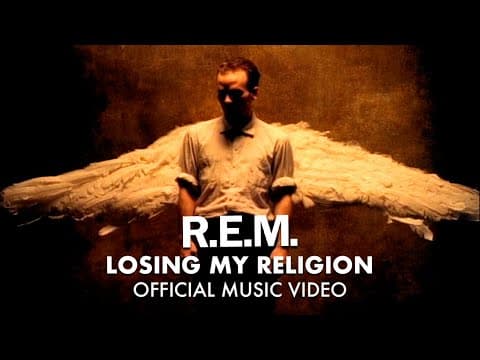
R.E.M. — Losing My Religion (1991) Director: Tarsem Singh Era: Alternative Rock Crossover Era (1991) - The moment college-radio darlings became global mainstream superstars, catalyzed by MTV heavy rotation and an art-house video that redefined the medium's ambitions. Tier-1 canonical artifact. One of the most awarded music videos in history, with six MTV VMAs and two Grammys. The video is a primary document of the alternative rock crossover moment, a landmark in art-directed music video history, and a case study in how a director's fine-art sensibility — Caravaggio, Tarkovsky, Koudelka — can be successfully translated into the three-minute pop format. Its billion-view YouTube milestone confirms enduring cross-generational cultural relevance. Essential for any archive covering 1990s popular music, MTV's cultural influence, or the history of the music video as an art form. Context: Released February 19, 1991 as the lead single from R.E.M.'s seventh album Out of Time, 'Losing My Religion' marked the band's definitive crossover from college-radio cult act to global mainstream artists. The song's title draws on a Southern U.S. idiom meaning 'at one's wit's end,' with lyrics addressing unrequited love and romantic obsession rather than literal theology — a nuance widely misread at the time. The video's art-cinema ambition and dense religious iconography were unprecedented for the alternative rock world and set a new standard for the music video as a fine-art medium. Heavy MTV rotation was central to its commercial success. The video reached one billion YouTube views in September 2020, cementing its status as a canonical cultural artifact of the early 1990s. Director notes: Singh was still finishing film school when selected to direct the video, reportedly working with a concept inspired by the photographer Josef Koudelka and proto-Baroque painter Caravaggio. The visual treatment also drew on a Gabriel García Márquez short story ('A Very Old Man With Enormous Wings') and Andrei Tarkovsky's cinematic language. The video was shot in 4:3 aspect ratio. A key production challenge arose when the original choreography treatment failed on camera; the spontaneous performance style that replaced it became a defining element of the finished work. The video was nominated in nine categories at the 1991 MTV Video Music Awards, winning six: Video of the Year, Best Group Video, Breakthrough Video, Best Art Direction, Best Direction, and Best Editing. It also won Grammy Awards for Best Short Form Music Video and Best Pop Performance by a Duo or Group with Vocal (1992). The video was edited by Robert Duffy, with cinematography by Larry Fong. In September 2020 it became the first R.E.M. video to reach one billion views on YouTube.
Source: radarchive.org
Part of RAD Archive · Watch in the documentary