Fångad av en stormvind: The Tiebreak That Rewrote the Rules
MAY 15 1991 · 12:05
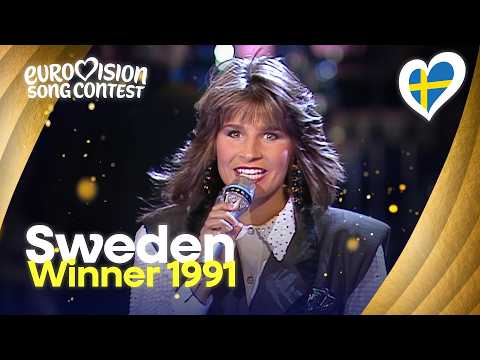
Carola · "Fångad av en stormvind" · Sweden · 1991 Placement: 1st · Score: 146 · Language: Swedish · Composers: Stephan Berg · Venue: Cinecittà · Host: Rome, Italy · Type: voting drama · Broadcast: color crt On May 4, 1991, inside a hastily-repurposed soundstage at Cinecittà in Rome — Italian broadcaster RAI had moved the contest at late notice from a Sanremo venue due to Gulf War security concerns — Swedish singer Carola Häggkvist, performing simply as Carola, took the stage with a gale-force pop anthem called 'Fångad av en stormvind.' She wore a white dress that billowed in stage-wind effects and delivered the song with the kind of full-belted theatrical power that had already made her a Swedish pop star. At the close of voting, something had happened that Eurovision had not yet planned for cleanly: Sweden and France were tied at 146 points apiece. Carola and Amina's 'C'est le dernier qui a parlé qui a raison' had received identical scores. The result was decided by a newly-introduced tiebreak procedure — most countries awarding the tied entries twelve points — which Sweden narrowly won. The contest's supervisor announced Sweden the winner amid visible on-camera confusion, and Amina, who had believed for several minutes she had won for France, reacted with gracious shock. The tiebreak margin was three votes of twelve. The composition 'Fångad av en stormvind' — a Stephan Berg-penned Swedish melodifestivalen winner — was Carola's second Eurovision attempt after her third-place finish in 1983. Context Eurovision 1991 was held in Italy following Toto Cutugno's 1990 win and had been logistically chaotic — the venue had moved from Sanremo to Rome late in the planning cycle, hosts had been reshuffled, and the Gulf War had prompted heightened security concerns across European broadcasting. The contest's voting rules had historically not handled ties cleanly; the newly-introduced tiebreak was its first serious codification. Sweden had won Eurovision twice before — ABBA's 'Waterloo' in 1974 and Herreys' 'Diggi-Loo Diggi-Ley' in 1984 — and Swedish popular music had become one of Eurovision's most consistent commercial presences. Carola had won Melodifestivalen in 1983 (placing third at Eurovision with 'Främling'), then again in 1991, becoming the first artist in Melodifestivalen history to represent Sweden twice at Eurovision. Legacy Sweden's 1991 win triggered Eurovision 1992 in Malmö and further established Sweden as one of the contest's most consistent winner-states, a status the country would reinforce through Charlotte Nilsson's 1999 win, Loreen's 2012 and 2023 victories, and Måns Zelmerlöw's 2015 triumph. Carola won Melodifestivalen a third time in 2006, placing fifth at Eurovision in Athens — one of only a handful of artists to represent Sweden at Eurovision three times. The 1991 tiebreak became the template for subsequent Eurovision tie resolution, which has since been refined to incorporate public televote weighting and multiple fallback criteria. The 1991 win is also remembered as the moment Eurovision's voting rules stopped being treated as implicit and started being treated as material and contestable. Mythology The tiebreak is sometimes described as a televote outcome; there was no public televoting in 1991 — the resolution was jury-based, using the count of twelve-point votes awarded to the tied entries. Amina is sometimes reported as having been declared winner on stage before the tiebreak result was reversed; accounts vary, but the official declaration only came after the tiebreak calculation. The song's composer is sometimes misattributed to Carola herself; she performed but did not write it — Stephan Berg was the credited composer.
Source: eurovisionoracle.com
Part of Eurovision · Watch in the documentary
More from Eurovision
- Rock Me: Yugoslavia's Only Eurovision Win, Two Years Before the War
- Insieme: 1992: A Pop Ballad for the European Union
- C'est le dernier: The Tied-and-Lost French Entry
- Rome 1991 Is the Longest and Most Chaotic Eurovision
- Linda Martin's Logan-Penned Coronation
- Michael Ball's Second Place Is the 1990s UK Pattern