Linda Martin's Logan-Penned Coronation
MAY 15 1992 · 12:00
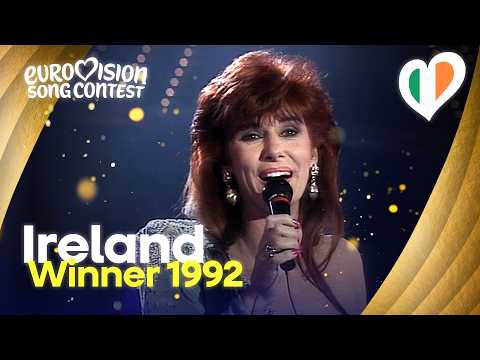
Linda Martin · "Why Me?" · Ireland · 1992 Placement: 1st · Language: English · Composers: Johnny Logan · Host: Malmö, Sweden · Type: winner · Broadcast: satellite On the evening of May 9, 1992, in Malmö, Linda Martin stood at the centre of the Eurovision stage in a structured emerald gown, lifted her arms on the opening swell of strings, and began to sing a ballad her friend Johnny Logan had written for her. 'Why Me?' was pure early-nineties Eurovision — key-change theatrical, confessional in its lyric, orchestrated with the lushness of a contest still conducted by a live conductor raising his baton in the pit. Martin was not a newcomer. She had finished second for Ireland in 1984 with another Logan composition, 'Terminal 3', and had spent the intervening years as one of the most recognisable voices on the Irish showband and light-entertainment circuit. When the votes came in from the European juries — read out country by country in the long, ritualistic cadence that defined the pre-televoting era — Ireland edged ahead of the United Kingdom in one of the tightest finishes of the decade, reportedly decided in the closing rounds. Martin pressed a hand to her chest; Logan, watching from the green room as the songwriter rather than the performer, was filmed grinning and shaking his head. It was his second win as a writer, after Johnny Logan's own 'Hold Me Now' in 1987, and the beginning of what would become Ireland's astonishing three-consecutive-year winning streak, a run unmatched in the contest's history. Context Eurovision 1992 was broadcast from a Sweden still basking in the post-Abba, post-Herreys afterglow of its cultural export confidence, while the rest of the continent was reshaping itself at speed. Yugoslavia was dissolving into war; the Maastricht Treaty was being signed that February; the former Soviet republics were applying, one by one, for admission to European broadcasting bodies. The contest itself was still a largely Western-European affair — Estonia, Latvia and the others would not debut until the mid-nineties — and its aesthetic remained firmly orchestral, sung in national languages, with juries rather than phone-in votes deciding the outcome. Ireland, under RTÉ, had become a Eurovision superpower almost by accident, its small population and deep songwriting bench producing win after win at a contest that was starting to cost host broadcasters serious money. 'Why Me?' arrived in that moment as the quintessential early-nineties Eurovision song: emotionally legible, vocally showcase-y, and built for a live-orchestra arrangement that felt closer to a West End ballad than to the Europop that would dominate the decade's second half. Legacy Martin's win set in motion the strangest economic problem in Eurovision history: Ireland, a country of under four million people, was about to host the contest three years running — 1993 in Millstreet, 1994 in Dublin, 1995 again in Dublin — straining RTÉ's budget and prompting the broadcaster to reportedly explore, only half-jokingly, how one might lose on purpose. 'Why Me?' itself became a karaoke and pageant standard in Ireland, and cemented Johnny Logan's unique status as the only person to have won Eurovision three times in any capacity: twice as performer, once as songwriter. For Martin, the win retroactively transformed her 1984 second place into part of a narrative arc rather than a near-miss. The broader legacy was structural: the streak forced the EBU to rethink host-country economics and contributed to the eventual introduction of the semi-final system, the Big Four/Five funding model, and a gradual move away from the live-orchestra era. Mythology It is often said that Ireland 'didn't want' to win in 1992 because of the cost of hosting, and that RTÉ quietly tried to submit weaker songs in subsequent years. The truth is messier — the broadcaster kept sending strong material and kept winning anyway. The scoreline is also frequently misremembered as a landslide; it was in fact a fairly close contest, with the UK's Michael Ball in 'One Step Out of Time' finishing a respectable second.
Source: eurovisionoracle.com
Part of Eurovision · Watch in the documentary
More from Eurovision
- C'est le dernier: The Tied-and-Lost French Entry
- Fångad av en stormvind: The Tiebreak That Rewrote the Rules
- Rome 1991 Is the Longest and Most Chaotic Eurovision
- Michael Ball's Second Place Is the 1990s UK Pattern
- Johnny Logan Is the Only Three-Time Eurovision Winner
- Bosnia's Delegation Crosses Sarajevo's Airport Under Sniper Fire