The Stick Figure and the Singer
MAY 15 2015 · 12:25
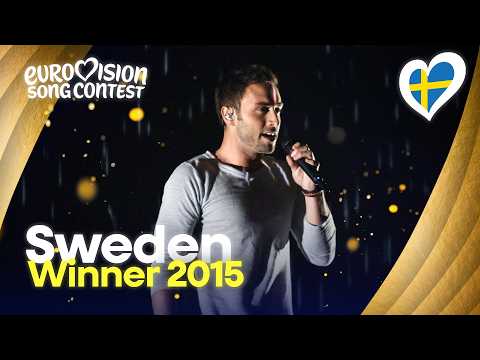
Måns Zelmerlöw · "Heroes" · Sweden · 2015 Placement: 1st · Language: English · Composers: Anton Hård af Segerstad, Joy Deb, Linnea Deb · Venue: Wiener Stadthalle · Host: Vienna, Austria · Type: performance innovation · Broadcast: HD On May 23, 2015, at the Wiener Stadthalle — Austria hosting after Conchita Wurst's win the previous year — Måns Zelmerlöw performed 'Heroes' accompanied by what appeared, improbably, to be an animated stick-figure character projected onto the stage floor and back wall. The conceit was straightforward and yet, as live-performance staging, unprecedented at that scale: projection-mapped animation synchronised to Zelmerlöw's movements, so that the singer appeared to interact with a small pen-drawn figure — running alongside it, catching it on his outstretched hand, being 'held' by a giant projected version of it during the chorus. The song itself was a propulsive, radio-friendly pop-dance number, written and produced in the Swedish export-pop style Melodifestivalen had perfected, and Zelmerlöw — a Swedish TV personality as much as a singer — performed it with the relaxed stagecraft of someone who had been rehearsing the choreography-to-projection timing for months. The overall effect was of a performance that could only have existed in that specific moment of projection-mapping technology meeting Eurovision's live-staging budgets. Sweden won comfortably, with particularly strong jury support. Context Eurovision 2015 was the contest's 60th edition, hosted in Vienna with an explicit 'Building Bridges' slogan, and notable for Australia's first-ever participation as a special-guest entrant. The 'Heroes' performance was a marker of where Eurovision staging had arrived technologically: LED stages, projection mapping, and real-time synchronisation between singer movement and animated content had all become feasible for a contest broadcast live to 200 million viewers. Sweden's Melodifestivalen infrastructure was at its most dominant, producing an industrial flow of Eurovision-optimised songs and staging concepts, and Zelmerlöw's win — Sweden's sixth — consolidated the country's position as the era's most consistent Eurovision competitor. The geopolitical backdrop included the ongoing Russian-Ukrainian conflict following the 2014 annexation of Crimea and the early stages of the European migration crisis. Legacy The 'Heroes' staging became the single most influential live-performance blueprint of its era. Within two years, most serious Eurovision contenders were incorporating some form of projection-mapped, camera-choreographed interaction between performer and digital visuals. Zelmerlöw himself became a Melodifestivalen fixture and Eurovision co-host of the 2016 contest in Stockholm. 'Heroes' also had a brief plagiarism controversy over its similarities to another song, which was settled without significantly denting its legacy. More broadly, 2015 is often cited as the year Eurovision's live-performance grammar caught up permanently with the possibilities of real-time digital staging, after which purely human-scale staging became increasingly unusual at the top of the leaderboard. Mythology The stick-figure animation is sometimes described as fully real-time and interactive. In practice it was tightly pre-choreographed to Zelmerlöw's rehearsed movements, with the singer following a precise blocking pattern to create the illusion of interaction. The plagiarism allegations are also often misremembered as more serious than they were in formal terms.
Source: eurovisionoracle.com
Part of Eurovision · Watch in the documentary