Dors, mon amour: The Last Missing Winner
MAY 15 1958 · 12:00
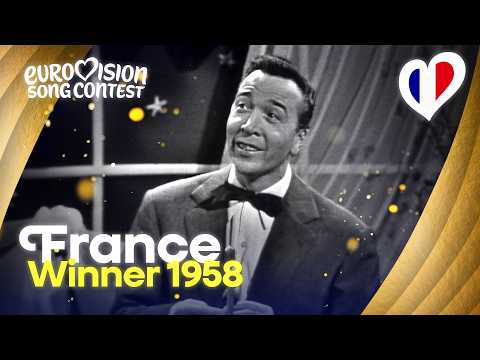
André Claveau · "Dors, mon amour" · France · 1958 Placement: 1st · Language: French · Composers: Pierre Delanoë, Hubert Giraud · Venue: AVRO Studios · Host: Hilversum, Netherlands · Type: winner · Broadcast: pre color Hilversum, a modest Dutch broadcasting town, staged Eurovision's third edition in March 1958 with the compressed intimacy that defined the contest's infancy — a small studio, a conductor in white tie, a handful of cameras, and the tentative wiring of a continent still re-learning how to speak to itself in public. Into this provisional cathedral walked André Claveau, a 46-year-old French crooner already a generation deep into Parisian music-hall respectability, carrying a song his authors had chosen deliberately against fashion. 'Dors, mon amour' was not a ballad of longing or a chanson of wound; it was a lullaby, quiet and uncomplicated, addressed to a sleeping lover as if the singer feared to raise his voice. Claveau delivered it in the dinner-jacket manner of the era — hands loose, expression courtly, the orchestra unspooling behind him with the understated restraint of Dutch public-service conducting. When the points came in, France held the top with 27, three ahead of Switzerland. It was France's first Eurovision victory, the first win for a male lead vocalist, and the first of what would eventually become five French wins — a lineage that begins, improbably, with a bedtime song. What made the 1958 contest legendary, however, was not Claveau at all. Italy had sent a gangling young Puglian named Domenico Modugno with a song about dreaming in blue. 'Nel blu dipinto di blu' finished third in Hilversum and went on to sell over twenty million copies, win the first Record of the Year Grammy, and enter the American songbook as 'Volare.' Claveau's victory became, in time, the Eurovision footnote to someone else's worldwide myth. Context The 1958 contest was hosted by the Netherlands because Switzerland, the 1957 winner, declined to stage the event — establishing a precedent of negotiated hosting that would recur for decades. France entered as a founding member riding a confident post-war chanson tradition; composer Hubert Giraud had already written 'Sous le ciel de Paris,' one of the city's signature songs. The broadcast reportedly reached roughly ten European countries via the fledgling Eurovision network, still assembled by coaxial cable and microwave relay. Legacy Claveau's win is widely considered the most forgotten of the fourteen pre-1966 Eurovision victories — partly because Modugno's third-place Italian entry eclipsed it commercially within weeks, partly because Claveau himself retired from performing in the mid-1960s and left almost no televisual afterlife. 'Dors, mon amour' never charted outside Belgium, never generated a signature cover, and is today known chiefly to Eurovision completists and French chanson archivists. Mythology Every contest produces a winner and a legend, and they are rarely the same performer. In Hilversum, Claveau took home the trophy while Modugno took home the century.
Source: eurovisionoracle.com
Part of Eurovision · Watch in the documentary