The People's Republic of China
OCT 01 1949 · 12:00
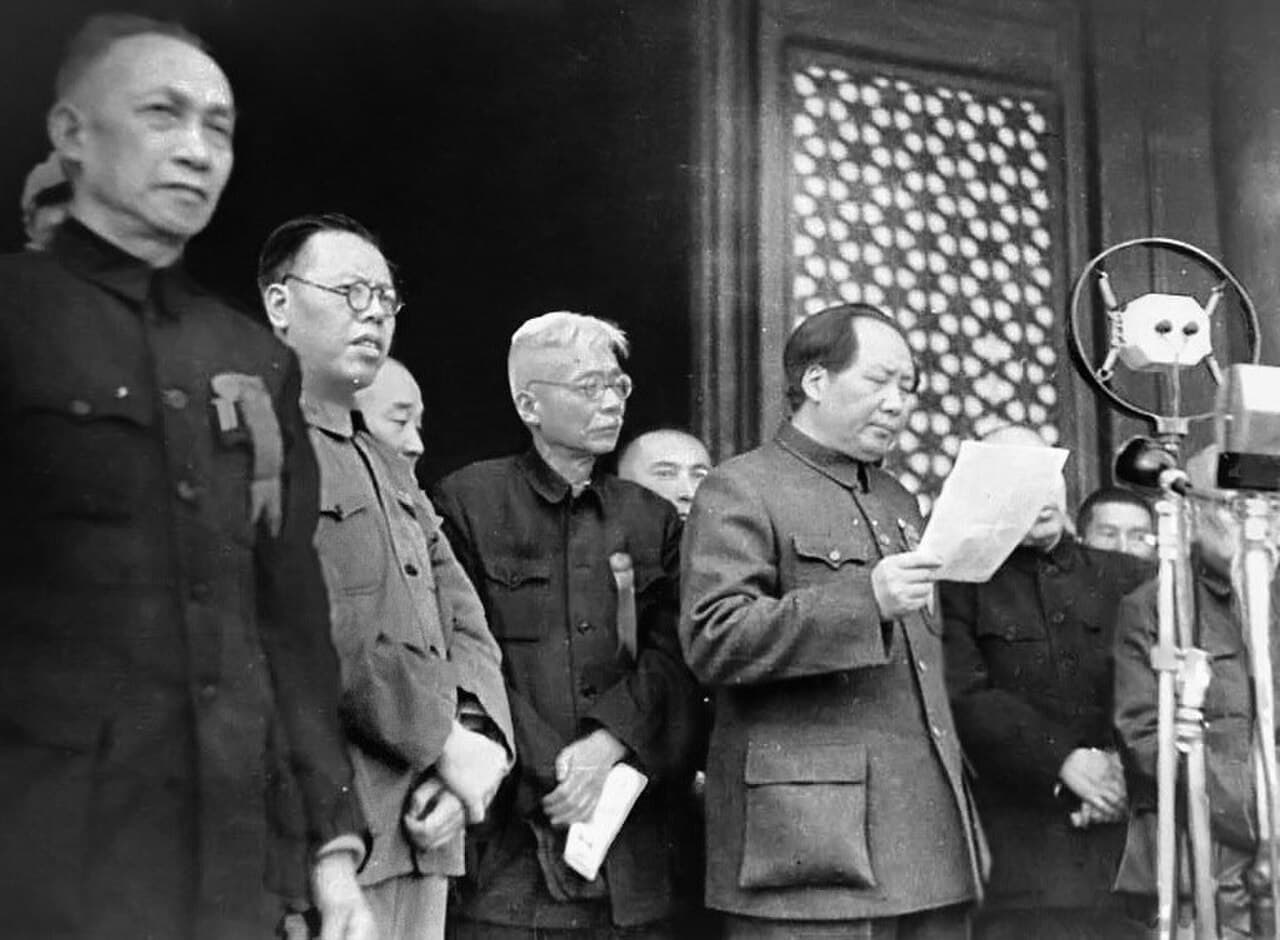
Mao Zedong proclaims the founding of the People's Republic of China from the rostrum of Tiananmen, 1 October 1949. Place: Tiananmen Gate (Gate of Heavenly Peace), Beijing Figures: Mao Zedong, Chairman · Zhou Enlai, Premier · Zhu De, commander-in-chief · Liu Shaoqi, vice-chairman · Chiang Kai-shek, retreating to Taiwan with the Republic of China government The Proclamation Mao reads the founding proclamation from the rostrum atop the Gate of Heavenly Peace at three o'clock on the afternoon of 1 October 1949. Below in the square, perhaps 300,000 people; on the rostrum, the leadership of the new state and the Communist Party. The Civil War is not formally over (Hainan and Tibet are not yet under PLA control), but the Republic of China government has lost the mainland. Chiang Kai-shek formally moves the seat of the Republic to Taipei on 7 December 1949. The Soviet Union recognizes the People's Republic on 2 October; the United Kingdom on 6 January 1950; the United States not until 1979. The world's most populous polity, roughly 540 million people in 1949, has become a sovereign communist state. The Sino-Soviet Treaty of Friendship, Alliance and Mutual Assistance is signed in Moscow on 14 February 1950 after eight weeks of difficult negotiation. For the next decade the Soviet Union extends industrial aid, military equipment, and a security umbrella; in exchange, the new state aligns its foreign policy with Moscow's. The China Seat Westphalia's planetary extension, codified in the UN Charter (see [[un-charter-1945]]), now contains the second-largest communist state in the world, bordering twelve other states, sharing the Korean peninsula with the Soviet-aligned north. China's seat on the Security Council is held by the Republic of China (Taiwan) from 1949 until 25 October 1971, when General Assembly Resolution 2758 transfers recognition to the People's Republic. The Sino-Soviet split of the late 1950s and the 1969 border clashes on the Ussuri convert what had looked like a bipolar contest into a triangular one, a structure Henry Kissinger and Richard Nixon will exploit at Beijing in February 1972. The 1949 founding is the largest single addition of population to a single sovereign authority in the Westphalian era. The Korean War (see [[korean-war-begins-1950]]) follows within nine months and brings the new state into direct combat with the United States. The Sino-Soviet alignment will be the structural fact of the early Cold War; its dissolution, of the late one. The Chinese state that emerges from the long arc 1949 to the present is, in 2026, the second largest economy in the world and the principal challeng Video: Restored newsreel of Mao Zedong proclaiming the founding of the People's Republic from the Tiananmen rostrum, 1 October 1949.
Source: westphalia-oracle.vercel.app