The Korean War Begins
JUN 25 1950 · 12:00
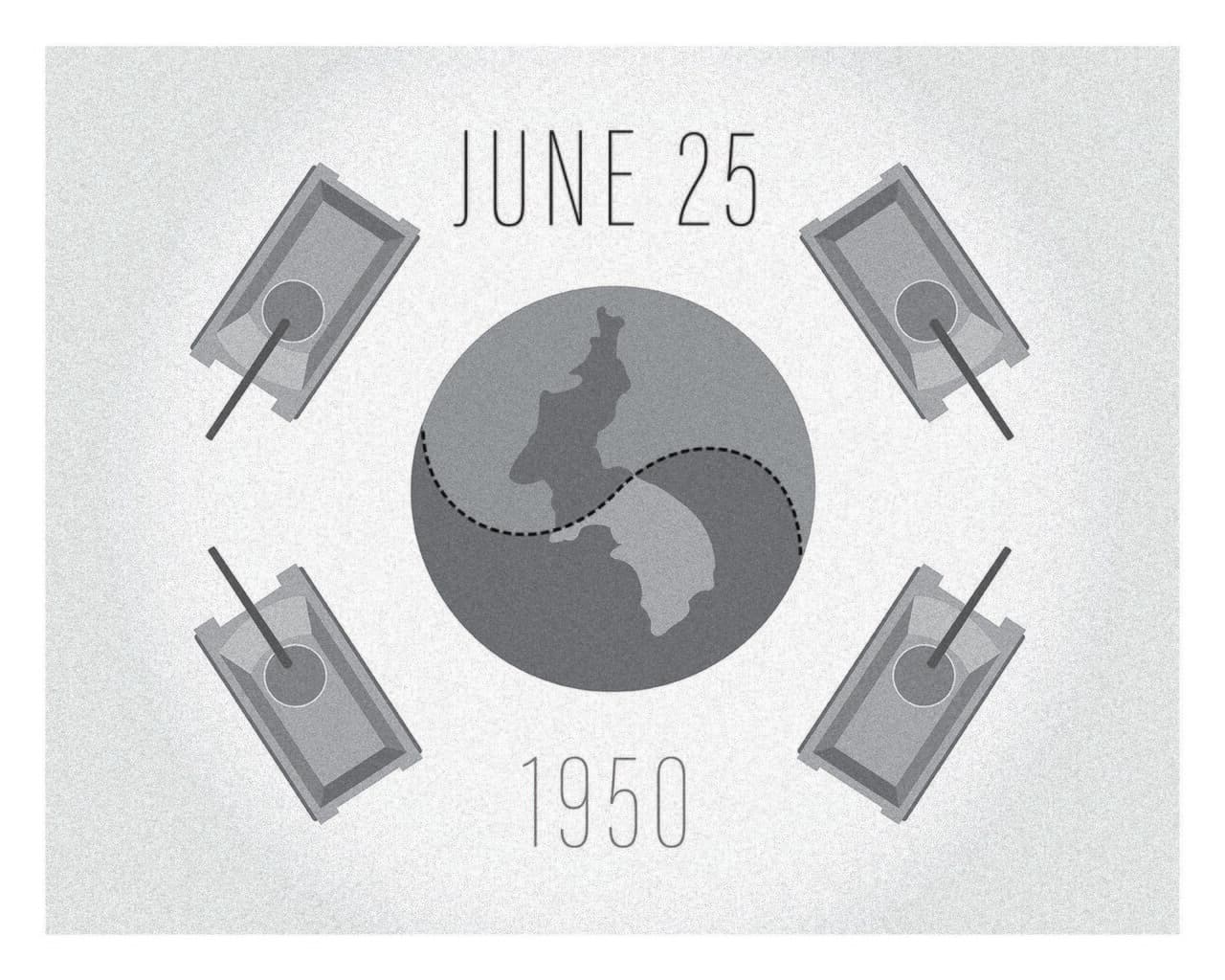
American troops disembark in Korea in the opening weeks of the war, summer 1950. Place: the 38th parallel, Korean peninsula Figures: Kim Il-sung, leader of the Democratic People's Republic of Korea · Syngman Rhee, President of the Republic of Korea · Joseph Stalin (who approves the invasion in April 1950) · Mao Zedong (who commits Chinese forces in October) · Harry S. Truman · Yakov Malik, Soviet UN ambassador, boycotting the Security Council The Boycotted Council Soviet ambassador Yakov Malik has been boycotting the UN Security Council since January 1950 in protest at the Council's continued seating of the Republic of China rather than the new People's Republic. The boycott is in its sixth month on 25 June, when North Korean forces cross the 38th parallel at four o'clock in the morning. The Security Council meets the same day. Resolution 82 condemns the invasion; Resolution 83, on 27 June, recommends that member states furnish such assistance to the Republic of Korea as may be necessary to repel the armed attack. The Soviet veto is the structural reservation of Great Power sovereignty within the Charter (see [[un-charter-1945]]); on this one occasion, the empty Soviet chair lets the Council act. Resolution 84 (7 July) creates the unified command under United States leadership and authorizes the use of the UN flag. Sixteen states contribute combat forces; another five send medical units. It is the only major war fought under formal UN authority. The Soviets return to the Council on 1 August 1950 and the window closes; no comparable authorization will be available for any subsequent Cold War conflict. Three Years to a Line MacArthur's Inchon landing of 15 September 1950 reverses the early collapse and drives UN forces to the Yalu by late October. The People's Republic of China (see [[peoples-republic-of-china-1949]]), one year old, enters the war with 300,000 troops on 19 October. The line is pushed south of Seoul, then north, then stabilizes in mid-1951 near the 38th parallel where it began. Truce talks open at Kaesong on 10 July 1951 and last two years; the armistice is signed at Panmunjom on 27 July 1953 by the UN Command, the Korean People's Army, and the Chinese People's Volunteers. South Korea, refusing to sign, is not a party. Casualty estimates: roughly 3 million Koreans (mostly civilians), 180,000 Chinese, 36,500 Americans, 14,000 other UN-flag soldiers. No peace treaty has been signed. The Demilitarized Zone, drawn in 1953, is, in 2026, the most heavily militarized border on earth. The war fixes the Cold War as a militarized stalemate rather than a continuing series of negotiated settlements, produces NSC-68 as US strategic doctrine, quadruples the US defense budget, and transforms NATO from a paper alliance into a stationed force. The Westphalian frontier, in Korea, has been redrawn by com Video: The outbreak of the Korean War as Kim Il-sung's Korean People's Army crosses the 38th parallel into the South, leading to the first UN-authorised collective security action.
Source: westphalia-oracle.vercel.app