The Truman Doctrine
MAR 12 1947 · 12:00
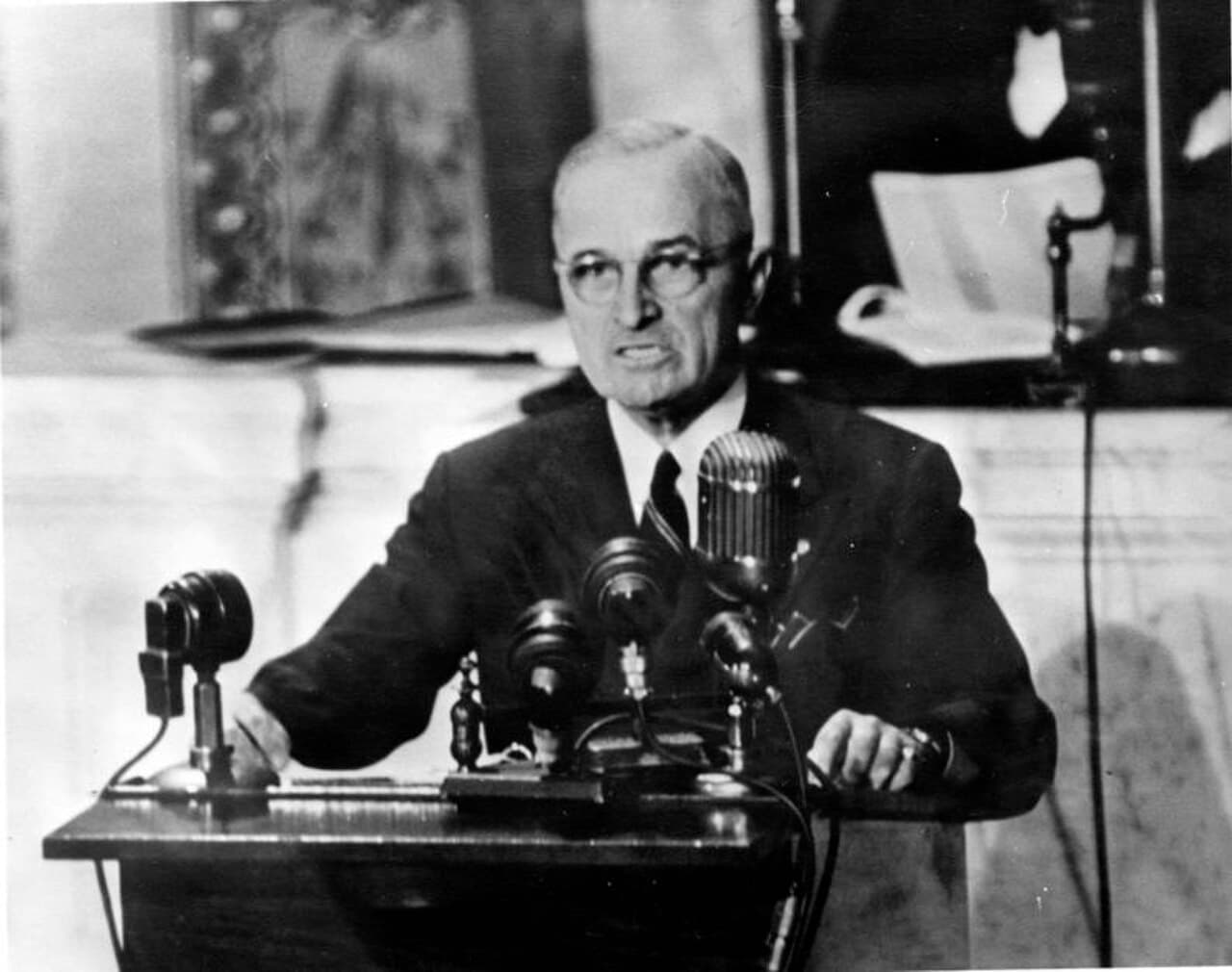
President Harry S. Truman addresses a joint session of Congress to request aid for Greece and Turkey, 12 March 1947. Place: Joint session of the United States Congress, Washington Figures: Harry S. Truman, President · George Marshall, Secretary of State · Dean Acheson, Under-Secretary · Arthur Vandenberg, Republican Senate Foreign Relations chair · the Greek and Turkish governments, the proximate beneficiaries The British Withdrawal Telegram On 21 February 1947, the British embassy in Washington delivers two notes: His Majesty's Government, bankrupt after the war and the coal-shortage winter, will cease military and financial aid to Greece and Turkey on 31 March. The civil war in Greece (the communist-led ELAS against the royalist government) and the Soviet pressure on the Turkish Straits will, on the British account, be the United States' problem from April. Acheson briefs congressional leaders on 27 February in language designed to dramatize the stakes; Vandenberg, the indispensable Republican, tells Truman he must scare hell out of the American people to get the appropriation through a Republican Congress. Truman addresses a joint session on 12 March. The speech requests $400 million for Greece and Turkey and articulates a general principle: it must be the policy of the United States to support free peoples who are resisting attempted subjugation by armed minorities or by outside pressures. The appropriation passes both houses by overwhelming margins by 22 May. The British retreat from a sphere of influence becomes the occasion for the American assumption of a global one. Containment as Declared Policy George Kennan's Long Telegram of 22 February 1946, recast as the X article in Foreign Affairs in July 1947, supplies the intellectual frame: the Soviet Union is an expansionary power that respects only force, and US policy should be the patient but firm and vigilant containment of Russian expansive tendencies. The Truman Doctrine is containment in its first operational form. The Marshall Plan (see [[marshall-plan-1947]]) follows within three months as the economic instrument; the Berlin airlift (see [[berlin-blockade-1948]]) within sixteen months as the demonstration; NATO (see [[nato-founded-1949]]) within two years as the institutional architecture. The doctrine is non-Westphalian in a particular sense. It commits the United States to act, in principle, anywhere on the planet, on the basis of the internal political composition of states. Westphalia's cuius regio survives as the Charter's Article 2.7; over it, Truman lays a second principle: in any contest between communist and non-communist sovereignty, the United States is a party. The Cold War's structural shape is, from this speech forward, set. Video: Surviving film of President Truman's 12 March 1947 address to a joint session of Congress requesting aid to Greece and Turkey, held by the Harry S. Truman Presidential Library.
Source: westphalia-oracle.vercel.app