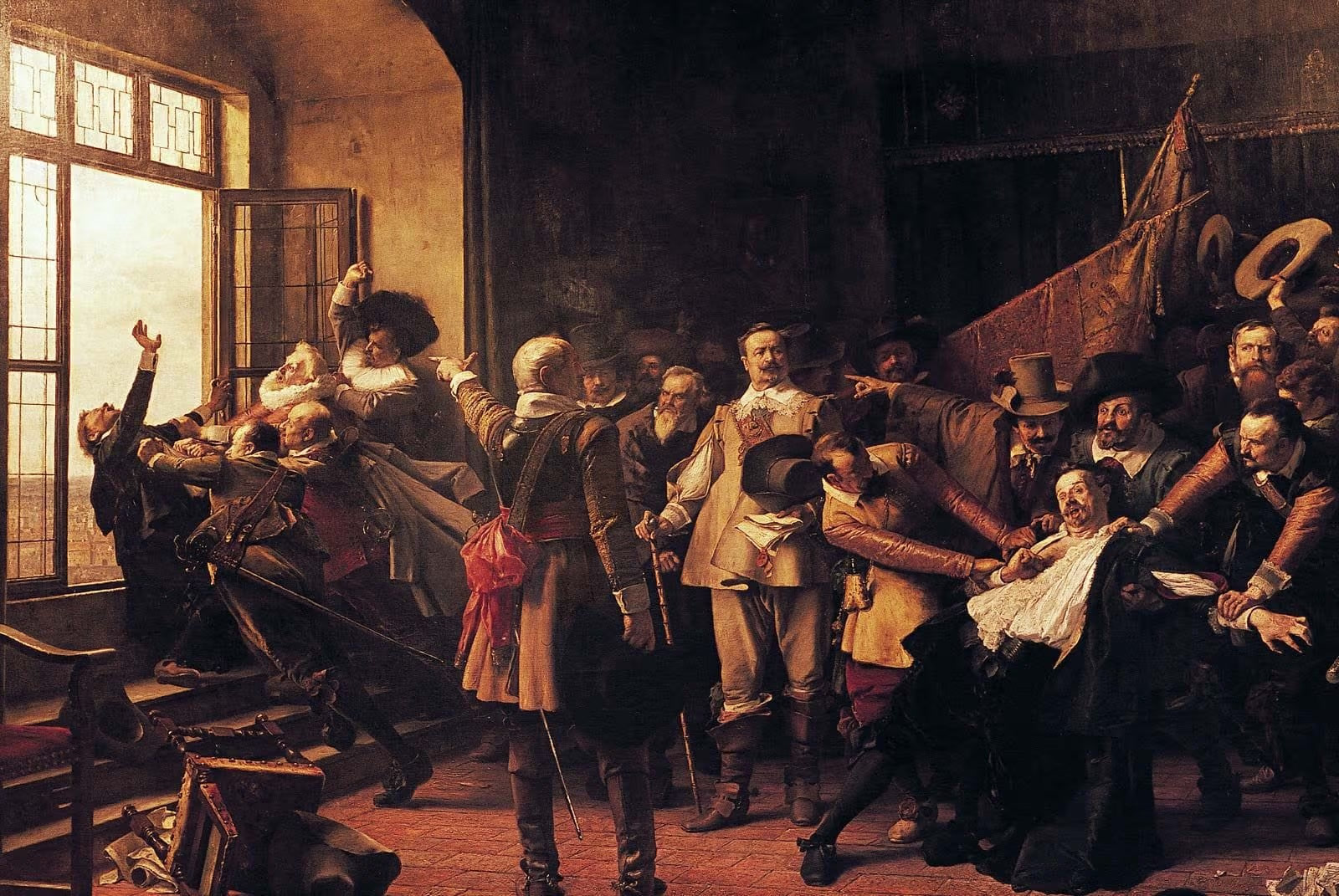
Farewell To Westphalia
A chronicle of the sovereign nation state as a 380-year technology, from the Defenestration of Prague in 1618 to the present moment of contested sovereignty. Built from The Westphalia Oracle by Ludwig Vonmesser, a folio of the Codex Vloriensis, research companion to Farewell to Westphalia by Jarrad Hope and Peter Ludlow. 120 folios across 10 eras.
A chronological documentary of 120 moments spanning 1618–2025 on Loreline.
Curated by Olivier · last updated 2026-09-20
Eras
- Long War, The Thirty Years' War. What begins as a Bohemian succession dispute over a window in Prague becomes a 30-year continental war that kills perhaps eight million people, ends the Holy Roman Empire as an effective polity, and forces Europe to invent a new principle for organizing itself.
- Settlement, Five years of parallel negotiations at Münster (Catholic powers + France) and Osnabrück (Catholic powers + Sweden, plus the Protestant Estates) produce a single treaty system. The Peace of Westphalia recognizes the sovereign equality of states and establishes the principle that what happens inside a state's borders is its own business.
- Absolutism, Absolutism and balance-of-power diplomacy entrench the new order. Utrecht (1713) formalizes equilibrium as an explicit treaty principle. The sovereign state becomes the only legitimate actor on the international stage. Empires, on this view, are sovereign states that happen to extend across oceans.
- Revolution and Empire, The Bastille falls. Sovereignty descends from the king to the nation. The Declaration of the Rights of Man makes the people the sovereign. Napoleon exports this principle across Europe at bayonet point; the Congress of Vienna tries to put it back in the bottle.
- Long Nineteenth Century, The Concert of Europe holds for a generation. Nationalism, the principle Napoleon scattered, slowly unifies Italy and Germany into Great Powers. The Westphalian state, now democratic in form, reaches its apex of legitimacy and reach. Imperialism extends the model to most of the planet.
- First Crisis, The First World War, the punitive settlement at Versailles, the failure of the League of Nations, the Second World War. The Westphalian system tested by total war and found wanting. Eight million dead in the first round; sixty million in the second.
- Bipolar Containment, The UN Charter preserves Westphalia at planetary scale, with the Security Council's five permanent vetoes as the structural reservation of Great Power sovereignty. Decolonization extends the nation-state to most of Africa and Asia. The Cold War is, structurally, Westphalia frozen in place by mutually assured destruction.
- Liberal Hegemony, The Berlin Wall falls. Fukuyama publishes The End of History. The European Union experiments with pooled sovereignty. NATO expands. The Washington Consensus globalizes finance. For a moment it looks as if liberal democracy is the final form of human government and the nation-state its permanent vehicle.
- Financial Crises, Lehman collapses; the financial system requires the nation-state in ways the nation-state cannot afford. The Bitcoin whitepaper proposes an alternative. The Arab Spring tests authoritarian sovereignty; the Eurozone crisis tests pooled sovereignty; Brexit, Trump, the surveillance state, the platform monopolies all chip at the Westphalian frame from different angles.
- Post-Westphalia, COVID returns the border. The Russian invasion of Ukraine reveals what sovereignty enforcement actually requires, and what the international order is willing to fund. Crypto-sovereignty, network states, DAO experiments. The question of what replaces the 380-year-old technology becomes the live political question of the decade.
- - The Defenestration of Prague. Imperial governors hurled from the chancery windows of Prague Castle, 23 May 1618. Place: Bohemian Chancellery, Prague Castle, third-floor eastern wing Figures: Heinrich Matthias von Thurn, Protestant leader · Jaroslav Bořita of Martinice, regent · Vilém Slavata of Chlum, regent · Filip Fabricius, secretary The Letter of Majesty Emperor Rudolf II signed the Majestätsbrief in 1609, guaranteeing Bohemian Protestants the right to build churches. His successor Matthias and his cousin Ferdinand, the future Ferdinand II, read it narrowly. Two Protestant churches at Hroby and Broumov are closed. The Protestant Estates meet in May 1618 with a list of grievances and a list of those responsible: Martinice and Slavata, both Catholic regents, both at the Castle. On the morning of 23 May, a delegation led by Count Thurn climbs to the chancellery. There is shouting, an attempt at justification, and then, around nine o'clock, the act. The Window and the War Martinice goes first, headfirst from the third-floor window: seventy feet to the moat. Slavata follows, clinging to the sill until his fingers are beaten loose. The secretary Fabricius, who has done nothing in particular, is thrown after them. All three survive (Catholic propaganda credits the Virgin Mary; Protestant chronicles credit a soft landing on accumulated household refuse in the dry moat). Within a year Bohemia is in open revolt. A Calvinist count, Frederick V of the Palatinate, is elected king. Within two years Frederick loses everything at the Battle of White Mountain. The defenestration is the conventional starting gun of the Thirty Years' War, which kills perhaps eight million across the empire and ends with the Peace of Westphalia (see [[peace-of-westphalia-1648]]) thirty years and five months later. Video: Peter Wilson, the leading modern historian of the war, opens with the act that lit the fuse.
- - The Battle of White Mountain. Contemporary depiction of Bohemian and Imperial armies meeting outside Prague, November 1620. Place: Bílá hora, west of Prague Figures: Christian I of Anhalt-Bernburg, Bohemian commander · Maximilian I of Bavaria, Catholic League · Johann Tserclaes, Count of Tilly, field commander · Frederick V of the Palatinate, the Winter King Two Hours on a Hill The Bohemian Estates have spent two years improvising a state. They elected a Calvinist king, Frederick V of the Palatinate, after deposing Ferdinand of Habsburg; they raised an army on credit; they waited for the foreign aid that Frederick's father-in-law James I of England conspicuously did not send. By autumn 1620 Christian of Anhalt has perhaps 21,000 men, unpaid for months, dug in along the chalk ridge of Bílá hora west of Prague. Tilly and Bouquoy, with a combined Catholic League and Imperial force slightly larger, attack on the morning of 8 November. The Bohemian line breaks within ninety minutes. Anhalt's cavalry scatters; the Moravian infantry are cut down where they stand. Perhaps 4,000 Bohemians and 700 Catholics die. By early afternoon Tilly's lead squadrons are at the gates of Prague. A Settlement Destroyed in One Afternoon Frederick flees the city that night with his English wife Elizabeth and the crown jewels, riding for Breslau and eventually The Hague, where he will live out his exile as the Winterkönig: the king of a single Bohemian winter. The Defenestration of Prague (see [[defenestration-of-prague-1618]]) had opened a question; White Mountain closes it, for Bohemia, for a century. Ferdinand II's reprisal is methodical. Twenty-seven Protestant leaders are executed on Prague's Old Town Square on 21 June 1621, their heads displayed for ten years on the Charles Bridge tower. The Verneuerte Landesordnung of 1627 abolishes the elective monarchy, makes Bohemia hereditary Habsburg, German co-official with Czech, Catholicism the only permitted faith. Three quarters of Bohemia's noble estates change hands; the Protestant nobility goes into exile and never returns. A confessional settlement, a constitution, and a political class are erased in one afternoon and the seven years that follow. Video: Frederick V loses Bohemia in an hour. Tilly and Bucquoy reset the war's opening phase.
- - Grotius and the Precedent. Hugo Grotius, jurist of the law of nations, painted in his French exile. Place: Paris (exile), and the chanceries of Münster and Osnabrück Figures: Hugo Grotius (Huig de Groot), Dutch Remonstrant (Arminian) jurist in French exile · the negotiators of Münster and Osnabrück, Catholic and Protestant, reading his treatise in common A Book Written in Exile Hugo Grotius escapes from Loevestein Castle in 1621, smuggled out in a book chest after being sentenced to life imprisonment in the Dutch confessional struggles of the Remonstrant crisis. He settles in Paris under a small French pension. There, in 1625, he publishes De Jure Belli ac Pacis, On the Law of War and Peace, three books in Latin dedicated to Louis XIII. He has already written, in his twenties, Mare Liberum (1609), the brief defending Dutch navigation of the open seas that founds the modern law of international waters. The treatise's premise is that there exists a law binding sovereigns toward one another that derives neither from the Pope nor from the Emperor but from natural reason. Even if we should concede that which cannot be conceded without the utmost wickedness, that there is no God, this law would still hold. The argument is offered first as philosophy, then as a practical handbook for diplomats who can no longer agree on a common religious authority. The Thirty Years' War, well underway when the book appears, is precisely the kind of confessional war it is designed to make obsolete. The Treaty as the Book Enacted The negotiators who gather at Münster and Osnabrück from 1643 onward read Grotius. Catholic and Protestant delegations cite him in common, because his arguments do not depend on a shared confession. The principles he names, sovereign equality, the binding force of treaties (pacta sunt servanda), the distinction between just and unjust war, the personality of states under a law of nations, are the principles the treaty drafters operationalize. Grotius dies at Rostock in August 1645, three years before the settlement is signed. He does not see the peace his book made thinkable. The Peace of Westphalia (see [[peace-of-westphalia-1648]]) is, in part, De Jure Belli ac Pacis turned into a treaty: a system of sovereign states regulated by mutual law, with religion expelled from the law's foundation. The discipline that grows from his book, taught for three centuries as the law of nations and now as public international law, supplies the language in which Westphalian sovereignty has been argued, defended, and challenged from 1648 to the present.
- - Gustavus Adolphus Lands at Peenemünde. Gustavus Adolphus meets Duke Bogislaw XIV of Pomerania after landing his army on the Baltic coast. Place: Peenemünde, isle of Usedom, Pomeranian coast Figures: Gustavus II Adolphus, King of Sweden · Axel Oxenstierna, Swedish Chancellor · Cardinal Richelieu, First Minister of France · Bogislaw XIV, Duke of Pomerania Thirteen Thousand at Peenemünde Gustavus Adolphus comes ashore on 6 July 1630 at the head of roughly 13,000 troops, with Chancellor Oxenstierna's logistics behind him and the Baltic at his back. He kneels on the sand and prays in front of his army, a gesture the Swedish chroniclers will not allow anyone to forget. His stated cause is the defense of German Protestantism against the Edict of Restitution of 1629, by which Ferdinand II proposed to reclaim every ecclesiastical territory secularized since 1552. His actual financing is more interesting. The Treaty of Bärwalde, signed the following January, commits Catholic France to subsidize the Swedish army at one million livres a year. The First Minister of France, Cardinal Richelieu, has decided that the strategic problem of a Habsburg-dominated Empire outweighs the theological problem of funding Lutherans to fight Catholics. He is right, and the war will run another eighteen years on the logic he has just made explicit. Confession Becomes Pretext Before Peenemünde the Thirty Years' War can still be narrated as a war of religion: Protestant Bohemia against Catholic Emperor, the Catholic League against the Protestant Union. After Peenemünde the narration falls apart. A Catholic cardinal is paying a Lutheran king to fight a Catholic emperor, in order to prevent a Catholic dynasty consolidating power that would threaten a Catholic kingdom on the Atlantic. The principle is not yet named, but it is now operational. What matters in European politics is not the confession of the sovereign but the balance among sovereigns. The war's remaining eighteen years are a tutorial in this principle, conducted at a cost of roughly six million further dead. The Westphalian settlement of 1648 will be the codification of what Peenemünde already demonstrated in 1630. Video: Gustavus Adolphus debarks at Usedom in July 1630. The Lion of the North enters Germany.
- - The Sack of Magdeburg. Magdeburg in flames after the Imperial sack of 20 May 1631, the war's defining atrocity. Place: Magdeburg, free imperial city on the Elbe Figures: Tilly, Imperial and Catholic League commander · Gottfried Heinrich Graf zu Pappenheim, cavalry commander · Dietrich von Falkenberg, Swedish-appointed city commandant (killed) · Christian William of Brandenburg, deposed administrator The City and the Promise Magdeburg, a free imperial city of perhaps 30,000 souls on the Elbe, has declared for Sweden in autumn 1630 on the strength of Gustavus Adolphus's promise to relieve any siege. Tilly's army arrives that November. Through the spring of 1631 the siege tightens; Swedish relief does not come, blocked by the diplomatic maneuvering required to extract a guarantee of passage from the Elector of Brandenburg. On the morning of 20 May the city falls. What follows over the next three days is the most notorious atrocity of the war, and one of the most notorious in European history. The fires that begin during the assault, possibly set by the defenders, possibly by Pappenheim's cavalry, possibly both, become unstoppable. By 23 May the city is ash. Perhaps 20,000 to 25,000 inhabitants are dead, the great majority of the population. Approximately 5,000 survivors are pulled from the cathedral, where Tilly has belatedly ordered the killing to stop. A Verb Enters the Language The pamphlet literature explodes. Roughly two hundred separate broadsheets and prints on the sack circulate within a year, the largest media event of the seventeenth century to date. Magdeburgisieren enters German as a verb meaning to obliterate utterly. The Swedish recruitment offices in the Protestant cities fill within weeks. Gustavus Adolphus, militarily late, is rhetorically transformed: the man who could not save Magdeburg becomes the man who will avenge it. Tilly, who had ordered no general massacre and could not control his troops once the assault opened, is now indelibly the butcher of Magdeburg in Protestant memory. The propaganda asymmetry is total. By autumn Saxony, which has spent twelve years trying to remain neutral, signs an alliance with Sweden. The next battle, three months later at Breitenfeld, will be Sweden's first major field victory and the beginning of the war's tactical revolution. Video: Twenty thousand dead in four days. The massacre that turned Protestant Germany toward Sweden.
- - The Battle of Breitenfeld. Swedish and Saxon forces shatter Tilly's veterans at Breitenfeld, 17 September 1631. Place: Breitenfeld, north of Leipzig, Saxony Figures: Gustavus II Adolphus of Sweden · Johann Georg I, Elector of Saxony · Tilly, Imperial commander · Pappenheim, cavalry Three-Pounder Field Pieces Tilly fields a tercio-based army of roughly 35,000 in the conventional Habsburg style: dense squares of pikemen with musketeers at the corners, cavalry on the wings, heavy artillery that has to be sited before the battle and stays there. Gustavus Adolphus, with about 23,000 Swedes and 18,000 freshly allied Saxons, fields something the European battlefield has not seen at scale: a linear deployment six ranks deep, mixed musketeer-pikeman brigades, cavalry interleaved with mobile musketeer platoons, and the famous Swedish three-pounder regimental guns, light enough to be repositioned by four men during the engagement. Pappenheim charges early, against orders, and shatters himself against the Swedish cavalry's salvo-and-countercharge drill. The Saxon wing collapses on contact and flees the field with Johann Georg; the Swedes redeploy under fire to plug the gap, swing their reserve onto Tilly's now-exposed flank, and turn his own captured artillery against his own infantry. By dusk the Imperial army has ceased to exist as a formation. A New Way of Fighting Perhaps 7,000 Imperial dead, 6,000 captured, the rest scattered. Tilly, wounded three times, escapes with a few hundred horse. The Catholic strategic position in northern Germany, intact for thirteen years, evaporates in an afternoon. Within weeks Sweden is in Würzburg, in Frankfurt, on the Rhine. Within six months Gustavus is in Munich. The tactical lessons travel faster than the political ones. Within a generation every army in Europe will be reorganizing along Swedish lines: lighter artillery, linear infantry, integrated combined arms, professional officers. The tercio is finished, though it will take Rocroi in 1643 (see [[battle-of-rocroi-1643]]) to make that obvious to Spain. Breitenfeld is the moment the early-modern battlefield becomes legible as the ancestor of the modern one. Video: Swedish-Saxon forces shatter Tilly's tercios. A landmark battle in the art of war.
- - The Battle of Lützen. 16 November 1632, where Gustavus Adolphus was killed in the fog. Place: Lützen, Saxony, southwest of Leipzig Figures: Gustavus II Adolphus of Sweden (killed) · Albrecht von Wallenstein, Imperial generalissimo · Bernhard of Saxe-Weimar, Swedish second · Axel Oxenstierna, Swedish Chancellor (assumes direction after) Fog at Lützen Wallenstein, recalled to Imperial command after Magdeburg and Breitenfeld, has spent 1632 maneuvering Gustavus across Saxony. On 15 November he detaches Pappenheim's corps north to Halle, judging that the campaigning season is closed. Gustavus, learning of the dispersion that night, marches at dawn through fog so thick that the two armies cannot see each other across a sunken road. The battle opens around eleven. Pappenheim races back at the gallop and is killed by a falconet ball mid-charge. Gustavus, leading the Swedish right cavalry through smoke that has mixed with the fog, becomes separated from his escort, takes a pistol ball through the arm, then a musket ball through the back, and finally a coup de grâce while lying in the mud. His riderless horse, returning to the Swedish lines smeared with the king's blood, becomes one of the war's most reproduced images. Victory and Subtraction Bernhard of Saxe-Weimar holds the army together through the afternoon, takes the Imperial guns, and forces Wallenstein from the field. The Swedes have technically won. They have also lost their king and roughly a third of the army that he made. The Lion of the North is dead at 37, of wounds inflicted at close range in conditions where neither commander could see his own line. Oxenstierna, in Mainz when the news reaches him, takes effective command of the Swedish war effort and will hold it for the next sixteen years. The war loses its presiding personality. Without Gustavus the Protestant cause has no figure who can be both a king and a general; without the king the German Protestant princes drift back toward separate negotiations with the Emperor. The war becomes longer, grimmer, more attritional. The political shape of the Westphalian settlement is being prepared, in negative, by everything Lützen subtracts. Video: Sweden wins the field and loses its king. Gustavus Adolphus falls in the November fog.
- - Wallenstein Assassinated at Cheb. Wallenstein cut down in his chamber at Eger by his own officers, 25 February 1634. Place: Pachelbel House, Cheb (Eger), western Bohemia Figures: Albrecht von Wallenstein, Duke of Friedland, Imperial generalissimo (killed) · Emperor Ferdinand II, who signed the order · Colonel Walter Butler, Irish dragoon · Captain Walter Devereux, Irish dragoon (struck the blow) A Private Army of a Hundred Thousand Wallenstein, born minor Bohemian gentry, has by 1634 made himself the largest single military entrepreneur in European history. His estates in Bohemia, consolidated after White Mountain at distressed prices, finance an army that at peak fielded 100,000 men under contract, equipped from his own foundries at Jičín. The Emperor pays him in titles (Duke of Friedland, of Mecklenburg, of Sagan) and in the right to tax his own occupation zones. For Ferdinand II, he is the indispensable man and the most dangerous subject the Habsburgs have ever had. After Lützen, Wallenstein retires to Bohemia and begins separate negotiations: with the Saxon court, with the Swedes through Oxenstierna's agents, with the Bohemian exiles. His exact intentions remain disputed by historians and were probably also disputed by Wallenstein. The Emperor, in any case, has heard enough. On 24 January 1634 Ferdinand signs a secret patent stripping Wallenstein of command and authorizing his arrest, alive if possible. In His Nightshirt On the night of 25 February at the Pachelbel House in Cheb, Wallenstein's senior officers are dispatched first at a banquet given by Colonel Butler: Trčka, Kinsky, Ilow, Neumann, hacked down between courses. The Irish dragoon captain Walter Devereux then leads a small party up to Wallenstein's chamber. The Duke of Friedland, woken by the noise, comes to the door in his nightshirt. Devereux runs him through the chest with a partisan. There are no last words on record. The estates are confiscated within months and redistributed to the men who killed him. Ferdinand orders three thousand Masses said for his soul, which is the seventeenth century's way of acknowledging that the killing was unclean. The structural lesson is harder to ritualize. The Emperor has demonstrated that a general too useful, too rich, too independent, with too much of his own diplomacy, will be removed by the sovereign he serves. Fourteen years before the Settlement, the principle that sovereignty does not share itself even with its own indispensable instruments has been established in a Bohemian nightshirt. Video: Bohemian-born generalissimo, killed at Cheb on his emperor's order. The Thirty Years War's most powerful private subject.
- - The Battle of Nördlingen. Spanish tercios and Imperial forces crush the Swedish-Protestant army at Nördlingen, September 1634. Place: Nördlingen, Swabia Figures: Cardinal-Infante Ferdinand of Spain · Ferdinand, King of Hungary (the future Emperor Ferdinand III) · Gustav Horn, Swedish commander (captured) · Bernhard of Saxe-Weimar, Swedish-Protestant commander The Cardinal-Infante's March The Cardinal-Infante Ferdinand, brother of Philip IV of Spain, has marched the Army of Flanders from Milan up the Spanish Road in the summer of 1634, eight thousand veteran tercio infantry brought to reinforce his Habsburg cousin. He joins the Hungarian-Imperial army outside the besieged free city of Nördlingen at the end of August. The combined force, perhaps 33,000, faces Horn and Bernhard with a Swedish-Protestant army of roughly 25,000, much of it raw. Horn attacks on the morning of 6 September up the slopes of the Albuch hill, where the Spanish tercios are entrenched in depth behind hastily dug field works. The Swedes assault fifteen times. Each time the Spanish squares hold, reload, and break the Swedish brigades coming up the broken ground. By midafternoon the Swedish left has fragmented. The Imperial cavalry sweeps in across the plain; Horn is taken prisoner; perhaps 12,000 of his men are killed and 4,000 captured. Spain Is Still Spain The strategic consequences are immediate. Sweden's hold on southern Germany evaporates in weeks; the Protestant Union collapses; Saxony begins the negotiations that will produce the Peace of Prague the following May. The Heilbronn League, Oxenstierna's project for organizing the Protestant estates under Swedish leadership, ceases to function. The tactical lesson of Breitenfeld is partially un-taught: a disciplined Spanish tercio in prepared positions, properly supported, can still break a Swedish-style assault. And Spain, which the Protestant pamphleteers had buried as a continental power, is visibly not buried. The Cardinal-Infante marches on into the Spanish Netherlands and reinforces the army that will hold the Low Countries for another decade. The war, however, does not end. Within seven months Richelieu will see exactly what Nördlingen means for the European balance, and France will enter the war directly to prevent the Habsburg recovery from completing itself. Video: Spanish tercios and Imperial brigades crush the Swedish army. The end of Swedish dominance in Germany.
- - France Declares War on Spain. Cardinal Richelieu, architect of France's open entry into the war on the Protestant side in 1635. Place: Grand-Place, Brussels (the French herald) · the Council, Paris (the declaration) Figures: Cardinal Richelieu, First Minister of France · Louis XIII of France · Philip IV of Spain · the French herald Jean Gratiollet, who read the declaration A Herald in the Grand-Place On the morning of 19 May 1635 a French herald, Jean Gratiollet, presents himself in the Grand-Place of Brussels and reads aloud Louis XIII's formal declaration of war against Philip IV of Spain. The pretext is technical: Spanish troops have seized the Elector of Trier, a French ally, the previous spring. The substantive reason had been visible since Nördlingen the previous September: the Habsburg recovery in Germany threatened to free Spanish forces to envelop France from the Pyrenees, Italy, the Low Countries, and Franche-Comté simultaneously. Catholic France has been subsidizing Lutheran Sweden against Catholic Habsburgs since the Treaty of Bärwalde (see [[gustavus-adolphus-lands-1630]]) four years earlier. With Sweden visibly faltering and the Peace of Prague (see [[peace-of-prague-1635]]) being signed eleven days later, the subsidies are no longer enough. Richelieu commits French armies directly. The Catholic-Catholic war runs from this declaration to the Peace of the Pyrenees in 1659, twenty-four years. The Principle Operationalized Richelieu's own justification, recorded across his Political Testament and his correspondence with Père Joseph, is unambiguous. The interest of the state is distinct from the interest of the faith. A Catholic king has a duty to defend France that is logically prior to, and operationally overrides, his duty to defend a particular configuration of Catholic powers. Raison d'état is the formula. Henri de Rohan's De l'intérêt des princes et États de la chrétienté, published in Paris three years later, makes it a Europe-wide vocabulary. What 1635 does to confessional politics is what 1789 will do to dynastic legitimacy and what 2008 will do to monetary monopoly: it makes the inherited justification optional. The war's confessional pretext, already strained since Bärwalde, is now publicly discarded by its largest belligerent. The remaining thirteen years of the Thirty Years' War run on raison d'état alone. The settlement at Westphalia in 1648 is the constitutional document of a Europe whose states will, from this point, organize their wars and peaces around the same principle.
- - The Peace of Prague. Ferdinand II, who reconciled with Saxony at Prague in 1635, hoping to end the German war. Place: Prague, Bohemia Figures: Emperor Ferdinand II · Johann Georg I, Elector of Saxony · most Lutheran imperial estates, as signatories or accessors What the Empire Agreed Six months after Nördlingen the Emperor and the Elector of Saxony sign a separate peace. The Edict of Restitution is suspended for forty years on a 1627 normal date, a compromise the Lutheran princes can live with. Saxony receives Lusatia. The various Protestant armies are to be merged into a single Imperial army under Imperial command. Swedish forces in the Empire are declared unlawful occupiers and to be expelled. Within a year most of the Lutheran imperial estates have acceded. On paper, this is the end of the German war. The confessional question that began at Prague in 1618 has been settled by another Prague compromise in 1635. The Imperial constitution survives largely intact. Sweden, isolated, would be expected to withdraw within a campaigning season or two. Eight million people are still alive at this point who will be dead by 1648. Why the War Did Not End France will not let it end. Eleven days before Prague is signed, on 19 May 1635, a French herald in Brussels has declared war on Spain (see [[french-intervention-1635]]). Richelieu has correctly read the Nördlingen result: a Habsburg-pacified Germany frees Spanish and Imperial forces to consolidate the Burgundian-Italian-Iberian axis around France's frontiers, and France will not survive that consolidation as a Great Power. So the German war does not end. France subsidizes Sweden to remain in the field; the Heilbronn Protestants who refused Prague (Hesse-Kassel, Bernhard of Saxe-Weimar) fight on with French money; the war that was theological in 1618 and dynastic in 1630 is now nakedly and only geopolitical. It will run another thirteen years and kill perhaps three million more people for reasons that have nothing to do with the question Saxony just signed away. The principle being demonstrated has a name in Richelieu's chancery: raison d'état. The Westphalian settlement will spend twenty volumes formalizing what 1635 already does in practice.
- - The Battle of Rocroi. The young Duc d'Enghien breaks the Spanish tercios at Rocroi, 19 May 1643. Place: Rocroi, Ardennes, northern France Figures: Louis II de Bourbon, Duke of Enghien (the future Grand Condé), 21 years old · Francisco de Melo, Spanish governor of the Netherlands · the Spanish Army of Flanders · the tercios of Alburquerque, Garcíez, Castelvi, Villalba and Visé A Twenty-One-Year-Old in Command Louis XIII has died five days before the battle. The Duke of Enghien, 21, in his first independent command of a French army, marches to relieve the besieged frontier town of Rocroi against the explicit advice of his veteran second, Marshal L'Hôpital. Francisco de Melo, with the Spanish Army of Flanders, accepts battle on 19 May in open country south of the town. The Spanish line is built around five veteran tercios in the center, perhaps 8,000 of the best infantry in Europe. Enghien opens with a cavalry charge on the right that breaks the Spanish horse, then wheels behind the Spanish line, then breaks the Spanish horse on the other wing, then turns the captured Spanish artillery on the tercios from the rear. The center holds, in the open, on three sides, against everything Enghien sends at it. Three assaults are repulsed. Enghien is reported to have offered the same terms a fourth time as he had offered the first. The tercios accept on the fourth offer. The End of an Era of European Warfare The Army of Flanders is destroyed as a field force. Perhaps 8,000 Spanish dead, 7,000 captured. The tercios that had broken Horn at Nördlingen nine years earlier (see [[battle-of-nordlingen-1634]]) are buried where they stood. Spain will fight on for another sixteen years, until the Peace of the Pyrenees in 1659, but never again will Spain dictate the European tempo. France's military century begins here; the Spanish century, which had begun at Pavia in 1525, ends. Five years and five months later, the Peace of Westphalia (see [[peace-of-westphalia-1648]]) will codify the European order that Rocroi has just made legible: France ascendant, Spain receding, the Habsburg cousins separated in fact if not in title, the Dutch independent, Sweden a Baltic power, the Empire reduced to constitutional fiction. The political-military map the Westphalian negotiators will spend five years drawing already exists, in outline, on the field south of Rocroi on the evening of 19 May 1643. Video: The young Condé breaks the Spanish tercios at Rocroi. France ascendant, Spain in eclipse.
- - The Westphalian Congresses Open. The Friedenssaal of Osnabrück town hall, where Imperial and Swedish envoys negotiated from 1644. Place: Münster (Catholic powers and France) and Osnabrück (Protestants and Sweden), prince-bishoprics of Westphalia Figures: Maximilian Graf Trauttmansdorff, principal Imperial plenipotentiary · Henri II d'Orléans-Longueville, French · Johan Oxenstierna, Swedish · Fabio Chigi, papal nuncio (later Pope Alexander VII) · Alvise Contarini, Venetian mediator Two Cathedral Towns, Thirty Miles Apart Preliminary negotiations on a German peace have been underway since the Treaty of Hamburg of 1641, which agreed the place and the procedure. On 4 December 1644 the formal congresses finally open. Catholic and Protestant powers cannot share a single negotiating table without each side compromising its own confessional theology of who may legitimately treat with whom. The improvised solution is to hold two congresses simultaneously, thirty miles apart, in two prince-bishoprics on the neutralized Westphalian Circle: Münster for the Catholics with France, Osnabrück for the Protestants with Sweden. Mounted couriers shuttle drafts between the two towns; the papal nuncio Chigi and the Venetian Contarini mediate at Münster but never set foot in Osnabrück. The Estates of the Empire are admitted as participants in their own right, not as delegates of the Emperor: 194 polities of various sizes eventually send representatives. The result is the largest diplomatic gathering Europe has ever assembled. The Infrastructure of the Settlement The first eight months are spent on questions of precedence. Who enters which door first; what title each delegation addresses the others by; whose carriage yields to whose in the streets; whether the Swedish chancellor's son outranks an Imperial count. These are not delays in the negotiation. They are the negotiation. The new system being designed at Münster and Osnabrück is an order in which sovereigns of incompatible doctrines must transact with each other on terms that none of them can claim as a victory of principle. Precedence is the syntax of that order being argued into existence. Four years of substantive bargaining follow. By the time the treaties are signed on 24 October 1648 (see [[peace-of-westphalia-1648]]), the procedural innovations of the Westphalian congresses (resident plenipotentiaries, secular mediation, written drafts, parallel tables, recognition of small powers as legal equals) will have become the operating manual of European diplomacy for the next three and a half centuries. The settlement is not only what the treaties say. It is also the way they were negotiated.
- - The Treaty of Münster (Spain–Dutch). Spanish and Dutch envoys swear the Treaty of Münster, ending eighty years of war. Place: Münster, Westphalia Figures: Adriaan Pauw and the Dutch plenipotentiaries · Gaspar de Bracamonte y Guzmán, Count of Peñaranda, for Spain · the Estates General of the United Provinces ratifying at home Eighty Years to a Signature The revolt of the Seventeen Provinces against Philip II begins in 1568. The Dutch declare independence in the Plakkaat van Verlatinghe of 1581, an act of formal abjuration that drafts, in advance, language the American colonies will borrow almost word for word in 1776. No European power recognizes the new republic for two generations. The Twelve Years' Truce of 1609 pauses the war without resolving its status question. Fighting resumes in 1621 and folds into the larger Thirty Years' War. By the early 1640s the Spanish treasury is exhausted by simultaneous wars in the Low Countries, against France, and against revolts in Catalonia and Portugal. The Dutch fleet has taken Brazil and lost it, taken the Caribbean salt trade, and made Amsterdam the busiest port in Europe. Peñaranda arrives at Münster with instructions to settle on the best terms still available. The Dutch arrive with eighty years of accumulated leverage and no need to compromise on the status question. Negotiation begins in 1646 and concludes 30 January 1648, five months before the main Westphalian instruments. Ratification at Münster follows on 15 May. A State Born by Revolt, Recognized by Treaty Article I of the treaty acknowledges the United Provinces as free and sovereign states, provinces, and lands, with Spain renouncing all claim in perpetuity. The Scheldt is closed to navigation past Antwerp, locking Dutch commercial primacy into the new map and condemning the Spanish Netherlands to a century of decline. The Republic keeps its conquests in Brabant, Flanders, and the East and West Indies. The Dutch East India Company's possessions in the Cape, Ceylon, and the spice islands pass under Republic sovereignty as colonial extensions of a state Spain has now conceded exists. The Treaty of Münster is the first instance under the new sovereign-state framework of a polity born by armed revolt being formally recognized as a peer of the powers it broke from. The Dutch state is not granted; it is acknowledged. The pattern will be invoked, with variations, by the United States in 1783, by the Spanish American republics after 1810, and by every secessionist movement that learns to speak the Westphalian language thereafter. Pope Innocent X protests this article especially. Peñaranda signs anyway. (See [[peace-of-westphalia-1648]] and [[innocent-x-denounces-westphalia-1648]].) Video: Eighty years of war ending at Münster, the first treaty of the Westphalian settlement.
- - The Peace of Westphalia. The Historic Town Hall of Münster, whose Friedenssaal hosted the signing of the Treaty of Münster on 24 October 1648. Place: Münster (Empire and France) and Osnabrück (Empire and Sweden), Westphalia Figures: Maximilian Graf Trauttmansdorff, imperial · Henri II d'Orléans-Longueville, French · Johan Oxenstierna, Swedish · Fabio Chigi, papal nuncio in Cologne and mediator at Münster (later Pope Alexander VII) Five Years at Two Tables Negotiations begin formally in 1643 and last five and a half years. The Catholic powers cannot share a table with Protestants without compromising their own theology; the solution is two cathedral towns, thirty miles apart, with mounted couriers shuttling drafts between them. Münster handles the Empire-France treaty and the Spain-Dutch Republic settlement; Osnabrück handles the Empire-Sweden treaty and the imperial constitution. Much of the diplomacy concerns precedence and procedure: which delegation enters which door first, who sits where, what title each negotiator is addressed by. These are not trivia. They are the questions the new system is being built to answer at scale. What the Treaty Settles The settlement does several things at once. It extends cuius regio, eius religio from 1555 to include Calvinism alongside Lutheranism and Catholicism, ending confessional war as an organizing principle of European politics. It recognizes the Dutch Republic and the Swiss Confederation as independent states. It awards territory to France (Alsace cities) and Sweden (Western Pomerania, Bremen, Verden). And it formalizes the principle that the sovereign of a state has supreme authority within its borders, and other sovereigns shall not intervene in matters within that domestic jurisdiction. Pope Innocent X denounces the treaty as null, void, invalid, iniquitous, unjust, damnable, reprobate, inane, and devoid of meaning for all time. The signatories ignore him. The Westphalian system has begun. Video: Westphalia as the resolution of the 17th-century crisis of religion, state, and dynasty.
- - Innocent X Denounces Westphalia. Pope Innocent X, who condemned the Peace of Westphalia as null and void. Place: Rome Figures: Pope Innocent X (Giovanni Battista Pamphilj) · Fabio Chigi, papal nuncio at Münster, drafter (later Pope Alexander VII) · the Catholic signatory crowns who ignore the protest The Bull The papal brief is dated 26 November 1648, one month after the treaties of Münster and Osnabrück are signed. It is promulgated formally as the bull Zelo Domus Dei on 20 November 1650, after the treaties have already taken full effect across the Empire. The text was drafted at Rome from despatches sent by Fabio Chigi, the papal nuncio who had been a witness at Münster, signed nothing, and would himself be elected pope as Alexander VII in 1655. Chigi had warned Rome from the beginning that the negotiations would conclude on terms the Holy See could not accept. He was right; he was ignored at every stage. The denunciation is total. The settlement is declared null, void, invalid, iniquitous, unjust, damnable, reprobate, inane, empty of meaning and effect, for all time. Particular protest is registered against the recognition of Calvinism alongside Catholicism and Lutheranism, the secularization of church lands in the Empire as of the 1624 reference year, the cession of the bishoprics of Bremen, Verden, Halberstadt, and Minden to Sweden and Brandenburg, and (above all) the recognition of the Dutch Republic against Catholic Spain. The Silence That Followed The signatory powers, Catholic crowns among them, ignore the bull. The Emperor does not withdraw his ratification. Spain does not unsign Münster. France, the most powerful Catholic monarchy on the continent, treats the brief as a matter for its archives and continues to occupy the cities of Alsace assigned to it by treaty. The diplomatic instruments themselves had anticipated the protest: clauses in the treaties declare in advance that any ecclesiastical condemnation, by whomever issued, shall be of no force against the peace. The negotiators had drafted, in effect, an immunity clause against Rome. Westphalia is the first major European settlement to be concluded without papal mediation and to proceed in defiance of papal sanction. It dates, in retrospect, the moment at which the Roman pontiff ceases to be a recognized arbiter of continental political authority. The Vatican will remain a moral voice and a diplomatic actor, but it will not again sit at the table where sovereign states are made. The bull's vehemence is the measure of what has been lost.
- - The Fronde Suppressed. Louis XIV, in Roman armour, trampling an allegorical figure of the Fronde (1653). Sculpture, Louvre-Lens. Place: Paris, Kingdom of France Figures: Louis XIV, fourteen years old · Anne of Austria, queen regent · Cardinal Mazarin, returning from exile · Louis II de Bourbon, Prince de Condé, in flight to Spain Five Years of Two Frondes The Fronde begins in 1648, the same year as Westphalia. The parlements of Paris refuse new taxes; the great nobles, led by Condé, take up arms against Mazarin and the regency. Twice the boy king is forced to flee the capital. Twice he returns. The second Fronde, the Fronde des princes, fuses noble revolt with foreign war: Condé takes a Spanish commission and fights against his own kingdom from the Netherlands. By the end of 1652 the rebellion has exhausted itself. Paris, sick of barricades and grain shortages, recalls the king. Louis XIV enters the capital on 21 October 1652. Mazarin returns from exile in February 1653. Confirmed. Bordeaux (the Ormée) capitulated on 3 August 1653 per Wikipedia (Fronde / Ormée). 'The previous August' is therefore off by ~6 months relative to Mazarin's February 1653 return, Bordeaux actually fell AFTER Mazarin's return, not before it. Suggest rewriting as: 'The last rebel stronghold, Bordeaux, falls in August 1653.' The kingdom is, for the first time since the wars of religion, undivided under one royal authority. The Model State The lesson Louis takes from his childhood is permanent: no parlement, no prince, no city is to be permitted an autonomous political will. When Mazarin dies in 1661 the king announces he will rule personally, without a first minister. The Roi-Soleil begins. Versailles is enlarged into a court whose function is to keep the high nobility under daily surveillance, gilded and disarmed. Other European chanceries study the result. The intendant system, the standing army of 300,000, the centralized treasury under Colbert, the codification of law and customs, the disciplining of provincial estates. French absolutism becomes the operating manual of post-Westphalian sovereignty. The Westphalian principle of 1648 (the sovereign is supreme within his borders) requires, the French case suggests, an internal machinery powerful enough to make that supremacy real. Prussia, Sweden, Austria, Russia, Spain, the Italian states all imitate, with local adjustments.
- - The Peace of the Pyrenees. Louis XIV and Philip IV meet on Pheasant Island to seal the Peace of the Pyrenees. Place: Pheasant Island (Île des Faisans), in the Bidassoa river, on the Franco-Spanish border Figures: Jules Cardinal Mazarin, for France · Luis Méndez de Haro y Guzmán, for Spain · Louis XIV, marrying Maria Theresa of Spain as a clause of the treaty The War That Outlasted Westphalia The Franco-Spanish War, opened in 1635 as France's overt entry into the Thirty Years' War, does not end at Münster in 1648. Spain, refusing France's terms, fights on for eleven further years against a France itself convulsed by the Fronde, the noble and parlementaire revolt that nearly unseats the young Louis XIV. The Spanish victory at Valenciennes in 1656 briefly suggests Madrid might recover its position. The Anglo-French victory at the Battle of the Dunes in 1658, fought partly with English New Model Army veterans loaned by Cromwell, closes the question. The Treaty of the Pyrenees is the closing instrument of the wider Westphalian round, signed eleven years after the main peace, on a small island in the river that separates the two crowns. Pheasant Island is chosen because it belongs to neither kingdom. A wooden pavilion is built across the border line laid through its center; Mazarin and Luis de Haro meet there for twenty-four conferences over three months. The island is, for the duration of the negotiations, the most carefully neutral square mile in Europe. Marriage as Clause France gains Roussillon, parts of Cerdagne, and Artois. Spain retains the rest of the Spanish Netherlands and its overseas empire, but its continental primacy is finished. The settlement extends the Westphalian framework to the Iberian peninsula and confirms what the war had decided: France is now the leading land power of Europe, and will remain so until 1815. The treaty's most consequential clause is a marriage. Louis XIV is to wed Maria Theresa of Spain, eldest daughter of Philip IV. She renounces her Spanish inheritance in exchange for a dowry of 500,000 gold écus; the renunciation is conditional on the dowry's payment. Spain, broke, never pays. The conditional renunciation becomes the legal pretext on which Louis claims Spanish territory in the War of Devolution (1667) and, more consequentially, the Spanish inheritance itself in the war that will end at Utrecht (see [[peace-of-utrecht-1713]]). The wedding takes place on the same island in June 1660. The bride crosses from the Spanish to the French half of the pavilion and is delivered to her husband at the border line.
- - The Treaty of Oliva. First page of the Treaty of Oliva, closing the northern war between Sweden, Poland, Brandenburg and the Habsburgs. Place: Oliva (Oliwa) Cistercian monastery, near Danzig (Gdańsk) Figures: John II Casimir Vasa of Poland-Lithuania · Charles XI of Sweden (a minor, represented by his regents) · Emperor Leopold I · Frederick William, the Great Elector of Brandenburg-Prussia · French mediation by Antoine de Lumbres The Deluge Settled The Second Northern War (1655 to 1660) is, for Poland-Lithuania, Potop, the Deluge: a Swedish invasion that occupies most of the Commonwealth within months, joined opportunistically by Brandenburg, Transylvania, and Russia. Warsaw and Kraków fall. The king flees to Silesia. Poland's recovery is partial, costly, and accomplished only with Habsburg and Tatar help, and only after a national mobilization rallied around the icon of the Black Madonna at Częstochowa. Sweden, having overreached, accepts a French-mediated peace at the Oliva monastery outside Danzig. John II Casimir Vasa, last of the Polish Vasas, renounces his hereditary claim to the Swedish throne for himself and his line. Sweden returns most of its Polish conquests but keeps Livonia, consolidating its eastern Baltic empire. Poland keeps its borders with Brandenburg substantially intact, though hollowed by the war. The settlement is filed as a coda to the Westphalian round, the eastern bookend to the Pyrenees in the west, completing the post-1648 grid of sovereign equality across the continent. A Hohenzollern Sovereignty The article that matters most is Article 2 on Ducal Prussia. Since 1525, Ducal Prussia had been a fief of the Polish crown, held by the Hohenzollern Electors of Brandenburg in vassalage. The Treaty of Wehlau (1657), confirmed at Oliva, releases the duchy from Polish suzerainty. Frederick William, the Great Elector, becomes a sovereign prince outside the Holy Roman Empire for the territory of Ducal Prussia, while remaining an Imperial Elector for Brandenburg. The implication is structural. The Hohenzollerns now hold sovereign territory that no Emperor can revoke, on which they can crown a king. Frederick III of Brandenburg does precisely that in 1701, crowning himself King in Prussia at Königsberg, a title legally permissible because Prussia lies outside the Empire. The kingdom that emerges, expanded by Silesia in 1742 and by the Polish partitions thereafter, will unify Germany in 1871 and propel two world wars in the twentieth century. The Cistercians of Oliva witness, in their abbey church, the founding clause of a state that will outlive their order in those provinces by less than three centuries.
- - The Revocation of the Edict of Nantes. Louis XIV signing the Revocation of the Edict of Nantes, 18 October 1685. Place: Château de Fontainebleau, France Figures: Louis XIV, signing the Edict of Fontainebleau · Michel Le Tellier, chancellor, drafting the text on his deathbed · Madame de Maintenon, the king's secret wife · the Huguenot consistories, suddenly illegal Eighty-Seven Years of Toleration, Revoked Henri IV signed the Edict of Nantes in 1598, ending the French Wars of Religion by granting Protestants the right to worship in specified places, hold office, and garrison fortified towns. The compromise had been corroded for decades: the fortified places lost under Richelieu, public worship narrowed under Mazarin, the dragonnades of 1681 (forced billeting of dragoons in Huguenot households) producing nominal conversions by the tens of thousands. On 18 October 1685, at Fontainebleau, Louis XIV signs the revocation. Protestant churches are to be demolished. Protestant schools are closed. Pastors have fifteen days to leave the kingdom; ordinary Huguenots are forbidden to follow them on pain of the galleys for men and imprisonment for women. The king's preamble announces that the original edict is no longer necessary because there are, effectively, no Protestants left in France. The statement is performative: it becomes true by being declared. The Cost of Total Sovereignty Within a few years roughly 200,000 Huguenots emigrate, in defiance of the law, to England, the United Provinces, Brandenburg-Prussia, Switzerland, and the American colonies. They are weavers, watchmakers, printers, naval officers, financiers. Brandenburg's Great Elector issues the Edict of Potsdam within a fortnight, offering tax exemptions and travel costs; Berlin's textile and luxury trades are reconstituted around the new arrivals. France's losses are concrete and lasting. The silk industry of Tours and Lyon contracts. Naval shipbuilding loses key technicians. The Bank of England, founded in 1694, is staffed disproportionately by Huguenot refugees and their descendants. The first major demonstration of post-Westphalian absolutism produces also the first major demonstration of its price: sovereign reach over the private confession of subjects is technically possible, and economically punitive on a century-long horizon. Other rulers (William III, the Great Elector, later Joseph II) draw the corresponding lesson.
- - The Glorious Revolution. William III of England, by Sir Godfrey Kneller, the Dutch stadtholder who landed at Torbay in November 1688. Place: Brixham, Torbay; London; Westminster Figures: William of Orange, Stadtholder of the United Provinces, arriving with 463 ships · James II, fleeing twice · Mary II, joint sovereign · the Convention Parliament The Invitation and the Invasion James II is a Catholic king of a Protestant kingdom, busy by 1688 with the prerogative suspension of penal laws against Catholics and dissenters, a standing army he refuses to disband, and (in June) a male heir who guarantees a Catholic succession. Seven peers, drawn from both Whig and Tory ranks, sign an invitation to William of Orange, husband of James's Protestant daughter Mary, to come and defend English liberties and the Protestant religion. William lands at Brixham on 5 November 1688 with about 21,000 troops, the largest invasion of England since 1066. He marches on London without a battle. James's army melts; his daughter Anne defects; his nose bleeds at Salisbury. On the night of 11 December James throws the Great Seal into the Thames and flees. He is briefly recaptured by fishermen who mistake him for a Jesuit, allowed to escape a second time, and reaches France on 23 December. William has the throne by default. The Bill of Rights The Convention Parliament meets in January 1689. Its solution is procedural and constitutional: James has abdicated by his flight; the throne is vacant; it is offered jointly to William and Mary on conditions. The conditions are written down as the Declaration of Rights and enacted in December as the Bill of Rights. The Crown shall not suspend laws, levy taxes, maintain a standing army in peacetime, or interfere with parliamentary elections, free speech in Parliament, or the right of Protestant subjects to bear arms, without parliamentary consent. The post-Westphalian sovereign is now plural. Where the Bourbon model fuses sovereignty in a single person, the English settlement distributes it between Crown and Parliament, with the bulk of the substance migrating to the latter over the eighteenth century. The two versions (Versailles absolutism, Westminster constitutionalism) will compete throughout the next 130 years for the definition of what Westphalian sovereignty actually contains, and the American revolutionaries of 1776 will explicitly conscript the second version against the first. Video: Lucy Worsley's BBC episode arguing that the 'Glorious Revolution' of 1688 was in fact a Dutch invasion sanitised by later Whig historians.
- - The Peace of Utrecht. Allegory on the Peace of Utrecht, 1713, ending the War of the Spanish Succession. Place: Utrecht, United Provinces of the Netherlands Figures: Louis XIV of France, defeated · Anne of Great Britain · Philip V of Spain, contested heir · the Habsburg emperor refusing to sign The War of the Spanish Succession Louis XIV's grandson takes the Spanish throne in 1700. The prospect that Bourbon France and Bourbon Spain might fuse, controlling the Iberian peninsula, the Spanish Netherlands, much of Italy, and the Spanish overseas empire, is intolerable to England, the Dutch Republic, and the Habsburg Emperor. The Grand Alliance forms; war begins in 1701. Eleven years of European-and-Atlantic war end inconclusively. France is exhausted; Philip V retains Spain but renounces his French inheritance and his heirs' French inheritance. The alliance cannot dislodge him; he cannot count on French support to expand. Balance as Treaty Principle Utrecht does something Westphalia had implied but not stated. Article II of the Anglo-French treaty formalizes balance of power as the explicit guiding principle of European peace. The signatories commit to maintain an equilibrium so that no single power can dominate the others. The Westphalian principle of sovereign equality is now operationalized as a method: alliances will form against any state that grows too strong. The cost: Spain's overseas empire begins to fragment (Gibraltar and Minorca to Britain, the asiento slave-trading monopoly to Britain, Sicily to Savoy, the Spanish Netherlands to Austria). Britain emerges as the principal maritime power. The British century begins, on terms that explicitly maintain Westphalian sovereign equality among European states while consolidating Britain's edge outside Europe. Video: The war that produced Utrecht and the explicit codification of balance-of-power as treaty principle.
- - The Treaty of Rastatt. Prince Eugene of Savoy and Marshal de Villars at Rastatt, 1714, by Paul Dominique Philippoteaux. Place: Schloss Rastatt, Margraviate of Baden-Baden Figures: Prince Eugene of Savoy, for Emperor Charles VI · Marshal Claude Louis Hector de Villars, for Louis XIV · Charles VI himself, refusing to sign anything bearing the title of Philip V of Spain The Emperor's Late Peace The Treaty of Utrecht (see [[peace-of-utrecht-1713]]) closes the War of the Spanish Succession for everyone except the Holy Roman Emperor, who refuses to recognize Philip V as king of Spain and continues the war alone on the upper Rhine. Within nine months the financial and military reality is plain: without British and Dutch subsidies Charles VI cannot sustain a campaign against an unburdened France. Eugene of Savoy and Villars, who have faced each other across the Rhineland for years, are sent to negotiate without their respective foreign ministries. They meet at Rastatt and Baden-Baden over the winter of 1713 to 1714. The text is drafted in French, the first major imperial treaty for which Latin is set aside. The diplomatic prestige of the Empire takes a small but symbolic blow at the level of the language itself. What Rastatt Confirms The substance is mostly an acceptance of Utrecht's distributions. Charles VI receives the former Spanish Netherlands (now the Austrian Netherlands), Milan, Naples, Sardinia, and the Tuscan ports. France keeps Strasbourg, Landau, and a strong position on the Rhine; the Wittelsbach electors of Bavaria and Cologne, who had sided with France, are restored to their lands. Philip V is, by absence rather than by named recognition, accepted as king of Spain. A separate Treaty of Baden in September 1714 is signed by the Empire as a whole, and stages the same outcome in Latin for the imperial record. The episode confirms a pattern visible at Münster and Osnabrück sixty-six years earlier: the Holy Roman Empire as a coordinated diplomatic actor is essentially ceremonial. The substantive treaty is negotiated by its largest member, Austria, in its own dynastic interest; the imperial signature is added afterwards. The Westphalian principle that princes are sovereign within their territories has, for the Empire itself, become indistinguishable from dissolution.
- - The Diplomatic Revolution. Wenzel Anton von Kaunitz-Rietberg, Austrian chancellor and architect of the 1756 Franco-Austrian rapprochement. Place: Château de Versailles, Kingdom of France Figures: Wenzel Anton, Prince von Kaunitz-Rietberg, Austrian chancellor, the architect · Abbé Bernis, French foreign minister · Maria Theresa of Austria · Madame de Pompadour, intermediary at Versailles Two and a Half Centuries Inverted Habsburg and Bourbon have fought each other since Charles V and Francis I in the 1520s. The opposition is the deep structure of European politics: Westphalia (1648), the Spanish Succession (1701 to 1714), the Polish Succession (1733 to 1738), the Austrian Succession (1740 to 1748) are all variations on it. Kaunitz, ambassador to Versailles from 1750 and chancellor from 1753, becomes convinced that the deep structure is the problem. Maria Theresa wants Silesia back from Prussia, which Frederick II seized in 1740. To take it she needs a continental coalition; the obvious partners are the Bourbon courts. Kaunitz's project is to persuade Louis XV to drop a 250-year alliance pattern with Prussia and the German Protestants and to ally instead with Austria. The Convention of Westminster, an Anglo-Prussian treaty signed in January 1756 to neutralize Hanover, provides the pretext. The Treaty of Versailles, signed on 1 May 1756, is the result: France and Austria pledge defensive support. The System Reveals Itself Within a year a second Treaty of Versailles makes the alliance offensive. France commits 100,000 troops and a large subsidy; Austria's war for Silesia becomes a French war as well. Russia under Elizabeth joins the Franco-Austrian side. Britain and Hanover join the Prussian. Sweden and most German states fall in behind the larger coalition. Within twelve months the alignment of European powers has been inverted in nearly every direction. Two things are revealed. First, the Westphalian system is genuinely indifferent to confession: a Bourbon-Habsburg alliance against a Protestant Prussia, backed by Orthodox Russia and Lutheran Sweden, is now possible without anyone pretending it has a religious shape. Second, the system is infinitely reconfigurable on instrumental grounds. Alliances follow interest, calculated treaty by treaty; the longue durée of dynastic enmity is, when sufficient pressure is applied, just policy. The Concert of Europe at Vienna sixty years later will inherit both of these lessons. Video: House of History on the 1756 reversal of alliances that put Austria with France and Britain with Prussia, the inversion that made the Seven Years' War possible.
- - The Seven Years' War Begins. Frederick the Great after the Battle of Kolin, 1757, by Julius Schrader. Place: Atlantic Ocean; Saxony; the Ohio Valley; Bengal; Senegal; the Philippines Figures: Frederick II of Prussia, opening the continental front · William Pitt the Elder, British war minister from 1757 · Robert Clive, in Bengal · the Marquis de Montcalm, in Canada The First Truly Global War Skirmishes between French and British colonial forces in the Ohio Valley have been running since 1754, where a young Virginian named George Washington fires the opening shots at Jumonville Glen. The diplomatic revolution at Versailles in May 1756 (see [[diplomatic-revolution-1756]]) turns a colonial scuffle into a continental alignment. Britain declares war on France on 17 May. Frederick II, anticipating attack from the new Franco-Austrian-Russian coalition, invades neutral Saxony on 29 August to seize its army and treasury preemptively. Within a year the war has theatres in Europe (Saxony, Bohemia, Westphalia, Pomerania), North America (where the colonists call it the French and Indian War), the Caribbean (Guadeloupe, Martinique, Havana), West Africa (Senegal), India (Bengal, the Carnatic), and the Philippines (the British capture of Manila in 1762). Naval engagements run from the English Channel to Quiberon Bay to Lagos to the Coromandel Coast. Westphalia Goes Intercontinental Roughly a million people die. The cost is borne by states whose tax base is the Westphalian sovereign's domestic subjects: Britain's national debt doubles; France's chronic fiscal crisis becomes terminal and produces, by 1789, the conditions for the Estates-General; Prussia survives only because Tsarina Elizabeth dies in January 1762 and her successor Peter III withdraws Russian forces from the war out of personal admiration for Frederick (the so-called Miracle of the House of Brandenburg). The war demonstrates that the Westphalian sovereign-state model, with its standing armies, its centralized treasuries, its tax and credit machinery, is now scalable to the planet. A war fought in Saxony has consequences in Pondicherry. The Peace of Paris (see [[treaty-of-paris-1763]]) will redraw the map of three continents. From this war forward, European peace treaties are also intercontinental treaties; the sovereign state's reach is, by demonstration, oceanic. Video: John Green on the Seven Years' War as the first truly global conflict, fought across four continents from 1756.
- - Vattel Publishes Le Droit des gens. Emer de Vattel (1714 to 1767), author of Le Droit des gens, published 1758. Place: Neuchâtel, Prussian principality in the Swiss cantons Figures: Emer de Vattel, Neuchâtel jurist in Saxon service · Christian Wolff, whose Jus Gentium Vattel reframes for a wider audience · Frederick II of Prussia, technical sovereign of Neuchâtel and dedicatee of the work The Textbook of the System Hugo Grotius had written De Jure Belli ac Pacis in 1625 in Latin, for a learned readership. Samuel von Pufendorf had followed with De Jure Naturae et Gentium in 1672. Christian Wolff had produced a vast and unreadable Latin Jus Gentium Methodo Scientifica Pertractatum in 1749. Emer de Vattel, a Neuchâtel diplomat in the service of the Elector of Saxony, takes the Wolffian system, prunes its scholasticism, writes it in clear French, and titles it Le Droit des gens, ou Principes de la loi naturelle appliqués à la conduite et aux affaires des nations et des souverains. Published at Neuchâtel in 1758, the book is at once the most cited treatise on international law in the second half of the eighteenth century. It is the first comprehensive work to take the post-Westphalian sovereign state, as it actually exists in 1758, as the basic unit of analysis. What Vattel Codifies Three propositions structure the work. First, the sovereign equality of states: une petite république n'est pas moins un État souverain que le plus puissant royaume. A small republic is no less a sovereign state than the most powerful kingdom. Second, non-intervention: it does not belong to any foreign power to take cognizance of the administration of any other sovereign. Third, the rights of neutrals in time of war, including freedom of commerce subject to contraband restrictions. American revolutionaries quote Vattel by name in the debates of the 1770s and 1780s. Benjamin Franklin orders three copies for the Continental Congress. Chief Justice John Marshall cites him repeatedly. Lincoln is said to keep The Law of Nations on his desk through the Civil War. Latin American independence movements read him in Spanish translation. The Westphalian principle of 1648 acquires, at Neuchâtel in 1758, a textbook that travels with the diplomatic bag of every new sovereign state for the next 150 years.
- - The Treaty of Paris. First page of the Treaty of Paris, 10 February 1763, between France, Great Britain, and Spain. Place: Hôtel de Grimaldi, Paris Figures: the Duc de Choiseul, French foreign minister · the Duke of Bedford, British plenipotentiary · the Marquis de Grimaldi, Spanish ambassador · William Pitt the Elder, opposing the terms in Parliament Three Continents at One Table Negotiations begin in autumn 1762, after British arms have taken Canada (1759 to 1760), Havana (August 1762), and Manila (October 1762). Choiseul prefers to recover the sugar islands (Guadeloupe and Martinique, whose annual yield exceeds Canada's by an order of magnitude) and to cede the snow. Bedford accepts: Britain takes Canada, all French territory east of the Mississippi except New Orleans, Florida (ceded by Spain in exchange for the recovery of Havana), Senegal, Tobago, Saint Vincent, Dominica, Grenada, and the bulk of French factories in India. France retains Saint-Domingue, Guadeloupe, Martinique, Saint Lucia, the right to fish off Newfoundland, and (under the secret Treaty of Fontainebleau the previous November) cedes Louisiana west of the Mississippi to Spain in compensation for the latter's losses. Spain recovers Cuba and the Philippines; France abandons most of its first overseas empire. Empire Consolidated, Revolution Seeded Britain emerges as the first global empire of the modern type: maritime, commercial, organized around a metropolitan core whose navy can be in two oceans at once. The Royal Navy's establishment grows to over 100 ships of the line. The East India Company, in the wake of Plassey (1757) and the wartime conquest of Bengal, will collect revenue from 30 million subjects within a decade. The Westphalian sovereign state has demonstrably scaled to intercontinental dimensions. The cost is fiscal. Britain's debt at the end of the war stands at £130 million, the largest of any state in history to that date. Servicing it requires new revenue, which Parliament looks for in the lightly-taxed American colonies. The Sugar Act of 1764, the Stamp Act of 1765, the Townshend duties of 1767, and the Tea Act of 1773 all follow directly. The conditions for the American Declaration of Independence (see [[american-declaration-of-independence-1776]]) are constituted within the same treaty that constitutes the British global empire. The two are causally inseparable.
- - The First Partition of Poland. Rejtan, or the Fall of Poland, by Jan Matejko (1866), depicting Tadeusz Rejtan's protest against the First Partition. Place: St Petersburg (treaty signed); Warsaw (Sejm forced to ratify, 30 September 1773) Figures: Catherine II of Russia · Frederick II of Prussia · Maria Theresa of Austria, signing in tears · Stanisław August Poniatowski, king of Poland, presiding over the ratifying Sejm Consuming a State by Treaty The Polish-Lithuanian Commonwealth in the mid-eighteenth century is the third-largest state in Europe by territory, with a population approaching twelve million, an elective monarchy, and a parliament (the Sejm) so jealously protective of noble privilege that any single deputy can dissolve it by invoking the liberum veto. Russia has effectively dominated Polish politics since 1717, but full annexation would force a war with Austria and Prussia. Frederick II proposes the alternative: each of the three neighboring powers takes a slice. Russia 92,000 km² (confirmed). Austria figure should be 83,000 km² per Wikipedia (First Partition of Poland), not 81,900. Prussia 36,000 km² (Wikipedia) vs. 36,300 in moment, within rounding tolerance. (Royal Prussia, minus Danzig and Thorn, joining Brandenburg to East Prussia). Territory ~30% confirmed (Wikipedia: 211,000 km² out of total). Population: Wikipedia gives 'roughly one-third' (~33%), not 35%. Suggest changing 'thirty-five percent' to 'one-third' or 'about a third.' without a war. The treaty is signed at St Petersburg on 5 August 1772; the Sejm, under occupation, ratifies it the following year. The Limit Case of the System The partition is the first major Westphalian-era violation of one sovereign state's territorial integrity by other sovereign states acting in concert. Vattel had been published fourteen years earlier (see [[de-vattel-publishes-1758]]); the principle of non-intervention is on every chancery shelf. The three powers justify the act with documents asserting historic claims to the seized territories. No European state intervenes. Frederick the Great calls the operation consuming Poland leaf by leaf, like an artichoke. Two further partitions follow (1793 between Russia and Prussia; 1795 between all three), and by 1795 Poland-Lithuania has ceased to exist as a sovereign state, not to return until 1918. The episode reveals the system's structural limit: balance-of-power diplomacy, in the absence of any enforcement mechanism above the Great Powers, can produce coordinated extinction of weaker sovereigns. The lesson is studied: in the Crimean settlement (1856), at Vienna (1815), and at Versailles (1919), small powers will demand explicit guarantees against partition by concert.
- - The Wealth of Nations. Adam Smith, author of An Inquiry into the Nature and Causes of the Wealth of Nations, 1776. Place: London (W. Strahan and T. Cadell); written largely at Kirkcaldy, Fife Figures: Adam Smith, Glasgow professor of moral philosophy · David Hume, dying that summer, who has read most of it in manuscript An Inquiry into Causes Smith has spent roughly ten years on the manuscript, much of it at his mother's house in Kirkcaldy on the Fife coast. The full title is An Inquiry into the Nature and Causes of the Wealth of Nations. The first edition runs to two quarto volumes and roughly 950 pages. The first printing sells out within six months despite a price (£1.16s.) that buys a labourer two weeks' food. The argument is structured against the prevailing mercantilist orthodoxy, in which wealth is bullion, the bullion stock of a state is increased by maintaining a favourable trade balance, and the favourable trade balance is maintained by tariffs, charters, monopolies, and the close coordination of commerce with the sovereign's foreign policy. Smith argues that wealth is not bullion but the annual produce of labour, that the division of labour increases that produce, that the division of labour is limited by the extent of the market, and that the extent of the market is enlarged by free exchange. The Sovereign Steps Back The implication for the Westphalian sovereign is direct and uncomfortable. The mercantilist sovereign of Colbert's pattern, who charters the East India Company, taxes imported textiles, subsidizes exports, and prosecutes commercial war on his neighbours, is, on Smith's analysis, mistaking sovereign interest for sovereign aggrandizement. Commerce flourishes across borders when sovereigns get out of the way. The book is published exactly four months before the American Declaration of Independence (see [[american-declaration-of-independence-1776]]); Smith uses the colonial question as a long worked example in Book IV. Read alongside Vattel (see [[de-vattel-publishes-1758]]), the post-Westphalian century has now produced its two foundational textbooks: a legal handbook for the sovereign state's external conduct, and an economic case for restricting that conduct in the commercial sphere. The argument over which of these two has the better claim on sovereign attention will animate every subsequent generation. Cobden and Bright will quote Smith against Palmerston; the Bretton Woods architects will quote him against autarky; the WTO will quote him against tariffs; the post-2008 critics wil Video: Dr Craig Smith of Glasgow on Adam Smith and the 1776 Wealth of Nations, given at the Adam Smith tercentenary.
- - The American Declaration of Independence. Declaration of Independence, by John Trumbull (1818). United States Capitol Rotunda. Place: Pennsylvania State House (Independence Hall), Philadelphia Figures: Thomas Jefferson, principal drafter · John Adams · Benjamin Franklin · the Second Continental Congress, fifty-six signers across August A Claim Before a Capability The Continental Congress has been at war with British forces since Lexington and Concord in April 1775. Independence is debated through the spring of 1776 and resolved on 2 July with twelve colonies voting yes and New York abstaining. The text, drafted by Jefferson and revised by Adams, Franklin, and the Congress itself, is adopted on 4 July. Its substantive paragraph is unprecedented in international law. The United Colonies are declared Free and Independent States, possessing full Power to levy War, conclude Peace, contract Alliances, establish Commerce, and to do all other Acts and Things which Independent States may of right do. The signers are aware that they are claiming a status they do not yet possess: the British army holds New York within a month, Philadelphia within fourteen months. The declaration is a performative bid for membership in the Westphalian system, issued before the bidder has the means to enforce it. Westphalian Principle Against the Westphalian Hegemon The list of grievances against George III is structured as a bill of indictment for the violation of constitutional sovereignty in the Whig sense (see [[glorious-revolution-1688]]): the king has dissolved colonial legislatures, quartered standing armies in peacetime, imposed taxes without consent, transported subjects for trial overseas. The argument is that the British Crown has itself broken the post-1688 settlement, and that the colonies, in declaring independence, are defending the principle rather than abandoning it. France, which has been quietly supplying powder and weapons since 1775, makes the alliance formal on 6 February 1778 after Saratoga. Spain follows in 1779; the United Provinces in 1780. The Westphalian system absorbs its first major non-European member. The principle of sovereign equality, which Vattel had codified twenty years earlier, is deployed in 1776 against the system's leading power, by colonists who quote Vattel and the English Whigs in the same paragraphs. The British recognition (see [[treaty-of-paris-1783]]) seven years later confirms the bid.
- - Catherine Annexes Crimea. Catherine II of Russia, by Johann Baptist Lampi the Elder, 1780s. Kunsthistorisches Museum. Place: Karasubazar (later Belogorsk), Crimean peninsula; manifesto issued at St Petersburg Figures: Catherine II of Russia · Grigory Potemkin, governor of New Russia, organizing the annexation on the ground · Şahin Giray, last khan of Crimea, pensioned then exiled then executed by the Ottomans · Abdul Hamid I, Ottoman sultan From Suzerainty to Sovereignty by Decree The Treaty of Küçük Kaynarca in 1774 had detached the Crimean Khanate from Ottoman suzerainty and made it nominally independent, with Russia recognized as protector. For nine years a sequence of pro-Russian and pro-Ottoman khans alternate; Şahin Giray, the Russian client, cannot pacify the peninsula. By the spring of 1783, Potemkin's troops are in occupation; Catherine signs the annexation manifesto on 8 April; Şahin Giray abdicates; the khanate's notables swear allegiance to the Russian Crown at Karasubazar on 9 July. The Ottoman Porte protests but does not fight. France and Austria, in conferences over the previous winter, have indicated they will not intervene. The system is again silent: a sovereign Muslim polity of three centuries' standing, recognized by treaty nine years earlier, is absorbed by treaty-less manifesto, and no European chancery objects in writing. A Claim Repeated in Two Centuries Russia takes the Black Sea coast from the Dniester to the Caucasus, the basis for the new naval base at Sevastopol (founded 1783), the city of Yekaterinoslav, the colonization of New Russia. The Tatar population emigrates in waves over the next century: an estimated 800,000 leave for the Ottoman lands between 1783 and 1922. The peninsula's demography is reshaped by Russian, Ukrainian, German, and Bulgarian settlement. The 1783 manifesto also produces an enduring rhetorical claim, repeated by every Russian government with an interest in restating it. Crimea is, on this argument, Russian by historic right of conquest and settlement; its inhabitants are Russians; its detachment under Khrushchev in 1954 was an administrative anomaly. The argument is rehearsed verbatim by Vladimir Putin in his March 2014 annexation speech and again in his February 2022 declaration (see [[invasion-of-ukraine-2022]]). The 1772 partition (see [[first-partition-of-poland-1772]]) and the 1783 Crimean manifesto, written eleven years apart by the same monarch, establish a method that Westphalian-era Russia will continue to apply.
- - The Treaty of Paris. American Commissioners of the Preliminary Peace Negotiations with Great Britain, by Benjamin West, 1783 to 1784. The British delegation refused to sit; the painting is unfinished. Place: Hôtel d'York, rue Jacob, Paris Figures: Benjamin Franklin · John Adams · John Jay · Henry Laurens · David Hartley, for Great Britain Britain Recognizes a Continent Preliminary articles are signed at Paris on 30 November 1782; the definitive treaty follows on 3 September 1783, the same day as the parallel treaties of Versailles between Britain and France and Britain and Spain. Article 1 is the substantive line: His Britannic Majesty acknowledges the said United States, viz. New Hampshire, Massachusetts Bay, Rhode Island and Providence Plantations, Connecticut, New York, New Jersey, Pennsylvania, Delaware, Maryland, Virginia, North Carolina, South Carolina, and Georgia, to be free, sovereign and independent states. The territorial settlement is generous to the United States: the western boundary at the Mississippi, the northern boundary roughly along the present Canadian line, the southern at the 31st parallel. Britain retains Canada, regains Senegal-side concessions, returns Florida to Spain, returns Tobago to France. The seven-year war has cost about £100 million; Britain accepts the loss of thirteen colonies and the continued possession of Canada and the Caribbean sugar islands as the consolation. The System Acquires Its First Non-European Member The Westphalian family of states, which since 1648 has expanded chiefly by recognizing existing European entities (Dutch Republic, Swiss Confederation, eventually Sweden and Russia) and by reorganizing them at treaty conferences, here for the first time admits a wholly new polity from outside Europe, constituted by revolution against an existing member. The American case becomes the template: a colonial population claims sovereign status, secures recognition by a European Great Power (France, then others), defeats the metropolitan power militarily, and is recognized in the resulting peace. Within fifty years the template will be applied across the Americas: Haiti (1804), the Spanish American republics (1810s and 1820s), Brazil (1822). The number of sovereign states recognized in the Westphalian system, which had been hovering around twenty European entities for most of the eighteenth century, more than doubles by the 1830s. The thirteen American states themselves write a federal constitution four years later, declaring their thirteen sovereignties to be one. The next century and a half of debate over what sovereignty can be pooled, divided, federated, and surrendered begins at Phil Video: Ken Burns' Benjamin Franklin on the 1783 Treaty of Paris that recognised the United States, negotiated by Franklin, Adams, and Jay.
- - The Fall of the Bastille. Storming of the Bastille, 14 July 1789. Anonymous, oil on canvas, c. 1789. Musee de la Revolution francaise. Place: Bastille fortress, Saint-Antoine, Paris Figures: Bernard-René Jordan de Launay, Bastille governor (killed) · the crowd, perhaps a thousand strong The Storming The crowd assembles outside the medieval fortress on the morning of 14 July, looking for the gunpowder rumored to be stored inside. The fortress has eighty-two retired soldiers and thirty-two Swiss guards defending it; it holds seven prisoners (four forgers, two lunatics, one aristocratic offender). De Launay attempts to negotiate; the crowd misreads a lowering drawbridge as an attack, storms in, takes the fortress in four hours. De Launay is dragged to the Hôtel de Ville, killed, his head paraded on a pike. The seven prisoners are freed. The act, in itself, is smaller than its symbolic charge: the fortress had four times more cannons than prisoners. From King's to People's Sovereignty Within six weeks the National Assembly publishes the Declaration of the Rights of Man and the Citizen. Article 3: Le principe de toute souveraineté réside essentiellement dans la nation. The principle of all sovereignty resides essentially in the nation. The Westphalian sovereign of 1648 was the prince; after 1789, the sovereign is the people. The revolution's wars (1792 to 1815) export this principle across Europe by bayonet. Where Napoleon's armies pass, monarchies are replaced or reorganized along French-revolutionary lines. The principle that sovereignty descends from the people, not God, becomes, over the next century, the operating assumption of every European state, even when nominally monarchical. Video: John Green walks the road from the Estates-General to the storming of the Bastille on 14 July 1789.
- - The Execution of Louis XVI. Execution of Louis XVI on the Place de la Revolution, 21 January 1793. German copperplate engraving, 1793. Place: Place de la Révolution (today Place de la Concorde), Paris Figures: Louis XVI, deposed king, tried as Louis Capet · Maximilien Robespierre, regicide · Charles-Henri Sanson, executioner · the National Convention, 749 deputies voting The Vote of the Convention The trial opens on 11 December 1792. The Convention sits as both court and jury. Robespierre's argument is theoretical and total: the king need not be tried for specific crimes, because his very existence is incompatible with the Republic. Louis doit mourir parce qu'il faut que la patrie vive. The proceedings nonetheless run for six weeks. The final roll-call on the sentence runs through the night of 16 to 17 January 1793. Each deputy mounts the tribune and says his vote aloud. The count: 387 for death, 334 for detention or conditional sentence. The margin is one vote in a hundred. Philippe d'Orléans, the king's own cousin, votes for death. The cousin will himself be guillotined within ten months. What the Blade Does to the Westphalian System At 10:22 on the morning of 21 January, the blade falls. The sovereign of 1648 (the prince, by divine right, as the Peace of Westphalia (see [[peace-of-westphalia-1648]]) had codified him) is killed in person by the sovereign of 1789 (the nation, by Article 3 of the Declaration of the Rights of Man, as the Bastille (see [[fall-of-the-bastille-1789]]) had launched her). The two principles cannot share a body politic. One has now killed the other on a public scaffold. European monarchies recoil. Within weeks Britain, the Dutch Republic, Spain, Naples, and the Holy Roman Empire form the First Coalition. The wars that follow run, with brief pauses, until 1815. France faces them by inventing, in August (see [[levee-en-masse-1793]]), the first national-conscription army in modern history. The Revolution has demonstrated that popular sovereignty, taken literally, can dispose of the person at the apex of the old order. The rest of Europe organizes to make sure it does not happen twice. Video: Sandbrook and Holland on the Convention's vote, the appeal, and the guillotine at the Place de la Revolution.
- - The Second Partition of Poland. The Polish-Lithuanian Commonwealth after the Second Partition of 1793, reduced to a Russian protectorate. Place: St Petersburg, with parallel signatures at Grodno Figures: Catherine II of Russia · Frederick William II of Prussia · Stanisław August Poniatowski, the powerless king at Grodno · the Grodno Sejm, sitting under Russian guns Berlin and St Petersburg, Two Days After Paris Two days after the Convention guillotines Louis XVI in Paris, the Russian and Prussian ambassadors sign a convention at St Petersburg dividing roughly 300,000 km² of the Polish-Lithuanian Commonwealth between their crowns. Russia takes most of Belarus and right-bank Ukraine: 250,000 km², perhaps three million subjects. Prussia takes Greater Poland with Gdańsk and Toruń: 58,000 km², a million subjects. Austria, occupied with the war on France, gets nothing in this round. The pretext is the Polish reform movement: a Commonwealth that had spent four years drafting and ratifying its Constitution of 3 May 1791 (the second written national constitution in the world, after the United States) is, on the partitioners' reading, infected by French Jacobinism and must be amputated for the safety of the monarchical order. Two Westphalian Crises in Parallel While Paris is killing its king in person, Berlin and St Petersburg are killing a kingdom by treaty. Both operations claim Westphalian legitimacy. The Convention argues that the sovereign nation has the right to depose and execute its monarch; Catherine argues that great powers have the right to dismember a state whose internal politics threaten their security. Both arguments shred different parts of the 1648 settlement. The Polish king Stanisław August is forced to convene a Sejm at Grodno in June, surrounded by Russian troops, to ratify the partition. Deputies who object are arrested. On the night of the final vote, the chamber sits in silence; the presiding marshal interprets the silence as consent. Poland loses half its remaining territory and over four million subjects. A third partition (see [[third-partition-of-poland-1795]]) two years later will finish what this one began. Video: Animated account of the three partitions, with the 1793 carve-up that followed the May Constitution.
- - The Levée en Masse. The levee en masse of 1793. Watercolour by Jean-Baptiste Lesueur depicting the Republic mobilising its citizens for war. Place: Convention nationale, Paris Figures: Bertrand Barère, rapporteur of the Committee of Public Safety · Lazare Carnot, the Convention's organizer of armies · the conscripted, perhaps 750,000 men under arms by 1794 Every Frenchman in Permanent Requisition France in August 1793 faces the First Coalition on every frontier, royalist insurrection in the Vendée, and federalist revolts in Lyon, Marseille, Bordeaux, Caen. The Committee of Public Safety responds with a decree of seventeen articles drafted by Barère. Article 1: Dès ce moment jusqu'à celui où les ennemis auront été chassés du territoire de la République, tous les Français sont en réquisition permanente pour le service des armées. From this moment until the enemy has been driven from the territory of the Republic, all Frenchmen are in permanent requisition for army service. The articles continue with a division of labor that no European state has ever decreed: Les jeunes hommes iront au combat; les hommes mariés forgeront les armes et transporteront les subsistances; les femmes feront des tentes, des habits, et serviront dans les hôpitaux; les enfants mettront le vieux linge en charpie; les vieillards se feront porter sur les places publiques, pour exciter le courage des guerriers. The young to combat, married men to forging and supply, women to tents and hospitals, children to bandages, the old to public squares to rouse the soldiers. What the State Can Now Demand Within twelve months France fields roughly three-quarters of a million soldiers, far larger than any of its dynastic opponents can match. Carnot reorganizes the army around the amalgame, mixing royal regulars with revolutionary volunteers and conscripts into a single force. Promotion is by merit and survival rather than birth. By 1794 the coalition is pushed off French soil; by 1795 French armies are operating in the Netherlands, the Rhineland, and northern Italy. Conscription is not a French invention in the abstract sense. Sweden and Prussia had used selective systems. The novelty is the universality and the framing. The Westphalian state of the seventeenth century could demand taxes and obedience; the Westphalian state after 1793 can demand the bodies of its entire male population, justified by the principle that the nation in arms is defending its own sovereignty. The technological ceiling on what wars can mobilize is removed. Every subsequent total war (1914, 1939) operates on Barère's basic permission.
- - The Third Partition of Poland. The three partitions of the Polish-Lithuanian Commonwealth, 1772, 1793 and 1795. After the third, sovereign Poland disappeared from the map for 123 years. Place: St Petersburg Figures: Catherine II of Russia · Frederick William II of Prussia · Francis II, Holy Roman Emperor · Tadeusz Kościuszko, leader of the failed 1794 uprising · Stanisław August, abdicating the following year After Kościuszko The 1794 uprising under Tadeusz Kościuszko (veteran of the American Revolution, engineer at West Point) is the Commonwealth's last attempt to reverse the dismemberment. The insurgents hold Warsaw and Wilno for several months. At Maciejowice on 10 October 1794, Kościuszko is wounded and captured by Russian forces. Warsaw falls a month later after the Praga massacre, in which Russian troops kill perhaps twenty thousand civilians in a single day's sack. The three eastern powers now agree that what remains of Poland must be divided. The convention is signed at St Petersburg on 24 October 1795. Russia takes Lithuania and Courland (120,000 km²); Prussia takes Warsaw and Mazovia (55,000 km²); Austria takes the remainder of Lesser Poland with Kraków (47,000 km²). Stanisław August abdicates the following year and dies in St Petersburg in 1798, a pensioner of the empire that destroyed his kingdom. What It Means to Delete a State Poland ceases to exist as a sovereign entity in international law for 123 years, until November 1918. The 1648 settlement had recognized the sovereign equality of states; the three partitions demonstrate, within 147 years, that the same system permits sovereignty to be deleted by the unanimous agreement of neighbors. There is no procedure for objection. The Sejm cannot meet. France is occupied with its own revolution and offers nothing beyond rhetorical solidarity. The Ottoman Empire, the only major European power that refuses to recognize the partitions, has neither the means nor the will to reverse them. The partition trains nineteenth-century nationalism in a specific lesson: that a stateless nation can persist as a cultural and linguistic project across generations, and that the recovery of sovereignty is the central political task. Mickiewicz, Chopin, Paderewski, and eventually Piłsudski operate within that schema. The lesson is also legible to other stateless peoples (Hungarians, Italians, Czechs, Irish, Jews, eventually Ukrainians) across the coming century.
- - The Coup of 18 Brumaire. General Bonaparte before the Council of Five Hundred at Saint-Cloud, 19 Brumaire Year VIII (10 November 1799). Francois Bouchot, oil on canvas, 1840. Place: Château de Saint-Cloud, near Paris Figures: Napoleon Bonaparte, general returned from Egypt · Emmanuel-Joseph Sieyès, Director and theorist · Lucien Bonaparte, presiding over the Council of Five Hundred · Joseph Fouché, Minister of Police, neutral A Coup Dressed as a Procedure Sieyès, one of the five Directors, has concluded that the Constitution of Year III is unworkable and that France needs a stronger executive. He needs a general with a reputation. Bonaparte, just returned from abandoning his army in Egypt, is the candidate of convenience. The conspirators frame the move as a defense of the Directory against a fictional Jacobin plot. On 18 Brumaire (9 November) the legislative councils are moved out of Paris to Saint-Cloud, ostensibly for their own safety. On 19 Brumaire (10 November) Bonaparte enters the Council of Five Hundred to demand emergency powers. Deputies shout hors-la-loi, outlaw. Lucien Bonaparte, presiding, refuses to put the outlawing motion to a vote. Napoleon withdraws; grenadiers under Murat clear the chamber at bayonet point. The conspirators reassemble a rump that evening to vote a provisional Consulate of three: Sieyès, Roger Ducos, and Bonaparte. First Consul, Then Consul for Life, Then Emperor Within weeks Bonaparte sidelines Sieyès and writes the Constitution of Year VIII, which makes him First Consul with effectively monarchical powers; a plebiscite ratifies it. In 1802 he becomes Consul for Life by a second plebiscite. In 1804 he crowns himself Emperor, in Notre-Dame, in Pope Pius VII's presence (taking the crown from the Pope's hands and placing it on his own head). The Revolution's exit from chronic instability is, characteristically, into a single executive far stronger than the Bourbon king it replaced. Brumaire is a model that the nineteenth and twentieth centuries will repeat without quite admitting they are repeating it. A republican constitution under stress, a war hero with administrative talents, an emergency framed to require him, a procedure dressed up to look constitutional, then a permanent revision of the system to reflect what the emergency had produced. Bonapartism enters the political vocabulary as a recognizable mode. Video: How the 18 Brumaire coup turned the Directory into the Consulate and Napoleon into First Consul.
- - The Napoleonic Code. Title page of the first edition of the Code civil des Francais, promulgated 21 March 1804. Place: Paris Figures: Napoleon, presiding over more than half the drafting sessions · Jean-Étienne-Marie Portalis, principal drafter · François Tronchet, Félix-Julien-Jean Bigot de Préameneu, Jacques de Maleville, the drafting commission Thirty-Six Sessions Chaired in Person The four-man commission appointed in August 1800 produces a draft within four months. Napoleon, as First Consul, then chairs 36 of the 102 Council of State sessions that revise it, intervening on questions ranging from paternal authority to the status of mining concessions. He has no legal training; his contribution is to insist on plain language and on resolving theological-sounding disputes by executive fiat. The completed code is promulgated on 30 Ventôse An XII (21 March 1804) as the Code civil des Français; it is renamed the Code Napoléon in 1807. Its 2,281 articles consolidate centuries of customary and Roman law into a single instrument. Property is secular and absolute. Contract is freely entered. Marriage is a civil ceremony. Births, marriages, and deaths are recorded by the municipality, not the parish. Primogeniture is abolished. Privileges of caste and corporation are erased. Adult sons and daughters inherit equally (a partial advance; the code remains deeply patriarchal, subordinating wives to husbands and restricting divorce within a generation). The Most Successful Revolutionary Export Where French armies go, the Code goes. Belgium, the Netherlands, the Rhineland, Westphalia, the Kingdom of Italy, Naples, the Grand Duchy of Warsaw, parts of Spain. Some of these regimes collapse with Napoleon in 1815, but the Code does not. Belgium and Luxembourg retain it. The Netherlands models its 1838 code on it. Italy's 1865 code is a direct descendant. Romania, Egypt, Bolivia, Chile, the Dominican Republic, Quebec, Louisiana all adopt or model on it. Napoleon's military empire lasts fifteen years; the legal empire is a two-century structure still operating. Ma vraie gloire n'est pas d'avoir gagné quarante batailles. Waterloo effacera le souvenir de tant de victoires. Ce que rien n'effacera, ce qui vivra éternellement, c'est mon code civil. (Saint Helena, dictated late.) The Westphalian state of the nineteenth century, even where it explicitly rejects French rule, inherits the French specification for what a civil legal system looks like.
- - The Dissolution of the Holy Roman Empire. The Holy Roman Empire on the eve of its dissolution, in its final 1789 configuration before Napoleon's reordering of the German lands. Place: Vienna Figures: Francis II, last Holy Roman Emperor (continuing as Francis I of Austria) · Napoleon, founding the Confederation of the Rhine · the sixteen princes who seceded from the Empire on 12 July Austerlitz, Then the Rhine Confederation Napoleon destroys an Austro-Russian army at Austerlitz on 2 December 1805. The Peace of Pressburg three weeks later strips Habsburg territories in Italy and Germany and recognizes Bavaria and Württemberg as kingdoms. Six months later, on 12 July 1806, sixteen German princes sign the act founding the Rheinbund, the Confederation of the Rhine, under Napoleon's protection. They formally secede from the Empire on 1 August. Francis II, having reigned in Vienna since 1792 and having already (in 1804) taken the precautionary title Emperor of Austria, now faces the prospect that Napoleon might claim the imperial title himself or designate one of his marshals. On 6 August Francis issues a brief proclamation: he releases all imperial estates from their obligations to him, dissolves the bond, and lays down the crown. After 1006 Years The Empire founded when Pope Leo III crowned Charlemagne on Christmas Day 800 dissolves after 1006 years. The Peace of Westphalia (see [[peace-of-westphalia-1648]]) had already rendered the Empire effectively a loose federation of sovereign principalities; 6 August 1806 removes even the ceremonial cap. The German lands are now plainly a system of states (the kingdoms of Bavaria, Württemberg, Saxony; the grand duchies; the free cities) loosely organized under Napoleonic suzerainty until 1813, then under the German Confederation (1815 to 1866), then under Prussian leadership. Voltaire's famous quip (the Holy Roman Empire was neither holy, nor Roman, nor an empire) is now retrospectively legible as an epitaph. The institution that had survived the Reformation, the Thirty Years' War, the rise of France, and a century and a half of post-Westphalian decay finally cannot survive a Corsican general who is willing to declare the question moot. The Roman imperial title, transmitted from Augustus through Charlemagne to Francis, lapses. The German question, which 1648 had answered with a constitutional fiction, is now genuinely open. Video: How Austerlitz, the Confederation of the Rhine, and Francis II's abdication ended eight centuries of Reich.
- - The Continental System. Napoleon's Continental System at its 1812 maximum: French Empire, vassal kingdoms and allied states enforcing the blockade against British trade. Place: Berlin (the Berlin Decree) Figures: Napoleon, having just defeated Prussia at Jena · Charles Maurice de Talleyrand, Foreign Minister · Tsar Alexander I (acceding at Tilsit in 1807) · the smugglers and licensed traders who make a fortune evading it Sovereignty as Embargo Napoleon has crushed the Prussian army at Jena-Auerstedt on 14 October 1806 and entered Berlin in triumph. From the Prussian capital, on 21 November, he decrees that the British Isles are in a state of blockade, that all commerce and correspondence with Britain is forbidden, that all British goods or goods produced in British colonies found in any territory occupied by French or allied troops shall be confiscated, and that any vessel that has called at a British port is barred from continental harbors. Britain responds in 1807 with Orders in Council requiring neutral ships bound for any port closed to British trade to first call at a British port and pay duties. Napoleon counters with the Milan Decree, declaring that any ship complying with the British orders is itself British property and subject to seizure. Neutral shipping is now squeezed from both sides. American merchant marine losses are heavy; the American embargo of 1807 and ultimately the War of 1812 trace partly to this pincer. Continental Scale, Continental Failure The economic theory is mercantilist: deprive Britain of European markets and the British economy will collapse, forcing peace. The empirical result is mixed. British exports do contract sharply in 1808 and again in 1811. Smuggling on a heroic scale develops along the North Sea coast, in Heligoland, and through Portugal. The French manufacturing sector benefits in the short run but is starved of colonial raw materials in the medium run. Russian noble landowners, dependent on Baltic grain exports to Britain, suffer severely; by 1810 Tsar Alexander is permitting neutral shipping to evade the system, and by 1812 his noncompliance becomes Napoleon's pretext for invasion (see [[invasion-of-russia-1812]]). The Continental System is sovereignty deployed at continental scale as an economic weapon. It is a recognizable ancestor of every subsequent sanctions regime: the 1935 League sanctions on Italy, the Cold War's CoCom, the post-2022 freeze of Russian central bank reserves. The instrument and its limits are first tested at this scale in Berlin in November 1806. Video: Kings and Generals walks the Berlin Decree, the smuggling economy, and why economic war broke Napoleon.
- - The Invasion of Russia. Napoleon's Retreat from Moscow. Adolph Northen, oil on canvas, second half of the 19th century. Of the 600,000 who marched east, fewer than 100,000 returned. Place: the crossing of the Niemen at Kaunas Figures: Napoleon, commanding the largest field army Europe has yet assembled · Mikhail Kutuzov, Russian commander at Borodino · Tsar Alexander I, refusing to negotiate · the Grande Armée, 685,000 men, perhaps 100,000 returning The Niemen, Borodino, Moscow Burning Napoleon crosses the Niemen on 24 June 1812 with the largest army Europe has assembled to date: 685,000 men of twenty nationalities, half of them French. The pretext is Russian noncompliance with the Continental System (see [[continental-system-1806]]). The real objective is to force Alexander into a binding peace that secures Napoleonic Europe. The Russian armies retreat eastward, refusing the decisive battle Napoleon needs, burning supplies as they withdraw. At Borodino on 7 September, Kutuzov finally stands. The battle lasts a single day and produces roughly 70,000 casualties on the two sides combined, the bloodiest single day of the entire Napoleonic Wars. Both armies claim victory; Napoleon holds the field; Kutuzov withdraws in order. A week later the French enter Moscow. The city is empty; the governor Rostopchin has ordered it set ablaze. The fires burn for four days. Napoleon waits five weeks in the half-ruined Kremlin for a peace offer that does not come. The Retreat On 19 October the Grande Armée begins to withdraw westward. Snow falls in early November; the temperature drops below minus 30 Celsius in late November. Cossack raids harass the column at every river crossing. At the Berezina (26 to 29 November) perhaps half the surviving force is lost in the crossing. Of the 685,000 who crossed the Niemen in June, perhaps 100,000 recross it in December as a functioning force; many more straggle home individually or die over the winter. Napoleonic Europe is finished. Prussia switches sides in February 1813; Austria in August. Within sixteen months the allies are at the gates of Paris. The Russian campaign demonstrates the upper bound of what conscript mass armies (see [[levee-en-masse-1793]]) and Napoleonic logistics can do. Beyond that bound, even genius cannot project sovereignty. The lesson will be re-learned by every continental power that tries to invade Russia for the next century and a half. Video: Epic History's Russia campaign episode, from the Niemen crossing to Borodino, Moscow, and the snow.
- - The Battle of Leipzig. 16 to 19 October 1813. Vladimir Moshkov, oil on canvas, 1815. The Battle of the Nations broke Napoleon's hold on Germany. Place: Leipzig, Kingdom of Saxony Figures: Napoleon, fighting his last great continental battle · Karl Philipp Schwarzenberg, allied commander-in-chief · Tsar Alexander I, King Frederick William III of Prussia, Emperor Francis I of Austria, watching from a rise · Crown Prince Bernadotte of Sweden, formerly a French marshal Völkerschlacht After the Russian disaster (see [[invasion-of-russia-1812]]) Napoleon rebuilds a field army of conscripts and veterans in the spring of 1813. He wins at Lützen and Bautzen in May but cannot finish the Russo-Prussian forces. An armistice in summer collapses when Austria joins the Sixth Coalition in August. By October the coalition has converged on Saxony with roughly 350,000 troops against Napoleon's 200,000. The battle opens on 16 October south of Leipzig and ends on 19 October with the French retreat across the Elster. The numbers exceed any previous battle in European history: roughly 600,000 combatants, perhaps 100,000 killed or wounded across the four days. Contemporaries name it the Völkerschlacht, the Battle of Nations, because of the multiplicity of armies engaged (Russians, Prussians, Austrians, Swedes, Saxons who defect mid-battle, Bavarians, Württembergers, Poles fighting for Napoleon, Italians, French). March on Paris The retreat is botched. A French sapper destroys the bridge over the Elster prematurely, stranding 30,000 troops including Marshal Józef Poniatowski (made marshal of France three days earlier, drowned in the retreat). The Confederation of the Rhine dissolves within weeks; Saxony, Bavaria, and the other German states change sides. Napoleon retreats across the Rhine in November with perhaps 70,000 effectives. The coalition follows. The 1814 campaign in France is one of Napoleon's most brilliant defensive efforts, won at small scale and lost at large. The allies enter Paris on 31 March 1814. Napoleon abdicates at Fontainebleau on 6 April and is exiled to Elba. The first phase of the Westphalian restoration begins. Leipzig is the European battle that ends the French revolutionary-imperial expansion; in the size of forces engaged, it will not be exceeded on European soil until the First World War. Video: Animated reconstruction of the four-day Battle of the Nations that broke French Germany.
- - The Congress of Vienna. Jean-Baptiste Isabey, 'Congress of Vienna' (1819), engraving of the negotiating chamber. Place: Vienna, Habsburg Empire Figures: Klemens von Metternich, host · Talleyrand, French · Castlereagh, British · Hardenberg, Prussian · Alexander I of Russia The Concert of Europe Twenty-two years of revolutionary and Napoleonic war end at Waterloo on 18 June 1815, nine days after the Final Act is signed at Vienna. The Great Powers (Britain, Russia, Austria, Prussia, and a re-admitted France) have spent the previous nine months in Habsburg ballrooms redrawing the European map. Metternich's project: a balance of power maintained by periodic congresses (Aix-la-Chapelle 1818, Troppau 1820, Verona 1822), sovereign legitimacy as monarchical right, the principle of intervention to suppress revolutionary movements that threaten the system itself. It works for a generation. The 1815 to 1853 stretch is the longest period without a Great Power war in Europe since 1648. What Vienna Built and Broke Vienna restores the Westphalian system in monarchical form but cannot suppress the nationalist principle Napoleon scattered. Belgium revolts from the Dutch (1830). Greece from the Ottomans (1830). 1848 sees revolutions in Paris, Vienna, Berlin, Milan, Naples, Budapest. Metternich himself flees Vienna for England. The 1848 wave fails politically but transmits the nationalist program to a continental scale. The Crimean War of 1853 to 1856 ends the Concert. Russia and Britain fight an actual war over Ottoman succession. The system survives, but its method (Great Powers cooperating through congresses to maintain equilibrium) is replaced by a more nakedly competitive balance of armed alliances. The road to 1914 begins here. Video: John Green on the 1814 to 1815 congress that redrew Europe and tried to put the Napoleonic genie back in the monarchical bottle.
- - Waterloo. Wellington at Waterloo. Robert Alexander Hillingford, oil on canvas, late 19th century. The Duke of Wellington commanding the Anglo-allied centre on 18 June 1815. Place: Mont-Saint-Jean, Belgian Brabant, twelve miles south of Brussels Figures: Napoleon, returned from Elba for the Hundred Days · Arthur Wellesley, Duke of Wellington, allied commander · Gebhard Leberecht von Blücher, Prussian field marshal, age 72 · Marshal Michel Ney, leading the French cavalry charges · roughly 190,000 combatants engaged across the day The Hundred Days Napoleon escapes Elba with a thousand men on 26 February 1815 and lands in Provence on 1 March. He reaches Paris on 20 March without firing a shot; the troops sent to arrest him at Grenoble join him instead. Louis XVIII flees to Ghent. The European powers, meeting at Vienna, declare Napoleon an outlaw and pledge 150,000 men each to crush him. Napoleon strikes first, into Belgium, hoping to defeat Wellington's Anglo-Allied army and Blücher's Prussian army separately before the Russians and Austrians can arrive. He nearly succeeds. On 16 June he mauls Blücher at Ligny while Marshal Ney holds Wellington at Quatre Bras. The Prussians retreat but, critically, retreat north toward Wellington rather than east. Napoleon detaches Grouchy with 33,000 men to pursue them and turns west with the bulk of the army to face Wellington at Mont-Saint-Jean. The Prussian Arrival Battle opens at 11:30 a.m. on 18 June. Wellington's infantry squares hold against repeated French cavalry charges through the afternoon. La Haye Sainte, the central farmhouse, finally falls to the French around 6 p.m., but by then the Prussians have begun to debouch from the woods at Plancenoit on Napoleon's right flank. Napoleon commits the Imperial Guard at around 7:30 p.m. for a final assault on Wellington's center; the Guard breaks for the first time in its history. The French line dissolves into rout. Napoleon abdicates a second time on 22 June. He attempts to escape to America from Rochefort, is blocked by the Royal Navy, surrenders to Captain Maitland of HMS Bellerophon, and is transported to Saint Helena in the South Atlantic. He dies there on 5 May 1821, age 51, perhaps of stomach cancer. The Concert of Europe (see [[congress-of-vienna-1815]]), whose Final Act has been signed nine days before the battle, is now the operating system. The Westphalian restoration has held; the revolutionary-imperial parenthesis is, formally, closed. Video: Blow-by-blow of 18 June 1815, with Hougoumont, La Haye Sainte, the Old Guard, and the Prussian arrival.
- - The Monroe Doctrine. Samuel F. B. Morse, portrait of President James Monroe (1819). Place: Washington, D.C. Figures: James Monroe, US President · John Quincy Adams, Secretary of State, principal drafter · George Canning, British Foreign Secretary, the silent enabler Adams Writes for Monroe The Spanish American republics, independent since the 1810s, are nominally unrecognized by the Holy Alliance, which has spent the Congress era (see [[congress-of-vienna-1815]]) suppressing liberal revolts in Italy and Spain. Rumors circulate in 1823 that France, fresh from restoring Ferdinand VII in Madrid, may turn next to the Americas. Canning proposes a joint Anglo-American declaration against any such intervention. Adams talks Monroe out of it: a joint declaration would tie the United States to British policy. A unilateral declaration commits the United States to nothing it does not already wish to do. On 2 December 1823, Monroe's seventh annual message to Congress contains, scattered across several paragraphs, what later generations will read as a single doctrine. The Western Hemisphere is closed to further European colonization. Any attempt by a European power to extend its system to any portion of this hemisphere will be regarded as dangerous to our peace and safety. In exchange the United States will not interfere in existing European colonies or in the internal affairs of Europe itself. Words First, Navy Later The doctrine in 1823 is rhetorical. The US Navy has perhaps a dozen frigates; the Royal Navy, which actually keeps the European powers out of the Americas, has roughly six hundred warships. For the first half-century the doctrine works because British interests align with American ones: London wants Latin American markets open, not reabsorbed into closed Iberian empires. By the 1890s the calculation reverses. The Venezuela boundary crisis of 1895 sees Secretary of State Olney inform Britain that the United States is practically sovereign on this continent. Theodore Roosevelt's 1904 corollary adds an interventionist right: the United States may itself intervene in Latin American states whose internal disorder might invite European involvement. The Westphalian principle (sovereign equality among states) is now modified for one hemisphere by a single regional hegemon. The Concert of Europe's right of intervention against revolution has been transplanted to the New World with the polarity reversed. Video: The doctrine's enforcement puzzle: a US Navy of a dozen frigates, a Royal Navy that quietly aligned with the policy for fifty years.
- - Greek Independence. Eugène Delacroix, 'Scenes from the Massacre at Chios' (1824), Salon icon of the Greek cause. Place: London; the protocol negotiated by Britain, France, and Russia Figures: Ioannis Kapodistrias, first head of state of independent Greece · Lord Aberdeen, British Foreign Secretary · Prince Lieven, Russian ambassador · Prince de Polignac, French Foreign Minister Nine Years of War, One Naval Afternoon The Greek War of Independence begins in March 1821 with risings in the Peloponnese. It runs for nine years and consumes perhaps 150,000 lives. Philhellene volunteers from across Europe (Byron at Missolonghi, 1824) lend it a romantic charge that the Holy Alliance powers find difficult to suppress at home. By 1825 the Ottoman position is shored up by Egyptian forces under Ibrahim Pasha, whose campaigns in the Morea reduce much of the Greek countryside to depopulation. On 20 October 1827, a combined British, French, and Russian fleet under Admiral Codrington enters Navarino Bay on a stated mission of mediation and, after a disputed first shot, destroys the Ottoman-Egyptian fleet in four hours. The Duke of Wellington, on hearing the news in London, calls it an untoward event. The Russo-Turkish War of 1828-29 follows. The Treaty of Adrianople in September 1829 forces the Sultan to accept Greek autonomy. The London Protocol of 3 February 1830 converts autonomy into full independence under joint Great Power guarantee. The Pattern That Follows Greek independence is the first nineteenth-century case of a Christian nation seceding from a Muslim empire with Great Power backing. It establishes a template the Concert (see [[congress-of-vienna-1815]]) had not anticipated: collective European intervention not to suppress a revolutionary movement, but to legitimize one, on the ground that the population being claimed has a right to self-determination the existing sovereign cannot or will not honor. The template repeats. Belgium (see [[belgian-independence-1831]]) the next year. The principalities of Wallachia and Moldavia in 1856 and 1859. Serbia, Montenegro, and Romania at the Congress of Berlin in 1878. Bulgaria across the same decades. By the time of the Balkan Wars (see [[balkan-wars-1912]]), the Ottoman position in Europe is reduced to a strip around Constantinople. The Westphalian principle that what happens inside a state is its own business has acquired an exception: not when the population is the wrong religion and the Great Powers can be persuaded to care. Video: Kings and Generals on the eleven-year war and the great-power intervention (Navarino, the London Protocol) that broke Ottoman sovereignty over a province for the first time on nationalist grounds.
- - Belgian Independence. Gustaf Wappers, 'Episode of the September Days 1830 on the Grand Place of Brussels' (1835). Place: Brussels; the London Conference, 1830-1839 Figures: Leopold I of Saxe-Coburg, first King of the Belgians · Lord Palmerston, British Foreign Secretary, chairing London · Talleyrand, French ambassador to London · King William I of the Netherlands, refusing to sign until 1839 Risings in August, a Kingdom by July The Congress of Vienna had grafted the Catholic southern Netherlands onto the Protestant Dutch crown to form a buffer state against France. The arrangement lasted fifteen years. On 25 August 1830, a performance of Auber's opera La Muette de Portici in Brussels turns into a riot, which turns into a revolt, which turns by October into a provisional government declaring independence. The French July Revolution two months earlier has shown the season's pattern. The Great Powers convene at London in November 1830. The choice is to suppress the revolt (the conservative option, which Russia favors) or to negotiate a new kingdom (the British and French preference). The Polish November Uprising, which breaks out the same month, distracts Russia. The London Conference issues protocols recognizing Belgian independence in January 1831. Leopold I, a Saxe-Coburg widower of Princess Charlotte of Britain, accepts the throne and is crowned 21 July 1831. The Dutch invade ten days later in the Ten Days' Campaign; a French army drives them back. The Scrap of Paper The Treaty of London, finalized in 1839 once William of the Netherlands stops refusing to sign, contains the article whose afterlife is the moment's chief significance. Belgium is to be an independent and perpetually neutral state, with that neutrality jointly guaranteed by Britain, France, Prussia, Austria, and Russia. The Westphalian principle of sovereign immunity is here reinforced by an explicit Great Power covenant: this small state shall not be invaded by anyone, and any invader will face the others. Seventy-five years later, on 4 August 1914, German troops cross the Belgian frontier under the Schlieffen Plan. Britain invokes the 1839 treaty as its casus belli. German Chancellor Bethmann-Hollweg reportedly asks the British ambassador whether Britain will make war for a scrap of paper. The First World War is fought, on the British side, on the proposition that yes, the scrap of paper means what it says. The Belgian guarantee of 1839 is the legal thread that draws the British Empire into the war the alliance system (see [[franco-russian-alliance-1894]]) makes structurally inevitable.
- - The Communist Manifesto. Title page of the first edition of 'Manifest der Kommunistischen Partei', London, February 1848. Place: London (printed); commissioned by the Communist League at its Second Congress in November 1847 Figures: Karl Marx, principal author · Friedrich Engels, co-author and editor · J. E. Burghard, the Bishopsgate printer · the Communist League, the small émigré society that commissioned it Twenty-Three Pages from Bishopsgate The Communist League, an organization of perhaps a few hundred German artisans and émigré intellectuals, commissions a programmatic statement at its Second Congress in London in late November, early December 1847. Marx, who has just been expelled from one country and is about to be expelled from another, writes most of it in January and early February 1848. Engels supplies the structure of a prior draft and edits. The text reaches the printer J. E. Burghard at 46 Liverpool Street, Bishopsgate, in the third week of February. It is printed as a twenty-three-page pamphlet in German and reaches the booksellers around 21 February. Three days later, Paris rises (see [[revolutions-of-1848]]). The pamphlet has, in its first season, almost no readers. The first English translation does not appear until 1850; the first widely-circulated edition is the 1872 German reissue. Its century is the next one, not the one it appears in. Capital Has No Fatherland The text's first sentence (Ein Gespenst geht um in Europa) names a spectre and an audience. Its analytic core, however, is the second chapter's claim that the modern bourgeois state is not a neutral arbiter but the executive committee of a transnational class. Capital, in this reading, is global by structure; the working class is national by happenstance; this asymmetry is the source of the worker's powerlessness and the bourgeoisie's freedom of movement. The political program follows. Workers must organize on the same scale on which capital operates: across borders. Die Arbeiter haben kein Vaterland. The Westphalian principle that politics ends at the border is here named as the specific institutional form that allows capital to escape any single state's regulation. The argument will animate the First and Second Internationals, dissolve into nationalism in August 1914, regroup as the Third International after 1919, and remain the most durable theoretical challenge to the nation-state as the natural container of political life. Whether the 2008 financial crisis (see [[bitcoin-whitepaper-2008]]) is a vindication of the analysis or a reminder of its limits is the live question its tr
- - The Revolutions of 1848. Eugène Delacroix, 'La Liberté guidant le peuple' (1830), iconographic anchor of the 1848 revolutionary wave. Place: Paris, Vienna, Berlin, Milan, Venice, Budapest, Frankfurt, Prague, Rome Figures: Louis-Philippe, abdicating · Klemens von Metternich, fleeing · Frederick William IV of Prussia, refusing the German crown · Lajos Kossuth, Hungarian · Giuseppe Mazzini, Roman · the Frankfurt Parliament, deliberating itself out of relevance The Springtime of Peoples Paris rises on 22 February 1848 over a banned political banquet. Louis-Philippe abdicates within two days. The Second Republic is declared on 25 February. Within six weeks the contagion reaches Vienna (Metternich resigns 13 March and flees in disguise to England), Berlin (Frederick William IV bareheaded behind the coffins of the March dead), Milan (the Five Days drive Radetzky's Austrians from the city), Venice (Manin's republic restored), Budapest (Kossuth's Hungarian Diet voting itself a constitution), Frankfurt (an all-German parliament convening at the Paulskirche), Prague, Rome, Palermo, Munich. The program is liberal-nationalist and broadly consistent: constitutions, parliaments, abolition of remaining feudal dues, freedom of press and assembly, and (where applicable) national unification or independence. The Concert (see [[congress-of-vienna-1815]]) is, for a season, simply absent. What Failed and What Did Not By summer 1849 nearly every rising is suppressed. The June Days in Paris are crushed by Cavaignac. Windischgrätz retakes Prague and Vienna. Radetzky retakes Milan. A Russian army (sent by Nicholas I under the Holy Alliance's principle of intervention) destroys the Hungarian republic at Világos in August 1849. The Frankfurt Parliament, having debated all year, offers the German imperial crown to Frederick William IV of Prussia, who refuses it as a crown from the gutter. Italy and Germany remain disunited. Politically, 1848 fails. Structurally, it transmits the program. Serfdom is abolished in the Habsburg lands (and not reimposed). Constitutions granted in 1848 and then withdrawn are demanded again in 1860, in 1867, in 1871, and eventually conceded. The Marxist reading (see [[communist-manifesto-1848]], published three days before the Paris rising) reframes the failure as evidence that bourgeois revolution alone cannot resolve the social question. Italian and German unification (see [[italian-unification-1861]] and [[german-unification-1871]]) will be achieved within a generation by the more conservative means of war and dynastic consolidation. The Concert survives 1848 in form, but Video: Paris, Vienna, Berlin, Milan, Budapest. The continental wave that failed politically and won the long argument for nationalism.
- - The Crimean War. Roger Fenton, 'Valley of the Shadow of Death', Crimea, April 1855, an early war photograph. Place: the Black Sea, Sevastopol, the Baltic; the Congress of Paris at the Quai d'Orsay Figures: Tsar Nicholas I, dying mid-war · Napoleon III of France · Lord Aberdeen and then Palmerston, Britain · Sultan Abdulmejid I of the Ottomans · Count Cavour of Piedmont-Sardinia, joining for diplomatic reasons A Quarrel Over the Holy Places The proximate cause is a dispute between Catholic France and Orthodox Russia over custody of the Holy Places at Jerusalem and Bethlehem, both within Ottoman territory. The structural cause is the question of what happens as Ottoman power declines. Tsar Nicholas I has been calling Turkey the sick man of Europe in private since 1844 and proposes to Britain in 1853 a partition of its inheritance. Britain refuses. Russia occupies the Danubian Principalities in July 1853. The Ottomans declare war in October. The Russian fleet destroys the Ottoman one at Sinope in November. Britain and France declare war on Russia on 28 March 1854. The war is fought principally in the Crimea around the great Russian naval base at Sevastopol, besieged from October 1854 to September 1855. Florence Nightingale arrives at Scutari in November 1854 with thirty-eight nurses; the death rate in her wards falls from forty-two percent to two percent in six months. The telegraph and the steam press produce, for the first time, a war the home publics read about within days rather than months. Total deaths approach 750,000, most from cholera, typhus, and dysentery. The End of the Concert The Treaty of Paris (30 March 1856) is the first major peace congress since Vienna (see [[congress-of-vienna-1815]]). Russia loses the right to maintain a Black Sea fleet (a clause renounced unilaterally in 1870). The Danubian Principalities are placed under collective European guarantee, beginning the path to Romanian unification. The Ottoman Empire is formally admitted to the Concert of Europe and to the public law of Europe. The significance, however, is what the war ends rather than what the treaty creates. The 1815-to-1853 stretch had been the longest period without a Great Power war in Europe since 1648. The Concert's premise (that the great monarchies cooperate through congresses to maintain equilibrium and suppress revolution) does not survive a war among them. Russia, humiliated, withdraws from the European balance for fifteen years and turns inward; Alexander II's emancipation of the serfs (see [[emancipation-of-the-serfs-1861]]) follows from this withdrawal. Napoleon III, having broken the Holy Alliance's hold on Italian affairs, will assist Cavour against Austria in 1859. Bismarck, watching from Frankfurt, draws the operational lesson: the Concert no longer constrains a Video: Real Time History on the first great-power war since 1815, the war that ended the Concert of Europe as a working method.
- - The Emancipation of the Serfs. Photographic portrait of Tsar Alexander II, the Emancipator. Place: St Petersburg Figures: Tsar Alexander II, signing · Yakov Rostovtsev, head of the editing commissions · the 23 million serfs receiving personal liberty and a redemption debt Better From Above Than Below Russia in 1855 has just lost the Crimean War (see [[crimean-war-1854]]) to coalition powers whose industrial and military superiority has been demonstrated in the field. The new tsar, Alexander II, addresses the Moscow nobility in March 1856 with a sentence that becomes the program: it is better to abolish serfdom from above than to wait until it begins to abolish itself from below. Editing commissions work for five years on drafts. The manifesto is signed on 3 March 1861 (19 February in the Julian calendar still used in Russia) and read from every church pulpit on the following Sunday. Twenty-three million peasants receive personal liberty: the right to marry, own property, conduct business, sue and be sued. They also receive land allotments, calculated and assigned through a redemption process whose terms favor the gentry. The state pays the landlords up front in interest-bearing bonds and recoups the value from the peasants over forty-nine years. Modernization Without Constitution The emancipation is followed across the 1860s by further Great Reforms: the zemstvo system of local self-government (1864), a modernized judiciary with juries (1864), universal military conscription (1874), expanded municipal government. Censorship is relaxed; universities are partly liberated. Russia attempts what the rest of Europe had attempted in 1848 (see [[revolutions-of-1848]]), but under autocratic direction, deliberately without a parliament or constitution at the imperial level. The result satisfies no one. The peasants regard the redemption payments as a swindle and the land allotments as insufficient. The gentry regard themselves as ruined. The radical intelligentsia regards the half-measures as proof that the autocracy is incapable of genuine reform; the Populist going to the people of the 1870s and the People's Will, which assassinates Alexander II in March 1881, follow directly. Russia's twentieth century (the 1905 revolution, the 1906 Duma, the 1917 revolutions) is foreshadowed in the 1861 attempt to modernize the substance of sovereignty while keeping its form intact. The Westphalian state, in the Russian case, will be remade by collapse rather than by constitution Video: Alexander II frees the serfs in 1861, the largest single act of European emancipation, told inside the Romanov arc.
- - Italian Unification. Photographic portrait of Giuseppe Garibaldi (1866). Place: Turin, the first capital of the Kingdom of Italy Figures: Victor Emmanuel II of Savoy, first king · Count Camillo Benso di Cavour, prime minister · Giuseppe Garibaldi, leader of the Thousand · Giuseppe Mazzini, the republican kept on the outside Three Wars and a Sail to Sicily Italy in 1815 is what Metternich called a geographical expression: the Kingdom of Sardinia-Piedmont in the northwest, Lombardy-Venetia under Habsburg rule, the Duchies of Parma, Modena, and Tuscany, the Papal States across the middle, and the Bourbon Kingdom of the Two Sicilies in the south. The Risorgimento works on all of them simultaneously through the 1830s and 1840s. The 1848 risings (see [[revolutions-of-1848]]) fail. Cavour, prime minister of Piedmont from 1852, adopts a method the republicans had not: dynastic war with French help. The Second Italian War of Independence (April-July 1859) is fought by Piedmont and France against Austria. Magenta and Solferino are won at horrific cost; the Red Cross is founded by Henri Dunant in response. Napoleon III pulls France out at Villafranca, but Lombardy passes to Piedmont. The central duchies vote for annexation in early 1860. Garibaldi sails for Sicily in May 1860 with a thousand red-shirted volunteers and conquers the Two Sicilies in six months. Cavour engineers Piedmontese annexation of Garibaldi's gains. The first parliament of a unified Italian state convenes at Turin in February 1861. Italy Made, Italians To Be Made Victor Emmanuel is proclaimed King of Italy on 17 March 1861. Venetia is added after the Austro-Prussian War of 1866. Rome falls to Italian troops on 20 September 1870, after the French garrison is withdrawn for the war with Prussia (see [[german-unification-1871]]); the city becomes the capital the following year. The Papacy retreats behind the Leonine Walls and refuses to recognize the Italian state for the next fifty-eight years. Massimo d'Azeglio's much-quoted line (Fatta l'Italia, bisogna fare gli italiani: Italy is made, now we must make Italians) registers the scale of what remains. A peninsula of 22 million people speaks perhaps two and a half percent Italian as a first language at unification. Literacy is below twenty-five percent; the economic gap between north and south is already wide. The Westphalian principle that one nation deserves one state has produced a state. The nation it presupposes will be constructed by schoolroom and railway over the next two generations, with results that include the Risorgimento's romance, the southern question, and (in due course) Fascism. Video: Kings and Generals on Cavour, Garibaldi, and the diplomatic and military mechanics of the Risorgimento.
- - The American Civil War Ends. Alexander Gardner, photographic portrait of Abraham Lincoln, November 1863. Place: Wilmer McLean's parlor, Appomattox Court House, Virginia Figures: Ulysses S. Grant, general-in-chief of all Union armies · Robert E. Lee, surrendering the Army of Northern Virginia · Wilmer McLean, the unlucky householder · Abraham Lincoln, assassinated five days later The Parlor at Appomattox Lee's Army of Northern Virginia, reduced to perhaps 28,000 effectives, is cut off west of Petersburg in the first week of April 1865. On 9 April, after a final attempt to break through fails, Lee asks for terms. Grant and Lee meet at the house of Wilmer McLean, a merchant whose previous home, in Manassas, had been used as a Confederate headquarters during the first battle of the war in July 1861. McLean is fond of remarking, after the surrender ceremony in his parlor, that the war began in his front yard and ended in his front room. Grant's terms are deliberately generous: officers and men paroled and sent home, officers keeping their sidearms and horses, no prosecutions for treason. Lincoln's reasoning, communicated through Grant, is that magnanimity in victory is the precondition of reunion. Five days later, on 14 April, Lincoln is shot at Ford's Theatre. He dies the following morning. Andrew Johnson, a Tennessee Democrat, becomes president. Sovereignty That Cannot Be Divided The war that ends at Appomattox has killed approximately 620,000 soldiers (a number revised upward in recent demographic studies) and an unknown number of civilians, by far the greatest mortality the United States has ever sustained in any conflict. The Thirteenth Amendment, ratified in December 1865, abolishes slavery. The Fourteenth (1868) guarantees due process and equal protection against state governments. The Fifteenth (1870) prohibits racial denial of the vote. The Westphalian implication of the verdict is precise. Sovereignty in the United States is national, not state-by-state. The compact theory of the Union (states retain a residual right to withdraw) is killed at Antietam, Gettysburg, the Wilderness, and finally Appomattox. The Reconstruction Amendments translate this into constitutional text: there are individual rights the federal government may enforce against the states, against the states' will if necessary. The American experiment, after 1865, is recognizably a single sovereign state on the European pattern, with federalism reduced to an administrative arrangement rather than a residue of original sovereignty. The Westphalian principle of indivisible internal sove Video: The Trust marks the 160th anniversary of Lee's surrender to Grant on 9 April 1865, the moment a continental federal nation-state was preserved by force of arms.
- - German Unification. Anton von Werner, 'Proclamation of the German Empire' at Versailles, 18 January 1871 (1885 version). Place: Hall of Mirrors, Palace of Versailles Figures: Wilhelm I of Prussia, proclaimed German Emperor · Otto von Bismarck, Chancellor, in the white uniform of a Prussian cuirassier · Helmuth von Moltke, Chief of the General Staff · the assembled German princes, ratifying by acclamation Three Wars in Six Years Bismarck arrives at the Prussian ministerial presidency in September 1862 with a constitutional crisis on his hands and a strategy in his pocket: the German question will be answered by iron and blood. The Second Schleswig War of 1864 against Denmark, fought jointly with Austria, produces an occupation condominium designed to generate conflict with Austria. The Austro-Prussian War of 1866 settles that conflict at Königgrätz in a single afternoon, ejecting Austria from German affairs and producing the North German Confederation under Prussian leadership. The Franco-Prussian War of 1870-71 absorbs the South German states (Bavaria, Württemberg, Baden, Hesse) into a unified German Empire. The proclamation ceremony is staged with deliberate symbolism in the Hall of Mirrors at Versailles, the palace built by Louis XIV to overawe Europe and now the headquarters of the besieging German armies. Wilhelm I is reluctant (he had wanted Emperor of Germany; Bismarck insists on German Emperor to placate the other princes). The ceremony is held on 18 January 1871, the 170th anniversary of the day the first King in Prussia was crowned in Königsberg. The European Balance Is Over The new German Empire contains 41 million people, possesses the strongest army in Europe, leads the continent in steel production within a decade, and sits squarely in the center of the European map. The Vienna settlement (see [[congress-of-vienna-1815]]) had been designed precisely to prevent any single continental power from achieving this position. The Holy Roman Empire's loose confederation of three hundred sovereignties, dissolved by Napoleon in 1806, is now replaced by a single Prussian-dominated industrial Great Power. Bismarck spends the next nineteen years building an alliance system designed to keep France diplomatically isolated and to manage Russian and Austrian rivalries in the Balkans (the Three Emperors' League, the Reinsurance Treaty, the Dual and Triple Alliances). The system requires continuous personal attention from Bismarck and a willingness to maintain contradictory commitments. After his dismissal by Wilhelm II in March 1890, the system unravels. The Franco-Russian alliance (see [[franco-russian-alliance-1894]]) follows within four years. The Concert is dead; the alliance blocs that produce 1914 are taking shape. Alsace and Lorraine, annexed from France in 18 Video: Real Time History's full documentary on the war that ended with Wilhelm I crowned German Emperor in the Hall of Mirrors, the keystone of Bismarck's three-war unification project.
- - The Berlin Conference. Contemporary engraving of the Berlin Conference (Kongokonferenz), 1884 to 1885. Place: Reich Chancellery, Wilhelmstraße 77, Berlin Figures: Otto von Bismarck, host · Henry Morton Stanley, present as technical adviser to the United States delegation · Pierre Savorgnan de Brazza, French explorer · Leopold II of the Belgians, conspicuously absent and entirely the point · the African polities, all uninvited Fourteen Powers at the Wilhelmstraße Bismarck convenes the conference at Leopold II's request and partly to assert German interests in a scramble that France and Britain are otherwise dividing between themselves. Fourteen delegations attend: Britain, France, Germany, Austria-Hungary, Belgium, Denmark, Spain, the United States, Italy, the Netherlands, Portugal, Russia, Sweden-Norway, and the Ottoman Empire. No African polity is represented. The session opens on 15 November 1884 and closes on 26 February 1885 with the General Act of Berlin. The Act establishes free trade in the Congo and Niger basins; bans the slave trade; declares the Congo Free State (Leopold's private holding) a neutral zone. Article 34 establishes the principle of effective occupation: a claim to African territory is recognized only when accompanied by demonstrable administration on the ground. Article 35 obliges the occupying power to maintain authority and protect existing trade. The legal effect is to convert the West African coast and the great river basins into a grid of claims that must be filled in by actual conquest. Westphalia Goes Planetary The Berlin Conference is the first formal European agreement on the partition of an entire continent. In 1880, perhaps ten percent of Africa is under European rule; by 1914, all but Ethiopia and Liberia is colonized. The Westphalian state's project of extending itself to the planet is now coordinated through treaty rather than improvised. The Congo Free State (1885-1908) becomes Leopold's personal property; the rubber regime imposed there kills perhaps half the population over twenty-three years before Belgian state annexation in 1908. The conference's deeper innovation, which will outlive the formal empires it organizes, is the principle that sovereignty outside Europe is a status to be conferred by Europeans on European terms. African polities, including ancient states with continuous administrative traditions (Ethiopia, Bornu, Asante, Oyo), are treated as objects of recognition rather than as subjects of it. The double standard that the UN Charter (see [[un-charter-1945]]) will formally repudiate sixty years later is here written into the public law of Europe. Decolonization, when it comes, will use Westphalian categories against the very system that codified them. Video: The Berlin Conference inside the broader scramble for Africa it formalized.
- - The Franco-Russian Alliance. France and Russia ratified a secret military convention on 4 January 1894, binding each to mobilise if the other were attacked by Germany or its allies. The rapprochement had been signalled publicly in July 1891, when a French squadron was received at Kronstadt and the Tsar stood bareheaded for the Marseillaise, an anthem his own censors banned at home. For the sovereignty order the alliance mattered because it closed the ring Bismarck had spent nineteen years keeping open: Europe now had two blocs rather than a managed balance, and a bilateral promise made in secret could commit a continent. The print shows Marianne and the Russian bear as allies.
- - The Balkan Wars. Bayonet charge at the Battle of Lule Burgas, First Balkan War, October 1912. Place: Macedonia, Thrace, Albania, the Aegean; treaties of London (1913) and Bucharest (1913) Figures: Tsar Ferdinand of Bulgaria · King Peter I of Serbia · King George I of Greece (assassinated at Salonika, March 1913) · King Nikola of Montenegro · Sultan Mehmed V of the Ottomans · Conrad von Hötzendorf, Austrian Chief of Staff, urging preventive war against Serbia Two Wars in Ten Months The Balkan League (Bulgaria, Serbia, Greece, Montenegro), assembled in spring 1912 with quiet Russian encouragement, declares war on the Ottoman Empire on 8 October. Within six weeks Ottoman forces are driven back to the Çatalca line outside Constantinople. Salonika falls to the Greeks the same day Bulgarian troops arrive at its outskirts. The Treaty of London of 30 May 1913 confirms that Ottoman Europe is reduced to a strip around the capital. Five hundred years of Turkish rule in the Balkans ends in eight months. The victors quarrel over Macedonia. On 29-30 June 1913, Bulgaria attacks its erstwhile Serbian and Greek allies in the night. Romania and the Ottomans join the war against Bulgaria; the Second Balkan War is over in five weeks. The Treaty of Bucharest, signed 10 August 1913, leaves Bulgaria humiliated and territorially diminished. Serbia, by contrast, has nearly doubled in size and population. Albania, carved out under Austrian and Italian pressure to deny Serbia an Adriatic coast, becomes nominally independent in November 1912. Austria-Hungary Reads the Map The strategic consequence for the alliance system (see [[franco-russian-alliance-1894]]) is precise. Serbia, now the largest South Slav state, becomes for Vienna an existential threat: its territorial ambitions extend into Bosnia-Herzegovina, the Habsburg province of two million Serbs annexed in 1908. Austria-Hungary had hoped to seize Serbian-claimed territory during the Balkan upheavals and was prevented from doing so by Russian and German pressure. Conrad von Hötzendorf has been calling for a preventive war against Serbia since 1908; by 1913 he has nearly succeeded in winning the argument. The Sarajevo assassination of 28 June 1914 finds the alliance system primed and the Habsburg general staff already convinced that the Serbian question must be settled by war. The Austrian ultimatum to Belgrade of 23 July 1914 is drafted to be rejected. Russia mobilizes; the Franco-Russian convention triggers; the German Schlieffen Plan triggers; the Belgian neutrality of 1839 (see [[belgian-independence-1831]]) is violated; the British guarantee triggers. The First World War begins from a Balkan crisis the Balkan Wars themselves had made structurally combustible. The Long Nineteenth Century en Video: The Great War channel on the two short wars that broke Ottoman Europe and primed the powder keg Sarajevo would ignite eighteen months later.
- - The Sarajevo Assassination. Police seize a bystander moments after the shooting of Archduke Franz Ferdinand and Sophie, Sarajevo, 28 June 1914. Place: Corner of Franz Josef Street and the Appel Quay, Sarajevo, Bosnia and Herzegovina Figures: Archduke Franz Ferdinand of Austria, heir presumptive · Sophie, Duchess of Hohenberg, his wife · Gavrilo Princip, 19, Bosnian Serb · the Young Bosnia cell · Leopold Lojka, the chauffeur who takes the wrong turn Wrong Turn at Franz Josef Street The Archduke's motorcade is already a survivor by mid-morning. At 10:10 a hand grenade thrown by Nedeljko Čabrinović bounces off the folded canvas roof of the Gräf & Stift and detonates under the car behind, wounding two officers. The cortege accelerates to the Town Hall, where Franz Ferdinand reads his planned speech with the bomber's congratulatory telegram visibly in his hand. He then insists on visiting the wounded officers at the Sarajevo Garrison Hospital. The route is changed; the chauffeur Lojka is not told. At the corner of Franz Josef Street, Lojka turns right, as planned for the original itinerary. Governor Potiorek shouts that it is the wrong way. Lojka stops to reverse. Gavrilo Princip, standing five feet from the running board outside Schiller's delicatessen, fires twice with a Browning 1910. Sophie is hit in the abdomen; Franz Ferdinand in the jugular. Both die within the hour. The Cascade Princip is a member of Young Bosnia, armed and trained by elements of the Serbian Black Hand under Colonel Apis. The Austro-Hungarian response is calibrated to be rejected: a 23 July ultimatum to Belgrade demanding, among other things, Austrian participation in the Serbian investigation. Serbia accepts nine of ten points. Vienna declares war on 28 July. What follows is the first full demonstration that the Westphalian alliance system, designed to keep equilibrium by automatic counter-mobilization, can no longer be stopped once it begins (see [[august-1914-mobilization]]). Five years to the day after the murders, the same dynasty's defeat will be sealed in the Hall of Mirrors (see [[treaty-of-versailles-1919]]). Video: A TimeGhost production with Indy Neidell walking through the 28 June 1914 motorcade route, the wrong turn at Franz Josef Street, and Gavrilo Princip's two shots.
- - The August 1914 Mobilization. An officer reads the German mobilisation order to a crowd on the Unter den Linden, Berlin, 1 August 1914. Place: Vienna, Belgrade, St Petersburg, Berlin, Paris, London, Brussels Figures: Helmuth von Moltke the Younger, German Chief of Staff · Nicholas II of Russia, ordering and rescinding · Theobald von Bethmann-Hollweg, German Chancellor · Sir Edward Grey, British Foreign Secretary · the railway timetables, sovereign in fact The Timetables Take Over Austria-Hungary declares war on Serbia on 28 July. Russia orders partial mobilization on 29 July, then full mobilization on 30 July when the General Staff convinces the Tsar that partial mobilization will fatally disrupt the timetable for full mobilization later. Germany issues an ultimatum demanding Russian demobilization within twelve hours; when it expires, Berlin declares war on Russia on 1 August. France mobilizes the same evening. The Schlieffen Plan, designed in the 1890s and refined through 1905, allows for no variant in which Germany mobilizes against Russia without also invading France through Belgium. Moltke informs the Kaiser, who has briefly hoped to fight east only, that the entire deployment schedule cannot be rewritten in an afternoon. Germany invades Luxembourg on 2 August and Belgium on 4 August. Britain, guarantor of Belgian neutrality since 1839, declares war on Germany the same night. A War No One Wanted, On Schedule Within a week of the Serbian ultimatum's expiry, all six European Great Powers are at war. Each general staff has built its credibility on the speed and rigidity of its mobilization plan; each plan has been designed to remove the political class's ability to hesitate. The system functions exactly as designed and produces a continental war that almost no leader actually wants. It is the first major Westphalian system failure to prevent a war. The Concert of Europe (see [[congress-of-vienna-1815]]) had assumed that Great Powers in periodic conference could damp local crises before they became general. By August 1914 the conference mechanism is gone; the alliances are automatic; the timetables are sovereign. Le système, as a French diplomat observes that week, marche tout seul. The system walks by itself. Video: Indy Neidell's opening episode of the centennial real-time series, tracking the cascade of ultimatums and general mobilisations through late July and early August 1914.
- - Wilson's Fourteen Points. President Woodrow Wilson addresses a joint session of Congress, the setting in which he delivered the Fourteen Points on 8 January 1918. Place: Joint session of the United States Congress, Capitol, Washington Figures: Woodrow Wilson, US President · Colonel Edward House, his adviser · The Inquiry, a 150-strong team of academics drafting policy at the New York Public Library An American Program for a European Peace Wilson addresses Congress with a fourteen-point program for the postwar world. Open covenants of peace, openly arrived at. Absolute freedom of the seas. Removal of economic barriers. Reduction of armaments. Adjustment of colonial claims with attention to the interests of the populations concerned. Evacuation of Russian, Belgian, French, Romanian, Serbian, and Montenegrin territory. Self-determination for the peoples of Austria-Hungary and the Ottoman Empire. An independent Poland with access to the sea. And, in the fourteenth point, a general association of nations. The Points are drafted largely by Colonel House and The Inquiry, a body of academics convened in September 1917 to design the American peace. They are issued, deliberately, before any Allied conference has agreed war aims. Wilson means to set the terms of the settlement from outside the European system, by making them the visible American precondition for American participation. What Versailles Keeps and Loses The Central Powers accept the Fourteen Points as the basis for armistice in October and November 1918. The German army lays down arms expecting the Points to govern the settlement. At Versailles (see [[treaty-of-versailles-1919]]), Wilson trades most of his program for Clemenceau's and Lloyd George's signatures on the fourteenth: the League of Nations. The remainder survives ideologically. Self-determination becomes the legitimating principle of the interwar successor states, of decolonization after 1945, and of every secessionist case from Bangladesh to Kosovo to South Sudan. The first sustained American attempt to redesign the European Westphalian system from outside it fails as a settlement and succeeds as a vocabulary. Video: Indy Neidell on Wilson's 8 January 1918 address to a joint session of Congress and the doctrine of self-determination it placed on the international agenda.
- - The Treaty of Brest-Litovsk. Arrival of the Soviet delegation at the peace conference in Brest-Litovsk, January 1918. Place: Brest-Litovsk, German-occupied Belarus Figures: Leon Trotsky, then Grigori Sokolnikov for Soviet Russia · Richard von Kühlmann, German Foreign Minister · Ottokar Czernin, Austro-Hungarian Foreign Minister · Lenin, in Petrograd, insisting on signature Peace at Any Price The Bolsheviks seize power in November 1917 on the explicit promise of immediate peace. Trotsky opens negotiations at Brest-Litovsk in December with the slogan no annexations, no indemnities, then walks out in February 1918 with the formula no peace, no war. Germany resumes its advance the next day, taking 240,000 square kilometres in eleven days against no resistance. Lenin overrules the party majority and orders signature on any terms available, on the argument that the Soviet republic must survive long enough for revolution to come to Germany. Sokolnikov signs on 3 March without reading the text, declaring it a dictated peace to be denounced at the first opportunity. A Sovereign State Made to Pay Russia loses Poland, the Baltic states, Ukraine, Finland, Belarus: 26 percent of population, 27 percent of cultivated land, 33 percent of railway track, 73 percent of iron, 89 percent of coal. The territories are detached as nominally independent buffer states under German military oversight. It is the first major Westphalian peace dictated to a sovereign state that has just had a revolution, and the first treaty to test whether the new system applies to a regime its signatories regard as illegitimate. The answer is given when Germany capitulates in the West eight months later. Article XV of the Versailles armistice annuls Brest-Litovsk in November 1918; the territorial settlement collapses; the successor states reappear in different shapes (see [[treaty-of-versailles-1919]] and [[league-of-nations-founded-1920]]). The Bolshevik regime survives, and remembers. Video: Indy Neidell on the 3 March 1918 treaty that ended Russia's war and transferred a third of the empire's population to German control.
- - The Treaty of Versailles. The signing of the Treaty of Versailles in the Hall of Mirrors, 28 June 1919. Place: Hall of Mirrors, Palace of Versailles Figures: David Lloyd George, Britain · Georges Clemenceau, France · Woodrow Wilson, United States · Vittorio Orlando, Italy (walked out) · the German delegation, made to sign at gunpoint Carthaginian Peace The treaty's Article 231, the war-guilt clause, assigns Germany sole responsibility for the war. Reparations are set at 132 billion gold marks. The Rhineland is demilitarized. Alsace-Lorraine returns to France. A Polish Corridor severs East Prussia from the rest of Germany. The German overseas empire is stripped and distributed as League of Nations mandates. The German army is capped at 100,000 men with no air force, no submarines, no heavy artillery. John Maynard Keynes resigns from the British delegation in protest and writes The Economic Consequences of the Peace within months. His thesis: the reparations are mathematically impossible to pay, and the attempt to enforce them will radicalize German politics until another war becomes inevitable. The book is widely read and largely ignored. The League That Couldn't The treaty also creates the League of Nations, the first attempt to overlay Westphalia with a planetary collective-security institution. Wilson proposes; Wilson cannot get the US Senate to ratify; Wilson collapses on a speaking tour in October 1919. The United States never joins the League it conceived. Without American participation, the League cannot enforce collective security where it matters. Japan invades Manchuria (1931); the League protests; nothing happens. Italy invades Abyssinia (1935); sanctions imposed and then quietly dropped. Munich (1938) is negotiated entirely outside the League framework. The Westphalian system's first attempt at collective enforcement has failed within twenty years, and a German war for which Versailles is widely blamed is, by 1939, twenty years and three months away. Video: The Great War channel on the 28 June 1919 signing in the Hall of Mirrors, with John Maynard Keynes's prophetic verdict on the reparations regime.
- - The League of Nations Founded. Members of the League of Nations Commission at the Paris Peace Conference, drafters of the Covenant that came into force on 10 January 1920. Place: Palais Wilson, Geneva, Switzerland Figures: Eric Drummond, first Secretary-General · Léon Bourgeois, French theorist of the League idea · Lord Robert Cecil, British architect · 42 founding member states · the United States, conspicuously absent A Standing Body for a Westphalian World The League comes into being on 10 January 1920 with the entry into force of the Treaty of Versailles (see [[treaty-of-versailles-1919]]). Forty-two founding members. Headquartered initially at the Palais Wilson, then from 1936 at the Palais des Nations on the lakeshore. Article 10 of the Covenant binds members to respect and preserve as against external aggression the territorial integrity and existing political independence of all members. Article 16 commits members to economic and military sanctions against any state that resorts to war in violation of its Covenant obligations. It is the first standing planetary body designed to constrain Westphalian sovereignty by collective security. The architecture is ambitious. The financing is thin: a budget around six million Swiss francs, a Secretariat of about 700 in its peak years. Born Without Its Architect The United States, having proposed the institution as Wilson's fourteenth point (see [[wilson-fourteen-points-1918]]), never joins. The Senate rejects ratification in November 1919 and again in March 1920, principally over Article 10's apparent commitment to collective force. Wilson collapses on a national speaking tour intended to break the deadlock and is incapacitated for the remainder of his term. Without American participation, the League cannot deliver either security or constraint. Germany joins in 1926 and withdraws in 1933. Japan withdraws in 1933. Italy withdraws in 1937. The Soviet Union joins in 1934 and is expelled in 1939 for invading Finland. By 1940 the Geneva offices are essentially shuttered. The institution survives juridically until 18 April 1946, when it dissolves and transfers its assets to the new United Nations (see [[un-charter-1945]]). Video: The Great War channel on the Covenant entering force 10 January 1920, the Senate's rejection of US membership, and the structural weaknesses built into Geneva from the start.
- - The Locarno Treaties. Foreign ministers Gustav Stresemann, Austen Chamberlain and Aristide Briand at the Locarno conference, October 1925. Place: Locarno, Ticino, Switzerland Figures: Gustav Stresemann, German Foreign Minister · Aristide Briand, French Foreign Minister · Austen Chamberlain, British Foreign Secretary · Émile Vandervelde, Belgian · Benito Mussolini, Italian (signing without enthusiasm) Borders Guaranteed Germany, France, Belgium, Britain, and Italy sign a treaty guaranteeing the post-Versailles Franco-German and Belgo-German borders, including the demilitarized status of the Rhineland. Britain and Italy commit to act against whichever of France, Belgium, or Germany violates the settlement. Germany signs arbitration treaties with France, Belgium, Poland, and Czechoslovakia. Crucially, the eastern German borders (with Poland and Czechoslovakia) are not guaranteed in the same terms. Stresemann refuses; nobody insists. The treaty is initialled on 16 October 1925 at the Palazzo del Pretorio in Locarno after two weeks in which the foreign ministers eat lunch together every day. It is signed formally at the Foreign Office in London on 1 December. Germany is admitted to the League of Nations the following September. Five Good Years Stresemann, Briand, and Chamberlain share the 1926 Nobel Peace Prize. For about five years it looks as if European reconciliation is real. The Briand-Kellogg Pact of 1928 (see [[kellogg-briand-pact-1928]]) follows directly from the esprit de Locarno. French troops evacuate the Rhineland in June 1930, five years ahead of the Versailles schedule. Stresemann dies on 3 October 1929. The Wall Street crash arrives three weeks later. The reparations system that the Dawes (1924) and Young (1929) plans had stabilized collapses with the German banking system in 1931. By March 1936 the Wehrmacht is back in the Rhineland; the Locarno guarantees are dead letter; nobody fires. The interval is remembered as the last moment in which the post-Versailles settlement could plausibly have stabilized into a durable Westphalian peace.
- - The Kellogg-Briand Pact. Frank B. Kellogg signs the instrument of ratification for the Pact of Paris, which had been concluded at the foreign ministry on 27 August 1928. Place: Quai d'Orsay, Paris Figures: Frank B. Kellogg, US Secretary of State · Aristide Briand, French Foreign Minister · Gustav Stresemann, German Foreign Minister · representatives of fifteen original signatories, eventually sixty-three War Renounced Briand proposes a bilateral Franco-American treaty in April 1927, on the tenth anniversary of US entry into the World War. Kellogg, wary of an entangling alliance, counter-proposes a multilateral treaty open to all states, renouncing war as an instrument of national policy. Briand accepts. The Pact is signed by fifteen states in the Salon de l'Horloge at the Quai d'Orsay on 27 August 1928. Sixty-three states eventually accede, including all major powers of the day. It enters into force on 24 July 1929. The text is two articles long. Article I: the signatories condemn recourse to war for the solution of international controversies, and renounce it as an instrument of national policy in their relations with one another. Article II: all disputes shall be settled by pacific means. There is no enforcement mechanism. A Treaty Without Teeth, A Charge With Them Within three years Japan invades Manchuria (see [[japan-invades-manchuria-1931]]); within seven, Italy invades Abyssinia (see [[italy-invades-abyssinia-1935]]); within eleven, Germany invades Poland (see [[germany-invades-poland-1939]]). The Pact prevents none of them. It is widely cited in the 1930s as a monument to interwar naïveté. But its language reappears as legal foundation in 1945. The Nuremberg Tribunal charges the surviving Nazi leadership with crimes against peace, defined as the planning and waging of aggressive war in violation of international treaties, with Kellogg-Briand cited specifically. The Tokyo Tribunal does the same. Oona Hathaway and Scott Shapiro argue in The Internationalists (2017) that the Pact's longer effect is the dismantling of conquest as a legal route to territory: states acquire by treaty after 1945, almost never by war.
- - Japan Invades Manchuria. Japanese troops of the Kwantung Army in the field near Mukden, October 1931, weeks after the staged railway incident of 18 September. Place: Liutiaohu, near Mukden (Shenyang), southern Manchuria Figures: Lieutenant Colonel Suemori Komoto and Colonel Seishirō Itagaki, conspirators · Kwantung Army staff · the Wakatsuki cabinet, informed after the fact · Victor Bulwer-Lytton, leading the League commission · Yōsuke Matsuoka, walking Japan out of Geneva The Mukden Incident Just after ten p.m. on 18 September 1931, Kwantung Army officers detonate a small charge on the South Manchuria Railway near Liutiaohu, north of Mukden. The damage is so minor that a Dalian-bound express passes the spot minutes later without incident. The conspirators blame Chinese saboteurs and order an immediate punitive advance. The Mukden garrison is taken by morning. Within five months the Kwantung Army has occupied all of Manchuria, an area larger than France and Germany combined, and installed the deposed Qing emperor Puyi as figurehead of a new puppet state, Manchukuo. The civilian government in Tokyo is informed after the operation is underway and cannot reverse it. The army acts; the cabinet ratifies; the constitutional question of who actually controls Japanese foreign policy is answered for the rest of the decade. Geneva Condemns, Tokyo Leaves China appeals to the League of Nations under Article 11 on 21 September. The League commissions a five-member inquiry under Lord Lytton, which travels to Manchuria in 1932 and reports in October that Japan's actions cannot be regarded as legitimate self-defence and that Manchukuo is not the product of genuine independence movement. The League Assembly adopts the report 42 to 1 (Japan dissenting) on 24 February 1933. Yōsuke Matsuoka, the Japanese delegate, walks out of the chamber and Japan formally withdraws from the League the following month. No sanctions follow. No state recognizes Manchukuo except Italy, Germany, and (later) the Vichy regime, and yet it persists for fourteen years. It is the first major demonstration that the League cannot constrain a Great Power (see [[league-of-nations-founded-1920]]). The Sino-Japanese war that begins formally in 1937 grows out of this opening; so does the road to Pearl Harbor. Video: Indy Neidell on the Mukden Incident of 18 September 1931, the Kwantung Army's runaway war, and the puppet state of Manchukuo.
- - Italy Invades Abyssinia. Emperor Haile Selassie of Ethiopia addresses the League of Nations in Geneva, 30 June 1936, appealing for collective action against the Italian invasion. Place: From Eritrea and Italian Somaliland into Ethiopia Figures: Benito Mussolini, ordering from Rome · Marshal Pietro Badoglio, commanding · Marshal Rodolfo Graziani, southern front · Haile Selassie, Emperor of Ethiopia · Samuel Hoare and Pierre Laval, drafting a secret partition · Anthony Eden, resigning over it Mustard Gas in the Highlands Italian forces cross from Eritrea into Tigray on 3 October 1935 without declaration of war. Badoglio commands roughly 400,000 men, the largest colonial expedition assembled to that date. Ethiopian resistance under Ras Mulugeta and Ras Imru is determined; Italian advance is slow until early 1936, when Mussolini authorizes the use of mustard gas, sprayed from aircraft over Ethiopian troops, civilians, and Red Cross stations in direct violation of the 1925 Geneva Protocol Italy has ratified. Addis Ababa falls on 5 May 1936. Haile Selassie escapes by train and ship to Britain. On 9 May Mussolini proclaims the empire from the Palazzo Venezia balcony. Italian East Africa, formed by the merger of Ethiopia, Eritrea, and Italian Somaliland, lasts five years. Sanctions Imposed and Quietly Dropped The League of Nations declares Italy the aggressor on 7 October and imposes Article 16 sanctions on 18 November: arms embargo, financial restrictions, ban on imports from Italy, ban on exports to Italy of certain raw materials. Oil, the one sanction that might have stopped the war, is excluded. In December the British and French foreign ministers privately draft the Hoare-Laval Pact, which would partition Ethiopia in Italy's favour; the plan leaks, public outcry forces Hoare's resignation, but the signal to Rome is unmistakable. On 30 June 1936, Haile Selassie addresses the League Assembly in Geneva in person: It is us today. It will be you tomorrow. Hecklers from the Italian press gallery shout him down. The League ends sanctions on 15 July. France and Britain are by now actively prioritizing Italian alignment against Germany. The League's second total failure (see [[japan-invades-manchuria-1931]]) is complete inside seven months. Within four years Italy is fighting on the German side anyway. Video: Indy Neidell on Mussolini's invasion of Ethiopia from 3 October 1935 and the League of Nations failure that followed.
- - The Munich Agreement. Chamberlain, Daladier, Hitler, Mussolini and Ciano before the signing of the Munich Agreement, 29 to 30 September 1938. Place: Führerbau, Königsplatz, Munich Figures: Adolf Hitler · Neville Chamberlain, British Prime Minister · Édouard Daladier, French Premier · Benito Mussolini, mediating · Edvard Beneš, Czechoslovak President, not invited Four Powers, One Absent The four heads of government meet at the Führerbau in Munich on the evening of 29 September 1938 and sign before two a.m. on the 30th. The agreement transfers the Sudetenland, the German-majority border districts of Czechoslovakia, to Germany in stages between 1 and 10 October. With the Sudetenland go the entire Czech border fortification system, most of the country's heavy industry, three-quarters of its electrical generating capacity, and the natural mountain frontier. The Czechoslovak delegation is held in a Munich hotel and presented with the terms after signature. Beneš accepts on 30 September because the alternative is to fight Germany alone. France abandons its 1924 alliance with Prague; Britain has never had one. The country that the Versailles settlement (see [[treaty-of-versailles-1919]]) had built as a Central European liberal democracy is partitioned by its supposed protectors in a thirteen-hour meeting to which it is not admitted. Peace for Our Time Chamberlain returns to Heston aerodrome on the afternoon of 30 September waving a separate Anglo-German declaration of non-aggression and tells the crowd at Downing Street that he has brought back peace for our time. Daladier, met by cheering crowds at Le Bourget, mutters to an aide that the French do not understand what has just happened (les imbéciles, in some accounts). On 15 March 1939, German troops occupy the rump Czech lands without resistance and declare the Protectorate of Bohemia and Moravia. Slovakia is detached as a German client. Whatever Munich was supposed to settle, it has settled nothing for six months. The agreement enters the lexicon as the canonical case of appeasement, and the comparison to Munich becomes one of the most weaponized analogies in twentieth-century foreign-policy debate. Six months later, the door is open to [[ribbentrop-molotov-1939]] and [[germany-invades-poland-1939]]. Video: Indy Neidell on the 29 September 1938 Munich Agreement, Chamberlain's peace for our time, and the dismemberment of Czechoslovakia.
- - The Ribbentrop-Molotov Pact. Vyacheslav Molotov signs the Soviet-German Non-Aggression Pact in Moscow as Joachim von Ribbentrop and Joseph Stalin look on, 23 August 1939. Place: The Kremlin, Moscow Figures: Joachim von Ribbentrop, German Foreign Minister · Vyacheslav Molotov, Soviet Foreign Minister · Joseph Stalin, observing the signature · Friedrich-Werner Graf von der Schulenburg, German Ambassador The Deepest Enemies Sign Negotiations move from trade talks in May to a political treaty by mid-August. Ribbentrop flies to Moscow on 23 August. The public Treaty of Non-Aggression, ten articles, commits each party not to attack the other and not to support any third party that attacks it. It is signed late that night in Molotov's office, with Stalin standing behind the table. The Secret Additional Protocol, four short articles, divides Eastern Europe into spheres of influence. The Baltic states north of Lithuania, eastern Poland, Bessarabia: Soviet. Lithuania and western Poland: German. A line runs roughly along the Vistula, the San, and the Narew. The protocol's existence is denied by Moscow for fifty years and confirmed only in 1989 when the Lithuanian SSR's commission accesses the German microfilm copy. Westphalian Raison d'État, Pure The deepest ideological enemies of the decade ally to dismember Poland. The Comintern reverses anti-fascist policy overnight; Western communist parties spend twenty-two months explaining that the imperialist war is none of their concern. The Soviet Union supplies Germany with grain, oil, manganese, and chrome until literally hours before the German invasion of June 1941. It is Westphalian raison d'état in its purest form: state interest unmoored from any ideological pretext. The alliances that produce 1914 (see [[august-1914-mobilization]]) had at least been ideologically plausible; the alliances of 1939 demonstrate that under sufficient pressure the Westphalian system will pair any two states whose immediate interests align. The pact lasts twenty-two months. Its territorial provisions outlast it. The Baltic states, partitioned in 1940, regain independence only in 1991. Video: Indy Neidell on the 23 August 1939 non-aggression pact and the secret protocol that partitioned Eastern Europe between Berlin and Moscow.
- - Germany Invades Poland. German troops parade through Warsaw following the invasion of Poland, September 1939. Place: The German-Polish border; Wieluń, Danzig, Mokra, the Mazury Figures: Adolf Hitler, in the Reichstag at ten · Edward Rydz-Śmigły, Polish Commander-in-Chief · Major Henryk Sucharski, Westerplatte garrison · Reinhard Heydrich, planning Operation Himmler · Neville Chamberlain, declaring war on 3 September Operation Himmler and the Border On the night of 31 August, SS men in Polish uniforms stage seven false-flag attacks along the border, the largest at the Gleiwitz radio station. Concentration-camp prisoners are killed, dressed in Polish uniforms, left as evidence. At 04:45 on 1 September the battleship Schleswig-Holstein opens fire on the Polish garrison at Westerplatte, near Danzig. Wieluń is bombed in the same minutes; sixty-five percent of the town is destroyed and roughly twelve hundred civilians killed. German armoured columns cross from East Prussia, Pomerania, Silesia, and Slovakia in coordinated lines. Hitler addresses the Reichstag at ten a.m. in field-grey uniform: seit 5:45 Uhr wird jetzt zurückgeschossen, fire is being returned since 05:45. The time is wrong by an hour and the verb's voice (passive, defensive) is a lie. The substance, that war has begun, is true. The Guarantees Honoured Britain and France issue ultimatums on 1 September demanding withdrawal. When they expire on 3 September, both states honour their guarantees to Poland and declare war on Germany. France will fight no serious offensive for eight months. The Soviet Union invades eastern Poland on 17 September per the secret protocols of [[ribbentrop-molotov-1939]]. Polish resistance ends formally on 6 October. The Second World War in Europe begins. By the time it ends in 1945, roughly sixty million people are dead, the continent is occupied by two non-European powers, and the Westphalian system requires (see [[un-charter-1945]] and [[yalta-conference-1945]]) a wholesale redesign. The interwar attempt at collective security through the League is over (see [[league-of-nations-founded-1920]]); the second attempt will be drafted at San Francisco within six years. Video: Episode 001 of the TimeGhost real-time WW2 series. Indy Neidell on the Wehrmacht crossing the Polish frontier at dawn on 1 September 1939.
- - The Yalta Conference. Winston Churchill, Franklin D. Roosevelt and Joseph Stalin at the Yalta Conference, Livadia Palace, February 1945. Place: Livadia Palace, Yalta, Crimea Figures: Franklin D. Roosevelt, frail and twelve weeks from death · Winston Churchill · Joseph Stalin, the host · Edward Stettinius, Anthony Eden, Vyacheslav Molotov, the foreign ministers · Alger Hiss, US delegation note-taker Seven Days at Livadia The three heads of government meet at the former summer palace of Nicholas II. The Red Army is on the Oder, forty miles from Berlin; Anglo-American forces are still west of the Rhine. The military balance frames every conversation. The agenda runs to four principal questions: the structure of the United Nations, the postwar treatment of Germany, the political shape of liberated Eastern Europe, and the terms of Soviet entry into the Pacific war. On the UN, agreement is reached on the Security Council veto formula (see [[un-charter-1945]]) and the General Assembly. On Germany, agreement is reached on division into occupation zones, with a French zone carved from the Anglo-American sectors and a separately occupied Berlin. On Poland, the eastern border runs along the Curzon Line, the western along the Oder-Neisse; the Lublin Committee will be the basis of the provisional government, broadened by some London Poles. On the Pacific, Stalin commits to declare war on Japan within three months of Germany's defeat, in exchange for the Kurile Islands, southern Sakhalin, and a sphere of influence in Manchuria. The Constitutional Document of the Cold War The Declaration on Liberated Europe, signed on 11 February, commits the three powers to the earliest possible establishment through free elections of governments responsive to the will of the people. The phrase is interpreted differently in Washington and in Moscow within months. By the Potsdam Conference in July the disagreement is open. By March 1946, Churchill is in Fulton, Missouri, speaking of an iron curtain. Yalta becomes the constitutional document of the Cold War, in the negative sense: the conference where, in the dominant Anglo-American reading, Eastern Europe was conceded; in the Soviet reading, Western recognition of facts already on the ground was secured. Both readings agree on the substance: Yalta sets the framework that San Francisco (see [[un-charter-1945]]) builds inside, and that the next forty-five years of bipolar Westphalia (the system the [[fall-of-the-berlin-wall-1989]] eventually ends) live under. Video: TimeGhost special on the 4 to 11 February 1945 conference at Livadia Palace, where Roosevelt, Churchill, and Stalin drew the postwar map.
- - The UN Charter. Delegates of 50 founding states convene at the United Nations Conference on International Organization, San Francisco, spring 1945. Place: War Memorial and Performing Arts Center, San Francisco Figures: Edward Stettinius, United States · V.M. Molotov, Soviet Union · Anthony Eden, United Kingdom · T.V. Soong, Republic of China · Georges Bidault, France · 50 founding member states The Five Permanent Vetoes Article 27 of the Charter: substantive decisions of the Security Council require the concurring votes of all five permanent members. The veto is not an oversight or a Cold War concession. It is the structural reservation of Great Power sovereignty within a planetary institution. Westphalia within Cosmopolis. Each veto preserves an emperor. Wilson's 1919 League had aimed at majoritarian collective security; the United States blocked it precisely because that majoritarianism could bind US action. Roosevelt's 1945 UN learns from that failure. The Great Powers get a permanent seat and a veto; in exchange, they actually join. Sovereign Equality and Its Limits Article 2.1 enshrines the sovereign equality of all its Members. Article 2.7 forbids UN intervention in matters which are essentially within the domestic jurisdiction of any state. The Westphalian principle of 1648 is now in a planetary charter, ratified within months by 50 states and eventually by 193. The article will be stress-tested across decolonization (most of Africa joins the UN as new sovereign states between 1957 and 1980), Korea (1950, the only major UN-authorized war), Suez (1956), the Cuban missile crisis (1962), Vietnam, Iraq (1991 and 2003), Kosovo (1999), Libya (2011), Crimea (2014), Ukraine (2022). The Charter's text holds; the practice strains, and strains, and strains. Video: British Pathé newsreel from the United Nations Conference on International Organization. Delegates of the fifty founding states sign the Charter, San Francisco, 26 June 1945.
- - The Nuremberg Trials. Defendants in the dock at the International Military Tribunal, Nuremberg, 1945. Goering, Hess, Ribbentrop and Keitel in the front row. Place: Palace of Justice, Nuremberg, Bavaria Figures: Robert H. Jackson, US chief prosecutor (on leave from the Supreme Court) · Geoffrey Lawrence, British presiding judge · Hartley Shawcross, British chief prosecutor · Roman Rudenko, Soviet chief prosecutor · François de Menthon, French chief prosecutor · 24 defendants including Hermann Göring, Rudolf Hess, Joachim von Ribbentrop, Albert Speer The London Charter Four governments (the United States, the United Kingdom, the Soviet Union, and the Provisional Government of France) sign the London Charter on 8 August 1945, six weeks after Germany's unconditional surrender and two days after Hiroshima. The Charter constitutes an International Military Tribunal and defines three categories of indictable offense: crimes against peace (the planning and waging of aggressive war), war crimes (the established Hague and Geneva violations), and a new category drafted at London, crimes against humanity (murder, extermination, enslavement, and persecution on political, racial, or religious grounds, whether or not in violation of the domestic law of the country where perpetrated). The last category is the load-bearing one. War crimes had been prosecutable since the late nineteenth century. Crimes against humanity reach inside the sovereign frontier of the perpetrating state and apply international law to acts a government commits against its own citizens. The Westphalian wall of domaine réservé has, by treaty, been breached. The Defendant Cannot Hide Behind the Office The trial of the 24 major defendants runs for 218 court days. The IMT delivers verdicts on 1 October 1946: twelve sentenced to death (ten hanged, Göring suicides the night before, Bormann tried in absentia), three to life, four to long prison terms, three acquitted. The judgment's enduring contribution is Article 7 of the Charter, applied as binding law: the official position of defendants, whether as Heads of State or responsible officials in Government Departments, shall not be considered as freeing them from responsibility or mitigating punishment. Sovereign immunity, the doctrine that an officeholder cannot be tried in another jurisdiction for acts of state, is, by precedent, pierced. The principle propagates. The UN General Assembly affirms the Nuremberg Principles in Resolution 95(I) on 11 December 1946. The 1948 Genocide Convention codifies a sub-category of crimes against humanity. The ICTY (1993), ICTR (1994), and ICC (2002) all build on the Nuremberg architecture. The arc from Nuremberg runs through Pinochet's 1998 arrest in London and to the ICC arrest warrants issued for sitting heads of state in the 2020s. Westphalia's cuius regio survives in the UN Charter (see [[un-c Video: British Pathé coverage of the opening of the International Military Tribunal at Nuremberg, November 1945. Lord Justice Lawrence presides; the principal Nazi defendants stand in the dock.
- - The Truman Doctrine. President Harry S. Truman addresses a joint session of Congress to request aid for Greece and Turkey, 12 March 1947. Place: Joint session of the United States Congress, Washington Figures: Harry S. Truman, President · George Marshall, Secretary of State · Dean Acheson, Under-Secretary · Arthur Vandenberg, Republican Senate Foreign Relations chair · the Greek and Turkish governments, the proximate beneficiaries The British Withdrawal Telegram On 21 February 1947, the British embassy in Washington delivers two notes: His Majesty's Government, bankrupt after the war and the coal-shortage winter, will cease military and financial aid to Greece and Turkey on 31 March. The civil war in Greece (the communist-led ELAS against the royalist government) and the Soviet pressure on the Turkish Straits will, on the British account, be the United States' problem from April. Acheson briefs congressional leaders on 27 February in language designed to dramatize the stakes; Vandenberg, the indispensable Republican, tells Truman he must scare hell out of the American people to get the appropriation through a Republican Congress. Truman addresses a joint session on 12 March. The speech requests $400 million for Greece and Turkey and articulates a general principle: it must be the policy of the United States to support free peoples who are resisting attempted subjugation by armed minorities or by outside pressures. The appropriation passes both houses by overwhelming margins by 22 May. The British retreat from a sphere of influence becomes the occasion for the American assumption of a global one. Containment as Declared Policy George Kennan's Long Telegram of 22 February 1946, recast as the X article in Foreign Affairs in July 1947, supplies the intellectual frame: the Soviet Union is an expansionary power that respects only force, and US policy should be the patient but firm and vigilant containment of Russian expansive tendencies. The Truman Doctrine is containment in its first operational form. The Marshall Plan (see [[marshall-plan-1947]]) follows within three months as the economic instrument; the Berlin airlift (see [[berlin-blockade-1948]]) within sixteen months as the demonstration; NATO (see [[nato-founded-1949]]) within two years as the institutional architecture. The doctrine is non-Westphalian in a particular sense. It commits the United States to act, in principle, anywhere on the planet, on the basis of the internal political composition of states. Westphalia's cuius regio survives as the Charter's Article 2.7; over it, Truman lays a second principle: in any contest between communist and non-communist sovereignty, the United States is a party. The Cold War's structural shape is, from this speech forward, set. Video: Surviving film of President Truman's 12 March 1947 address to a joint session of Congress requesting aid to Greece and Turkey, held by the Harry S. Truman Presidential Library.
- - The Marshall Plan. Secretary of State George C. Marshall, whose 5 June 1947 Harvard commencement speech proposed the European Recovery Program. Place: Memorial Church, Harvard Yard, Cambridge, Massachusetts Figures: George C. Marshall, Secretary of State · Will Clayton, Under-Secretary for Economic Affairs (the plan's principal drafter) · Ernest Bevin, British Foreign Secretary (who calls Marshall's speech a lifeline to sinking men) · V. M. Molotov, Soviet Foreign Minister (who walks out of the Paris conference on 2 July) Harvard Commencement Marshall speaks for eleven minutes at the Harvard commencement on 5 June 1947. The address is short on specifics by design: the United States stands ready to assist any European government willing to coordinate a recovery program. The offer is, formally, open to the Soviet Union and its satellites. Molotov attends the Paris organizing conference of 27 June, finds the conditions (open economic data, joint planning, integration into a Western trade system) unacceptable, and walks out on 2 July. The Soviets compel Czechoslovakia and Poland (both initially interested) to withdraw. The plan becomes, by Soviet refusal, a Western-bloc instrument. Sixteen states form the Committee of European Economic Co-operation by September 1947 (later the OEEC, eventually the OECD). The Economic Cooperation Act passes Congress on 3 April 1948 after the Czechoslovak coup of February has concentrated Republican minds. Paul Hoffman runs the Economic Cooperation Administration from Washington; Averell Harriman runs the Paris counterpart. Thirteen Billion Dollars and a Continent Over four years (April 1948 to June 1952) $13.3 billion in grants and loans flows to sixteen Western European countries (roughly $173 billion in 2024 dollars, or about 5 percent of US GDP for 1948 alone). The United Kingdom receives the largest share, France the second, West Germany the third. The aid is conditioned on internal liberalization, removal of trade barriers between recipients, and rejection of communist participation in government. The French and Italian communist parties (the largest in non-Soviet Europe and credibly contesting for power in both countries in 1947) are excluded from coalition cabinets by mid-1947, a condition the United States makes explicit through diplomatic channels. The Plan is Westphalian state-rebuilding undertaken at the expense of one Westphalian sovereign for the benefit of sixteen others. It is also the precondition for the European Coal and Steel Community (1951) and the Treaty of Rome (see [[treaty-of-rome-1957]]). The OEEC, created to administer Marshall aid, becomes the institutional habit of European cooperation that the EEC will inherit. By 1952 Western European industrial production stands 35 percent above 1938 levels. The recovery is r Video: Secretary of State George C. Marshall's Harvard commencement address proposing the European Recovery Program, 5 June 1947. Audio from the Marshall Foundation archive.
- - The Partition of India. A refugee train crosses the new Indo-Pakistani frontier in the Punjab, autumn 1947. Some fifteen million people were displaced by Partition. Place: Karachi (Pakistan, 14 August) and New Delhi (India, 15 August) Figures: Louis Mountbatten, last Viceroy · Jawaharlal Nehru, first Prime Minister of India · Muhammad Ali Jinnah, first Governor-General of Pakistan · Cyril Radcliffe, the British barrister who drew the line in five weeks having never visited India · Mohandas Gandhi, absent from the Delhi celebrations The Radcliffe Line The Indian Independence Act receives royal assent on 18 July 1947 and sets the transfer of power for the night of 14–15 August. Cyril Radcliffe arrives in India on 8 July with no prior knowledge of the subcontinent, is given five weeks and a small staff to partition Punjab and Bengal, and submits his award on 12 August. Mountbatten withholds the line's publication until 17 August (two days after independence), so that the new sovereigns inherit the violence rather than the empire. Radcliffe burns his papers before leaving and never returns. He later refuses payment for the work. The line cuts through Lahore, Amritsar, Calcutta, and across the canal systems of Punjab. Roughly 14 million people are displaced in the months that follow, the largest sudden migration in recorded history. Communal massacres on trains, in villages, in city quarters, kill between one and two million. The Kashmir question (a Hindu maharaja, a Muslim majority, a contested instrument of accession dated 26 October 1947) erupts into the first India-Pakistan war within ten weeks of independence and remains unresolved in the present. The Largest Single Addition Since Versailles Two sovereign states, with a combined 1947 population of roughly 390 million, enter the international system in 36 hours. It is the largest single addition to the Westphalian state roster since the post-Versailles settlement and the largest by population in the system's history. Both states join the UN within a year (India on 30 October 1945 as a founding member, Pakistan on 30 September 1947). Both inherit the colonial state apparatus (civil service, army, railway, treasury) and divide it under Mountbatten's arbitration. The Indian decolonization template (negotiated transfer to a successor government within the inherited administrative frontier) is the one most of Africa and Asia will follow over the next thirty years. The opposing template, partition along communal lines drawn by the departing power, will recur in Palestine within a year (see UN Resolution 181, 29 November 1947), in Ireland a generation earlier, and in Korea and Vietnam within the decade. The Westphalian state system absorbs both versions and treats the resulting frontiers as inviolable thereafter; Kashmir is the durable counter-example. Video: Mountbatten's transfer of power and the partition of British India into the new dominions of India and Pakistan, August 1947. Some fifteen million people would be displaced.
- - The Berlin Blockade and Airlift. Berliners watch a US Air Force C-54 Skymaster descend toward Tempelhof Airport during the airlift, 1948. Place: West Berlin and the Berlin air corridors Figures: Lucius D. Clay, US military governor in Germany · Ernst Reuter, Lord Mayor-elect of West Berlin · Curtis LeMay and William Tunner, commanders of the airlift · Vasily Sokolovsky, Soviet military governor The Currency Trigger The Western occupation zones introduce the Deutsche Mark on 20 June 1948 to replace the discredited Reichsmark. The new currency is extended to the Western sectors of Berlin (an island 100 miles inside the Soviet zone) on 23 June. The Soviets respond on 24 June by closing all road, rail, and canal access to the Western sectors and cutting electricity. The legal status of the Western presence in Berlin rests on inter-Allied agreements of 1944–45; the Soviets do not formally repudiate those agreements but argue that the ground corridors are matters of bilateral courtesy. The Western sectors hold roughly 2.4 million people with stocks for thirty-six days of food and forty-five of coal. Clay proposes an armored convoy to force the autobahn; Truman vetoes the option. The remaining instrument is the air corridor, which the 1945 agreements specify by treaty. The first C-47 lands at Tempelhof on 26 June 1948 with 80 tons of cargo. Two-Point-Three Million Tons Operation Vittles (American) and Operation Plainfare (British) deliver 2.3 million tons of supplies on 277,728 flights over 324 days. At peak (Easter Sunday 1949) a plane lands at one of the three West Berlin airfields every 62 seconds. RAF Sunderland flying boats land on the Havel; coal accounts for two-thirds of tonnage; the entire operation is run on a tighter schedule than the prewar German rail system had managed. The Soviets lift the blockade on 12 May 1949 without securing any of their objectives. The episode is the template for the rest of the Cold War. Both sides assert sovereign rights to the same physical space (Berlin, Cuba, Korea, Vietnam, Afghanistan), and the contest is conducted through credible non-military pressure rather than through the inter-state war the Westphalian system had treated as the normal sovereign instrument. The Federal Republic of Germany is proclaimed on 23 May 1949 (eleven days after the blockade ends); the German Democratic Republic on 7 October 1949. Two German sovereignties from one, with Berlin as the wound that will reopen at the Wall (1961) and close again in 1989 (see [[fall-of-the-berlin-wall-1989]]). Video: British Pathé footage of the Anglo-American airlift sustaining West Berlin during the Soviet blockade. C-54s and Dakotas land at Tempelhof and Gatow with food, coal and flour.
- - NATO Founded. President Truman signs the instrument of ratification of the North Atlantic Treaty in the Oval Office, 24 August 1949. Place: Departmental Auditorium, Washington Figures: Dean Acheson, US Secretary of State · Ernest Bevin, British Foreign Secretary · Robert Schuman, French Foreign Minister · Halvard Lange, Norwegian Foreign Minister · the foreign ministers of the other eight founding signatories Twelve Signatures The Brussels Treaty of 17 March 1948 commits five Western European states (Belgium, France, Luxembourg, the Netherlands, the United Kingdom) to mutual defense, but without American participation it lacks credible deterrent weight. Senator Arthur Vandenberg's Resolution 239 of 11 June 1948 clears the constitutional path for the United States to enter a peacetime alliance, the first since the 1778 treaty with revolutionary France. Negotiations at Washington run from July 1948 to March 1949. Twelve states sign on 4 April 1949: the five Brussels Treaty members plus the United States, Canada, Denmark, Iceland, Italy, Norway, and Portugal. Italy's inclusion is the contested case (former Axis; large Communist Party; barely on the Atlantic), accepted on French insistence and over Norwegian misgiving. Iceland's inclusion is the one against the Icelandic public's wishes; the riots in Reykjavík on 30 March 1949, the day the Althing ratifies, will not be forgotten in Icelandic memory. Article 5 The treaty's substantive commitment is Article 5: an armed attack against one or more of them in Europe or North America shall be considered an attack against them all, with each party committed to assist by such action as it deems necessary, including the use of armed force. The qualifier (as it deems necessary) preserves the Westphalian sovereign right of each member to determine its own response, while the collective framing commits the alliance as a whole. The Senate ratifies on 21 July 1949 by 82 to 13. The Federal Republic of Germany joins in 1955, prompting the Soviet response of the Warsaw Pact two weeks later. Spain joins after Franco's death (1982); the post-1989 enlargements take the alliance to 32 members by 2024 (with Finland 2023, Sweden 2024). Article 5 is invoked exactly once in the alliance's first seventy-five years, by the United States on 12 September 2001. The Westphalian principle of sovereign self-defense, pooled across a continent and an ocean, becomes the longest-lived military alliance in modern history. Video: Foreign ministers of the twelve founding members sign the North Atlantic Treaty at the Departmental Auditorium, Washington, with President Truman and Secretary of State Acheson present.
- - The People's Republic of China. Mao Zedong proclaims the founding of the People's Republic of China from the rostrum of Tiananmen, 1 October 1949. Place: Tiananmen Gate (Gate of Heavenly Peace), Beijing Figures: Mao Zedong, Chairman · Zhou Enlai, Premier · Zhu De, commander-in-chief · Liu Shaoqi, vice-chairman · Chiang Kai-shek, retreating to Taiwan with the Republic of China government The Proclamation Mao reads the founding proclamation from the rostrum atop the Gate of Heavenly Peace at three o'clock on the afternoon of 1 October 1949. Below in the square, perhaps 300,000 people; on the rostrum, the leadership of the new state and the Communist Party. The Civil War is not formally over (Hainan and Tibet are not yet under PLA control), but the Republic of China government has lost the mainland. Chiang Kai-shek formally moves the seat of the Republic to Taipei on 7 December 1949. The Soviet Union recognizes the People's Republic on 2 October; the United Kingdom on 6 January 1950; the United States not until 1979. The world's most populous polity, roughly 540 million people in 1949, has become a sovereign communist state. The Sino-Soviet Treaty of Friendship, Alliance and Mutual Assistance is signed in Moscow on 14 February 1950 after eight weeks of difficult negotiation. For the next decade the Soviet Union extends industrial aid, military equipment, and a security umbrella; in exchange, the new state aligns its foreign policy with Moscow's. The China Seat Westphalia's planetary extension, codified in the UN Charter (see [[un-charter-1945]]), now contains the second-largest communist state in the world, bordering twelve other states, sharing the Korean peninsula with the Soviet-aligned north. China's seat on the Security Council is held by the Republic of China (Taiwan) from 1949 until 25 October 1971, when General Assembly Resolution 2758 transfers recognition to the People's Republic. The Sino-Soviet split of the late 1950s and the 1969 border clashes on the Ussuri convert what had looked like a bipolar contest into a triangular one, a structure Henry Kissinger and Richard Nixon will exploit at Beijing in February 1972. The 1949 founding is the largest single addition of population to a single sovereign authority in the Westphalian era. The Korean War (see [[korean-war-begins-1950]]) follows within nine months and brings the new state into direct combat with the United States. The Sino-Soviet alignment will be the structural fact of the early Cold War; its dissolution, of the late one. The Chinese state that emerges from the long arc 1949 to the present is, in 2026, the second largest economy in the world and the principal challeng Video: Restored newsreel of Mao Zedong proclaiming the founding of the People's Republic from the Tiananmen rostrum, 1 October 1949.
- - The Korean War Begins. American troops disembark in Korea in the opening weeks of the war, summer 1950. Place: the 38th parallel, Korean peninsula Figures: Kim Il-sung, leader of the Democratic People's Republic of Korea · Syngman Rhee, President of the Republic of Korea · Joseph Stalin (who approves the invasion in April 1950) · Mao Zedong (who commits Chinese forces in October) · Harry S. Truman · Yakov Malik, Soviet UN ambassador, boycotting the Security Council The Boycotted Council Soviet ambassador Yakov Malik has been boycotting the UN Security Council since January 1950 in protest at the Council's continued seating of the Republic of China rather than the new People's Republic. The boycott is in its sixth month on 25 June, when North Korean forces cross the 38th parallel at four o'clock in the morning. The Security Council meets the same day. Resolution 82 condemns the invasion; Resolution 83, on 27 June, recommends that member states furnish such assistance to the Republic of Korea as may be necessary to repel the armed attack. The Soviet veto is the structural reservation of Great Power sovereignty within the Charter (see [[un-charter-1945]]); on this one occasion, the empty Soviet chair lets the Council act. Resolution 84 (7 July) creates the unified command under United States leadership and authorizes the use of the UN flag. Sixteen states contribute combat forces; another five send medical units. It is the only major war fought under formal UN authority. The Soviets return to the Council on 1 August 1950 and the window closes; no comparable authorization will be available for any subsequent Cold War conflict. Three Years to a Line MacArthur's Inchon landing of 15 September 1950 reverses the early collapse and drives UN forces to the Yalu by late October. The People's Republic of China (see [[peoples-republic-of-china-1949]]), one year old, enters the war with 300,000 troops on 19 October. The line is pushed south of Seoul, then north, then stabilizes in mid-1951 near the 38th parallel where it began. Truce talks open at Kaesong on 10 July 1951 and last two years; the armistice is signed at Panmunjom on 27 July 1953 by the UN Command, the Korean People's Army, and the Chinese People's Volunteers. South Korea, refusing to sign, is not a party. Casualty estimates: roughly 3 million Koreans (mostly civilians), 180,000 Chinese, 36,500 Americans, 14,000 other UN-flag soldiers. No peace treaty has been signed. The Demilitarized Zone, drawn in 1953, is, in 2026, the most heavily militarized border on earth. The war fixes the Cold War as a militarized stalemate rather than a continuing series of negotiated settlements, produces NSC-68 as US strategic doctrine, quadruples the US defense budget, and transforms NATO from a paper alliance into a stationed force. The Westphalian frontier, in Korea, has been redrawn by com Video: The outbreak of the Korean War as Kim Il-sung's Korean People's Army crosses the 38th parallel into the South, leading to the first UN-authorised collective security action.
- - The Suez Crisis. Crowds in Alexandria as President Gamal Abdel Nasser announces the nationalisation of the Suez Canal Company, 26 July 1956. Place: Cairo, the Sinai, Port Said; emergency at the UN in New York; reckonings in London and Paris Figures: Gamal Abdel Nasser, President of Egypt · Anthony Eden, British Prime Minister · Guy Mollet, French Prime Minister · David Ben-Gurion, Prime Minister of Israel · Dwight D. Eisenhower, US President · Nikita Khrushchev, Soviet First Secretary · Lester B. Pearson, Canadian Secretary of State for External Affairs (who proposes the UN Emergency Force) Nationalization and Sèvres Nasser announces the nationalization of the Suez Canal Company on 26 July 1956 in a speech at Alexandria, citing the World Bank and Anglo-American withdrawal of finance for the Aswan High Dam the previous week. The Canal Company is a private concession dating to 1858, jointly held by British and French interests; the canal itself runs through Egyptian territory. Nasser offers full compensation at the closing share price. The act is legally defensible and politically intolerable to London and Paris. Through August and September, Britain and France pursue diplomatic options at the UN that they expect will fail. On 22–24 October at Sèvres outside Paris, British, French, and Israeli delegations agree a secret protocol: Israel will invade Sinai; Britain and France will issue an ultimatum demanding both sides withdraw from the Canal; Egypt will refuse; Britain and France will then occupy the Canal Zone as peacekeepers. The Israeli invasion begins on 29 October, the ultimatum on 30 October, the Anglo-French air campaign on 31 October, paratroop landings at Port Said on 5 November. By 6 November the canal is in coalition hands. Washington and Moscow Say No Eisenhower, six days from a presidential election he wins on 6 November, refuses to support the operation. The United States sponsors UN General Assembly resolutions demanding a ceasefire under the Uniting for Peace procedure (which bypasses the Security Council, where Britain and France hold vetoes). More damagingly, the US Treasury declines to support sterling in the foreign-exchange markets and indicates that any IMF assistance to Britain will be conditional on withdrawal. The pound loses 15 percent of its reserves in the first week of November. Khrushchev simultaneously threatens nuclear strikes on London and Paris. Eden accepts the ceasefire on 6 November; British and French forces withdraw by 22 December; Israeli forces by March 1957. The Crisis ends the postwar pretense that Britain and France remain autonomous Great Powers within the Westphalian system. Eden resigns in January 1957; the Fourth French Republic does not survive the next North African crisis, the Algerian, and falls to de Gaulle in 1958. Pearson's UN Emergency Force, deployed to Sinai under the General Assembly's authority, becomes the template for UN peacekeeping. The first UN-flag soldiers in blue helmets ar Video: President Gamal Abdel Nasser's Alexandria speech announcing the nationalisation of the Suez Canal Company, 26 July 1956. The code-word "de Lesseps" triggers Egyptian seizure of the canal.
- - The Treaty of Rome. Foreign ministers of the Six sign the Treaties of Rome establishing the EEC and Euratom at the Palazzo dei Conservatori, 25 March 1957. Place: Sala degli Orazi e Curiazi, Palazzo dei Conservatori, Capitoline Hill, Rome Figures: Paul-Henri Spaak, Belgian Foreign Minister (and principal architect, via the Spaak Report) · Konrad Adenauer, West German Chancellor · Christian Pineau, French Foreign Minister · Antonio Segni, Italian Prime Minister · Joseph Bech, Luxembourg Prime Minister · Joseph Luns, Dutch Foreign Minister From Coal and Steel to Common Market The European Coal and Steel Community of 1951 pools the two industries most directly implicated in the war just past, under a High Authority that is the first supranational executive in European history. The proposed European Defence Community fails when the French National Assembly rejects it on 30 August 1954. The Messina Conference of June 1955 picks up the surviving thread: an inter-governmental committee under Paul-Henri Spaak produces a report (April 1956) proposing a common market and a separate atomic-energy community. The Spaak Report becomes the negotiating text. Suez (see [[suez-crisis-1956]]) the following autumn concentrates French and German minds on the value of pooling. Two treaties are signed in Rome on 25 March 1957 by the six Coal and Steel Community states: the European Economic Community treaty and the European Atomic Energy Community (Euratom) treaty. The signing room is the same hall where Michelangelo's bronze plaque of Marcus Aurelius once stood and where the popes had received foreign ambassadors. The choice of venue is deliberate; the choice of date (Annunciation) is not coincidental either. Adenauer takes the night train from Bonn rather than fly; the Ge Sovereignty Above the State The EEC treaty creates a customs union (in force by July 1968), a common agricultural policy (codified 1962), free movement of labor and capital (progressive through the 1960s), and four institutions (Commission, Council, Assembly, Court of Justice) with powers that, in their respective domains, override national law. The European Court of Justice will establish the doctrine of direct effect in Van Gend en Loos (1963) and of primacy of EEC law in Costa v. ENEL (1964). Pooled sovereignty, the first significant attempt at it since 1648, is operational within seven years of signature. The Community expands from six to nine (1973: UK, Ireland, Denmark), twelve (1981, 1986: Greece, Spain, Portugal), fifteen (1995: Austria, Finland, Sweden), and after the 1989 reset to twenty-seven by 2013. The Maastricht Treaty (1992) makes it the European Union and adds monetary union; the euro circulates from 2002. Brexit (2020) is the first reversal. The Westphalian state, in this experiment, has consented in eleven languages and seventy years to be partially superseded by a supranational legal order. The experiment is unfinished; in 2026 it is the only one of its scale anywhere in the world. Video: Official European Commission archive footage of the signing of the Treaties of Rome at the Palazzo dei Conservatori, 25 March 1957, establishing the EEC and Euratom.
- - The Cuban Missile Crisis. US Air Force U-2 reconnaissance photograph of a Soviet MRBM launch site at San Cristobal, Cuba, 14 October 1962. Place: Cuba; the White House Cabinet Room; the Soviet embassy on Sixteenth Street; the Kremlin Figures: John F. Kennedy, US President · Nikita Khrushchev, Soviet First Secretary · Fidel Castro, Prime Minister of Cuba · Robert F. Kennedy, US Attorney-General · Anatoly Dobrynin, Soviet ambassador to Washington · Vasily Arkhipov, Soviet submarine officer (B-59) who refused to authorize the nuclear torpedo Thirteen Days U-2 reconnaissance photographs of San Cristóbal in Pinar del Río, taken on 14 October 1962, reveal SS-4 medium-range ballistic missile launchers under construction. Kennedy is briefed on the morning of 16 October. The Executive Committee of the National Security Council (ExComm) deliberates in secret for six days, considering options from diplomatic protest to invasion. Kennedy chooses naval quarantine, announced in a televised address on the evening of 22 October. The choice of the word quarantine rather than blockade is deliberate; under international law a blockade is an act of war. Soviet ships approach the quarantine line; some turn back; one (the Bucharest) is allowed to pass after inspection by signal. On 27 October (Black Saturday) a U-2 is shot down over Cuba, killing Major Rudolf Anderson; a second U-2 strays into Soviet airspace over Chukotka; the Soviet submarine B-59, hounded by US destroyers near the quarantine line and out of radio contact with Moscow, considers and rejects the use of its nuclear-armed torpedo (Arkhipov's vote against, as second-in-command, is the one that determines the rejection). The world is closer to nuclear war on that single day than at any ot The Quiet Deal Khrushchev sends two messages on 26 and 27 October. The first (private channel, conciliatory) offers withdrawal in exchange for a US pledge not to invade Cuba. The second (public broadcast, harder) demands also the removal of Jupiter intermediate-range missiles from Turkey. Robert Kennedy meets Dobrynin at the Justice Department on the evening of 27 October and conveys the President's agreement on both: a public non-invasion pledge, and a private commitment that the Jupiters in Turkey will be withdrawn within four to five months. The Jupiter element is kept secret for sixteen years. Khrushchev announces the withdrawal at nine in the morning, Moscow time, on 28 October. The crisis ends. The Washington-Moscow direct communications link (the hotline) is established 20 June 1963. The Partial Nuclear Test Ban Treaty is signed 5 August 1963. The Non-Proliferation Treaty opens for signature 1 July 1968. Détente, the SALT process, the Helsinki Accords (see [[helsinki-accords-1975]]), follow. The Westphalian system, having brushed against the possibility of its own physical end, builds the architecture by which the two surviving Great Powers will manage their nuclear duopoly for the next tw Video: CBS News broadcast of President Kennedy's 22 October 1962 address to the nation revealing Soviet missile sites in Cuba and announcing the naval quarantine.
- - The Tonkin Gulf Resolution. USS Maddox (DD-731), the destroyer at the centre of the Gulf of Tonkin incidents, refuels in the South China Sea, 1964. Place: United States Congress, Washington Figures: Lyndon B. Johnson, President · Robert McNamara, Secretary of Defense · J. William Fulbright, Senate Foreign Relations chair (the resolution's floor manager, later one of its principal critics) · Wayne Morse (Oregon) and Ernest Gruening (Alaska), the two senators voting no Two Incidents, One Confirmed The USS Maddox, conducting signals-intelligence patrols in the Gulf of Tonkin in support of South Vietnamese commando raids on North Vietnamese coastal installations, engages three North Vietnamese P-4 torpedo boats on 2 August 1964. The exchange is real; one North Vietnamese boat is sunk, the Maddox is undamaged. On 4 August, in heavy weather, the Maddox and the Turner Joy report a second engagement and fire for two hours at radar contacts that the commanders on station, within hours, doubt were ever there. Captain John Herrick cables that review of action makes many recorded contacts and torpedoes fired appear doubtful. McNamara is briefed on the doubts; Johnson is told. Johnson orders retaliatory air strikes (Operation Pierce Arrow) the same evening and addresses the nation at 11:36 p.m. on 4 August. The resolution is sent to Congress on 5 August, passes the House 416 to 0 on 7 August, and the Senate 88 to 2 the same day. Wayne Morse rises to argue that the executive is asking for an open-ended grant of war power in violation of Article I; he is voted down. All Necessary Measures The operative text authorizes the President to take all necessary measures to repel any armed attack against the forces of the United States and to prevent further aggression, and to take all necessary steps, including the use of armed force, to assist any member or protocol state of the Southeast Asia Collective Defense Treaty. No declaration of war is requested; none is voted on. By 1968 there are 549,500 US troops in Vietnam; by 1973, 58,220 American dead and roughly two million Vietnamese (the higher estimates are higher). The resolution is repealed in January 1971 over Nixon's objections; the war continues until April 1975. The constitutional war-declaration power of Article I, the one element of US foreign policy the Founders most explicitly intended to differ from the British monarchical pattern, has, by this maneuver, been delegated to the executive in a single resolution. The War Powers Resolution of 1973, passed over Nixon's veto, attempts to reclaim it and is ignored or evaded by every subsequent administration. American Westphalian sovereignty over its own war-making is, from 1964 forward, executive rather than legislative; the pattern continues to the present, with Aut Video: President Lyndon Johnson's televised address of 4 August 1964 announcing retaliatory strikes against North Vietnam and requesting congressional authorisation, the speech that precedes the Tonkin Gulf Resolution.
- - The Helsinki Accords. President Gerald Ford and Soviet General Secretary Leonid Brezhnev toast the signing of the CSCE Final Act in Helsinki, 1 August 1975. Place: Finlandia Hall, Helsinki Figures: Gerald Ford, US President · Leonid Brezhnev, Soviet General Secretary · Helmut Schmidt, West German Chancellor · Erich Honecker, East German General Secretary · Urho Kekkonen, Finnish President (host) · Aldo Moro, Italian Prime Minister · 35 heads of state or government in all Two Baskets, One Bargain The Conference on Security and Cooperation in Europe convenes in 1973 at Soviet initiative and Finnish hosting, after a decade of inconclusive Warsaw Pact and NATO exchanges. Negotiations run through 1973–75 at Helsinki and Geneva; the Final Act is signed 1 August 1975 by thirty-three European states (every European state except Albania), plus the United States and Canada. The text is divided into three baskets: Basket I (political-military), Basket II (economic and scientific cooperation), Basket III (humanitarian, including human contacts, information, culture, and education). The Soviet priority is Basket I, specifically the principle of inviolability of frontiers, which functions as a Western recognition of the postwar division of Europe (including the GDR, the Oder-Neisse line, the Baltic annexations). The Western counterpart is Basket III. The trade is consciously asymmetric on both sides. Brezhnev believes he has secured permanent ratification of Yalta; Western negotiators (especially the British and the Dutch) believe they have secured an instrument that will, slowly, corrode the closed system from within. Charter 77, Solidarity, Helsinki Watch The Final Act is published in full in the official press of every signatory state, including the Soviet Union and its satellites, as required by the agreement. Eastern European dissidents who had previously had to argue for human rights as a moral claim now have a treaty their own governments have signed. Charter 77 forms in Czechoslovakia in January 1977 explicitly invoking Helsinki; the Moscow Helsinki Group forms in May 1976; Polish KOR (1976) and Solidarity (1980) cite the Final Act repeatedly; Helsinki Watch is founded in New York in 1978, becoming Human Rights Watch in 1988. The accords give the dissident movements a vocabulary their regimes cannot publicly repudiate without repudiating their own signatures. Brezhnev's calculation, that the legitimation of borders mattered more than the soft human-rights commitments, proves wrong on a fifteen-year horizon. The Helsinki process and its CSCE follow-ups (Belgrade 1977, Madrid 1980, Vienna 1986) become the slow infrastructure through which Eastern European civil society organizes the 1989 revolutions. Cold War realism produces, by accident, the conditions of its own dissolution. The CSCE becomes the OSCE in 1995, with fifty-seven Video: AP Archive footage of the signing of the Final Act of the Conference on Security and Cooperation in Europe at Finlandia Hall, 1 August 1975. Thirty-five heads of state and government sign.
- - Gorbachev Becomes General Secretary. Mikhail Gorbachev, newly elected General Secretary of the CPSU Central Committee, 1985. Place: Politburo meeting, the Kremlin, Moscow Figures: Mikhail Sergeyevich Gorbachev, age 54 · Andrei Gromyko, Foreign Minister (who delivers the nominating speech) · Yegor Ligachev (rival, then deputy) · Eduard Shevardnadze, future Foreign Minister · Alexander Yakovlev, future architect of glasnost Four Funerals and a Politburo Vote Leonid Brezhnev dies on 10 November 1982 after eighteen years in power. Yuri Andropov succeeds and dies fifteen months later, on 9 February 1984. Konstantin Chernenko, already terminally ill at his selection, dies on 10 March 1985 after thirteen months. The Politburo meets the following morning. Andrei Gromyko, the most senior figure present and Foreign Minister since 1957, delivers the nominating speech for Gorbachev: This man has a nice smile, but he has iron teeth. The vote is unanimous. Gorbachev, age 54, is the youngest Politburo member and the first general secretary born after the October Revolution. He inherits a Soviet economy growing at zero in real terms, a war in Afghanistan in its sixth year that has killed roughly 25,000 Soviet soldiers without securing the Kabul government, an arms race that is consuming 15 to 25 percent of GDP (the upper estimates are credible), and a system of permanent shortages that the satellite populations no longer take seriously. He has six years. Glasnost, Perestroika, and the Decision Not to Shoot Glasnost (openness) and perestroika (restructuring) are introduced at the Twenty-Seventh Party Congress in February–March 1986 and formalized at the January 1987 Plenum. The Reykjavik summit with Reagan in October 1986 nearly produces an agreement to eliminate all nuclear weapons; the INF Treaty (December 1987) eliminates an entire class of intermediate-range missiles. The withdrawal from Afghanistan begins May 1988 and completes February 1989. The unilateral conventional-forces reductions announced at the UN on 7 December 1988 amount to 500,000 troops and 10,000 tanks from Eastern Europe. The decisive moment is what Gorbachev does not do. When Solidarity wins the partly-free Polish elections of 4 June 1989, when Hungary opens its border with Austria on 11 September 1989, when crowds gather in East German cities through October, when the Berlin Wall opens on the night of 9 November 1989 because the East German leadership cannot get a clear instruction from Moscow, the instruction that does not come is the order to use force. Brezhnev had ordered it in 1968 in Prague; Khrushchev in 1956 in Budapest. Gorbachev does not. The Soviet Union dissolves on 25 December 1991 into fifteen sove Video: Gorbachev's election as General Secretary of the CPSU on 11 March 1985, the day after Chernenko's death. At fifty-four he is the youngest member of the Politburo.
- - The Fall of the Berlin Wall. West and East Germans at the Brandenburg Gate the morning after the wall opened, 10 November 1989. Place: Bornholmer Straße crossing; later the Brandenburg Gate, Berlin Figures: Günter Schabowski, East German Politburo spokesman · Harald Jäger, Bornholmer crossing commander · the crowd, growing through the evening The Mistake At a 6 p.m. press conference, Günter Schabowski reads a hastily-drafted travel-regulation document. An Italian journalist asks when the regulations take effect. Schabowski, who has not read the document carefully, shuffles his papers and says ab sofort, immediately. The document had specified the following morning, with prior application for visas. Schabowski's misreading is broadcast live across both Germanies on the 8 p.m. news. Crowds gather at the Berlin crossings by 9 p.m. Border commanders have no orders. At Bornholmer Straße, Harald Jäger telephones for guidance for hours, receives no useful instruction, and at 11:30 p.m. opens the barrier on his own authority. The Wall falls because an East German Politburo spokesman misread his notes and a colonel decided not to shoot. End of the Cold Equilibrium Within two years, the Soviet Union dissolves into fifteen sovereign states. The bipolar Westphalia that the UN Charter (see [[un-charter-1945]]) had codified for forty-five years ceases to exist. The veto-structured Security Council becomes effectively a Western-dominated body, until China and a recovering Russia begin asserting their vetoes again in the 2010s. Francis Fukuyama publishes The End of History? in the summer 1989 issue of The National Interest, then a 1992 book. The argument: liberal democracy has won the great ideological contest, and history (in the Hegelian sense of conflict over fundamental principles) is over. The Westphalian state, briefly, looks like the final destination. The post-Cold-War decade is shaped by that briefly-credible reading. Video: Associated Press news flash from the morning after the border opened, reporting that East Germany had begun dismantling the Wall. Crowds at the Brandenburg Gate, 10 November 1989.
- - The Dissolution of the Soviet Union. Leonid Kravchuk, Stanislav Shushkevich and Boris Yeltsin sign the Belovezha Accords dissolving the Soviet Union, 8 December 1991. Place: the Kremlin, Moscow; the Belovezha hunting lodge, Brest oblast, Belarus (8 December); Alma-Ata, Kazakh SSR (21 December) Figures: Mikhail Gorbachev, last Soviet president · Boris Yeltsin, Russian president · Leonid Kravchuk, Ukrainian president · Stanislav Shushkevich, Belarusian chairman · the Soviet of the Republics voting itself out of existence Belovezha to Alma-Ata On 8 December 1991, in a hunting lodge in the Belovezhskaya Pushcha forest, the heads of the Russian, Ukrainian, and Belarusian republics sign an accord declaring that the USSR as a subject of international law and a geopolitical reality, ceases to exist. The three founding signatories of the 1922 Union Treaty have, between them, simply revoked it. On 21 December at Alma-Ata, eight further republics sign the Alma-Ata Protocols, joining the Commonwealth of Independent States and confirming the dissolution. Gorbachev learns of Belovezha after the fact, by telephone, from Shushkevich, who calls George H. W. Bush before he calls the man whose state has just been dismantled. Gorbachev resigns on the evening of 25 December. His televised address concedes the necessary lesson, that the old system collapsed before a new one had time to start working. The next day, 26 December, the Soviet of the Republics, the upper chamber of the Supreme Soviet, passes Declaration 142-N, formally dissolving the Union. The chamber is half empty. The vote is not contested. The Flag at 19:32 At 19:32 Moscow time on 25 December, the red banner with hammer and sickle is lowered over Senate Dome of the Kremlin. The Russian tricolor is raised in its place. The footage carries no commentary; Soviet state television, on instructions, simply broadcasts the lowering and the raising. Fifteen sovereign states emerge from one: Russia, Ukraine, Belarus, Moldova, the three Baltic republics (already independent since September), the three Transcaucasian republics, and the five Central Asian republics. Each inherits a flag, a foreign ministry, a seat at the United Nations. The Russian Federation inherits the USSR's permanent Security Council seat (see [[un-charter-1945]]), its strategic nuclear arsenal, and the bulk of its sovereign debt. It does not inherit confidence. The unipolar moment that Charles Krauthammer had named in 1990 now formally begins. Fukuyama's argument (see [[fall-of-the-berlin-wall-1989]]) acquires its empirical anchor. For the next seventeen years, until Lehman, the system will be governed on the working assumption that the contest is over. Video: CBS News coverage of Mikhail Gorbachev's resignation address from the Kremlin, 25 December 1991. The Soviet flag is lowered for the last time and replaced by the Russian tricolour.
- - NAFTA. Presidents George H. W. Bush and Carlos Salinas with Prime Minister Brian Mulroney at the NAFTA initialing ceremony, San Antonio, October 1992. Place: trilateral: signing at San Antonio, Mexico City, and Ottawa simultaneously; effect across the USA, Canada, and Mexico Figures: George H. W. Bush, US president (signing) · Bill Clinton, US president (ratification) · Carlos Salinas de Gortari, Mexican president · Brian Mulroney, Canadian prime minister · Subcomandante Marcos, EZLN spokesman in Chiapas A Continent as a Free-Trade Zone The North American Free Trade Agreement enters force at midnight on 1 January 1994, eliminating most tariffs across a continent of 370 million people and 6.5 trillion dollars in combined GDP. It is the first major free-trade agreement between an industrialized economy (the United States) and a developing one (Mexico). Negotiated under Bush, signed in his last weeks, ratified in 1993 with decisive Republican support over the objections of organized labor and the Perot wing, NAFTA is the template the Washington Consensus exports to the rest of the hemisphere for the next decade. The Mexican concessions are the most significant: liberalization of the financial sector, of agricultural protection, of the constitutional reservation of the ejido communal lands. The 1917 constitution's Article 27, which protected the communal land tenure of indigenous communities, is amended in 1992 to enable NAFTA compliance. The amendment, more than the tariff schedule, is what the Zapatistas will fight. The Zapatista Counter-Reading At dawn on 1 January 1994, hours after NAFTA enters force, masked indigenous fighters of the Ejército Zapatista de Liberación Nacional seize seven municipal seats in Chiapas including San Cristóbal de las Casas. Their First Declaration of the Lacandon Jungle, read from the balcony of the captured palace, frames the rebellion explicitly: NAFTA is a death sentence for indigenous Mexico, and the constitutional amendments enabling it have voided the social contract of the 1917 revolution. Subcomandante Marcos, the movement's writer and spokesman, gives the framing its global vocabulary across the next year: a revolt of the local against capital's borderlessness, fought from a forest, mediated by the early internet. NAFTA's record over the next three decades is genuinely mixed. Mexican manufacturing employment in the maquiladora border zone expands sharply, then is hollowed out by China's WTO accession (see [[wto-founded-1995]]) in 2001. US manufacturing employment declines. Cross-border supply chains for autos and electronics become continental. The Westphalian state's sovereignty over its own trade policy has been explicitly pooled in regional treaty form. The Zapatista reading, which Video: President Bill Clinton signs the North American Free Trade Agreement Implementation Act in the Mellon Auditorium, Washington, 8 December 1993. Former Presidents Carter, Ford and Bush stand alongside him. NAFTA enters into force 1 January 1994.
- - The Dayton Accords. Slobodan Milosevic, Franjo Tudjman and Alija Izetbegovic initial the Dayton Peace Accords at Wright-Patterson Air Force Base, 21 November 1995. Place: Wright-Patterson Air Force Base, Dayton, Ohio (negotiation); Élysée Palace, Paris (signing) Figures: Richard Holbrooke, US chief negotiator · Slobodan Milošević, for the Bosnian Serbs and Serbia · Alija Izetbegović, Bosniak president of Bosnia and Herzegovina · Franjo Tuđman, Croatian president · Warren Christopher, US secretary of state · Carl Bildt, EU co-mediator Three Weeks at a Base in Ohio The Bosnian war (April 1992 to November 1995) has killed approximately 100,000 people, displaced more than two million, and produced the first systematic ethnic cleansing in Europe since the 1940s. The July 1995 Srebrenica massacre, in which Bosnian Serb forces executed approximately 8,000 Muslim men and boys in a UN-declared safe area, has made continued Western non-intervention politically intolerable. NATO airstrikes through August and September, combined with a Croat-Bosniak ground offensive, force the Bosnian Serb leadership to the table. Holbrooke chooses an air force base in Dayton, Ohio, partly for security and partly to keep the delegations physically unable to leave the negotiation. Twenty-one days of proximity talks, with no press access, produce the General Framework Agreement and eleven annexes. The parties initial at Dayton on 21 November; the formal signing takes place at the Élysée Palace in Paris on 14 December. Holbrooke's account, To End a War, will later document the negotiation in detail; the Bosnian Serb delegation, present at Dayton, refuses to sign there, leaving Milošević to sign on their behalf, a clarifying signal about who actually controlled the war. A State and a Protectorate Bosnia and Herzegovina is preserved as a single sovereign state within its 1992 borders, with two constituent entities (the Bosniak-Croat Federation, holding 51 percent of the territory, and Republika Srpska, holding 49 percent) and three constituent peoples (Bosniaks, Croats, Serbs). Annex 4 of the agreement is the country's constitution, drafted in English, never translated into Bosnian as an official text. Annex 10 establishes the Office of the High Representative, an international official with so-called Bonn Powers to dismiss elected officials and impose laws by decree. NATO's IFOR (later SFOR, then EUFOR) deploys 60,000 troops to enforce the military annexes. The arrangement is a Westphalian sovereign state on the legal surface and a quasi-protectorate beneath it. Two High Representatives have, in practice, governed by decree for stretches of the post-war period. The three-presidency rotating head of state, the ethnic vetoes in parliament, and the entity-level governments produce a polity that functions and a polity that cannot reform itself. Dayton ends the war and freezes its outcome; three decades later, the freeze is still operative, the High Representative is still in of Video: Assistant Secretary of State Richard Holbrooke speaks to the PBS NewsHour on the day the Dayton Peace Agreement was initialled at Wright-Patterson Air Force Base, 21 November 1995, ending the Bosnian war.
- - The NATO Bombing of Serbia. USAF F-117 Nighthawk returns from a strike mission over Yugoslavia during Operation Allied Force, 1999. Place: Federal Republic of Yugoslavia (Serbia, Montenegro, Kosovo) Figures: Javier Solana, NATO secretary-general issuing the activation order · General Wesley Clark, NATO Supreme Allied Commander Europe · Slobodan Milošević, Yugoslav president · Bill Clinton, US president · Tony Blair, British prime minister · Yevgeny Primakov, Russian prime minister turning his plane around mid-Atlantic Operation Allied Force The Rambouillet negotiations collapse on 19 March 1999 when the Yugoslav delegation refuses an annex granting NATO forces freedom of movement through all of Yugoslavia. Five days later, at 19:00 UTC on 24 March, Operation Allied Force begins: the first sustained military action in NATO's fifty-year history, conducted without a UN Security Council resolution because Russia and China would have vetoed one. The legal basis offered is a doctrine of humanitarian necessity, articulated as the operation proceeds rather than before it begins. The campaign lasts 78 days. NATO flies approximately 38,000 sorties, drops several thousand precision munitions, kills an estimated 500 Serbian civilians (Human Rights Watch's lower-bound figure) including in the bombings of the Radio Television of Serbia building in Belgrade and the Chinese embassy on 7 May (a CIA targeting error that triggers a diplomatic crisis with Beijing). The Yugoslav army largely preserves itself; the campaign's pressure on the Belgrade leadership comes from infrastructure strikes and Russian withdrawal of diplomatic support. Sovereignty Overridden Milošević accepts NATO's terms on 3 June; the bombing ends on 10 June with UN Security Council Resolution 1244 placing Kosovo under UN administration. Kosovo declares independence in February 2008, recognized by approximately 100 states but blocked from UN membership by the Russian and Chinese vetoes that the 1999 campaign had been designed to bypass. The Westphalian principle of non-intervention codified in UN Charter Article 2.7 (see [[un-charter-1945]]) has, in this case, been treated by NATO as overridable when a Great Power coalition is willing to override it. The precedent is contested across the next twenty-five years. Russia cites it explicitly when annexing Crimea in 2014 and again when invading Ukraine in 2022 (see [[invasion-of-ukraine-2022]]). China cites it as evidence that Western humanitarian rhetoric is a cover for unilateral force. The 2005 Responsibility to Protect doctrine (see [[responsibility-to-protect-2005]]) is the formal post-hoc attempt to put the Kosovo precedent on a multilateral legal basis. Whether that attempt has succeeded is the question that hangs over every subsequent intervention debate, from Libya 2011 to Syria's chemical-weapons crises. Video: AP Archive footage from Belgrade during Operation Allied Force, March 1999. Air raid sirens sound through the streets; tracer fire and explosions illuminate the city as NATO conducts its first sustained bombing campaign against a European capital since 1945.
- - The 9/11 Attacks. The Statue of Liberty stands against the smoke rising from Lower Manhattan, 11 September 2001. Place: World Trade Center, Manhattan; the Pentagon, Arlington, Virginia; a field near Shanksville, Pennsylvania Figures: Osama bin Laden, al-Qaeda emir · the 19 hijackers · George W. Bush, US president · Rudy Giuliani, mayor of New York · Lord George Robertson, NATO secretary-general invoking Article 5 · Mohammed Atta, the lead hijacker of American 11 The Morning At 08:46 Eastern Time, American Airlines Flight 11 strikes the North Tower of the World Trade Center between the 93rd and 99th floors. At 09:03, United 175 strikes the South Tower. At 09:37, American 77 strikes the western face of the Pentagon. At 10:03, United 93, retaken in part by its passengers after they learn by air-phone what has happened to the other three aircraft, crashes into a field outside Shanksville. The South Tower collapses at 09:59; the North Tower at 10:28. By the time the dust clears that afternoon, 2,977 people are dead, plus the 19 hijackers; the casualties include citizens of more than 90 countries. The hijacking and crashing of four civil airliners into national-monument targets is, in physical terms, a small operation. Nineteen men with box-cutters, four aircraft, perhaps half a million dollars in operating costs. The asymmetry between cost of attack and scale of response will become the defining feature of the war that follows. Article 5 and a War Without an Enemy State On 12 September, the North Atlantic Council invokes Article 5 of the Washington Treaty for the first and (to date) only time in NATO's history: an armed attack on one member is to be treated as an armed attack on all. The collective-defense clause, drafted in 1949 against the Soviet Union, is being invoked over an attack by a non-state network headquartered in caves on the Pakistan-Afghanistan border. The Westphalian framework, in which legitimate war is conducted between sovereign states, has been asked to absorb a category it was not designed for. The Bush administration's response is the global war on terror: open-ended, conducted across multiple theatres, against a network rather than a state. Afghanistan is invaded in October 2001 because the Taliban regime is providing sanctuary; Iraq is invaded in March 2003 on grounds that prove false (see [[invasion-of-iraq-2003]]). The legal architecture (the 2001 Authorization for Use of Military Force, the 2002 Iraq AUMF, the Guantánamo detention regime, the targeted-killing drone program) treats the world as a single battlespace and sovereignty as a variable subject to security need. The pattern Westphalian war was designed to make rar Video: CBS News Radio coverage from the morning of 11 September 2001, introduced by Major Garrett. Live reports as the second plane strikes the South Tower and the towers fall.
- - The Invasion of Iraq. U.S. Marines and Iraqi civilians topple the statue of Saddam Hussein in Firdos Square, Baghdad, 9 April 2003. Place: Iraq; ground assault from Kuwait, naval and air support across the Persian Gulf Figures: George W. Bush, US president · Tony Blair, British prime minister · Saddam Hussein, Iraqi president (captured December 2003, executed December 2006) · Hans Blix, UNMOVIC chief inspector · Colin Powell, US secretary of state · Dominique de Villepin, French foreign minister The Case That Was Not There On 5 February 2003, Colin Powell addresses the UN Security Council with vials, satellite photographs, and intercepts, presenting the case that Iraq retains weapons of mass destruction and is reconstituting a nuclear program. The presentation is the centerpiece of the US public diplomacy for war. Powell later, after leaving office, calls it a blot on his record. France, Germany, and Russia indicate they will not support a second resolution authorizing force. The US and UK abandon the attempt at Security Council cover and proceed without it. UN weapons inspectors leave Iraq on 18 March; the air campaign begins on 20 March; the ground invasion follows within hours. Baghdad falls on 9 April. The statue of Saddam in Firdos Square is pulled down by a US Marine recovery vehicle with a small Iraqi crowd present (a tableau, much-reproduced at the time, that later inquiries showed had been managed at least in part by US press handlers). Saddam's regime is dismantled within weeks. No weapons of mass destruction stockpiles are found. The Duelfer Report of 2004 confirms there were none to find. What the War Cost the System The Coalition Provisional Authority dissolves the Iraqi army and the Baath Party in May 2003, decisions widely understood within the year as the engine of the insurgency that follows. The war's direct US military fatalities reach approximately 4,500; Iraqi civilian deaths estimated by Iraq Body Count exceed 200,000, with academic estimates including indirect deaths running considerably higher. The US occupation does not end until December 2011; ISIS rises in 2013 in the territorial and institutional vacuum the invasion produced; US troops return in 2014. The 2003 war is the clearest Westphalian violation by the system's leading power since 1945 (see [[un-charter-1945]]). The invasion is conducted without Security Council authorization, on a pretext later established as false, against a state that had not attacked the invading powers. Kofi Annan calls the war illegal from the UN podium in 2004. The unipolar moment's strongest claim, that the lead state would underwrite the liberal order rather than disregard it, is the war's most expensive casualty. The 2008 financial crisis and the Russian return to revisionism both happen against an international backdrop in which the US claim to Video: APTN footage of the opening of the air campaign over Baghdad, 21 March 2003. Explosions over the skyline, columns of smoke, and the presidential palace on fire as Operation Iraqi Freedom begins.
- - The WTO Founded. Delegates at the WTO Ministerial Conference, Hong Kong, December 2005. Place: Centre William Rappard, Geneva (headquarters); negotiated through the Uruguay Round 1986–1994, concluded at Marrakesh, April 1994 Figures: Peter Sutherland, last GATT director-general and first WTO chief · Renato Ruggiero, second director-general · the trade ministers of 123 GATT contracting parties signing the Marrakesh Agreement on 15 April 1994 From GATT to WTO The General Agreement on Tariffs and Trade had operated since 1948 as a provisional treaty framework, never the institution its drafters intended (the 1948 Havana Charter for an International Trade Organization had failed to win US Senate ratification, the same reef on which the League of Nations had broken in 1919; see [[treaty-of-versailles-1919]]). The Uruguay Round, opened at Punta del Este in 1986 and concluded at Marrakesh in April 1994, replaces the provisional GATT with a permanent World Trade Organization. The new body has 123 founding members, a director-general, a secretariat in Geneva, and (decisively) a binding dispute-settlement mechanism. The WTO's mandate is far wider than tariffs on goods. The General Agreement on Trade in Services (GATS) covers banking, telecommunications, education, and health. The Agreement on Trade-Related Aspects of Intellectual Property Rights (TRIPS) sets minimum patent and copyright standards globally, with major consequences for pharmaceutical access in the developing world. The Agreement on Trade-Related Investment Measures (TRIMS) constrains domestic-content rules. The Westphalian state's regulatory sovereignty over its own economy has, Binding Dispute, Eventual Paralysis The Dispute Settlement Body's Appellate Body, a standing seven-member panel, issues binding rulings that member states accept by default unless all members vote to reject (the so-called negative consensus rule, which makes rejection mathematically nearly impossible). Member states accept that their domestic regulations, when challenged as trade-distorting, can be overturned by a panel sitting in Geneva. The most ambitious institutional encroachment on Westphalian economic sovereignty ever attempted is, for fifteen years, the operative law of world trade. China accedes to the WTO on 11 December 2001, the largest single shift in the global division of labor since the British abolition of the Corn Laws. The Doha Development Round, opened the same year, deadlocks and is never concluded. The United States, from 2017 onward, blocks all Appellate Body appointments; by December 2019, the body lacks a quorum and ceases to function. The WTO survives as a forum and a rule-book; its enforcement teeth, the feature that made it different from the GATT, have been quietly drawn. The unipolar moment that created the institution and the unipolar moment that hollowed it out are the same arc. Video: World Trade Organization commemorative film marking three decades since the WTO began operations on 1 January 1995, succeeding the GATT under the Marrakesh Agreement. Ambassadors and director-general staff reflect on its founding. The subject dates from 1995; this photograph was taken in 2005.
- - Responsibility to Protect. Heads of state and government convene at the UN Security Council Summit during the 2005 World Summit, the meeting that endorsed the Responsibility to Protect doctrine. Place: UN General Assembly, World Summit, New York Figures: Kofi Annan, UN secretary-general · Gareth Evans and Mohamed Sahnoun, ICISS co-chairs (2001) · the 191 heads of state and government adopting the World Summit Outcome From ICISS to Paragraphs 138-139 The Responsibility to Protect doctrine originates with the International Commission on Intervention and State Sovereignty (ICISS), convened by Canada in 2000 after Kofi Annan's two sovereignties speech challenged the General Assembly to reconcile Westphalian non-intervention with the post-Rwanda, post-Srebrenica conscience of the system. The ICISS report, published December 2001, reframes sovereignty as responsibility: a state's sovereign immunity derives from, and depends on, its discharging the responsibility to protect its own population from mass atrocity. If the state fails or is itself the perpetrator, the responsibility shifts to the international community. Four years of diplomacy convert the ICISS framework into a formal General Assembly text. The 2005 World Summit Outcome, adopted by consensus by all UN member states at the 60th anniversary summit in September 2005, includes paragraphs 138 and 139 setting out R2P. The doctrine is restricted to four crimes (genocide, war crimes, ethnic cleansing, and crimes against humanity), requires Security Council authorization for any coercive measures, and is framed as a complement to rather than a replacement for the Charter. Libya, Then Syria R2P's first explicit operational invocation is UN Security Council Resolution 1973 of 17 March 2011, authorizing all necessary measures to protect civilians in Libya from the Gaddafi regime's threatened assault on Benghazi. NATO's air campaign that follows is widely judged to have exceeded the protection mandate and become a regime-change operation. Russia and China, who had abstained on 1973, draw the lesson that R2P is a vehicle for Western unilateralism dressed in multilateral cover. Their vetoes on Syria from 2011 through 2024 are the direct consequence. R2P is the most explicit modification of Westphalian sovereignty (see [[peace-of-westphalia-1648]] and [[un-charter-1945]]) ever formally adopted by the United Nations. The doctrine survives in the diplomatic vocabulary; its operational record is one major invocation (Libya), one major non-invocation (Syria), and a long subsequent silence. The contradiction at the heart of liberal hegemony, between the universalist claim and the Great Power vehicle that carries it, is folded into R2P from the start. The 2008 financial crisis closes the window in which the contradiction could be papered over. Video: Former Secretary-General Kofi Annan reflects on the adoption of the Responsibility to Protect doctrine at the 2005 UN World Summit, recorded at the University of Ottawa Centre for International Policy Studies, 2011.
- - The Hague Peace Conference. The Peace Palace at The Hague, built 1907 to 1913 to house the institutions born of the 1899 Hague Conference. Place: Huis ten Bosch palace, The Hague, Netherlands Figures: Tsar Nicholas II, convenor in name · Count Mikhail Muravyov, Russian Foreign Minister, the actual mover · Léon Bourgeois, French · Andrew Dickson White, United States · Frederic de Martens, Russian jurist, drafter of much of the legal text A Tsar Proposes Disarmament On 24 August 1898, Count Muravyov circulates a Russian note to all governments accredited to St Petersburg proposing an international conference on arms limitation. Russia's actual motive (it cannot afford to match the new rapid-fire field artillery the Austrians and Germans are introducing) is given a humanitarian wrapper. The proposal is met with some embarrassment in Berlin and Vienna and some enthusiasm in Britain and the United States. Twenty-six states accept. The conference opens at The Hague on 18 May 1899, Nicholas II's birthday, in the seventeenth-century summer palace of the House of Orange. Ten weeks of negotiation produce three conventions and three declarations. The First Convention establishes machinery for the peaceful settlement of international disputes and creates the Permanent Court of Arbitration. The Second codifies the laws and customs of war on land, drawing heavily on the work of the jurist de Martens. The Third extends the Geneva Convention to maritime warfare. Three declarations ban dum-dum bullets, projectiles diffusing asphyxiating gases, and (for five years, renewable) the discharge of explosives from balloons. Law That Cannot Bind The conference does not achieve arms limitation; the Germans block any binding cap. What it does achieve is the first systematic attempt to overlay the Westphalian system (see [[congress-of-vienna-1815]]) with codified multilateral law. The Permanent Court of Arbitration handles its first case in 1902 and a handful per year thereafter. The 1907 follow-up conference, with forty-four states attending, expands the conventions. A planned third conference for 1915 is cancelled by the war that begins the previous August. The poison-gas declaration is comprehensively violated at Ypres in April 1915. The dum-dum ban is violated throughout the war. The Belgian neutrality treaty (see [[belgian-independence-1831]]) had been similarly violated the previous August. The Hague conventions remain in legal force; they bind no one whose interest in violating them is sufficient. The League of Nations and the United Nations will inherit the same problem on a larger scale. The Westphalian system can codify itself; it cannot, by codification alone, compel its members to obey the codes they sign. The subject dates from 1899; this photograph was taken in 2007.
- - The Lehman Collapse. The Lehman Brothers logo at the firm's Times Square headquarters shortly before bankruptcy, New York, September 2008. Place: 745 Seventh Avenue, New York Figures: Richard Fuld, Lehman CEO · Henry Paulson, US Treasury Secretary · Timothy Geithner, New York Fed President · Ben Bernanke, Federal Reserve Chair · the unnamed counterparties of $639 billion in assets The Weekend at the New York Fed The weekend of 12 to 14 September 2008 is spent in the Liberty Street conference rooms of the Federal Reserve Bank of New York. Paulson, Geithner, and the chief executives of the surviving Wall Street firms try to assemble a private-sector rescue. Barclays declines under pressure from UK regulators. Bank of America peels off to take Merrill Lynch instead. By Sunday evening it is clear: there will be no buyer. Lehman files Chapter 11 at 1:45 a.m. Monday morning with $639 billion in assets and $619 billion in debt. The largest bankruptcy in United States history. Within 36 hours the consequences arrive in series. AIG, the largest insurer in the world and the counterparty on roughly half a trillion dollars of credit-default swaps, requires an $85 billion Federal Reserve loan to avoid liquidation. The Reserve Primary Fund breaks the buck, triggering a global money-market run. Commercial paper markets freeze. The interbank dollar lending rate spikes. Within a week the Fed has opened or expanded swap lines with fourteen foreign central banks; the dollar shortage is planetary. Who Can Actually Backstop the System The Westphalian state turns out to be the only entity that can backstop a global financial system. TARP authorizes $700 billion in the United States on 3 October. The United Kingdom recapitalizes RBS, HBOS, and Lloyds. Ireland guarantees the entire deposit base of its six largest banks. Iceland's three largest banks collapse and the country negotiates an IMF program. Germany guarantees Hypo Real Estate. The transnational financial system is sustained only by sovereign balance sheets that will strain for a decade afterwards under the resulting public debt. The lesson, drawn by everyone in different directions: globalized finance had outgrown the national container, yet only the national container could save it. Six weeks after Lehman, on 31 October, a nine-page paper proposing a financial system that requires no national container at all is posted to a cryptography mailing list. (See [[bitcoin-whitepaper-2008]].) The era's two main responses to the crisis appear within forty-six days of each other. Video: Al Jazeera English report on the morning of 15 September 2008, the day Lehman Brothers filed the largest bankruptcy in United States history.
- - The Bitcoin Whitepaper. The Bitcoin logo, the public emblem of the protocol first described in Satoshi Nakamoto's whitepaper of 31 October 2008. Place: the metzdowd cryptography mailing list, the early internet Figures: Satoshi Nakamoto, identity unknown Six Weeks After Lehman Lehman Brothers fails on 15 September 2008. On 7 October, Iceland's three largest banks collapse in 36 hours. The Troubled Asset Relief Program (TARP) passes the US Congress on 3 October, authorizing 700 billion dollars to recapitalize failing banks. The Federal Reserve opens dollar-swap lines with foreign central banks at unprecedented scale. Whatever the Westphalian state was supposed to do for its currency, that month it does an enormous amount of it. On 31 October, a nine-page paper titled Bitcoin: A Peer-to-Peer Electronic Cash System is posted to the metzdowd cryptography mailing list by someone using the name Satoshi Nakamoto. The paper describes a digital cash system that requires no central authority, no nation-state, no bank. The cryptographers on the list, who have been trying to build such a thing for two decades (DigiCash, Hashcash, b-money, Bit Gold), recognize that this proposal works. Genesis Block On 3 January 2009, Nakamoto mines the genesis block. Embedded in the coinbase parameter, the field that lets miners include arbitrary data with their block, is a UTF-8 string from that day's London Times front page: The Times 03/Jan/2009 Chancellor on brink of second bailout for banks. It is the most explicit timestamp of intent in software history. A medium of exchange whose protocol makes sovereign currency manipulation impossible has been deployed, with a citation to the specific failure it intends to correct. Bitcoin's market capitalization over the next sixteen years grows from zero to (in the trillions of dollars). The technical primitive (a censorship-resistant, fixed-supply, peer-to-peer ledger) becomes the substrate for an entire alternative financial system. Whether this constitutes an exit from Westphalian monetary sovereignty, or merely a parallel system the Westphalian state will eventually capture, is the live question Hope and Ludlow's Farewell to Westphalia takes up directly.
- - The Greek Debt Crisis. Demonstrators fill Syntagma Square in Athens during the anti-austerity Aganaktismenoi movement, 2011, at the height of the Greek bailout crisis. Place: Athens (formal request); Brussels and Frankfurt (subsequent decisions) Figures: George Papandreou, Greek Prime Minister · Wolfgang Schäuble, German Finance Minister · Jean-Claude Trichet, then Mario Draghi, ECB Presidents · Yanis Varoufakis, Greek Finance Minister (2015) · Alexis Tsipras, Greek Prime Minister (2015) The Request On 23 April 2010, from the island of Kastellorizo, George Papandreou formally requests financial assistance from the European Union and the International Monetary Fund. Greek ten-year yields have crossed 9 percent. The previous October's revised deficit number (12.7 percent of GDP, twice what the prior government had reported) has revealed that the country has been borrowing on terms its books cannot support. The first sovereign-debt crisis inside the eurozone has begun. The structural diagnosis is immediate and uncontested among economists: a monetary union without fiscal union cannot survive a major asymmetric shock without either fiscal transfers or exit. Greece can no longer devalue (it does not have its own currency), cannot inflate (the ECB sets policy for Germany too), and cannot grow its way out at the speeds required. What it can do is borrow from the so-called Troika (European Commission, ECB, IMF) on terms that mandate austerity. Five Governments and the German Floor The crisis runs to 2018. Three bailout programs total roughly €289 billion. Five Greek governments fall. Unemployment peaks at 27.5 percent in 2013. The Tsipras-Varoufakis government wins a 5 July 2015 referendum to reject Troika conditions with 61 percent όχι, then accepts harsher conditions a week later under the threat of euro exit. The Eurogroup confirms, by the manner of its negotiation, that pooled sovereignty has a German floor: there is a member-state whose preferences the union will not override. Greece does not exit. The eurozone holds. But the price has been paid in two coins: the Greek standard of living (which by 2018 has fallen roughly 25 percent from the 2008 peak), and the European public's confidence that the monetary union belongs to all its members equally. Both currencies devalue further over the remainder of the decade. (See [[brexit-vote-2016]] for the political aftershock.) Video: Al Jazeera English Inside Story panel on the Greek bailout programme, the austerity terms imposed by the Troika, and the political crisis they triggered.
- - The Arab Spring Begins. Protesters confront security forces in central Tunis on 14 January 2011, the day President Ben Ali fled, set in motion by Mohamed Bouazizi's self-immolation in Sidi Bouzid. Place: Sidi Bouzid, Tunisia Figures: Mohamed Bouazizi, fruit vendor · Faida Hamdi, municipal inspector · Zine El Abidine Ben Ali, Tunisian President (fell 14 January 2011) · Hosni Mubarak, Egyptian President (fell 11 February 2011) · Bashar al-Assad, Syrian President (held) Sidi Bouzid Mohamed Bouazizi is 26 years old. He sells fruit from a cart on the main street of Sidi Bouzid, a market town of 40,000 in the Tunisian interior, to support his mother and six siblings. On the morning of 17 December 2010 a municipal inspector confiscates his scales for the third time. He goes to the governorate to complain, is refused a meeting, returns to the street in front of the building, douses himself in paint thinner, and sets himself on fire. He dies on 4 January 2011. By then the protests in his name have spread across the country. On 14 January 2011 Ben Ali, in power for twenty-three years, flees to Saudi Arabia. The first Arab autocracy of the satellite-television and social-media era has fallen in under four weeks from a single act of self-immolation by a man whose video reached the diaspora through Facebook before reaching state television at all. The Wave and Its Limits Within months the wave reaches Egypt, Libya, Yemen, Bahrain, Syria. Mubarak falls in eighteen days. Gaddafi falls after a NATO air campaign authorized under UN Security Council Resolution 1973, the first invocation of the responsibility to protect doctrine for active regime change. Yemen's Saleh is negotiated out. Bahrain's Khalifa survives with Saudi help. Syria's Assad survives by reducing several of his own cities to rubble; the resulting civil war becomes the most consequential of the decade and the proximate cause of the 2015 European refugee crisis. By 2014 only Tunisia has produced a durable democratic transition. The Arab Spring is the first major test of whether networked communications would let civil societies overrun authoritarian Westphalian containers. The answer turns out to be: sometimes the container breaks, more often it adapts; the regimes that survive learn faster than the protesters do. The lesson is absorbed by every authoritarian state with a competent intelligence service, and applied through the rest of the decade. Video: Middle East Eye reconstruction of the December 2010 events in Sidi Bouzid, from the confiscation of Bouazizi's scales to the fall of Ben Ali twenty-eight days later.
- - The Fukushima Disaster. Damaged reactor buildings at the Fukushima Daiichi Nuclear Power Plant in the aftermath of the 11 March 2011 earthquake and tsunami. Place: Fukushima Daiichi Nuclear Power Plant, Ōkuma, Fukushima Prefecture Figures: Naoto Kan, Japanese Prime Minister · Masao Yoshida, plant manager (stayed at his post; died 2013) · TEPCO executives · the unnamed Fukushima 50, plant workers who remained Three Meltdowns At 2:46 p.m. on 11 March 2011, a magnitude 9.1 earthquake strikes off the Tōhoku coast. The plant's reactors scram successfully. Forty-one minutes later the tsunami arrives at heights of up to 14 meters, overtops the 5.7-meter seawall, and floods the emergency diesel generators in the basements. Cooling fails in Units 1, 2, and 3. Over the following four days, three reactor cores melt, hydrogen explosions destroy the secondary containment buildings of Units 1 and 3, and Unit 4's spent-fuel pool comes within hours of dewatering. Masao Yoshida, the plant manager, holds his crew in place through repeated TEPCO orders that the Japanese government later concludes would have abandoned the site to total breach. He authorizes seawater injection against headquarters' explicit instruction. The decision is the difference, in the post-incident analysis, between Fukushima as the third-worst nuclear accident in history and Fukushima as something for which there is no precedent. The Limits of Sovereign Containment The Japanese government cannot adequately disclose: SPEEDI radiation-dispersion data is withheld from the public for weeks. TEPCO cannot adequately contain: contaminated cooling water continues to leak to the Pacific for years. The international response is constrained by sovereign jurisdiction: the IAEA can advise but cannot direct; foreign offers of robotic and remediation assistance are slow to integrate; the 30-kilometre exclusion zone is a Japanese decision affecting downwind populations across several jurisdictions. Germany announces its nuclear phase-out within four months. Switzerland and Belgium follow. The release of treated tritium water into the Pacific, beginning 2023, requires twelve years of diplomacy with neighbors who hold no veto. Sovereignty over nuclear technology meets the limits of what any single state can manage when the failure mode is climatic, trans-jurisdictional, and trans-generational. The relevant time horizon (a thousand years for the spent fuel, a million for the high-level waste) is longer than the Westphalian system itself has existed. Video: BBC News account of the 11 March 2011 earthquake, tsunami, and reactor meltdowns at the Fukushima Daiichi Nuclear Power Plant.
- - The Snowden Revelations. Edward Snowden, the former NSA contractor whose leaks to The Guardian and Washington Post broke in June 2013. Place: The Guardian, London; The Washington Post, Washington Figures: Edward Snowden, NSA contractor · Glenn Greenwald, journalist · Laura Poitras, filmmaker · Barton Gellman, journalist · James Clapper, US Director of National Intelligence (had testified to Congress in March that the NSA did not collect data on millions of Americans) The Hong Kong Hotel Room Edward Snowden, 29 years old, an NSA infrastructure contractor with broad systems-administrator access, has been copying documents for months. He flies to Hong Kong on 20 May 2013 with four laptops of classified material. He meets Greenwald, Poitras, and Ewen MacAskill at the Mira Hotel. The first story, on the Foreign Intelligence Surveillance Court order compelling Verizon to hand over all domestic call metadata, runs in The Guardian on 5 June. PRISM, the program collecting from Google, Facebook, Apple, Microsoft, Yahoo, YouTube, Skype, and AOL, runs in both papers on 6 June. Over the following months the revelations expand. XKeyscore (searchable surveillance of nearly all internet activity). Tempora (UK GCHQ tapping of transatlantic fiber cables). Bullrun (NSA sabotage of commercial encryption standards). The bugging of Angela Merkel's personal phone. The bugging of Dilma Rousseff's office. The bugging of UN secretariat communications, of EU offices in Washington and at the UN, of OPEC. What the Westphalian Communications Were Made Of The structural revelation is not that intelligence services spy. It is that the digital infrastructure on which contemporary Westphalian states conduct their sovereign business (Google's email, Microsoft's operating systems, Facebook's social graph, undersea fiber owned by US-listed companies) runs largely on platforms that one state's intelligence services treat, with legal sanction, as their own. Merkel's Abhören unter Freunden, das geht gar nicht (eavesdropping among friends, that simply isn't done) acknowledges that the friendship has been one-sided. Snowden, charged under the Espionage Act, flies to Moscow on 23 June. The United States revokes his passport while he is in transit. He receives Russian temporary asylum and then, after years, citizenship. Brazil and Germany jointly draft UN General Assembly resolution 68/167 on the right to privacy in the digital age. The EU passes the GDPR in 2016. End-to-end encryption deploys to Signal, then WhatsApp, then iMessage. Nothing replaces the underlying architecture. The disclosure is metabolized; the dependency remains. Video: The Guardian's first published interview with Edward Snowden, filmed in Hong Kong in June 2013 by Glenn Greenwald and Laura Poitras.
- - The Annexation of Crimea. Vladimir Putin signs the treaty admitting Crimea and Sevastopol to the Russian Federation, Kremlin, 18 March 2014. Place: Kremlin, Moscow (treaty signed); Simferopol, Crimea (referendum, 16 March) Figures: Vladimir Putin, Russian President · Sergey Aksyonov, installed Crimean leader · Viktor Yanukovych, ousted Ukrainian President · the unmarked Russian troops (little green men) who took the peninsula without insignia Little Green Men On 27 February 2014, three days after Yanukovych flees Kyiv, soldiers in unmarked uniforms seize the Crimean parliament building in Simferopol. They install Sergey Aksyonov as prime minister of an autonomous Crimea that has not, until now, sought to be one. By the following weekend, similar uniformed personnel hold every Ukrainian military base, airport, and government building on the peninsula. Putin denies they are Russian troops; in April he will acknowledge they were. The 16 March referendum, organized at two weeks' notice under occupation, reports 96.77 percent in favor of joining Russia. The annexation treaty is signed at the Kremlin on 18 March. Putin's accompanying speech invokes Crimea's historical Russianness back to the baptism of Vladimir the Great in 988, the Crimean War, Sevastopol's defense in 1941–44, and Khrushchev's 1954 transfer of Crimea from the RSFSR to the Ukrainian SSR as an administrative act within a single Soviet state. The argument: Ukrainian sovereignty over Crimea was always a Soviet-era technicality, and the technicality has now been corrected. The Helsinki Settlement Broken The Helsinki Final Act of 1975 had committed all signatories, the USSR among them, to the inviolability of frontiers and the territorial integrity of states. The 1994 Budapest Memorandum had committed Russia, the United States, and the United Kingdom to respect Ukraine's existing borders in exchange for Ukraine's surrender of the world's third-largest nuclear arsenal. Both commitments are now visibly broken without effective Western response. Sanctions are imposed and absorbed; Russia is expelled from the G8; SWIFT is not yet touched. The first forcible annexation of European territory since 1945 sets the conditions for [[invasion-of-ukraine-2022]] eight years later. The lesson drawn by Western capitals (that Russia must be deterred more credibly) and the lesson drawn by the Kremlin (that the cost of redrawing borders is manageable) point in opposite directions and lead, by their interaction, to the larger war. The Westphalian principle of territorial integrity, the load-bearing assumption of the UN Charter (see [[un-charter-1945]]), is now openly contested in Europe. Video: Euronews full recording of Vladimir Putin's address to the Federal Assembly and the Kremlin signing of the treaty incorporating Crimea into the Russian Federation, 18 March 2014.
- - The Maastricht Treaty. Memorial stone outside the Limburg provincial government building in Maastricht marking the signing of the Treaty on European Union, February 1992. Place: Maastricht, Limburg, Netherlands Figures: Jacques Delors, European Commission president · Helmut Kohl, German chancellor · François Mitterrand, French president · John Major, British prime minister (opt-out) · the foreign and finance ministers of the twelve member states Three Pillars The Treaty on European Union, signed at the Provinciehuis in Maastricht on 7 February 1992 by the foreign and finance ministers of the twelve European Community states, restructures the European project on three pillars. The first pillar is the European Communities themselves, now renamed the European Union, with new competences in education, public health, consumer protection, and (decisively) economic and monetary union. The second pillar is the Common Foreign and Security Policy. The third is Justice and Home Affairs, covering asylum, immigration, and judicial cooperation. Two of the three pillars are explicitly intergovernmental; the first is supranational, with binding effect through the Court of Justice in Luxembourg. The treaty also creates European citizenship, granting every citizen of a member state the right to live, work, and vote in local elections in any other member state. The Westphalian principle that a state defines who counts as a member of the political community (see [[peace-of-westphalia-1648]]) is, for the first time at scale, layered with a transnational citizenship that overrides it. The Currency and the Opt-Out The most consequential commitment is monetary. The treaty schedules the introduction of a single currency in three stages, with convergence criteria (3 percent deficit, 60 percent debt-to-GDP, inflation within 1.5 points of the three best performers, exchange-rate stability) that member states must meet to join. The euro will enter accounting use in 1999 and circulation in 2002. The deepest pooling of sovereignty above the Westphalian state in the system's history is being scheduled, in a treaty article, with deadlines. Britain negotiates an opt-out from the single currency, and Denmark a referendum-driven opt-out shortly after. The opt-outs preview, in 1992, the contradiction that will surface in Brexit. A state can pool monetary sovereignty or retain it; it cannot do both. The Maastricht text registers the choice as a footnote; twenty-four years later (see [[cracks]] era) the footnote becomes a constitutional crisis. Video: European Parliament retrospective on the signing of the Treaty on European Union at Maastricht, 7 February 1992, using archival footage of the ceremony at the Limburg provincial government building. The subject dates from 1992; this photograph was taken in 2015.
- - The Iran Deal. Federica Mogherini and Mohammad Javad Zarif announce the Joint Comprehensive Plan of Action in Vienna, 14 July 2015, as Steinmeier, Kerry and Hammond look on. Place: Palais Coburg, Vienna Figures: Mohammad Javad Zarif, Iranian Foreign Minister · John Kerry, US Secretary of State · Federica Mogherini, EU High Representative · Wang Yi, Sergey Lavrov, Philip Hammond, Frank-Walter Steinmeier, Laurent Fabius · Ali Akbar Salehi and Ernest Moniz, the nuclear physicists on each side The Joint Comprehensive Plan of Action Ten years of negotiation, three of them at full intensity, conclude in Vienna at 10:30 a.m. on 14 July 2015. Iran agrees to reduce its low-enriched-uranium stockpile by 98 percent, cap enrichment at 3.67 percent for fifteen years, dismantle two-thirds of its operating centrifuges, redesign the Arak heavy-water reactor so it cannot produce weapons-grade plutonium, and accept the most intrusive verification regime in the history of nuclear non-proliferation. In exchange, nuclear-related sanctions are suspended; some $100 billion in frozen Iranian assets are released over time. P5+1 plus Iran. The most ambitious multilateral arms-control agreement of the century, negotiated by the only configuration of powers that could plausibly enforce it. Endorsed unanimously by UN Security Council Resolution 2231 six days later. The technical achievement is acknowledged even by critics: the nuclear breakout time, estimated at two to three months in 2013, is pushed to roughly twelve months under the deal's restrictions. What One Administration Can Undo On 8 May 2018, Donald Trump withdraws the United States from the JCPOA and reimposes sanctions. The other five P5+1 parties (UK, France, Germany, Russia, China) attempt to preserve the deal through INSTEX, a special-purpose vehicle designed to bypass dollar clearing. INSTEX never reaches meaningful volume; secondary US sanctions are sufficient to deter European corporates from any Iran-related transaction. Iran begins exceeding enrichment limits in 2019. By 2022 it is enriching to 60 percent, weeks from weapons-grade. The collapse demonstrates that even a fifteen-year multilateral negotiation, ratified by the Security Council, can be undone by a single sovereign's administration change. The dollar's role as global reserve currency, and Washington's willingness to police it, gives the United States a unilateral capacity to nullify multilateral instruments to which it has acceded. The Westphalian principle of sovereign equality coexists, in practice, with a financial asymmetry that no treaty has yet succeeded in containing. (See [[trump-elected-2016]].) Video: Secretary of State John Kerry in Vienna on 14 July 2015, announcing the conclusion of the Joint Comprehensive Plan of Action between Iran and the P5+1.
- - The Ethereum Launch. The Ethereum logo, emblem of the smart-contract platform whose Frontier mainnet went live on 30 July 2015. Place: the genesis block; the early protocol, mined globally Figures: Vitalik Buterin, lead designer · Gavin Wood, co-founder and Yellow Paper author · Joseph Lubin, co-founder · Charles Hoskinson, co-founder · the Ethereum Foundation, registered Zug, Switzerland What Bitcoin Could Not Do Vitalik Buterin, then 19, publishes the Ethereum whitepaper in late 2013. His argument: Bitcoin's scripting language is deliberately limited to financial transactions, but the underlying primitive (a censorship-resistant, globally replicated state machine) can run arbitrary programs. The whitepaper proposes a Turing-complete virtual machine on top of a Nakamoto-style consensus layer. Funded by a 2014 token presale that raises roughly 31,000 bitcoin (about $18 million at the time), the protocol launches at block zero on 30 July 2015 with the Frontier release. Gavin Wood's Yellow Paper formalizes the Ethereum Virtual Machine in mathematical specification. The instruction set, the gas-metering model, the state-trie data structure are all defined to be implementable by any developer in any language. Within a year there are clients in Go, Rust, C++, Python, Java. The protocol is not a product; it is a specification that anyone can run. The Substrate for Sovereign-Equivalent Institutions Where [[bitcoin-whitepaper-2008]] proposes an exit from sovereign monetary policy, Ethereum proposes the substrate for arbitrary sovereign-equivalent institutions: DAOs as constitutions, ENS as identity systems, on-chain voting, Kleros and Aragon Court as dispute-resolution venues, stablecoins as private currencies, NFTs as property registries. The technical primitive for Hope and Ludlow's Farewell to Westphalia argument (that the institutional functions of the nation-state can be unbundled and reassembled on programmable consensus) is now deployed in production. By 2025 the system settles trillions of dollars annually, hosts a stablecoin float of several hundred billion, and runs application logic in roughly two hundred jurisdictions simultaneously without operating in any of them. Whether this constitutes the substrate for post-Westphalian governance or merely a sophisticated marketplace the Westphalian state will eventually regulate is the live question of the next era. The substrate exists; what is built on it remains contingent. Video: Vitalik Buterin at DEVCON1 in November 2015, four months after the Ethereum genesis block, explaining the protocol's account model and the Ethereum Virtual Machine.
- - The Paris Agreement. French Foreign Minister Laurent Fabius brings down the gavel as 196 parties approve the Paris Agreement at COP21, Le Bourget, 12 December 2015. Place: COP21, Le Bourget, Paris Figures: Laurent Fabius, COP21 President · Christiana Figueres, UNFCCC Executive Secretary · Ban Ki-moon, UN Secretary-General · François Hollande, French President · the 196 parties (195 states plus the European Union) The Hammer At 7:25 p.m. on 12 December 2015, Laurent Fabius brings down a small green gavel, fashioned for the occasion, on the table of the plenary at Le Bourget. 196 parties have adopted the Paris Agreement: each state submits a nationally determined contribution toward holding warming well below 2 °C above pre-industrial levels and pursuing efforts to limit it to 1.5 °C. The text is twenty-seven pages. Two decades of failed top-down negotiations (Kyoto, Copenhagen) had insisted on legally binding emissions targets; Paris abandons that structure in exchange for universal participation. The compromise of the era: planetary problem, Westphalian instruments. Each sovereign sets its own contribution. There is no binding enforcement and no penalty for non-achievement. The mechanism is a ratchet: every five years, each party submits a new NDC that will represent a progression. Peer review and transparency replace legal compulsion. The wager is that publicly committed targets, in a system where everyone can see who is missing them, will outperform mandatory targets that the largest emitters would never have signed. What the Agreement Settles, and What It Cannot Trump notifies withdrawal in 2017 (effective 4 November 2020, one day after the election that returns him to opposition). Biden rejoins in 2021. Trump notifies again in 2025. The on-off-on pattern itself becomes part of the test: the agreement is designed to survive any single party's exit because participation, not compliance, is its load-bearing feature. By 2025 global emissions are still rising, but the rate of increase has slowed and renewable deployment exceeds the IEA's most optimistic 2015 projections. Whether the agreement is sufficient is the live question of the next two decades. The 1.5 °C threshold is on track to be breached on the multi-year average by the early 2030s. The instruments themselves remain Westphalian: 196 sovereign decisions, aggregated. Hope and Ludlow's argument that planetary-scale collective-action problems may exceed the capacity of the sovereign-state system to solve them is, on the climate question, the central wager of this folio. The wager has not yet resolved. Video: UNFCCC recording of Laurent Fabius bringing down the green gavel at Le Bourget on the evening of 12 December 2015, signalling the adoption of the Paris Agreement.
- - The Brexit Vote. Result of the United Kingdom's referendum on EU membership, 23 June 2016: Leave 51.9%, Remain 48.1%. Place: United Kingdom (referendum) Figures: David Cameron, UK Prime Minister (resigned the morning after) · Boris Johnson, Vote Leave figurehead · Nigel Farage, UKIP leader · Theresa May, Cameron's successor · Michel Barnier, EU chief negotiator 51.9 to 48.1 Turnout reaches 72.2 percent, the highest in any UK national vote since 1992. Leave wins 51.9 percent to Remain's 48.1, by a margin of 1.27 million votes out of 33.5 million cast. The result is geographically distinct: England outside London and Scotland votes Leave; Scotland and Northern Ireland vote Remain. Cameron, who called the referendum to settle his party's European question, resigns on the steps of Downing Street the following morning. Sterling falls 8 percent against the dollar in a single trading session. The campaign had been fought largely on sovereignty: take back control. Of borders, of laws, of money. The EU's pooled-sovereignty arrangement (the single market's four freedoms, the European Court of Justice, the customs union, the contributions to the EU budget) is reframed by the Leave campaign as a transfer of authority that a sovereign state should never have made and can always retract. The Westphalian principle that a state can unilaterally exit a supranational arrangement is reasserted. Negotiating the Exit Article 50 is triggered on 29 March 2017. Three and a half years of negotiation produce a withdrawal agreement (the May version is rejected three times by the Commons; the Johnson version passes); the United Kingdom formally leaves on 31 January 2020; the transition period ends on 31 December 2020. The Trade and Cooperation Agreement, signed on Christmas Eve 2020, preserves zero-tariff zero-quota trade in goods but imposes customs declarations, sanitary checks, and the end of services passporting. The Westphalian retrieval is achieved at significant cost to both sides. The Office for Budget Responsibility estimates a long-run 4 percent reduction in UK GDP versus continued membership. The Northern Ireland Protocol, designed to keep the island border open, creates a customs interface in the Irish Sea that fundamentally complicates UK internal sovereignty over its own territory. Scottish opinion polls show sustained majorities for independence for the first time in the union's history. Pooled sovereignty turns out to have been, on this evidence, easier to enter than to leave; the act of leaving reorganizes the leaving state itself. Video: David Cameron's statement outside Number 10 on the morning of 24 June 2016, the day after the United Kingdom voted to leave the European Union, announcing his resignation.
- - The Trump Election. Donald Trump addresses supporters on his post-election Victory Tour in Hershey, Pennsylvania, 15 December 2016. Place: United States (general election) Figures: Donald Trump, Republican nominee · Hillary Clinton, Democratic nominee · Mike Pence, running mate · Stephen Bannon, campaign chair · the 304 Republican electors who cast the official vote America First Donald Trump wins 304 electoral votes to Hillary Clinton's 227, despite losing the popular vote by 2.87 million. The margin runs through Pennsylvania, Michigan, and Wisconsin (states no Republican had carried since 1988) by a combined 77,744 votes. Every major political analyst, every major polling firm, and most of his own campaign staff had predicted Clinton would win. The inaugural address on 20 January 2017 frames the platform: From this day forward, it's going to be only America First. America First. The phrase carries deliberate historical weight. The America First Committee of 1940–41 had opposed US entry into the Second World War and the internationalist consensus that produced the UN Charter (see [[un-charter-1945]]) and the post-1945 alliance system. Trump's reuse is not accidental. The doctrine is articulated as explicit Westphalian retrenchment: the United States is a sovereign state with interests, and those interests are not served by treaties and institutions that constrain it more than they constrain its rivals. The Withdrawals The first term withdraws from the Trans-Pacific Partnership (23 January 2017), the Paris Agreement (notified 1 June 2017), UNESCO (12 October 2017), the UN Human Rights Council (19 June 2018), the Iran nuclear deal (8 May 2018), the INF Treaty (announced October 2018), the Open Skies Treaty (May 2020), the WHO (notification July 2020). NAFTA is renegotiated as USMCA. NATO contributions are publicly questioned. The Republic of China is granted formal cabinet-level contacts that previous administrations had carefully avoided. The post-1991 liberal-internationalist consensus is now openly contested from within its leading power. Biden reverses many of these in 2021. Trump reverses many of the reversals in 2025. The on-off pattern itself becomes the new normal. The era's central recognition (that even the leading power of the postwar order can be turned, through ordinary electoral mechanisms, against the order it built) propagates through every other capital: every multilateral commitment is now conditional on the next election. This is, in a sense, the Westphalian system functioning exactly as designed. It is also, in a sense, the end of the system's capacity to address problems that Video: ABC News broadcast of Donald Trump's full victory speech at the Hilton Midtown in New York, in the early hours of 9 November 2016.
- - The COVID State of Emergency. WHO Director-General Tedros Adhanom Ghebreyesus at the Munich Security Conference, February 2020, three weeks before declaring COVID-19 a global pandemic. Place: Geneva (WHO declaration); within two weeks, most Western capitals Figures: Tedros Adhanom Ghebreyesus, WHO Director-General · Ursula von der Leyen, European Commission President · the world's interior ministers, suddenly relevant again The Border Reactivated On 11 March 2020 the WHO Director-General Tedros uses a word the organization has avoided for weeks. Pandemic. Within fourteen days most Western states close borders that had functioned, since the 1990s, mainly as architectural ornament. Schengen, the 1995 agreement that abolished internal frontiers among twenty-six European states, suspends in panels: Austria closes to Italy on 10 March; Germany to France, Switzerland, Austria, Denmark and Luxembourg on 16 March; the European Commission proposes a thirty-day ban on non-essential travel into the Union on 17 March. The United States closes to most of Europe on 13 March. Australia and New Zealand close to everyone on 19 and 20 March. Within the borders, the state reaches into private life at a depth not seen since the Second World War: stay-at-home orders, business closures by ministerial decree, mass economic transfers by emergency legislation. The Westphalian state, on this evidence, has not been hollowed out by globalization. It has been resting. What the Reactivation Reveals The reactivation is uneven, and that unevenness is the point. East Asian states (Taiwan, South Korea, Singapore) execute pandemic protocols with a granularity Western publics tolerate only briefly. The European Union, designed around the four freedoms, discovers that public health is a national competence and reconstructs its internal frontier overnight. The United States devolves the response to the fifty governors and produces fifty different pandemics. China seals Wuhan with a thoroughness no liberal state can match, then enforces a zero-COVID policy for almost three years. By the time vaccines roll out in late 2020, a vocabulary has reentered ordinary politics that had been dormant for a generation: state of emergency, border control, essential travel, national stockpile. The post-1991 reading, that the sovereign nation state was a fading instrument in a globalized world, dies in those fourteen days. The Westphalian state, when summoned, still answers. Video: WHO Director-General Tedros Adhanom Ghebreyesus declares COVID-19 a pandemic at the daily media briefing in Geneva, 11 March 2020. Within fourteen days most Western states reactivated borders that had functioned as ornament for a generation.
- - The George Floyd Protests. George Floyd protest at Grand Army Plaza, Brooklyn, 7 June 2020. Place: Minneapolis, then approximately 2,000 US cities and 60 countries Figures: George Floyd, killed · Derek Chauvin, Minneapolis Police Department officer · Darnella Frazier, the seventeen-year-old who filmed it · the millions who marched, in twenty languages Nine Minutes Twenty-Nine Seconds On the evening of 25 May 2020, the Minneapolis police officer Derek Chauvin kneels on George Floyd's neck for nine minutes and twenty-nine seconds, on the pavement outside a convenience store at 38th and Chicago. The seventeen-year-old Darnella Frazier films it on her phone. The video is on social media within hours. By 28 May the precinct house is on fire. By the end of June, fifteen to twenty-six million Americans have demonstrated, the largest single wave of protest in US history. Parallel marches occur in at least sixty countries, on every continent except Antarctica, in cities (Tokyo, Berlin, Sydney, São Paulo, Seoul, Cape Town) with no obvious stake in Minneapolis policing. The organizing infrastructure is not the union hall or the political party. It is Instagram, Twitter, TikTok, Telegram, and the encrypted group chats on Signal that Hong Kong protesters had popularized eight months earlier. The platforms' sovereignty footprint, what laws they obey, what speech they enforce, whose police can subpoena their data, is unclear to everyone including the platforms. Whose Police, Whose Public The Westphalian state's monopoly on the legitimate framing of its own policing is, classically, an internal matter. Article 2.7 of the UN Charter (see [[un-charter-1945]]) forbids intervention in matters which are essentially within the domestic jurisdiction. Floyd's killing is litigated simultaneously inside that jurisdiction (Chauvin is convicted of murder in April 2021) and outside it (the UN High Commissioner for Human Rights, the Council of Europe, the foreign ministries of Iran and China and Russia, all weigh in within days). The protests are the first major transnational political movement organized at speed through streaming-era infrastructure. They do not produce a treaty or a new institution. They produce a demonstration: a domestic policing event in one American city can become, in seventy-two hours, an item on the foreign-policy agenda of every Westphalian state with an internet population, without any state's mediation. The international public is not in the Charter. It is now operative anyway. Video: AP retrospective on the protests that swept the United States and more than fifty countries after the murder of George Floyd in Minneapolis, 25 May 2020. The largest protest wave in U.S. history, peaceful in 93 percent of recorded actions.
- - The Fall of Kabul and the End of the Forever War. U.S. National Guard soldiers from the 34th Infantry Division providing security at Hamid Karzai International Airport during the Kabul evacuation, 28 August 2021. Place: Hamid Karzai International Airport, Kabul Figures: Major General Christopher Donahue, last US soldier out · Ashraf Ghani, departing Afghan president · the Taliban leadership, arrived two weeks early · the thirteen US service members killed at Abbey Gate, 26 August Two Weeks Early US intelligence in July 2021 projects the Afghan government will hold Kabul for ninety days after the American withdrawal. The Taliban take Kabul on 15 August, two weeks before the last US aircraft is scheduled to leave. President Ashraf Ghani flies out the same afternoon. The presidential palace falls without a shot. The twenty-year, eleven-month war that began in October 2001 ends in the airport perimeter, in seventeen days of evacuation chaos punctuated by a suicide bombing at Abbey Gate that kills thirteen American service members and at least 169 Afghan civilians on 26 August. On 30 August at 23:59 Kabul time, the last C-17 lifts off. Major General Christopher Donahue, commander of the 82nd Airborne, is photographed walking up the ramp alone in night vision, the last US soldier to leave Afghan soil. Total cost of the war by Brown University's Costs of War project: approximately 2.3 trillion dollars, approximately 174,000 deaths including roughly 70,000 Afghan civilians, 2,448 US service members, and 3,846 US contractors. The Project That Closes The post-2001 Western project assumed that Westphalian states could be assembled from outside: that with enough money, soldiers, ministerial training, NGO mentorship and electoral assistance, a sovereign state with a monopoly on legitimate violence could be cultivated in a territory that lacked one. Iraq from 2003. Afghanistan from 2001. Libya from 2011. Somalia, on and off. Mali, with the French in the lead. Kosovo, under UN administration. The track record by August 2021 is, charitably, mixed. Kabul's fall is the cleanest single declaration that the project is over. The Biden administration's defense of the withdrawal is explicit: the United States was not in Afghanistan to build a nation. It was in Afghanistan to deny territory to a particular terrorist organization. With that organization's leader killed in Pakistan in 2011, the original mission has been complete for a decade. The decade since was nation-building by inertia. The era of externally-assembled Westphalian sovereignty closes in the dust of the runway. Video: Reuters footage from 15 August 2021 as Taliban fighters enter Kabul and U.S. helicopters lift diplomatic staff from the embassy compound. The twenty-year republic collapsed in roughly ten days.
- - The Invasion of Ukraine. Map of territorial control during the Russian invasion of Ukraine, launched 24 February 2022. Place: Kyiv, Kharkiv, the Donbas; eventually most of Ukraine Figures: Vladimir Putin, Russian President · Volodymyr Zelenskyy, Ukrainian President The 4 a.m. Decree Putin's pre-dawn televised speech declares a special military operation to demilitarize and denazify Ukraine. Russian forces cross the border before the speech finishes. Zelenskyy, offered evacuation by the US, refuses with a line that immediately enters the war's mythology: Потрібні набої, а не таксі, I need ammunition, not a ride. Westphalian sovereignty is invoked by both sides at once: Russia claims Ukraine is not really sovereign (it is, on this argument, a historical anomaly within the Russian world); Ukraine claims that whatever it is, sovereign states do not cross each other's borders with armored columns at 4 a.m. What the War Reveals The war reactivates NATO. Sweden and Finland join, ending two centuries of Swedish neutrality and seventy-five of Finnish. Western sanctions reach a scope no previous regime has attempted: SWIFT cutoffs, energy import bans, and (the genuinely unprecedented move) the freezing of roughly 300 billion dollars of Russian central bank reserves held in Western financial systems. The reserves a sovereign holds abroad are now visibly conditional on geopolitical alignment. Three years in (early 2025) the war has not ended. The lessons are still being drawn. One reading: the Westphalian system holds; sovereign borders matter; the international community will fund their defense at scale. Another reading: the system is more porous than its idealizers believed; sovereign immunity was always conditional on access to the dollar and Brussels-issued payment rails. Both readings are correct. The question of which one is more interesting is the question Hope and Ludlow's book makes urgent. Video: Vladimir Putin's pre-dawn televised address on 24 February 2022 announcing what the Kremlin called a special military operation. Within minutes Russian missiles struck Kyiv, Kharkiv, and Odesa.
- - The Ethereum Merge. Ethereum logo. The network transitioned from proof-of-work to proof-of-stake on 15 September 2022. Place: Ethereum mainnet, block 15537394, approximately 06:42 UTC Figures: Vitalik Buterin, Ethereum co-founder · the Ethereum Foundation core developers · roughly 500,000 staking validators worldwide A Hard Fork Without a Schism At 06:42 UTC on 15 September 2022, the Ethereum network executes the most consequential live upgrade in the history of decentralized computing. The proof-of-work consensus mechanism, in which miners spend electricity to publish blocks, is replaced by proof-of-stake, in which validators bond capital and are economically penalized for misbehavior. The transition has been engineered for seven years, simulated on three intermediate testnets, and rehearsed by the entire validator set over the preceding weeks. The merge happens cleanly. Energy consumption falls by approximately 99.95 percent. The price barely moves. What makes the merge remarkable is not the engineering, which is remarkable enough. It is the governance. A network with no CEO, no headquarters, no board, no founding charter, no legal personality and no sovereign jurisdiction has coordinated hundreds of thousands of independent operators on three continents to swap out its consensus engine in mid-flight, without anyone losing access, without a chain split, without a court. The Sovereignty Question Reopens The merge demonstrates that the technical infrastructure of post-Westphalian institutions can evolve without a sovereign decision-maker. The Westphalian state's monopoly on the legitimate alteration of its own constitutive rules, the thing every revolution since 1789 has been about, is, in this domain, simply not at issue. The rules change because the community of stakeholders running the software agrees to run the new version. It also reopens an older question. By 2024 roughly a third of staked ether is concentrated in three providers: Lido, Coinbase, Binance. The validator set is wide; the operator set is narrow. Sovereignless governance, in practice, looks increasingly like stake-weighted oligarchy with technical extras. Whether that is an improvement on Westphalian sovereignty, a reproduction of it in a new register, or merely the early-medieval phase of something that has not finished settling, is a question to which mid-2026 has no answer. Video: Official Ethereum Foundation livestream from 15 September 2022 as the mainnet completed the long-promised transition from proof-of-work to proof-of-stake, cutting the network's energy consumption by roughly 99 percent.
- - The 7 October Attack and the Gaza War. Map of the Israel-Gaza conflict following the Hamas attack of 7 October 2023. Place: Israel-Gaza barrier; kibbutzim of the western Negev; the Nova music festival site, Re'im Figures: Yahya Sinwar, Hamas leader in Gaza, killed October 2024 · Benjamin Netanyahu, Israeli Prime Minister · the 1,200 Israelis killed, mostly civilians · the 251 taken hostage · the Palestinians killed in the response that follows The Fence At 06:29 on 7 October 2023, Hamas fires more than 4,000 rockets at southern and central Israel. Within minutes, militants in pickup trucks, on motorcycles, on paragliders and on foot cross the Israel-Gaza barrier at thirty separate points. They reach the Nova electronic-music festival at Re'im, the kibbutzim of Be'eri, Kfar Aza, Nir Oz, Sufa, the town of Sderot. By the end of the day approximately 1,200 Israelis are dead, the great majority of them civilians, with 251 taken hostage into Gaza. The deadliest day for Jews since the Holocaust. The Israeli response begins within hours and escalates into a fifteen-month war. By the end of 2024 the Gaza Health Ministry reports approximately 45,000 Palestinians killed. Lancet researchers, accounting for indirect deaths from disease and infrastructure collapse, suggest the true toll may be substantially higher. Most of Gaza's housing stock is destroyed; the strip's two million residents are displaced repeatedly within an enclave of 365 square kilometers. The Doctrines, All at Once The Westphalian principles that bear on the war are all simultaneously contested in plain view. Sovereignty: Gaza is administered by Hamas but recognized internationally as part of a Palestinian state most Western governments have not yet recognized. Occupation: Israel withdrew settlers and soldiers in 2005 but, by 2024, the International Court of Justice rules the broader occupation of Palestinian territory illegal. Self-defense: Article 51 of the UN Charter applies to attacks by states; whether it applies straightforwardly to Hamas is the subject of competing legal opinions. Proportionality: the law of armed conflict requires it; what it means when an enemy operates from within civilian infrastructure is litigated at the ICJ, at the ICC, in every parliament, on every campus. By the end of 2024 South Africa has brought a genocide case against Israel at the ICJ; the Court has issued provisional measures; the ICC has issued arrest warrants for Israeli leaders (see [[icc-warrant-netanyahu-2024]]). The war becomes the first armed conflict of the streaming era in which every Westphalian doctrine bearing on the conduct of war is being argued, in real time, in front of a planetary audien Video: BBC News institutional report from 8 October 2023 documenting the Hamas attack of the previous day and the Israeli declaration of war. The deadliest day for Jews since the Holocaust.
- - The EU AI Act. The European Parliament hemicycle in Strasbourg, where the EU AI Act was approved on 13 March 2024. Place: European Parliament, Strasbourg; Council of the European Union, Brussels Figures: Dragoș Tudorache, Romanian MEP, co-rapporteur · Brando Benifei, Italian MEP, co-rapporteur · Margrethe Vestager, Commission Executive Vice-President · the OpenAI, Anthropic, Google and Meta lobbyists, all newly resident in Brussels Risk-Tiered Sovereignty On 13 March 2024 the European Parliament approves Regulation (EU) 2024/1689, the Artificial Intelligence Act, by 523 votes to 46. It enters into force on 1 August 2024 with staged application: prohibitions from February 2025, obligations for general-purpose AI models from August 2025, the full risk-tiered regime by August 2026. The Act is the first comprehensive AI regulation by a major Westphalian polity, drafted across three years of trilogue, transformed in late 2022 by the arrival of ChatGPT, which a regulation begun in 2021 had not anticipated. The architecture is risk-tiered. Unacceptable risk uses (social scoring, untargeted scraping of facial images, real-time biometric identification in public spaces with narrow law-enforcement exceptions, emotion recognition in workplaces and schools) are prohibited outright. High-risk uses (in employment, education, critical infrastructure, migration, judicial administration) require conformity assessments before deployment. General-purpose models above a compute threshold of 10^25 floating-point operations face transparency, safety-evaluation and systemic-risk obligations. The Brussels Effect on a Stateless Stack The Act's jurisdictional reach is the heart of the matter. Article 2 extends it to providers and deployers established outside the Union whenever the output of the AI system is used inside the Union. Almost every frontier model trained in San Francisco, Mountain View or Hangzhou is, by that test, in scope. The Union's regulatory sovereignty extends, by writing, into the development practices of laboratories in jurisdictions that did not consent to it. The same Brussels effect that GDPR achieved for data protection in 2018 is now claimed for the foundation-model stack. Whether it works is the open question. The largest model developers are American or Chinese; the largest compute is American or Chinese; the export of US chips is regulated by the US Department of Commerce, not by Brussels. The Act is the clearest current example of a Westphalian polity attempting to project regulatory sovereignty over a technology whose development is extraterritorial, and on a substrate (matrix multiplication on accelerators) that does not respect any border. The next two years will be a tutorial in how much of that projection compiles. Video: France 24 coverage of the European Parliament vote on the AI Act in Strasbourg, 13 March 2024. The world's first comprehensive statutory framework for artificial intelligence, passed 523 to 46.
- - The Return of Trump. Official portrait of Donald J. Trump, 47th President of the United States, sworn in on 20 January 2025. Place: United States; the second-term West Wing Figures: Donald J. Trump, 45th and 47th President · J.D. Vance, Vice President · Marco Rubio, Secretary of State · the European chancelleries, recalibrating Repeated, Not Reversed On 5 November 2024 Donald Trump wins the presidency with 312 electoral votes to Kamala Harris's 226 and, for the first time in his three campaigns, a national popular-vote plurality. The Republican Party takes the Senate 53-47 and holds the House narrowly. The transition is orderly. He is sworn in on 20 January 2025. The relevant fact for the chronicle of Westphalia is not the personality but the structure: this is the first major Westphalian power since 1945 to repeat a populist-retrenchment turn after a previous correction. The 2016-to-2020 turn could be read as an aberration. The 2024 return cannot. Within four months the administration imposes a tariff regime broader than 2018's, withdraws from the Paris Agreement again, signals a renegotiation of US contributions to NATO, opens direct talks with Moscow over Ukraine that initially bypass Kyiv and Brussels, and restructures parts of the federal civil service by executive order. The pace surprises the European chancelleries, which had spent the campaign assuming a return would mean a slower-motion version of the first term. The Underwriter Becomes Conditional The post-1991 international order has rested on an American underwriting nobody quite wrote down. The US dollar was the world's reserve currency. The US Navy guaranteed Pacific and Atlantic sea lanes. The US nuclear umbrella covered Europe and East Asia. US troops sat in Germany, Italy, the UK, Japan, South Korea, Turkey, the Gulf. NATO's Article 5 had been invoked exactly once, by Washington's allies on Washington's behalf, after 9/11. The arrangement was so taken-for-granted that it was rarely named. What 2024 makes explicit is that the arrangement is conditional and the conditions are now being renegotiated in public. Europe begins planning, in early 2025, for a credible conventional and possibly nuclear defense without American underwriting. Japan and South Korea reopen debates on sovereign nuclear options that had been closed for decades. The Westphalian system survives the absence of an underwriter (it predates one by three centuries); the liberal version of that system, which assumed an American underwriter, is the version in question. Whether what follows is a multipolar Westphalia, a regional-bloc system, or something with no clean precedent, is the question the second hal Video: The Associated Press calls the 2024 presidential election for Donald Trump in the early hours of 6 November 2024, the first defeated incumbent to return to the White House since Grover Cleveland in 1892.
- - The ICC Warrant for Netanyahu. The International Criminal Court in The Hague, which issued arrest warrants for Benjamin Netanyahu and Yoav Gallant on 21 November 2024. Place: International Criminal Court, The Hague Figures: Karim Khan KC, ICC Prosecutor · Benjamin Netanyahu, Israeli Prime Minister · Yoav Gallant, former Israeli Defense Minister · Mohammed Deif, Hamas military chief (deceased) · the Court's Pre-Trial Chamber I The Pre-Trial Chamber Acts On 21 November 2024 Pre-Trial Chamber I of the International Criminal Court issues arrest warrants against Benjamin Netanyahu (sitting Prime Minister of Israel), Yoav Gallant (his former Defense Minister), and Mohammed Deif (the Hamas military chief, whose death Israel had announced months earlier and the Court treated as unconfirmed). The charges against the Israeli officials: war crimes and crimes against humanity in connection with the conduct of the Gaza war (see [[hamas-attack-2023]]), including the use of starvation as a method of warfare. The Prosecutor Karim Khan had requested the warrants in May; the Chamber's six-month deliberation was conducted under sustained political pressure from Washington and Jerusalem. The legal architecture of the Rome Statute is unambiguous. Sitting heads of government and of state are subject to the Court's jurisdiction; immunity attaches to the office for the purposes of domestic and bilateral law, not for the purposes of international criminal jurisdiction over the most serious offenses. Article 27 says so explicitly. What it has historically meant in practice is a different question. Bashir of Sudan was indicted in 2009; he traveled to ICC s Pierced, in Writing Netanyahu is the first sitting head of government of a US-allied liberal democracy against whom the Court has issued a warrant. The Westphalian principle that par in parem non habet imperium, an equal has no jurisdiction over an equal, has been the operating premise of sovereign immunity since the seventeenth century. The Rome Statute's Article 27 was always a stated exception. The 21 November 2024 warrants are the test case in which the exception meets a polity with the political and military weight to refuse it. By mid-2026 the warrant has not been enforced. Netanyahu travels to Hungary in April 2025; Viktor Orbán withdraws Hungary from the Rome Statute the same week, the first state party to leave. Other ICC states parties (Germany, France, Italy) signal that they would not arrest Netanyahu if he visited. The United States imposes sanctions on the Prosecutor and on Chamber judges. Whether the warrant is ultimately enforceable is the question. Whether sovereign immunity for a sitting head of government in office is still doctrine, or is now contested in writing, is no longer a question. It is contested in writing. The Westphalian system has not collapsed; the principle of par in Video: Al Jazeera English reports the International Criminal Court's decision of 21 November 2024 to issue arrest warrants for Benjamin Netanyahu and Yoav Gallant for alleged war crimes in Gaza. The first such warrant against the sitting leader of a Western-aligned state.
- - Farewell To Westphalia
Full text archive: /loreline-text/the-westphalia-oracle.md