Waterloo
JUN 18 1815 · 12:00
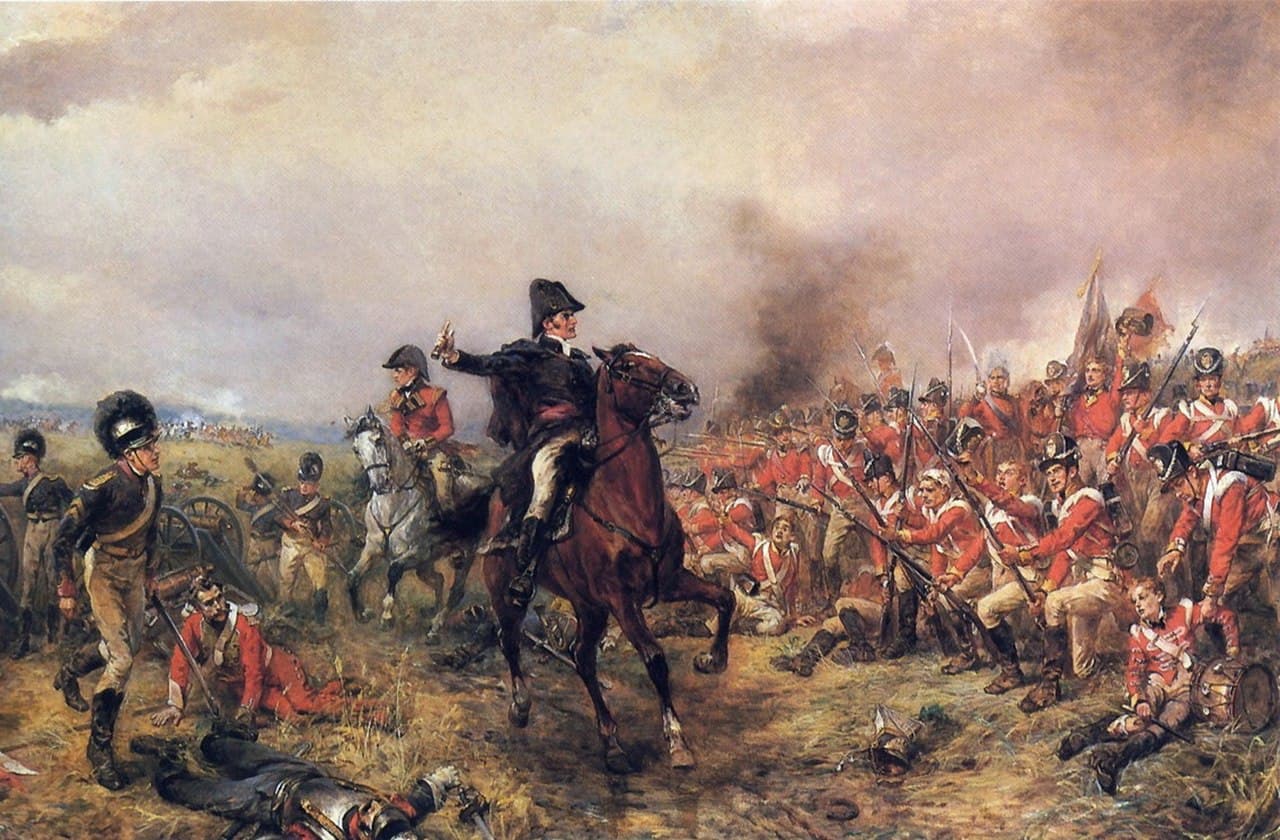
Wellington at Waterloo. Robert Alexander Hillingford, oil on canvas, late 19th century. The Duke of Wellington commanding the Anglo-allied centre on 18 June 1815. Place: Mont-Saint-Jean, Belgian Brabant, twelve miles south of Brussels Figures: Napoleon, returned from Elba for the Hundred Days · Arthur Wellesley, Duke of Wellington, allied commander · Gebhard Leberecht von Blücher, Prussian field marshal, age 72 · Marshal Michel Ney, leading the French cavalry charges · roughly 190,000 combatants engaged across the day The Hundred Days Napoleon escapes Elba with a thousand men on 26 February 1815 and lands in Provence on 1 March. He reaches Paris on 20 March without firing a shot; the troops sent to arrest him at Grenoble join him instead. Louis XVIII flees to Ghent. The European powers, meeting at Vienna, declare Napoleon an outlaw and pledge 150,000 men each to crush him. Napoleon strikes first, into Belgium, hoping to defeat Wellington's Anglo-Allied army and Blücher's Prussian army separately before the Russians and Austrians can arrive. He nearly succeeds. On 16 June he mauls Blücher at Ligny while Marshal Ney holds Wellington at Quatre Bras. The Prussians retreat but, critically, retreat north toward Wellington rather than east. Napoleon detaches Grouchy with 33,000 men to pursue them and turns west with the bulk of the army to face Wellington at Mont-Saint-Jean. The Prussian Arrival Battle opens at 11:30 a.m. on 18 June. Wellington's infantry squares hold against repeated French cavalry charges through the afternoon. La Haye Sainte, the central farmhouse, finally falls to the French around 6 p.m., but by then the Prussians have begun to debouch from the woods at Plancenoit on Napoleon's right flank. Napoleon commits the Imperial Guard at around 7:30 p.m. for a final assault on Wellington's center; the Guard breaks for the first time in its history. The French line dissolves into rout. Napoleon abdicates a second time on 22 June. He attempts to escape to America from Rochefort, is blocked by the Royal Navy, surrenders to Captain Maitland of HMS Bellerophon, and is transported to Saint Helena in the South Atlantic. He dies there on 5 May 1821, age 51, perhaps of stomach cancer. The Concert of Europe (see [[congress-of-vienna-1815]]), whose Final Act has been signed nine days before the battle, is now the operating system. The Westphalian restoration has held; the revolutionary-imperial parenthesis is, formally, closed. Video: Blow-by-blow of 18 June 1815, with Hougoumont, La Haye Sainte, the Old Guard, and the Prussian arrival.
Source: westphalia-oracle.vercel.app