The Iran Deal
JUL 14 2015 · 12:00
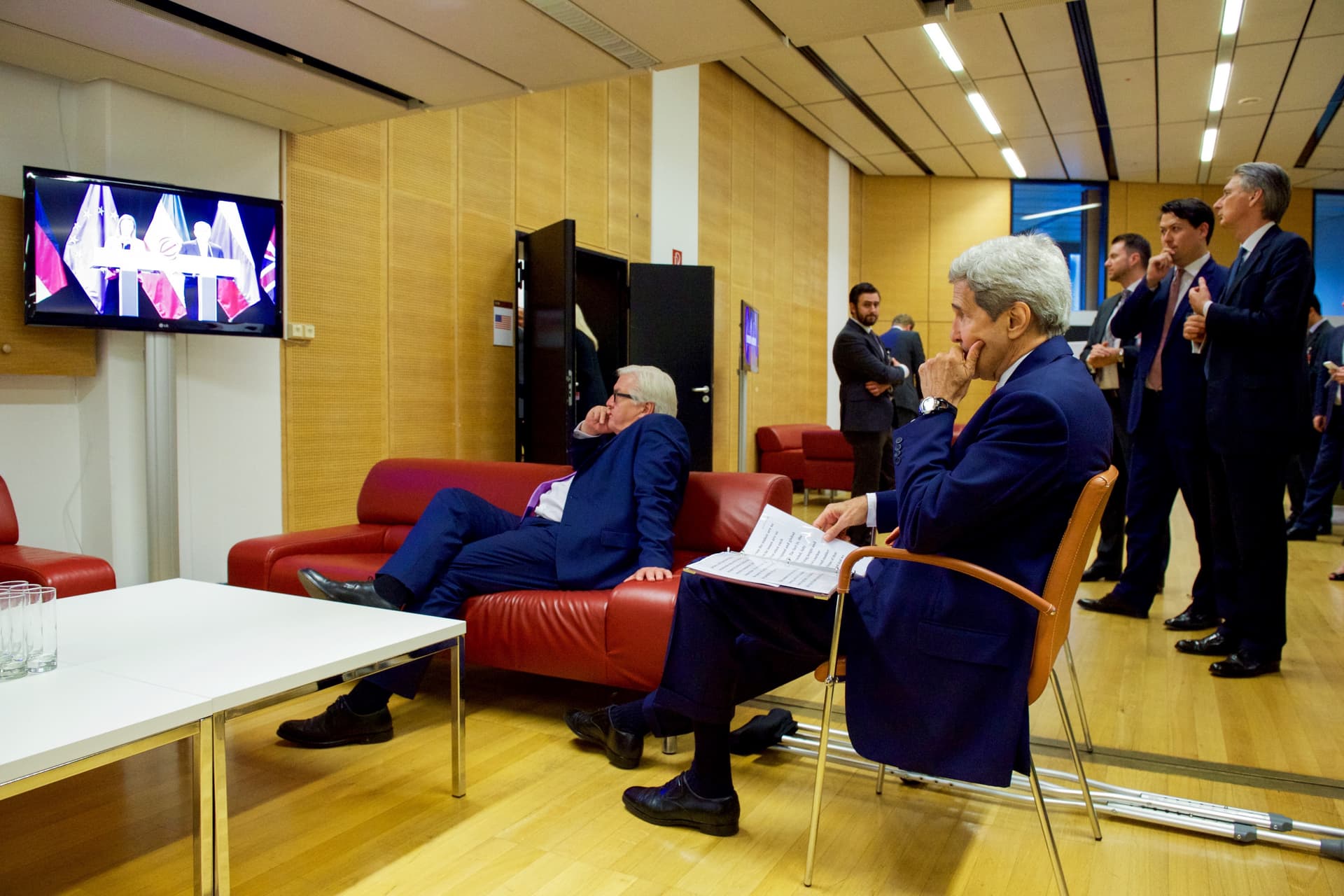
Federica Mogherini and Mohammad Javad Zarif announce the Joint Comprehensive Plan of Action in Vienna, 14 July 2015, as Steinmeier, Kerry and Hammond look on. Place: Palais Coburg, Vienna Figures: Mohammad Javad Zarif, Iranian Foreign Minister · John Kerry, US Secretary of State · Federica Mogherini, EU High Representative · Wang Yi, Sergey Lavrov, Philip Hammond, Frank-Walter Steinmeier, Laurent Fabius · Ali Akbar Salehi and Ernest Moniz, the nuclear physicists on each side The Joint Comprehensive Plan of Action Ten years of negotiation, three of them at full intensity, conclude in Vienna at 10:30 a.m. on 14 July 2015. Iran agrees to reduce its low-enriched-uranium stockpile by 98 percent, cap enrichment at 3.67 percent for fifteen years, dismantle two-thirds of its operating centrifuges, redesign the Arak heavy-water reactor so it cannot produce weapons-grade plutonium, and accept the most intrusive verification regime in the history of nuclear non-proliferation. In exchange, nuclear-related sanctions are suspended; some $100 billion in frozen Iranian assets are released over time. P5+1 plus Iran. The most ambitious multilateral arms-control agreement of the century, negotiated by the only configuration of powers that could plausibly enforce it. Endorsed unanimously by UN Security Council Resolution 2231 six days later. The technical achievement is acknowledged even by critics: the nuclear breakout time, estimated at two to three months in 2013, is pushed to roughly twelve months under the deal's restrictions. What One Administration Can Undo On 8 May 2018, Donald Trump withdraws the United States from the JCPOA and reimposes sanctions. The other five P5+1 parties (UK, France, Germany, Russia, China) attempt to preserve the deal through INSTEX, a special-purpose vehicle designed to bypass dollar clearing. INSTEX never reaches meaningful volume; secondary US sanctions are sufficient to deter European corporates from any Iran-related transaction. Iran begins exceeding enrichment limits in 2019. By 2022 it is enriching to 60 percent, weeks from weapons-grade. The collapse demonstrates that even a fifteen-year multilateral negotiation, ratified by the Security Council, can be undone by a single sovereign's administration change. The dollar's role as global reserve currency, and Washington's willingness to police it, gives the United States a unilateral capacity to nullify multilateral instruments to which it has acceded. The Westphalian principle of sovereign equality coexists, in practice, with a financial asymmetry that no treaty has yet succeeded in containing. (See [[trump-elected-2016]].) Video: Secretary of State John Kerry in Vienna on 14 July 2015, announcing the conclusion of the Joint Comprehensive Plan of Action between Iran and the P5+1.
Source: westphalia-oracle.vercel.app