The First Partition of Poland
AUG 05 1772 · 12:00
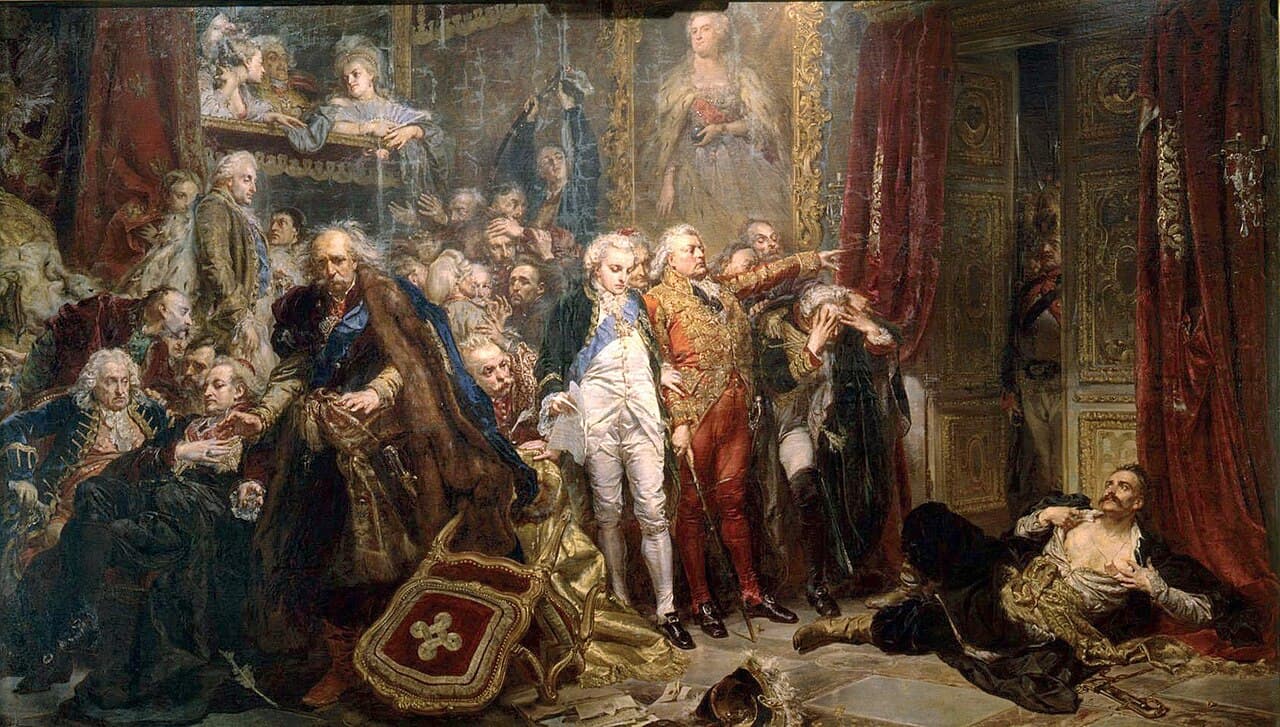
Rejtan, or the Fall of Poland, by Jan Matejko (1866), depicting Tadeusz Rejtan's protest against the First Partition. Place: St Petersburg (treaty signed); Warsaw (Sejm forced to ratify, 30 September 1773) Figures: Catherine II of Russia · Frederick II of Prussia · Maria Theresa of Austria, signing in tears · Stanisław August Poniatowski, king of Poland, presiding over the ratifying Sejm Consuming a State by Treaty The Polish-Lithuanian Commonwealth in the mid-eighteenth century is the third-largest state in Europe by territory, with a population approaching twelve million, an elective monarchy, and a parliament (the Sejm) so jealously protective of noble privilege that any single deputy can dissolve it by invoking the liberum veto. Russia has effectively dominated Polish politics since 1717, but full annexation would force a war with Austria and Prussia. Frederick II proposes the alternative: each of the three neighboring powers takes a slice. Russia 92,000 km² (confirmed). Austria figure should be 83,000 km² per Wikipedia (First Partition of Poland), not 81,900. Prussia 36,000 km² (Wikipedia) vs. 36,300 in moment — within rounding tolerance. (Royal Prussia, minus Danzig and Thorn, joining Brandenburg to East Prussia). Territory ~30% confirmed (Wikipedia: 211,000 km² out of total). Population: Wikipedia gives 'roughly one-third' (~33%), not 35%. Suggest changing 'thirty-five percent' to 'one-third' or 'about a third.' without a war. The treaty is signed at St Petersburg on 5 August 1772; the Sejm, under occupation, ratifies it the following year. The Limit Case of the System The partition is the first major Westphalian-era violation of one sovereign state's territorial integrity by other sovereign states acting in concert. Vattel had been published fourteen years earlier (see [[de-vattel-publishes-1758]]); the principle of non-intervention is on every chancery shelf. The three powers justify the act with documents asserting historic claims to the seized territories. No European state intervenes. Frederick the Great calls the operation consuming Poland leaf by leaf, like an artichoke. Two further partitions follow (1793 between Russia and Prussia; 1795 between all three), and by 1795 Poland-Lithuania has ceased to exist as a sovereign state, not to return until 1918. The episode reveals the system's structural limit: balance-of-power diplomacy, in the absence of any enforcement mechanism above the Great Powers, can produce coordinated extinction of weaker sovereigns. The lesson is studied: in the Crimean settlement (1856), at Vienna (1815), and at Versailles (1919), small powers will demand explicit guarantees against partition by concert.
Source: westphalia-oracle.vercel.app