The Helsinki Accords
AUG 01 1975 · 12:00
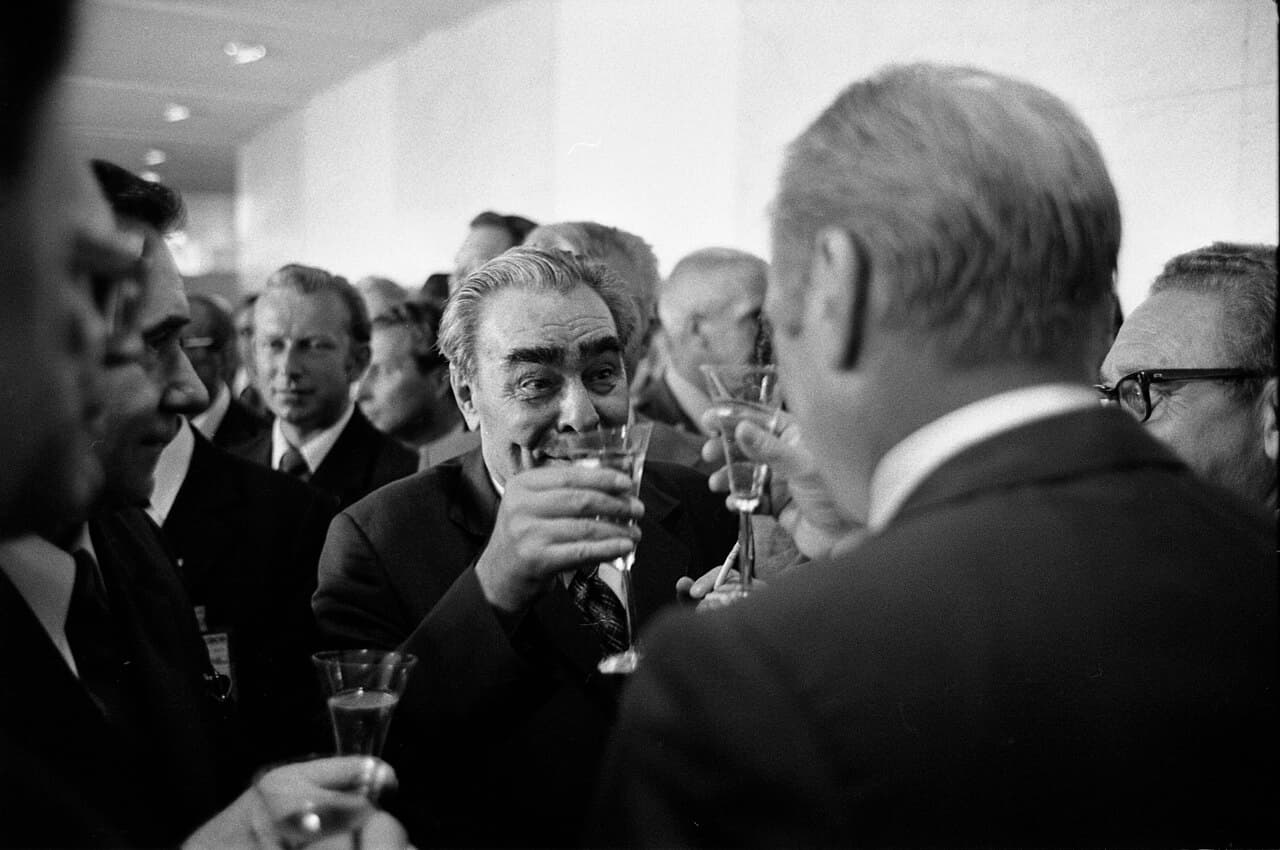
President Gerald Ford and Soviet General Secretary Leonid Brezhnev toast the signing of the CSCE Final Act in Helsinki, 1 August 1975. Place: Finlandia Hall, Helsinki Figures: Gerald Ford, US President · Leonid Brezhnev, Soviet General Secretary · Helmut Schmidt, West German Chancellor · Erich Honecker, East German General Secretary · Urho Kekkonen, Finnish President (host) · Aldo Moro, Italian Prime Minister · 35 heads of state or government in all Two Baskets, One Bargain The Conference on Security and Cooperation in Europe convenes in 1973 at Soviet initiative and Finnish hosting, after a decade of inconclusive Warsaw Pact and NATO exchanges. Negotiations run through 1973–75 at Helsinki and Geneva; the Final Act is signed 1 August 1975 by thirty-three European states (every European state except Albania), plus the United States and Canada. The text is divided into three baskets: Basket I (political-military), Basket II (economic and scientific cooperation), Basket III (humanitarian, including human contacts, information, culture, and education). The Soviet priority is Basket I, specifically the principle of inviolability of frontiers, which functions as a Western recognition of the postwar division of Europe (including the GDR, the Oder-Neisse line, the Baltic annexations). The Western counterpart is Basket III. The trade is consciously asymmetric on both sides. Brezhnev believes he has secured permanent ratification of Yalta; Western negotiators (especially the British and the Dutch) believe they have secured an instrument that will, slowly, corrode the closed system from within. Charter 77, Solidarity, Helsinki Watch The Final Act is published in full in the official press of every signatory state, including the Soviet Union and its satellites, as required by the agreement. Eastern European dissidents who had previously had to argue for human rights as a moral claim now have a treaty their own governments have signed. Charter 77 forms in Czechoslovakia in January 1977 explicitly invoking Helsinki; the Moscow Helsinki Group forms in May 1976; Polish KOR (1976) and Solidarity (1980) cite the Final Act repeatedly; Helsinki Watch is founded in New York in 1978, becoming Human Rights Watch in 1988. The accords give the dissident movements a vocabulary their regimes cannot publicly repudiate without repudiating their own signatures. Brezhnev's calculation, that the legitimation of borders mattered more than the soft human-rights commitments, proves wrong on a fifteen-year horizon. The Helsinki process and its CSCE follow-ups (Belgrade 1977, Madrid 1980, Vienna 1986) become the slow infrastructure through which Eastern European civil society organizes the 1989 revolutions. Cold War realism produces, by accident, the conditions of its own dissolution. The CSCE becomes the OSCE in 1995, with fifty-seven Video: AP Archive footage of the signing of the Final Act of the Conference on Security and Cooperation in Europe at Finlandia Hall, 1 August 1975. Thirty-five heads of state and government sign.
Source: westphalia-oracle.vercel.app