The Dissolution of the Soviet Union
DEC 26 1991 · 12:00
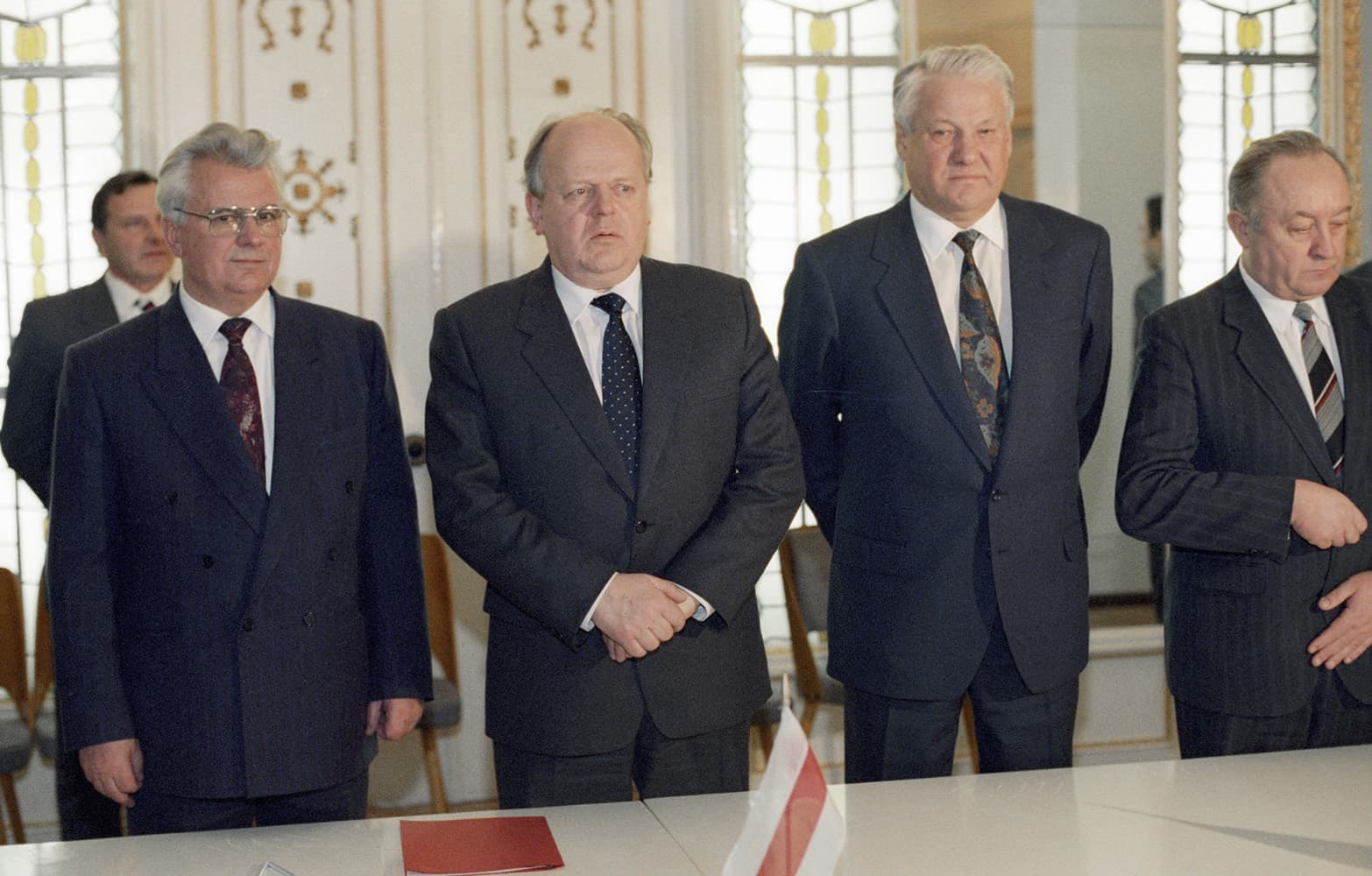
Leonid Kravchuk, Stanislav Shushkevich and Boris Yeltsin sign the Belovezha Accords dissolving the Soviet Union, 8 December 1991. Place: the Kremlin, Moscow; the Belovezha hunting lodge, Brest oblast, Belarus (8 December); Alma-Ata, Kazakh SSR (21 December) Figures: Mikhail Gorbachev, last Soviet president · Boris Yeltsin, Russian president · Leonid Kravchuk, Ukrainian president · Stanislav Shushkevich, Belarusian chairman · the Soviet of the Republics voting itself out of existence Belovezha to Alma-Ata On 8 December 1991, in a hunting lodge in the Belovezhskaya Pushcha forest, the heads of the Russian, Ukrainian, and Belarusian republics sign an accord declaring that the USSR as a subject of international law and a geopolitical reality, ceases to exist. The three founding signatories of the 1922 Union Treaty have, between them, simply revoked it. On 21 December at Alma-Ata, eight further republics sign the Alma-Ata Protocols, joining the Commonwealth of Independent States and confirming the dissolution. Gorbachev learns of Belovezha after the fact, by telephone, from Shushkevich, who calls George H. W. Bush before he calls the man whose state has just been dismantled. Gorbachev resigns on the evening of 25 December. His televised address concedes the necessary lesson, that the old system collapsed before a new one had time to start working. The next day, 26 December, the Soviet of the Republics, the upper chamber of the Supreme Soviet, passes Declaration 142-N, formally dissolving the Union. The chamber is half empty. The vote is not contested. The Flag at 19:32 At 19:32 Moscow time on 25 December, the red banner with hammer and sickle is lowered over Senate Dome of the Kremlin. The Russian tricolor is raised in its place. The footage carries no commentary; Soviet state television, on instructions, simply broadcasts the lowering and the raising. Fifteen sovereign states emerge from one: Russia, Ukraine, Belarus, Moldova, the three Baltic republics (already independent since September), the three Transcaucasian republics, and the five Central Asian republics. Each inherits a flag, a foreign ministry, a seat at the United Nations. The Russian Federation inherits the USSR's permanent Security Council seat (see [[un-charter-1945]]), its strategic nuclear arsenal, and the bulk of its sovereign debt. It does not inherit confidence. The unipolar moment that Charles Krauthammer had named in 1990 now formally begins. Fukuyama's argument (see [[fall-of-the-berlin-wall-1989]]) acquires its empirical anchor. For the next seventeen years, until Lehman, the system will be governed on the working assumption that the contest is over. Video: CBS News coverage of Mikhail Gorbachev's resignation address from the Kremlin, 25 December 1991. The Soviet flag is lowered for the last time and replaced by the Russian tricolour.
Source: westphalia-oracle.vercel.app