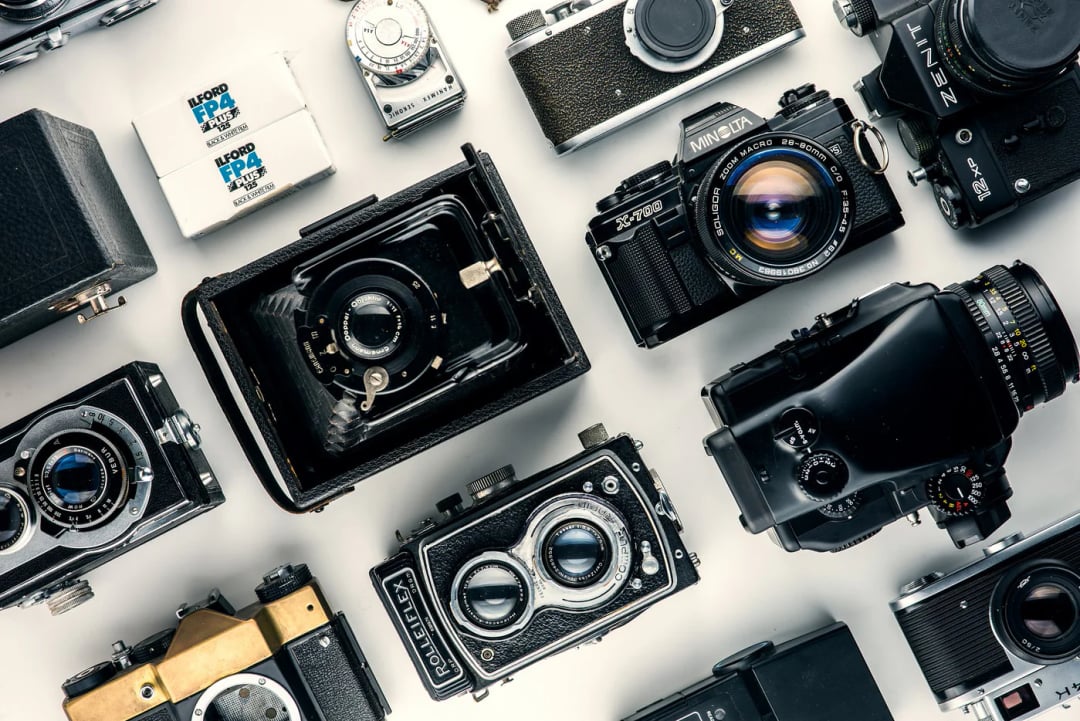
Cameras
Two hundred years of the camera — and the footage it gave us. From Niépce's eight-hour window in 1826 and Muybridge's galloping horse to the Lumière train, the moon-landing broadcast, the camcorder, the first digital frame, and the film studio everyone now carries in a pocket. The devices that captured the world, shown beside what they captured.
A chronological documentary of 729 moments spanning 1700–2026 on Loreline.
last updated 2026-07-21
Eras
- The Birth of the Image (1826–1888) — The camera obscura, Niépce's first surviving photograph, the daguerreotype, the calotype negative, wet plate — humanity learns to fix light.
- Colour, Instant & the Moon (1907–1979) — Autochrome and Kodachrome bring colour; Polaroid makes it instant; Super 8 fills the family album; and a camera on the Moon shows us the whole Earth.
- Pictures That Move (1878–1895) — Muybridge's galloping horse settles a bet and starts cinema; Edison's Kinetoscope and the Lumières' Cinématographe make pictures move.
- The Snapshot & The Silver Screen (1888–1929) — Kodak puts a camera in everyone's hands and the Brownie invents the snapshot; Méliès and Porter invent the movies; the Leica miniaturises it all.
- The Video Revolution (1936–2005) — Television cameras, the first videotape, the Portapak, the camcorder — and the bystander's camcorder that could suddenly hold power to account.
- The Digital Turn (1975–2007) — Steven Sasson's 1975 prototype, the megapixel race, the DSLR, and the first cameras built into phones — film becomes data.
- A Camera in Every Pocket (2007–today) — The iPhone, GoPro, the drone, mirrorless and computational photography — until everyone alive carries a film studio and the whole world is on camera.
- — Camera obscura (1700). Camera obscura — the camera itself, 1700. In the first age of photography, exposures took hours and every image was a small miracle of chemistry and light.
- — Camera obscura (1700). Camera obscura — the camera itself, 1700. In the first age of photography, exposures took hours and every image was a small miracle of chemistry and light.
- — Camera obscura (1700). Camera obscura — the camera itself, 1700. In the first age of photography, exposures took hours and every image was a small miracle of chemistry and light.
- — Camera obscura (1700). Camera obscura — the camera itself, 1700. In the first age of photography, exposures took hours and every image was a small miracle of chemistry and light.
- — The 1st Photographer - Joseph Nicéphore Niépce. Niepce First Photograph (1826). In the first age of photography, exposures took hours and every image was a small miracle of chemistry and light.
- — The World’s Earliest Photograph | Episode 42: View from the Window at Le Gras, Joseph Niépce. Niepce First Photograph (1826). In the first age of photography, exposures took hours and every image was a small miracle of chemistry and light.
- — The First Photographer: The Photographs of Nicéphore Niépce. Niepce First Photograph (1826). In the first age of photography, exposures took hours and every image was a small miracle of chemistry and light.
- — The First Photograph: Scientific Analysis. Niepce View from the Window at Le Gras 1826 (1826). In the first age of photography, exposures took hours and every image was a small miracle of chemistry and light.
- — Niépce's first photograph (1826). Niépce's first photograph — an image made in 1826. In the first age of photography, exposures took hours and every image was a small miracle of chemistry and light.
- — Niépce's first photograph (1826) (1826). Niépce's first photograph (1826) — an image made in 1826. In the first age of photography, exposures took hours and every image was a small miracle of chemistry and light.
- — Niépce's first photograph (1826) (1826). Niépce's first photograph (1826) — an image made in 1826. In the first age of photography, exposures took hours and every image was a small miracle of chemistry and light.
- — Niépce's first photograph (1826) (1826). Niépce's first photograph (1826) — an image made in 1826. In the first age of photography, exposures took hours and every image was a small miracle of chemistry and light.
- — Niépce's first photograph (1826) (1826). Niépce's first photograph (1826) — an image made in 1826. In the first age of photography, exposures took hours and every image was a small miracle of chemistry and light.
- — The Oldest Photographs in the World. Oldest photographs history (1838). In the first age of photography, exposures took hours and every image was a small miracle of chemistry and light.
- — The Shoe Shiner and the Inventor | Episode 36: Boulevard Du Temple, Louis Daguerre. Boulevard du Temple (first photo of a person) (1838). In the first age of photography, exposures took hours and every image was a small miracle of chemistry and light.
- — First photo of a human (1838) (1838). First photo of a human (1838) — an image made in 1838. In the first age of photography, exposures took hours and every image was a small miracle of chemistry and light.
- — First photo of a human (1838) (1838). First photo of a human (1838) — an image made in 1838. In the first age of photography, exposures took hours and every image was a small miracle of chemistry and light.
- — First photo of a human (1838) (1838). First photo of a human (1838) — an image made in 1838. In the first age of photography, exposures took hours and every image was a small miracle of chemistry and light.
- — First photo of a human (1838) (1838). First photo of a human (1838) — an image made in 1838. In the first age of photography, exposures took hours and every image was a small miracle of chemistry and light.
- — The Daguerreotype - Photographic Processes Series - Chapter 2 of 12. Daguerreotype process (1839). In the first age of photography, exposures took hours and every image was a small miracle of chemistry and light.
- — The Oldest Portrait Photographs - Part 1. Earliest portrait photographs (1839). In the first age of photography, exposures took hours and every image was a small miracle of chemistry and light.
- — Sun Pictures: Henry Fox Talbot and the First Photographs. Talbot Calotype (1839). In the first age of photography, exposures took hours and every image was a small miracle of chemistry and light.
- — How was it made? The Daguerreotype | V&A. Daguerreotype (1839). In the first age of photography, exposures took hours and every image was a small miracle of chemistry and light.
- — Early Photography: Making Daguerreotypes. Daguerreotype (1839). In the first age of photography, exposures took hours and every image was a small miracle of chemistry and light.
- — Photographic processes | The Daguerreotype. Daguerreotype (1839). In the first age of photography, exposures took hours and every image was a small miracle of chemistry and light.
- — The science of making a daguerreotype. Daguerreotype (1839). In the first age of photography, exposures took hours and every image was a small miracle of chemistry and light.
- — The daguerreotype camera (1839). The daguerreotype camera — the camera itself, 1839. In the first age of photography, exposures took hours and every image was a small miracle of chemistry and light.
- — The daguerreotype camera (1839). The daguerreotype camera — the camera itself, 1839. In the first age of photography, exposures took hours and every image was a small miracle of chemistry and light.
- — The daguerreotype camera (1839). The daguerreotype camera — the camera itself, 1839. In the first age of photography, exposures took hours and every image was a small miracle of chemistry and light.
- — The daguerreotype camera (1839). The daguerreotype camera — the camera itself, 1839. In the first age of photography, exposures took hours and every image was a small miracle of chemistry and light.
- — The Birth of Photography: Drawing With Light. Photography / film chemistry explainer (1839). Colour, instant prints and home movies brought the camera into everyday life — and one rode to the Moon.
- — OTD in Space – March 23: First Photo of the Moon. First Photograph of the Moon (1840). In the first age of photography, exposures took hours and every image was a small miracle of chemistry and light.
- — Bayard's staged photo (1840) (1840). Bayard's staged photo (1840) — an image made in 1840. In the first age of photography, exposures took hours and every image was a small miracle of chemistry and light.
- — Bayard's staged photo (1840) (1840). Bayard's staged photo (1840) — an image made in 1840. In the first age of photography, exposures took hours and every image was a small miracle of chemistry and light.
- — Bayard's staged photo (1840) (1840). Bayard's staged photo (1840) — an image made in 1840. In the first age of photography, exposures took hours and every image was a small miracle of chemistry and light.
- — Bayard's staged photo (1840) (1840). Bayard's staged photo (1840) — an image made in 1840. In the first age of photography, exposures took hours and every image was a small miracle of chemistry and light.
- — Photographic Processes | The Calotype. Talbot calotype negative (1841). In the first age of photography, exposures took hours and every image was a small miracle of chemistry and light.
- — How was it made? Calotypes | V&A. Talbot Calotype (1841). In the first age of photography, exposures took hours and every image was a small miracle of chemistry and light.
- — William Henry Fox Talbot - Scientist, Inventor and Photography Pioneer. Talbot Calotype (1841). In the first age of photography, exposures took hours and every image was a small miracle of chemistry and light.
- — Talbot's calotype negative (1843). Talbot's calotype negative — an image made in 1843. In the first age of photography, exposures took hours and every image was a small miracle of chemistry and light.
- — Talbot's calotype negative (1843). Talbot's calotype negative — an image made in 1843. In the first age of photography, exposures took hours and every image was a small miracle of chemistry and light.
- — Talbot's calotype negative (1843). Talbot's calotype negative — an image made in 1843. In the first age of photography, exposures took hours and every image was a small miracle of chemistry and light.
- — Talbot's calotype (1843). Talbot's calotype — an image made in 1843. In the first age of photography, exposures took hours and every image was a small miracle of chemistry and light.
- — Talbot's calotype (1843). Talbot's calotype — an image made in 1843. In the first age of photography, exposures took hours and every image was a small miracle of chemistry and light.
- — Talbot's calotype negative (1843). Talbot's calotype negative — an image made in 1843. In the first age of photography, exposures took hours and every image was a small miracle of chemistry and light.
- — Talbot's calotype (1843). Talbot's calotype — an image made in 1843. In the first age of photography, exposures took hours and every image was a small miracle of chemistry and light.
- — FIRST EVER Photo of the Sun Revealed 180 Years Ago Today!. First Photograph of the Sun (1845). In the first age of photography, exposures took hours and every image was a small miracle of chemistry and light.
- — Early daguerreotype portrait (1845). Early daguerreotype portrait — an image made in 1845. In the first age of photography, exposures took hours and every image was a small miracle of chemistry and light.
- — Early daguerreotype portrait (1845). Early daguerreotype portrait — an image made in 1845. In the first age of photography, exposures took hours and every image was a small miracle of chemistry and light.
- — Early daguerreotype portrait (1845). Early daguerreotype portrait — an image made in 1845. In the first age of photography, exposures took hours and every image was a small miracle of chemistry and light.
- — Early daguerreotype portrait (1845). Early daguerreotype portrait — an image made in 1845. In the first age of photography, exposures took hours and every image was a small miracle of chemistry and light.
- — Stereoscope and Stereographs. Stereograph / Stereoscope (1850). In the first age of photography, exposures took hours and every image was a small miracle of chemistry and light.
- — Victorian Virtual Reality: How does stereoscopy work?. Stereograph / Stereoscope (1850). In the first age of photography, exposures took hours and every image was a small miracle of chemistry and light.
- — The Wet Collodion Process. Wet-plate Collodion (1851). In the first age of photography, exposures took hours and every image was a small miracle of chemistry and light.
- — Photography: A Victorian Sensation – Stereography. Stereograph / Stereoscope (1851). In the first age of photography, exposures took hours and every image was a small miracle of chemistry and light.
- — How was it made? Wet Collodion | V&A. Wet-plate Collodion (1851). In the first age of photography, exposures took hours and every image was a small miracle of chemistry and light.
- — The Collodion - Photographic Processes Series - Chapter 5 of 12. Wet-plate Collodion (1851). In the first age of photography, exposures took hours and every image was a small miracle of chemistry and light.
- — First photo of the moon (1851). First photo of the moon — an image made in 1851. In the first age of photography, exposures took hours and every image was a small miracle of chemistry and light.
- — First photo of the moon (1851). First photo of the moon — an image made in 1851. In the first age of photography, exposures took hours and every image was a small miracle of chemistry and light.
- — Digitising Ambrotypes and Daguerreotypes. Ambrotype & Daguerreotype (1855). In the first age of photography, exposures took hours and every image was a small miracle of chemistry and light.
- — TinType Photography Process HD. Tintype photography process (1856). In the first age of photography, exposures took hours and every image was a small miracle of chemistry and light.
- — The First Aerial Photographs. First aerial photography (1858). Colour, instant prints and home movies brought the camera into everyday life — and one rode to the Moon.
- — Nadar's portraits (1860). Nadar's portraits — an image made in 1860. In the first age of photography, exposures took hours and every image was a small miracle of chemistry and light.
- — The stereoscope (1860). The stereoscope — the camera itself, 1860. In the first age of photography, exposures took hours and every image was a small miracle of chemistry and light.
- — Nadar's portraits (1860). Nadar's portraits — an image made in 1860. In the first age of photography, exposures took hours and every image was a small miracle of chemistry and light.
- — The stereoscope (1860). The stereoscope — the camera itself, 1860. In the first age of photography, exposures took hours and every image was a small miracle of chemistry and light.
- — Nadar's portraits (1860). Nadar's portraits — an image made in 1860. In the first age of photography, exposures took hours and every image was a small miracle of chemistry and light.
- — Nadar's portraits (1860). Nadar's portraits — an image made in 1860. In the first age of photography, exposures took hours and every image was a small miracle of chemistry and light.
- — Almanac: America's First Aerial Photograph. First aerial photograph (USA) (1860). Colour, instant prints and home movies brought the camera into everyday life — and one rode to the Moon.
- — The world's first colour photograph. First Color Photograph (Maxwell) (1861). In the years cinema was invented, the camera learned to capture not a moment but motion itself.
- — First colour photo (Maxwell 1861) (1861). First colour photo (Maxwell 1861) — an image made in 1861. In the first age of photography, exposures took hours and every image was a small miracle of chemistry and light.
- — Mathew Brady's Vision. Mathew Brady / Civil War Photography (1862). In the first age of photography, exposures took hours and every image was a small miracle of chemistry and light.
- — Civil War photography (Brady) (1863). Civil War photography (Brady) — an image made in 1863. In the first age of photography, exposures took hours and every image was a small miracle of chemistry and light.
- — Civil War photography (Brady) (1863). Civil War photography (Brady) — an image made in 1863. In the first age of photography, exposures took hours and every image was a small miracle of chemistry and light.
- — Civil War photography (Brady) (1863). Civil War photography (Brady) — an image made in 1863. In the first age of photography, exposures took hours and every image was a small miracle of chemistry and light.
- — Civil War photography (Brady) (1863). Civil War photography (Brady) — an image made in 1863. In the first age of photography, exposures took hours and every image was a small miracle of chemistry and light.
- — Early landscape photography (1865). Early landscape photography — an image made in 1865. In the first age of photography, exposures took hours and every image was a small miracle of chemistry and light.
- — Early landscape photography (1865). Early landscape photography — an image made in 1865. In the first age of photography, exposures took hours and every image was a small miracle of chemistry and light.
- — Early landscape photography (1865). Early landscape photography — an image made in 1865. In the first age of photography, exposures took hours and every image was a small miracle of chemistry and light.
- — Early landscape photography (1865). Early landscape photography — an image made in 1865. In the first age of photography, exposures took hours and every image was a small miracle of chemistry and light.
- — A tintype (1870). A tintype — an image made in 1870. In the first age of photography, exposures took hours and every image was a small miracle of chemistry and light.
- — A tintype (1870). A tintype — an image made in 1870. In the first age of photography, exposures took hours and every image was a small miracle of chemistry and light.
- — A tintype (1870). A tintype — an image made in 1870. In the first age of photography, exposures took hours and every image was a small miracle of chemistry and light.
- — A tintype (1870). A tintype — an image made in 1870. In the first age of photography, exposures took hours and every image was a small miracle of chemistry and light.
- — Eadweard Muybridge: Leland Stanford Jr.. Muybridge / Leland Stanford (1872). In the years cinema was invented, the camera learned to capture not a moment but motion itself.
- — How One Horse Inspired the Invention of Movies. Muybridge & the Stanford horse bet (1872). In the years cinema was invented, the camera learned to capture not a moment but motion itself.
- — Motion Capture Evolution: Muybridge to Marey | Shell Historical Film Archive. Muybridge to Marey (motion capture) (1878). In the years cinema was invented, the camera learned to capture not a moment but motion itself.
- — Muybridge's galloping horse (1878) (1878). Muybridge's galloping horse (1878) — an image made in 1878. In the years cinema was invented, the camera learned to capture not a moment but motion itself.
- — Muybridge's galloping horse (1878) (1878). Muybridge's galloping horse (1878) — an image made in 1878. In the years cinema was invented, the camera learned to capture not a moment but motion itself.
- — Muybridge's galloping horse (1878) (1878). Muybridge's galloping horse (1878) — an image made in 1878. In the years cinema was invented, the camera learned to capture not a moment but motion itself.
- — Muybridge's galloping horse (1878) (1878). Muybridge's galloping horse (1878) — an image made in 1878. In the years cinema was invented, the camera learned to capture not a moment but motion itself.
- — 1st Movie (Motion Picture) - Sallie Gardner at a Gallop (1878) Eadward Muybridge | Frame-by-Frame. Muybridge Horse in Motion 1878 (1878). In the years cinema was invented, the camera learned to capture not a moment but motion itself.
- — The Horse in Motion (Eadweard Muybridge) 1878. Muybridge The Horse in Motion (1878). Colour, instant prints and home movies brought the camera into everyday life — and one rode to the Moon.
- — Slices of Time: Eadweard Muybridge’s Cinematic Legacy. Eadweard Muybridge (1878). In the years cinema was invented, the camera learned to capture not a moment but motion itself.
- — "Sallie Gardner at a Gallop" or "The Horse in Motion" (Eadweard Muybridge, 1878). Muybridge — Sallie Gardner at a Gallop (1878). In the years cinema was invented, the camera learned to capture not a moment but motion itself.
- — 1878 - Sallie Gardner at a Gallop - Eadweard Muybridge. Muybridge — Sallie Gardner at a Gallop (1878). In the years cinema was invented, the camera learned to capture not a moment but motion itself.
- — Muybridge, The Attitudes of Animals in Motion. Eadweard Muybridge zoopraxiscope (1879). In the years cinema was invented, the camera learned to capture not a moment but motion itself.
- — The zoopraxiscope (1879). The zoopraxiscope — the camera itself, 1879. In the years cinema was invented, the camera learned to capture not a moment but motion itself.
- — The zoopraxiscope (1879). The zoopraxiscope — the camera itself, 1879. In the years cinema was invented, the camera learned to capture not a moment but motion itself.
- — The magic lantern (1880). The magic lantern — the camera itself, 1880. In the years cinema was invented, the camera learned to capture not a moment but motion itself.
- — The magic lantern (1880). The magic lantern — the camera itself, 1880. In the years cinema was invented, the camera learned to capture not a moment but motion itself.
- — The magic lantern (1880). The magic lantern — the camera itself, 1880. In the years cinema was invented, the camera learned to capture not a moment but motion itself.
- — Etienne-Jules Marey - Sport in the Darkroom (EN). Etienne-Jules Marey (1882). In the years cinema was invented, the camera learned to capture not a moment but motion itself.
- — Marey's chronophotography (1882). Marey's chronophotography — an image made in 1882. In the years cinema was invented, the camera learned to capture not a moment but motion itself.
- — Marey's chronophotography (1882). Marey's chronophotography — an image made in 1882. In the years cinema was invented, the camera learned to capture not a moment but motion itself.
- — Marey's chronophotography (1882). Marey's chronophotography — an image made in 1882. In the years cinema was invented, the camera learned to capture not a moment but motion itself.
- — Marey's chronophotography (1882). Marey's chronophotography — an image made in 1882. In the years cinema was invented, the camera learned to capture not a moment but motion itself.
- — Eadweard Muybridge: Studies in Motion. Eadweard Muybridge (1887). In the years cinema was invented, the camera learned to capture not a moment but motion itself.
- — Muybridge's motion studies (1887). Muybridge's motion studies — an image made in 1887. In the years cinema was invented, the camera learned to capture not a moment but motion itself.
- — Muybridge's motion studies (1887). Muybridge's motion studies — an image made in 1887. In the years cinema was invented, the camera learned to capture not a moment but motion itself.
- — Muybridge's motion studies (1887). Muybridge's motion studies — an image made in 1887. In the years cinema was invented, the camera learned to capture not a moment but motion itself.
- — Muybridge's motion studies (1887). Muybridge's motion studies — an image made in 1887. In the years cinema was invented, the camera learned to capture not a moment but motion itself.
- — How Kodak invented the “snapshot”. Kodak No.1 1888 / You press the button (1888). As the snapshot and the silent film arrived, photography left the studio and the movies were born.
- — Kodak: How George Eastman revolutionized photography. Kodak No.1 / George Eastman (1888). As the snapshot and the silent film arrived, photography left the studio and the movies were born.
- — Roundhay Garden Scene (1888) (1888). Roundhay Garden Scene (1888) — an image made in 1888. In the years cinema was invented, the camera learned to capture not a moment but motion itself.
- — The first Kodak (1888) (1888). The first Kodak (1888) — the camera itself, 1888. As the snapshot and the silent film arrived, photography left the studio and the movies were born.
- — The first Kodak (1888) (1888). The first Kodak (1888) — the camera itself, 1888. As the snapshot and the silent film arrived, photography left the studio and the movies were born.
- — ADVANCED EMULSION: Silver Halide Crystals, Imaging Couplers, Orange Masks and Processing. How film photography chemistry works (1888). In the first age of photography, exposures took hours and every image was a small miracle of chemistry and light.
- — Roundhay Garden Scene (1888). (1888). In the years cinema was invented, the camera learned to capture not a moment but motion itself.
- — 1891-95; 1900 - Chronophotographs by Étienne-Jules Marey (HA series) - Marey, Georges Demenÿ, Comte. Marey Chronophotography (1891). In the years cinema was invented, the camera learned to capture not a moment but motion itself.
- — PBS|The Kinetoscope. Edison Kinetoscope (1891). In the years cinema was invented, the camera learned to capture not a moment but motion itself.
- — Dickson Greeting (1891). ). In the years cinema was invented, the camera learned to capture not a moment but motion itself.
- — Dickson Greeting. (1891). In the years cinema was invented, the camera learned to capture not a moment but motion itself.
- — PBS|The Black Maria. Edison Black Maria studio (1893). In the years cinema was invented, the camera learned to capture not a moment but motion itself.
- — Edison Kinetoscopic Record of a Sneeze, Jan. 7, 1894. Edison Kinetoscope (1894). In the years cinema was invented, the camera learned to capture not a moment but motion itself.
- — The Dickson Experimental Sound Film. Dickson Experimental Sound Film (1894). In the years cinema was invented, the camera learned to capture not a moment but motion itself.
- — Fred Ott's Sneeze (1894). Fred Ott's Sneeze (Edison) (1894). In the years cinema was invented, the camera learned to capture not a moment but motion itself.
- — William Dickson: Fred Ott's Sneeze (1894). Fred Ott's Sneeze (Edison) (1894). In the years cinema was invented, the camera learned to capture not a moment but motion itself.
- — Thomas Edison's - Carmencita - Black Maria Studio (1894) World's First Film Studio. Carmencita (Edison Black Maria) (1894). In the years cinema was invented, the camera learned to capture not a moment but motion itself.
- — Carmencita. (Edison) (1894). In the years cinema was invented, the camera learned to capture not a moment but motion itself.
- — Edison Kinetoscope (1894). Edison Kinetoscope — the camera itself, 1894. In the years cinema was invented, the camera learned to capture not a moment but motion itself.
- — Edison Kinetoscope (1894). Edison Kinetoscope — the camera itself, 1894. In the years cinema was invented, the camera learned to capture not a moment but motion itself.
- — 1894 - Buffalo Dance - William Kennedy Laurie Dickson (Edison Studios). Buffalo Dance (Edison) (1894). In the years cinema was invented, the camera learned to capture not a moment but motion itself.
- — Annie Oakley (1894) : by Thomas A. Edison Kinetoscope. Annie Oakley (Edison) (1894). In the years cinema was invented, the camera learned to capture not a moment but motion itself.
- — Annie Oakley. Edison film 1894 (1894). In the years cinema was invented, the camera learned to capture not a moment but motion itself.
- — Early Traffic (1890-1899). Early traffic (British Pathe) (1895). In the years cinema was invented, the camera learned to capture not a moment but motion itself.
- — L'arroseur arrosé [The Sprinkler Sprinkled] (Louis Lumière, 1895). The Sprinkler Sprinkled (Lumiere) (1895). In the years cinema was invented, the camera learned to capture not a moment but motion itself.
- — 1895 - Serpentine Dance by Annabelle - William Kennedy Laurie Dickson (Edison Studios). Annabelle Serpentine Dance (Edison) (1895). In the years cinema was invented, the camera learned to capture not a moment but motion itself.
- — Boat Leaving The Port (1895). Boat Leaving the Port (Lumiere) (1895). In the years cinema was invented, the camera learned to capture not a moment but motion itself.
- — Baby's Dinner - Repas de Bebe (Lumiere - 1895). Baby's Meal (Lumiere) (1895). In the years cinema was invented, the camera learned to capture not a moment but motion itself.
- — [Actual 4K Scan] The Arrival of a Train at La Ciotat Station - Lumière Brothers - 1896.. Lumiere Arrival of a Train La Ciotat 1895 (1895). In the years cinema was invented, the camera learned to capture not a moment but motion itself.
- — Workers Leaving the Lumière Factory (1895) - The First Motion Picture in History | Lumière Brothers. Workers Leaving the Lumiere Factory (1895). In the years cinema was invented, the camera learned to capture not a moment but motion itself.
- — "Workers Leaving the Lumière Factory in Lyon" (Lumière Brothers, France, 1895). Workers Leaving the Lumiere Factory (1895). In the years cinema was invented, the camera learned to capture not a moment but motion itself.
- — Workers Leaving The Lumiere Factory - Lumiere Brothers 1895. Lumiere Workers Leaving the Factory 1895 (1895). In the years cinema was invented, the camera learned to capture not a moment but motion itself.
- — La Sortie de l'Usine Lumière à Lyon (Workers Leaving the Lumiere Factory) 2 (1895) Louis Lumiere. Workers Leaving the Lumiere Factory (1895). In the years cinema was invented, the camera learned to capture not a moment but motion itself.
- — Repas de bébé (Baby's Breakfast) (1895) Louis Lumiere. Lumiere Baby's Breakfast 1895 (1895). In the years cinema was invented, the camera learned to capture not a moment but motion itself.
- — The Lumière Cinématographe (1895). The Lumière Cinématographe — the camera itself, 1895. In the years cinema was invented, the camera learned to capture not a moment but motion itself.
- — The Lumière Cinématographe (1895). The Lumière Cinématographe — the camera itself, 1895. In the years cinema was invented, the camera learned to capture not a moment but motion itself.
- — Arrival of a Train at La Ciotat, 1895 (Lumière brothers). Lumiere Arrival of a Train (1895). Colour, instant prints and home movies brought the camera into everyday life — and one rode to the Moon.
- — The Lumiere Brothers: Crash Course Film History #3. Lumiere Cinematographe (1895). In the years cinema was invented, the camera learned to capture not a moment but motion itself.
- — Feeding the Doves 1896. Feeding the Doves (Lumiere) (1896). In the years cinema was invented, the camera learned to capture not a moment but motion itself.
- — Auguste and Louis Lumière - Démolition d'un mur (1896). Demolition of a Wall (Lumiere) (1896). In the years cinema was invented, the camera learned to capture not a moment but motion itself.
- — The Arrival of a Train at La Ciotat (1896) Louis Lumière. Arrival of a Train at La Ciotat (Lumiere) (1896). In the years cinema was invented, the camera learned to capture not a moment but motion itself.
- — The Arrival of a Train at La Ciotat Station 1896 - Lumière Brothers (4K scan). Arrival of a Train at La Ciotat (Lumiere) (1896). In the years cinema was invented, the camera learned to capture not a moment but motion itself.
- — 1896 - On Brighton Beach - George Albert Smith ou Robert William Paul (?). On Brighton Beach (G.A. Smith / R.W. Paul) (1896). In the years cinema was invented, the camera learned to capture not a moment but motion itself.
- — Démolition d'un mur [Demolition of a Wall] (Lumière, 1896). Demolition of a Wall (Lumiere) (1896). In the years cinema was invented, the camera learned to capture not a moment but motion itself.
- — The Kiss (1896) May Irwin, John Rice - First kiss in commercial cinema. The Kiss (May Irwin / John Rice, Edison) (1896). In the years cinema was invented, the camera learned to capture not a moment but motion itself.
- — May Irwin Kiss. The Kiss (May Irwin Kiss, Edison) (1896). In the years cinema was invented, the camera learned to capture not a moment but motion itself.
- — G.A. Smith Stop Motion. (1898). In the years cinema was invented, the camera learned to capture not a moment but motion itself.
- — Early English Traffic: Turn of the Century London (1896-1903) | British Pathé. Early London traffic (British Pathe) (1900). In the years cinema was invented, the camera learned to capture not a moment but motion itself.
- — The One Man Band (1900) George Melies. The One-Man Band (Melies) (1900). In the years cinema was invented, the camera learned to capture not a moment but motion itself.
- — grandma's reading glass / short experimental film directed by George Albert Smith 1900. Grandma's Reading Glass (G.A. Smith) (1900). In the years cinema was invented, the camera learned to capture not a moment but motion itself.
- — The One-Man Band (L'Homme-Orchestre, 1900) ㅡ Georges Méliès. The One-Man Band (Melies) (1900). In the years cinema was invented, the camera learned to capture not a moment but motion itself.
- — 1901 - The Big Swallow - James Williamson. The Big Swallow (Williamson) (1901). In the years cinema was invented, the camera learned to capture not a moment but motion itself.
- — A Trip to the Moon (1902) (1902). A Trip to the Moon (1902) — an image made in 1902. As the snapshot and the silent film arrived, photography left the studio and the movies were born.
- — A Trip to the Moon (1902) (1902). A Trip to the Moon (1902) — an image made in 1902. As the snapshot and the silent film arrived, photography left the studio and the movies were born.
- — A Trip to the Moon (1902) (1902). A Trip to the Moon (1902) — an image made in 1902. As the snapshot and the silent film arrived, photography left the studio and the movies were born.
- — A Trip to the Moon (1902) (1902). A Trip to the Moon (1902) — an image made in 1902. As the snapshot and the silent film arrived, photography left the studio and the movies were born.
- — 1901/1902 - 8 preserved fragments of Edward Raymond Turner. Early color film Friese-Greene Biocolour (1909). As the snapshot and the silent film arrived, photography left the studio and the movies were born.
- — The First Colour Film by Edward Raymond Turner (1899/1902). Edward Turner 1902 first color film (1902). Colour, instant prints and home movies brought the camera into everyday life — and one rode to the Moon.
- — Le Voyage dans la Lune (1902) - Georges Méliès - (HQ) - Music by David Short - Billi Brass Quintet. Melies A Trip to the Moon 1902 (1902). As the snapshot and the silent film arrived, photography left the studio and the movies were born.
- — A Trip to the Moon (1902) - ORIGINAL B/W Movie by Georges Méliès (le voyage dans la lune). A Trip to the Moon (Melies) (1902). In the years cinema was invented, the camera learned to capture not a moment but motion itself.
- — Life of an American Fireman (1903) Edison. Life of an American Fireman (Porter) (1903). In the years cinema was invented, the camera learned to capture not a moment but motion itself.
- — EdisonElectrocutesElephant. Electrocuting an Elephant (Topsy, Edison) (1903). In the years cinema was invented, the camera learned to capture not a moment but motion itself.
- — Electrocuting an Elephant. (Topsy, Edison) (1903). In the years cinema was invented, the camera learned to capture not a moment but motion itself.
- — The Great Train Robbery (1903) (1903). The Great Train Robbery (1903) — an image made in 1903. As the snapshot and the silent film arrived, photography left the studio and the movies were born.
- — The Great Train Robbery (1903) (1903). The Great Train Robbery (1903) — an image made in 1903. As the snapshot and the silent film arrived, photography left the studio and the movies were born.
- — The Great Train Robbery (1903) (1903). The Great Train Robbery (1903) — an image made in 1903. As the snapshot and the silent film arrived, photography left the studio and the movies were born.
- — The Great Train Robbery (1903) Edwin S. Porter. The Great Train Robbery (Porter) (1903). In the years cinema was invented, the camera learned to capture not a moment but motion itself.
- — The Great Train Robbery. (Porter) (1903). In the years cinema was invented, the camera learned to capture not a moment but motion itself.
…429 further moments continue the chronology here. Full text archive: /loreline-text/cameras.md
- — Polaroid: Edwin Land, Instant Photography and the SX-70. Polaroid SX-70 / Edwin Land (1972). Colour, instant prints and home movies brought the camera into everyday life — and one rode to the Moon.
- — CRAZY FPV DRONE HIGH SPEED MOUNTAIN RUN (4K). The FPV drone (2020). Now everyone carries a film studio: the phone camera, GoPro, the drone, and software that paints with light.
- — The most urgent threat of deepfakes isn't politics. Deepfakes explainer (2020). Now everyone carries a film studio: the phone camera, GoPro, the drone, and software that paints with light.
- — The Super 8 camera (1965) (1965). The Super 8 camera (1965) — the camera itself, 1965. Colour, instant prints and home movies brought the camera into everyday life — and one rode to the Moon. The subject dates from 1965; this photograph was taken in 2020.
- — The Bolex (1935). The Bolex — the camera itself, 1935. As the snapshot and the silent film arrived, photography left the studio and the movies were born. The subject dates from 1935; this photograph was taken in 2020.
- — Charles Wyckoff and the Rapatronic Camera. Edgerton/Wyckoff rapatronic camera (1952). Colour, instant prints and home movies brought the camera into everyday life — and one rode to the Moon.
- — Kodak Instamatic 50 (1963). Kodak Instamatic 1963 (1963). Colour, instant prints and home movies brought the camera into everyday life — and one rode to the Moon.
- — Kodak 'First' Instamatic 100 (1963). Kodak Instamatic 1963 (1963). Colour, instant prints and home movies brought the camera into everyday life — and one rode to the Moon.
- — Preserving Guerrilla Television. Guerrilla television (1971). Magnetic tape and the camcorder put a moving-image camera in the home, the newsroom, and the bystander’s hand.
- — 6K RED Komodo Impressions: The Mini Cine Camera. RED Komodo (2020). Film gave way to data: the first digital sensors, the DSLR, and the first cameras built into telephones.
- — Apple ProRAW is Here — iPhone 12 Pro & Pro Max. iPhone 12 Pro ProRAW (2020). Now everyone carries a film studio: the phone camera, GoPro, the drone, and software that paints with light.
- — 世界を変えた日本発カメラ付き携帯発売から20年 シャープ「J-SH04」. First camera phone Sharp J-SH04 2000 (2000). Film gave way to data: the first digital sensors, the DSLR, and the first cameras built into telephones.
- — What Is Mini DV?. MiniDV camcorder era (1995). Magnetic tape and the camcorder put a moving-image camera in the home, the newsroom, and the bystander’s hand.
- — The Blind Smartphone Camera Test Winners!. MKBHD smartphone camera test (2021). Now everyone carries a film studio: the phone camera, GoPro, the drone, and software that paints with light.
- — What Is Computational Photography?. Computational photography explainer (2021). Now everyone carries a film studio: the phone camera, GoPro, the drone, and software that paints with light.
- — Introducing Sony Alpha 1. Sony A1 (2021). Film gave way to data: the first digital sensors, the DSLR, and the first cameras built into telephones.
- — How Does a DSLR Camera Work. DSLR camera explained (1999). Film gave way to data: the first digital sensors, the DSLR, and the first cameras built into telephones.
- — Sony FX3 Product Features | Sony Cinema Line. Sony FX3 (Cinema Line) (2021). Film gave way to data: the first digital sensors, the DSLR, and the first cameras built into telephones.
- — Mariner IV: NASA's Vidicon Tube Camera (First Mars Close-Up Photos 1965). Mariner 4 vidicon camera / hand-colored image (1965). Colour, instant prints and home movies brought the camera into everyday life — and one rode to the Moon.
- — Nam June Paik: Electronic Superhighway. Nam June Paik video art (1995). Magnetic tape and the camcorder put a moving-image camera in the home, the newsroom, and the bystander’s hand.
- — Mariner 9, the First Spacecraft to Orbit Another Planet (Mars 1971). Mariner 9 (first orbit of another planet) (1971). Colour, instant prints and home movies brought the camera into everyday life — and one rode to the Moon.
- — Before Beta: Sony's 1969 Camcorder. Sony 1969 'camcorder' (1969). Magnetic tape and the camcorder put a moving-image camera in the home, the newsroom, and the bystander’s hand.
- — The Wonderful World of Early Colour | BFI National Archive. Early colour film history BFI (1900). Colour, instant prints and home movies brought the camera into everyday life — and one rode to the Moon.
- — The surveillance camera (1970). The surveillance camera — the camera itself, 1970. Magnetic tape and the camcorder put a moving-image camera in the home, the newsroom, and the bystander’s hand. The subject dates from 1970; this photograph was taken in 2021.
- — The Sony Mavica (1981). The Sony Mavica — the camera itself, 1981. Film gave way to data: the first digital sensors, the DSLR, and the first cameras built into telephones. The subject dates from 1981; this photograph was taken in 2021.
- — The Sony Mavica (1981). The Sony Mavica — the camera itself, 1981. Film gave way to data: the first digital sensors, the DSLR, and the first cameras built into telephones. The subject dates from 1981; this photograph was taken in 2021.
- — Technicolor Tests (1933-1936, compiled 1954) | MoMA Film Vault. Technicolor tests 1933-1936 (1933). Colour, instant prints and home movies brought the camera into everyday life — and one rode to the Moon.
- — Wet-plate field camera (1860). Wet-plate field camera — the camera itself, 1860. In the first age of photography, exposures took hours and every image was a small miracle of chemistry and light. The subject dates from 1860; this photograph was taken in 2021.
- — The surveillance camera (1970). The surveillance camera — the camera itself, 1970. Magnetic tape and the camcorder put a moving-image camera in the home, the newsroom, and the bystander’s hand. The subject dates from 1970; this photograph was taken in 2021.
- — Fujifilm's 5 Best Film Simulations. Fujifilm film simulations (2021). Film gave way to data: the first digital sensors, the DSLR, and the first cameras built into telephones.
- — How TikTok's Algorithm Figures You Out | WSJ. TikTok algorithm / vertical video (2021). Now everyone carries a film studio: the phone camera, GoPro, the drone, and software that paints with light.
- — Quentin Stafford-Fraser - The First Webcam (Trojan Room Coffee Pot). First webcam (coffee pot) (1991). Magnetic tape and the camcorder put a moving-image camera in the home, the newsroom, and the bystander’s hand.
- — First Uploaded Photo on the Internet - Les Horribles Cernettes. first photo uploaded to the web - Les Horribles Cernettes 1992 (1992). Film gave way to data: the first digital sensors, the DSLR, and the first cameras built into telephones.
- — How Vintage 16mm Cameras Work!. 16mm home movie cameras (Bolex) explainer (1923). Colour, instant prints and home movies brought the camera into everyday life — and one rode to the Moon.
- — Why people think this photo of JFK's killer is fake. Zapruder film JFK (1963). Colour, instant prints and home movies brought the camera into everyday life — and one rode to the Moon.
- — Behind the scenes: An Apple Event shot on iPhone. iPhone cinematic mode film (2021). Now everyone carries a film studio: the phone camera, GoPro, the drone, and software that paints with light.
- — Apple iPhone 13 Cinematic Mode Explained. iPhone 13 Cinematic mode (2021). Now everyone carries a film studio: the phone camera, GoPro, the drone, and software that paints with light.
- — GoPro: Introducing HERO10 Black. GoPro Hero 10 (2021). Now everyone carries a film studio: the phone camera, GoPro, the drone, and software that paints with light.
- — The Coffee Pot Webcam: Connecting Cameras and Computers. First webcam (coffee pot) (1991). Magnetic tape and the camcorder put a moving-image camera in the home, the newsroom, and the bystander’s hand.
- — The Portable Revolution: The 1970s Guerrilla Television Movement. Guerrilla TV movement (1970). Magnetic tape and the camcorder put a moving-image camera in the home, the newsroom, and the bystander’s hand.
- — What is an autochrome? | Colour Photography Processes | V&A. Autochrome Lumiere color 1907 (1907). Colour, instant prints and home movies brought the camera into everyday life — and one rode to the Moon.
- — First phone with Front facing camera "Kyocera Visual Phone VP 210 1999". Kyocera VP-210 first camera phone 1999 (1999). Film gave way to data: the first digital sensors, the DSLR, and the first cameras built into telephones.
- — Selfies, Video Calls and the Kyocera VP-210. The first camera phone (1999). Film gave way to data: the first digital sensors, the DSLR, and the first cameras built into telephones.
- — 1984 Sony Betamovie BMC-220. Sony Betamovie BMC-220 (1984). Magnetic tape and the camcorder put a moving-image camera in the home, the newsroom, and the bystander’s hand.
- — The Crazy Computations Inside Your Smartphone Cameras. Smartphone camera computation (2022). Now everyone carries a film studio: the phone camera, GoPro, the drone, and software that paints with light.
- — What is a Kodachrome? | Colour Photography Processes | V&A. Kodachrome film process (1935). Colour, instant prints and home movies brought the camera into everyday life — and one rode to the Moon.
- — The Camera That Went to the Moon: Hasselblad Archives. Hasselblad Moon camera (1969). Colour, instant prints and home movies brought the camera into everyday life — and one rode to the Moon.
- — Panasonic Lumix GH6 - Mirrorless Camera for Pro Filmmakers. Panasonic Lumix GH6 (2022). Film gave way to data: the first digital sensors, the DSLR, and the first cameras built into telephones.
- — My Vintage Iconoscope TV Camera Tube. Iconoscope tube (1934). Magnetic tape and the camcorder put a moving-image camera in the home, the newsroom, and the bystander’s hand.
- — The Autochrome; Color photos? Just add potatoes.. Autochrome Lumiere (1907). As the snapshot and the silent film arrived, photography left the studio and the movies were born.
- — The Oldest Color Portrait Photographs - Part 2. Autochrome Lumiere 1907 (1907). Colour, instant prints and home movies brought the camera into everyday life — and one rode to the Moon.
- — All About Color: 35mm Film History & Demonstration. 35mm color film history demo (1935). Colour, instant prints and home movies brought the camera into everyday life — and one rode to the Moon.
- — ARRI ALEXA 35 Xtreme - The Guided Tour. ARRI Alexa 35 (2022). Film gave way to data: the first digital sensors, the DSLR, and the first cameras built into telephones.
- — We tracked what happens after TikTok songs go viral. TikTok vertical video era (2022). Now everyone carries a film studio: the phone camera, GoPro, the drone, and software that paints with light.
- — AI art, explained. AI-generated images explainer (2022). Now everyone carries a film studio: the phone camera, GoPro, the drone, and software that paints with light.
- — The Polaroid SX-70 (1972). The Polaroid SX-70 — the camera itself, 1972. Colour, instant prints and home movies brought the camera into everyday life — and one rode to the Moon. The subject dates from 1972; this photograph was taken in 2022.
- — The Polaroid SX-70 (1972). The Polaroid SX-70 — the camera itself, 1972. Colour, instant prints and home movies brought the camera into everyday life — and one rode to the Moon. The subject dates from 1972; this photograph was taken in 2022.
- — The Betamovie camcorder (1983) (1983). The Betamovie camcorder (1983) — the camera itself, 1983. Magnetic tape and the camcorder put a moving-image camera in the home, the newsroom, and the bystander’s hand. The subject dates from 1983; this photograph was taken in 2022.
- — Art exhibition reveals Vermeer's secrets using technology to look under paintings. Camera obscura art history Vermeer (1660). In the first age of photography, exposures took hours and every image was a small miracle of chemistry and light.
- — The Betamovie camcorder (1983) (1983). The Betamovie camcorder (1983) — the camera itself, 1983. Magnetic tape and the camcorder put a moving-image camera in the home, the newsroom, and the bystander’s hand. The subject dates from 1983; this photograph was taken in 2022.
- — The Story Behind Earth's Most Famous Photo. Blue Marble photo (Apollo 17) (1972). Colour, instant prints and home movies brought the camera into everyday life — and one rode to the Moon.
- — DJI - Introducing DJI Avata. DJI Avata (2022). Now everyone carries a film studio: the phone camera, GoPro, the drone, and software that paints with light.
- — WHY RED 2 | Mark Toia | Shot on RED. Shot on RED (Mark Toia) (2022). Film gave way to data: the first digital sensors, the DSLR, and the first cameras built into telephones.
- — From Portapak to Handycam: how portable video has empowered artists, activists and journalists. Sony Portapak 1967 (1967). Magnetic tape and the camcorder put a moving-image camera in the home, the newsroom, and the bystander’s hand.
- — How BBC Television First Went Live. BBC TV first goes live (1936). Magnetic tape and the camcorder put a moving-image camera in the home, the newsroom, and the bystander’s hand.
- — MicroMV and Me - Tiny Videotape, Big Impact. Sony MicroMV tape (2001). Magnetic tape and the camcorder put a moving-image camera in the home, the newsroom, and the bystander’s hand.
- — GoPro: Our Story So Far | 20 Years of Capture, Innovation, + Community. GoPro founding story Nick Woodman surf (2004). Now everyone carries a film studio: the phone camera, GoPro, the drone, and software that paints with light.
- — CD Mavica: Sonys Weird CD Burning Digital Cameras. Sony CD Mavica - CD-burning digital cameras (2000). Film gave way to data: the first digital sensors, the DSLR, and the first cameras built into telephones.
- — Sony DCR-PC5: Impossibly Small for 2000. Sony DCR-PC5 MiniDV 2000 (2000). Magnetic tape and the camcorder put a moving-image camera in the home, the newsroom, and the bystander’s hand.
- — Betamax vs VHS (1976). Betamax vs VHS — the camera itself, 1976. Magnetic tape and the camcorder put a moving-image camera in the home, the newsroom, and the bystander’s hand. The subject dates from 1976; this photograph was taken in 2023.
- — The Leica 35mm (1925). The Leica 35mm — the camera itself, 1925. As the snapshot and the silent film arrived, photography left the studio and the movies were born. The subject dates from 1925; this photograph was taken in 2023.
- — The Rolleiflex TLR (1929). The Rolleiflex TLR — the camera itself, 1929. As the snapshot and the silent film arrived, photography left the studio and the movies were born. The subject dates from 1929; this photograph was taken in 2023.
- — The High Speed Photography of Prof Harold (Doc) Edgerton 1903-1990. Doc Edgerton high-speed photography (1940). Colour, instant prints and home movies brought the camera into everyday life — and one rode to the Moon.
- — The Polaroid (1948) (1948). The Polaroid (1948) — the camera itself, 1948. Colour, instant prints and home movies brought the camera into everyday life — and one rode to the Moon. The subject dates from 1948; this photograph was taken in 2023.
- — The Nikon F (1959). The Nikon F — the camera itself, 1959. Colour, instant prints and home movies brought the camera into everyday life — and one rode to the Moon. The subject dates from 1959; this photograph was taken in 2023.
- — The Polaroid (1948) (1948). The Polaroid (1948) — the camera itself, 1948. Colour, instant prints and home movies brought the camera into everyday life — and one rode to the Moon. The subject dates from 1948; this photograph was taken in 2023.
- — The Polaroid (1948) (1948). The Polaroid (1948) — the camera itself, 1948. Colour, instant prints and home movies brought the camera into everyday life — and one rode to the Moon. The subject dates from 1948; this photograph was taken in 2023.
- — The Polaroid (1948) (1948). The Polaroid (1948) — the camera itself, 1948. Colour, instant prints and home movies brought the camera into everyday life — and one rode to the Moon. The subject dates from 1948; this photograph was taken in 2023.
- — The Leica 35mm (1925). The Leica 35mm — the camera itself, 1925. As the snapshot and the silent film arrived, photography left the studio and the movies were born. The subject dates from 1925; this photograph was taken in 2023.
- — GoPro: Jackson Goldstone's World Cup Winning Run | Raw POV. GoPro mountain biking POV (2023). Now everyone carries a film studio: the phone camera, GoPro, the drone, and software that paints with light.
- — World's First Consumer Camcorder: The 1983 Sony BMC-110 Betamovie. Sony Betamovie BMC-110 (1983). Magnetic tape and the camcorder put a moving-image camera in the home, the newsroom, and the bystander’s hand.
- — Introducing DJI Air 3. DJI Air 3 (2023). Now everyone carries a film studio: the phone camera, GoPro, the drone, and software that paints with light.
- — EARLY MOVIE THEATERS: A LOOK AT NICKELODEON FILM HISTORY. Nickelodeon early cinema history (1905). As the snapshot and the silent film arrived, photography left the studio and the movies were born.
- — The Kodak Story You Havent Heard. Kodak digital camera story (Sasson / Kodak fall) (2023). Film gave way to data: the first digital sensors, the DSLR, and the first cameras built into telephones.
- — How Smartphone Cameras Actually Work. How smartphone cameras work (2023). Now everyone carries a film studio: the phone camera, GoPro, the drone, and software that paints with light.
- — Animated Autochromes, Part 1: 1912-1919 (Kahn Archives). Albert Kahn autochromes 1912-1919 (1912). Colour, instant prints and home movies brought the camera into everyday life — and one rode to the Moon.
- — Animated Autochromes, Part 2: 1920-1927 (Kahn Archives). Albert Kahn autochromes 1920-1927 (1920). Colour, instant prints and home movies brought the camera into everyday life — and one rode to the Moon.
- — Animated Autochromes, Part 3: 1927-1930 (Kahn Archives). Albert Kahn autochromes 1927-1930 (1927). Colour, instant prints and home movies brought the camera into everyday life — and one rode to the Moon.
- — Meet DJI Avata 2. DJI Avata 2 (2024). Now everyone carries a film studio: the phone camera, GoPro, the drone, and software that paints with light.
- — The Season's Best GoPro POVs. GoPro ski POV (2024). Now everyone carries a film studio: the phone camera, GoPro, the drone, and software that paints with light.
- — Wet-plate field camera (1860). Wet-plate field camera — the camera itself, 1860. In the first age of photography, exposures took hours and every image was a small miracle of chemistry and light. The subject dates from 1860; this photograph was taken in 2024.
- — Triumph: Jesse Owens and the Berlin Olympics (Part 1). Jesse Owens 1936 Berlin (1936). Colour, instant prints and home movies brought the camera into everyday life — and one rode to the Moon.
- — The Trojan Room Coffee Pot Movie. Trojan Room coffee pot webcam (1991). Magnetic tape and the camcorder put a moving-image camera in the home, the newsroom, and the bystander’s hand.
- — Google Pixel 9 With Magic Editor. Pixel Magic Editor / Magic Eraser (2024). Now everyone carries a film studio: the phone camera, GoPro, the drone, and software that paints with light.
- — Everything New with GoPro HERO13 Black. GoPro Hero 13 (2024). Now everyone carries a film studio: the phone camera, GoPro, the drone, and software that paints with light.
- — How Smartphones KILLED Photography. smartphones killed photography / camera industry (2024). Now everyone carries a film studio: the phone camera, GoPro, the drone, and software that paints with light.
- — Trichrome - Sergey Prokudin-Gorsky. Prokudin-Gorsky three-color process (1909). Colour, instant prints and home movies brought the camera into everyday life — and one rode to the Moon.
- — Incredible Drone Display is World's Biggest Ever. Drone light show world record (2024). Now everyone carries a film studio: the phone camera, GoPro, the drone, and software that paints with light.
- — MEGAPIXELS Don't Matter. Here is why.. Megapixel race CCD vs CMOS (2003). Film gave way to data: the first digital sensors, the DSLR, and the first cameras built into telephones.
- — Sony 3CCD VX1000 (1995 Handycam, DV). Sony DCR-VX1000 MiniDV (1995). Magnetic tape and the camcorder put a moving-image camera in the home, the newsroom, and the bystander’s hand.
- — December 2, 1991: Apple QuickTime. QuickTime launch 1991 (1991). Magnetic tape and the camcorder put a moving-image camera in the home, the newsroom, and the bystander’s hand.
- — Mr. Polaroid (Chapter 1) - American Experience. Edwin Land / Polaroid history (1948). Colour, instant prints and home movies brought the camera into everyday life — and one rode to the Moon.
- — Kinemacolor. (1908). As the snapshot and the silent film arrived, photography left the studio and the movies were born.
- — A Brief Introduction to… George Albert Smith. Brighton School / George Albert Smith (1900). In the years cinema was invented, the camera learned to capture not a moment but motion itself.
- — Sergey Prokudin-Gorsky and the Techniques Behind Early Colour Photography. Prokudin-Gorsky three-color process (1909). Colour, instant prints and home movies brought the camera into everyday life — and one rode to the Moon.
- — QuickTake Was Great! So They Killed It? - Krazy Ken's Tech Talk. Apple QuickTake history (1994). Film gave way to data: the first digital sensors, the DSLR, and the first cameras built into telephones.
- — Dycam Model 1 / Logitech Fotoman (1990) - The First Digital Camera Ever Sold. Dycam Model 1 / Logitech Fotoman 1990 first consumer digital camera (1990). Film gave way to data: the first digital sensors, the DSLR, and the first cameras built into telephones.
- — How a CERN doo-wop band spawned the social web. Les Horribles Cernettes - first photo on the web (1992). Film gave way to data: the first digital sensors, the DSLR, and the first cameras built into telephones.
- — The Nikon F (1959). The Nikon F — the camera itself, 1959. Colour, instant prints and home movies brought the camera into everyday life — and one rode to the Moon. The subject dates from 1959; this photograph was taken in 2025.
- — The Betamovie camcorder (1983) (1983). The Betamovie camcorder (1983) — the camera itself, 1983. Magnetic tape and the camcorder put a moving-image camera in the home, the newsroom, and the bystander’s hand. The subject dates from 1983; this photograph was taken in 2025.
- — A VHS-C camcorder (1985). A VHS-C camcorder — the camera itself, 1985. Magnetic tape and the camcorder put a moving-image camera in the home, the newsroom, and the bystander’s hand. The subject dates from 1985; this photograph was taken in 2025.
- — This Free AI Generates Video FASTER Than Real Life. AI video generation (2025). Now everyone carries a film studio: the phone camera, GoPro, the drone, and software that paints with light.
- — EARTHRISE: The First Photo of Earth From Deep Space (NASA's 1966 Masterpiece). Lunar Orbiter 1 first Earthrise photo (1966). Colour, instant prints and home movies brought the camera into everyday life — and one rode to the Moon.
- — Your phone's camera isn't as good as you think. phone camera computation explainer (TED-Ed) (2025). Now everyone carries a film studio: the phone camera, GoPro, the drone, and software that paints with light.
- — Shot in Dealey Plaza: JFK Film and TV Productions. Zapruder film JFK (1963). Colour, instant prints and home movies brought the camera into everyday life — and one rode to the Moon.
- — Shooting With The First DSLR - The Kodak DCS-420. Kodak DCS first DSLR (DCS-420) (1991). Film gave way to data: the first digital sensors, the DSLR, and the first cameras built into telephones.
- — Police Body Cameras: Last Week Tonight with John Oliver. Police body cameras explainer (2026). Now everyone carries a film studio: the phone camera, GoPro, the drone, and software that paints with light.
- — The Wounded Cameraman Who Captured D-Day's Deadliest Moment. D-Day combat cameramen (1944). Colour, instant prints and home movies brought the camera into everyday life — and one rode to the Moon.
- — Testing the First Digital8 Camcorder: Sony DCR-TRV110 (1999). Sony DCR-TRV110 Digital8 1999 (1999). Magnetic tape and the camcorder put a moving-image camera in the home, the newsroom, and the bystander’s hand.
- — NBC's First Color Broadcast: The Rose Parade (1954). NBC first color broadcast 1954 (1954). Magnetic tape and the camcorder put a moving-image camera in the home, the newsroom, and the bystander’s hand.
Full text archive: /loreline-text/cameras.md