Antoni Muntadas — Between the Lines — early Muntadas media work
1971
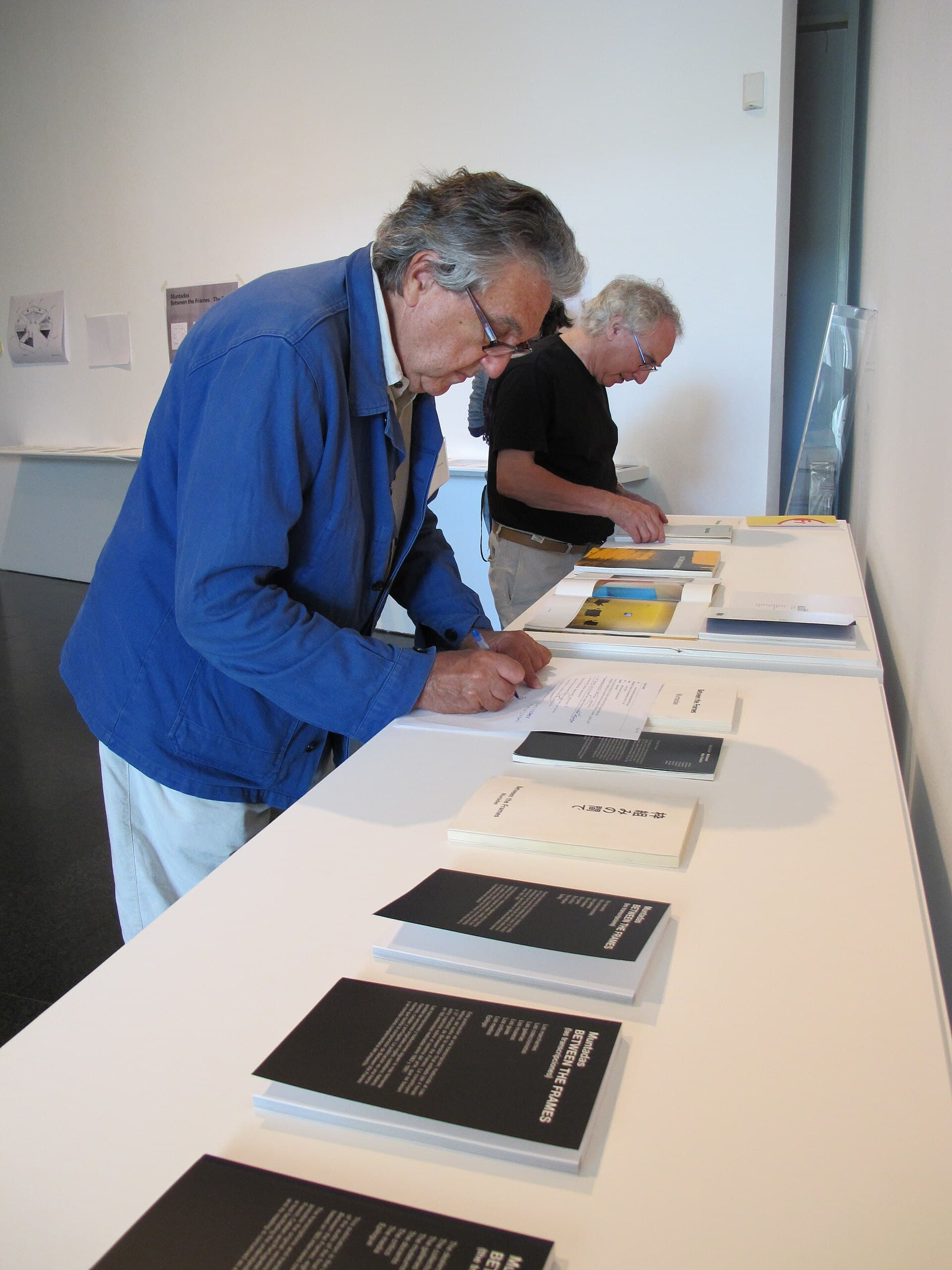
Artists: Antoni Muntadas · Year: 1971 · Medium: Media intervention — early works engaging broadcast television and telephone infrastructure as material · Substrate: Television broadcast capture, telephone-line interventions, early video equipment · Place: Barcelona / New York · Institution: Independent Antoni Muntadas's Between the Lines (1971) is a three-channel video installation (originally shown on open-reel tape) in which three monitors present synchronized footage of three sites of information-control: a television studio's control room during a news broadcast, a telephone switchboard room during a peak call hour, and a newspaper press hall during the morning print run. No narration. No editing. The three feeds run in parallel for approximately forty minutes, and the viewer stands in a darkened room watching them produce, in real time, the infrastructure of mass-media communication — the human gestures, the machine operations, the flow of information from the site of its production to the site of its delivery. Muntadas had been born in Barcelona in 1942 and had moved to New York in 1971, the same year he made Between the Lines. The work was his first American piece, made during his first year in New York, and it set the vocabulary he would pursue for the next five decades. Muntadas's subsequent major works — The File Room (1994, an online collaborative archive of historical censorship cases), On Translation (ongoing since 1995, a distributed series on translation as cultural practice), Asian Protocols (2011), Archive Museums (various) — all extend the 1971 premise: that the material infrastructure of information is an appropriate subject for sustained artistic attention, and that the artist's job is to make the infrastructure visible in its specific, physical, labored form. What Between the Lines argues is that mass media is, before it is ideology, a set of bodies in rooms operating equipment. The television anchor speaks because a control-room operator is cueing her. The telephone call completes because a switchboard operator is connecting it. The newspaper arrives because pressroom workers have run the print cycle. Muntadas's triangulation of these three sites into a single synchronized installation makes the invisible labor-infrastructure of the information economy the primary content of the work. Muntadas continues to work, has taught at MIT's Program in Art, Culture and Technology since the 1990s, and is represented by Galería Kewenig in Madrid and Kent Fine Art in New York. His archive is jointly held by the Museo Nacional Centro de Arte Reina Sofía in Madrid and the MIT List Visual Arts Center. Lore Muntadas shot Between the Lines using a borrowed Sony Portapak during his first months in New York, negotiating access to the three sites (a CBS TV studio in midtown, a Ma Bell switchboard office, and a Daily News print hall) through connections made during the long 1970 summer he had spent preparing the move from Barcelona. He spoke limited English at the time; the access was brokered largely by gestural negotiation and by a hand-typed letter of introduction that Muntadas carried in his pocket. The three shots were done on three consecutive days. The installation premiered at the Vanguard Gallery in Vancouver in late 1971 and was subsequently acquired by the Stedelijk Museum in Amsterdam. Muntadas has kept the original Portapak reels in his personal archive since 1971 and has supervised several restorations; the work is now also held in digital form at MIT. Sources • Muntadas, Antoni — Antoni Muntadas: On Translation (MACBA / Actar, 2002). • Museo Nacional Centro de Arte Reina Sofía — Muntadas archive. • MIT List Visual Arts Center — Muntadas collection files.
Source: daoracle.com
Part of Digital Art · Watch in the documentary
More from Digital Art
- Waldemar Cordeiro (organizer) — Arteônica — first Latin American computer-art ex
- Maurice Tuchman (curator-organizer) — Art and Technology Program — LACMA
- George Stiny — Shape Grammars and the Generative Specification of Painting and S
- Centers — Vito Acconci's mirror-like video
- Shigeko Kubota — video sculpture and Duchamp series
- Herbert W. Franke — Computergraphik – Computerkunst