RuneScape
Jagex's RuneScape, from the Gower brothers and the RuneScape 2 beta to the Falador Massacre, the 2007 removal of free trade and the Wilderness, Evolution of Combat, and the Old School revival that let players vote on their own game.
A chronological documentary of 194 moments spanning 2003–2026 on Loreline.
last updated 2026-08-09
- — RuneScape Classic player killing, 2003. Player killing in the original RuneScape Classic client, which the uploader says he recorded around 2003 and posted years later. Combat here predates the RuneScape 2 engine, with none of the interface or animation later players would recognise.
- — RuneScape Classic screenshots, 2001 to 2003. Screenshots from the RuneScape Classic years set to music, covering 2001 through 2003, before the RuneScape 2 engine replaced the original client. Very little visual material survives from the game's first years, which makes even a screenshot slideshow a useful record.
- — Sea Shanty Two. The Port Sarim theme from RuneScape's soundtrack, credited by the uploader to composer Ian Taylor and dated to 2004. The game's music carries more of its nostalgia than its graphics do, and this track became shorthand for the whole era.
- — Staking in RuneScape Classic, 2004. Duel Arena staking recorded in 2004 on the RuneScape Classic client and posted years later. The uploader notes the prices of the day, with dragon medium helmets at two million and party hats between roughly three and eight million coins.
- — RuneScape 2 beta footage from January 2004. Video of the RuneScape 2 beta recorded in January 2004 and recovered a decade later from the uploader's old computer. He believes it is the only surviving footage of the beta, which ran from December 2003 until the engine launched that March.
- — Arabian Two, the Al Kharid mine theme. Another Ian Taylor track dated by the uploader to 2004, played in the Al Kharid mine. Jagex's in-house music was written to loop quietly under hours of repetitive skilling, which is why returning players recognise it instantly.
- — Screenshots from late 2004. A short run of screenshots the uploader dates to November and December 2004, months after the RuneScape 2 engine replaced the original client. Captures pinned this precisely to a month are uncommon for the period.
- — Old School RuneScape soundtrack: Sea Shanty. Ian Taylor's Sea Shanty, the track that plays at Musa Point on Karamja and one of the pieces most associated with the free-to-play game. The uploader gives its in-game release date as 15 March 2004. The RuneScape soundtrack is a large part of what players mean when they talk about nostalgia for the game.
- — Clan fight: SoG against RF. Surviving footage of a clan battle in RuneScape 2, recorded during the era when organised clans fought scheduled wars in the Wilderness. Recordings of clan fights from this period are scarce, and much of the context has been lost.
- — A player's year in 2005. A narrated pass through screenshots the uploader took during 2005, the year he started playing. He stops on individual images to explain what was happening, turning a screenshot dump into a personal record of the mid-2000s game.
- — Early RuneScape Classic footage. A 2006 upload of play in the original RuneScape Classic client, from the years when Classic was still the live game for a large part of the player base. The title labels the footage 2001, but nothing in the video confirms when it was recorded.
- — Unseen footage of the Falador Massacre. Footage recorded during the Falador Massacre on 6 June 2006 and released ten years later by the player who captured it. A bug at a player-owned house party let players kill each other outside the Wilderness, and the killing ran for close to an hour before Jagex stepped in.
- — A player's year in 2006. The second part of the same narrated screenshot history, covering 2006. It documents an ordinary player settling in during the year of the Falador Massacre and the run-up to the December 2007 updates.
- — Riots over the removal of player killing. Footage of the mass protests that followed Jagex's removal of Wilderness player killing and free trade in December 2007. Players filled the streets to riot against a change made to strangle real-world trading, and the game's population never looked the same afterwards.
- — A player reacts to the trade limit. A period recording of a RuneScape player arguing that removing the Wilderness and limiting unbalanced trades saved the game from real-world traders, at the height of the community's anger over the changes. Jagex announced the trade and Wilderness changes on 10 December 2007 and enforced the trade limit on 2 January 2008.
- — Player killing footage from 2007. Clips drawn from the uploader's seventh through tenth player-killing videos, all recorded in 2007 and rebuilt at higher quality after the originals were taken down. It is Wilderness combat as it worked in the final months before the December 2007 changes.
- — Screenshots of RuneScape from 2003 to 2007. A player's screenshot compilation posted in May 2007, gathering images taken between 2003 and 2007. The uploader's note about buying items at Falador in world 2 records how trading worked before the Grand Exchange and before the trade limit.
- — Red paper party hat (public-domain clip art). A public-domain vector drawing of a red paper party hat, uploaded to Commons in November 2007. Its file description states it was inspired by, but not derived from, the famous item in a massively multiplayer online role-playing game. The red partyhat, dropped during RuneScape's 2001 Christmas event, became the game's most valuable rare item.
- — Map of RuneScape server locations, December 2007. A contributor-drawn world map plotting the physical locations of RuneScape's game servers as of December 2007. It shows the concentration of worlds in the United Kingdom, the United States, Canada, the Netherlands and Australia. The map is original Wikipedia work built from published server lists, not Jagex artwork.
- — Playing RuneScape on a home PC, 2008. A player at a cluttered bedroom desk running RuneScape in a browser window on a Samsung monitor in January 2008, wearing a Darth Vader helmet for the joke. The photograph captures the ordinary domestic setting in which RuneScape was actually played during its peak years. The uploader captioned it "Plotting my conquest on Runescape".
- — 140 Cambridge Science Park, an early Jagex office. Offices at 140 Cambridge Science Park, photographed in April 2008. The Geograph contributor's caption names the tenants as several software companies including Jagex and Datanomic. This is the building Jagex occupied during RuneScape's peak-subscriber years in the late 2000s.
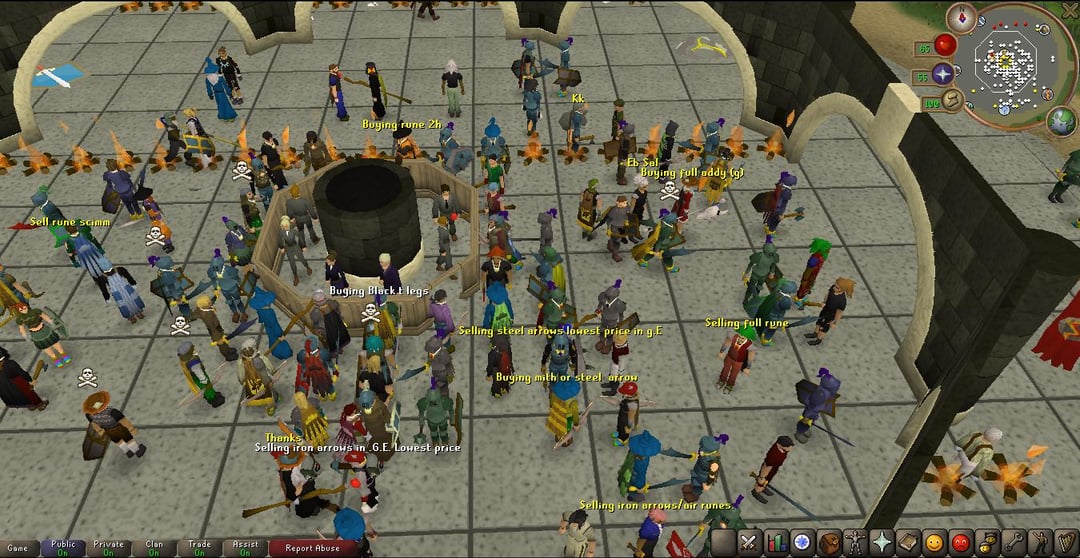
- — Billion-coin drop party in world eighteen. A player films a Falador drop party that the uploader bills as a 1.9 billion coin giveaway, on a world so crowded the recording stutters. The size of the crowd shows how a single announced drop party could pull an entire world's population to one bank.
- — Gold farmers before the Wilderness closed. A player from the RuneVillage community documents gold farming operations occupying training and resource spots across the game, and the organised effort to push back against them. Farming on this scale is the pressure that led Jagex to remove free trade and Wilderness combat in December 2007.
- — Falador drop party, January 2008. A mass drop party outside the Falador bank on 20 January 2008, filmed by an attending player. Drop parties were the community's own economic theatre: wealthy players dumped items on a crowded world and everyone else scrambled for them.
- — Rioting in world two after the trade update. Player-recorded footage of the riot in world 2 on 2 January 2008, weeks after Jagex removed free trade and Wilderness player killing. The uploader blames the new trade system for players losing items, and the protests that followed the December 2007 updates carried on into the new year.
- — Andrew Gower interviewed on radio. A player's recording of RuneScape creator Andrew Gower speaking on live radio in 2008. Public appearances by the game's lead developer were uncommon, and captures like this are how much of that material survives at all.
- — Quitting RuneScape after the 2007 updates. A player's farewell video, pairing screenshots from 2004 and 2005 with a caption declaring the old RuneScape dead after 2007. The framing captures the wave of players who left following the removal of free trade and Wilderness player killing.
- — One player's history, 2001 to 2008. A long screenshot and clip history covering one player's time in the game from 2001 to 2008. The uploader signs off by linking a campaign to bring the old game back, which places the video squarely in the years when that demand was building.
- — How RuneScape began. A player-made account of the game's origins, assembled in 2008 from screenshots and narration. It is a record of what the community itself understood about RuneScape's beginnings long before Jagex published its own histories.
- — Andrew Gower playing his own game. A short clip of RuneScape's creator playing RuneScape. Footage of the lead developer inside the world he wrote is rare, whatever the setting.
- — Zezima, RuneScape's best known player. A community-made biography of Zezima, the player who held the top of the high scores and became the game's first celebrity. The video repeats claims about his records that belong to community lore rather than verified fact.
- — RuneScape trailer, 2009. An official Jagex trailer touring locations, activities and combat, scored with 'Temple Desecrated' from the While Guthix Sleeps quest. It shows how Jagex was selling the game in the years between RuneScape 2 and RuneScape 3.
- — Interview with Andrew Gower. A player-run interview with Andrew Gower, described in the video as lead designer and head of RuneScape at Jagex. Long-form conversations with the game's creator from this period are unusual.
- — RuneScape server locations, vector map. A public-domain vector map marking the countries hosting RuneScape game servers, drawn in June 2009. The highlighted territories are the United Kingdom, the United States, Canada, the Netherlands, Australia, Finland, Sweden and Mexico. It documents how Jagex distributed its worlds as the player base globalised.
- — Corporeal Beast soloed without food. Woox kills the Corporeal Beast alone using no food and no brews, in a fight he times at about two minutes and fifty seconds. It sits early in a line of self-imposed restriction kills that came to define high-end RuneScape play.
- — DeviousMUD shown at RuneFest. Andrew Gower demonstrates DeviousMUD, the game he built before RuneScape, at the first RuneFest in London on 28 August 2010. DeviousMUD has been shown in public only a handful of times, so any footage of it is a significant record.
- — Memories of RuneScape, 2006 to 2010. A player clears out four years of saved screenshots and clips before deleting the originals, covering 2006 to 2010. Compilations like this were how the community archived itself, and the uploader invites anyone who spots themselves to comment.
- — Jad killed without items. Woox fights TzTok-Jad with no armour, no items, no stat boosts and a single prayer point, in a fight he times at thirteen minutes and twenty-two seconds. Jad's attacks demand instant prayer switching, so stripping away every safety net leaves nothing but reaction.
- — Bot Nuking Day explained. A commentary walkthrough of Bot Nuking Day and the Bonus Week that came with it, recorded the day the update landed. It also covers the new reporting option and the clan citadel changes announced alongside.
- — Waiting for the bot nuke. Footage of players gathered waiting for Bot Nuking Day to go live, the riot that broke out when the update ran late, and the countdown when it finally arrived. It records a community treating an anti-cheating patch as a public event.
- — Before and after the bot nuke. A side-by-side of bot-infested locations before and after 25 October 2011, when Jagex deployed the anti-bot project it code-named ClusterFlutterer. The comparison shows how much of the game's visible population had been automated.
- — Trailer for a 2006 RuneScape recreation. A trailer for a private server rebuilding RuneScape as it stood in 2006, made a year before Jagex opened Old School RuneScape. The demand these unofficial projects exposed is the backdrop to the 2013 vote that brought the old game back officially.
- — Riots against the Evolution of Combat. Players gather to protest the Evolution of Combat, the combat rewrite the video dates to 20 November 2012. The scenes echo the 2007 riots almost exactly, and as in 2007 the update went ahead and split the player base.
- — Reaction to the Squeal of Fortune. A player opens twenty Squeal of Fortune spins and argues that Jagex's paid-spin system amounts to the company selling advantage itself. The Squeal of Fortune opened the microtransaction argument that has followed RuneScape ever since.
- — The first Old School content poll. A call to vote in the first Old School RuneScape content poll, in March 2013. The poll system is what makes Old School unusual: nothing enters the game unless players approve it by a large majority.
- — Commentary on an Old School poll. A long-form breakdown of the seventh Old School RuneScape poll, covering minor conveniences and contested changes to what players keep on death. It shows the poll system working as continuous community argument rather than a single vote.
- — A lure in the Wilderness. An episode of a series documenting scams, following a lure at Annakarl in which a player is talked into the Wilderness and killed for everything he carries. The headline value in the title is the uploader's claim and is not verified.
- — Old School servers announced. The announcement that 2007-era servers would open on 22 February 2013, with a link to the poll that decided it. Jagex restored the game from an old backup rather than rebuilding it, and let paying players vote it into existence.
- — The campaign to bring back 2007 RuneScape. A player reports back on the push to reach the vote threshold Jagex had set for reopening 2007-era servers, after speaking to Jagex's chief executive. The excitement here is the immediate run-up to Old School RuneScape opening later the same month.
- — Live commentary player killing in Old School. Whip player killing in Old School RuneScape with live commentary, recorded in the first weeks after the 2007 servers opened. The uploader is building both the account and the streaming habit that would make him one of the game's most-watched players.
- — Battle of Lumbridge on launch day. A player records the RuneScape 3 opening and the Battle of Lumbridge on 22 July 2013, the day it launched. The battle was a world event whose outcome was meant to be decided by what players did in it.
- — Behind the scenes on the Sixth Age. Mod Mark and Mod Osborne explain what the Sixth Age means for RuneScape's story, in a behind-the-scenes video released ahead of RuneScape 3. The launch was framed as a turning point in the world's lore, not only a change of engine.
- — RuneScape 3 release date revealed. Jagex reveals the launch date for RuneScape 3, calling it the biggest upgrade in the game's twelve-year history. RuneScape 3 brought a new client, a rebuilt interface and the Sixth Age storyline.
- — RuneScape 3 announced. Jagex's short teaser for RuneScape 3, posted in May 2013. It sells the coming version as a browser game with hundreds of quests and dozens of skills, two months before launch.
- — RuneScape 3 launch trailer. The official launch trailer for RuneScape 3, released in July 2013. It is Jagex's own statement of what the third major version of the game was meant to be.
- — Screenshots from the RuneScape 2 beta. Screenshots taken during the RuneScape 2 beta, which opened to paying members on 1 December 2003 and ran until the new engine went live on 29 March 2004. They show the three-dimensional client being tested before it became the game the community played for the next decade.
- — Story time with the RuneScape team. A 2015 livestream in which some of Jagex's longest-serving staff, joined by Ian Gower, sit down and reminisce about the game's early years. Long-form recollection from the people who built and maintained RuneScape is rare, and this session runs over an hour.
- — Starting an Old School ironman account. The first episode of a long-running ironman series in Old School RuneScape, where the account may not trade with or take help from other players. The self-imposed restriction turned ordinary progress into a format people would watch for years.
- — An argument against RuneScape 3 microtransactions. A long, detailed rant arguing that RuneScape 3's microtransactions and purchasable experience had made it pay-to-win. It is a full statement of the case the RuneScape 3 community was making against Jagex's monetisation in 2016.
- — World 666 anniversary event. Player footage of the world 666 event on 6 June 2016, ten years to the day after the Falador Massacre. Jagex opened a dedicated world so players could re-stage the massacre on purpose, turning an old exploit into a scheduled celebration.
- — RuneFest highlights, 2016. Jagex's own highlights from RuneFest, held at Battersea in London on 17 September 2016. The convention is where the studio's staff and its players meet in person, with stage talks, announcements and cosplay.
- — Deadman final streamed from TwitchCon. The full final hour of the third Deadman Invitational, streamed live from TwitchCon in San Diego on 1 October 2016 for a ten thousand dollar prize. Putting an Old School RuneScape tournament on a convention stage marked the game's arrival as spectator content.
- — First Deadman Invitational final. The full final stream of the first Deadman Invitational, a ten thousand dollar Old School RuneScape tournament that reached its climax on 26 March 2016 and was won by the player YaNeverLearn. Deadman Mode removes the usual protections, so the closing hour comes down to who can survive a shrinking safe zone.
- — The Gower brothers on how RuneScape began. Andrew, Ian and Paul Gower answer questions about creating RuneScape in a Jagex livestream. All three brothers appearing together to talk about the game's origins is unusual, and the session runs close to an hour.
- — The history of the Falador Massacre. A documentary account of the Falador Massacre, covering the bug at Cursed You's house party, the players involved including Durial321, and the rumours that grew up around the event. The uploader works through which parts of the community's version hold up.
- — Looking back at RuneScape Classic. A long personal feature on RuneScape Classic and what playing it as a young gamer in 2001 meant to the uploader. It was made while the Classic servers were still running, before Jagex finally closed them.
- — The RuneScape Documentary. Jagex's own feature-length documentary, released for the game's fifteenth year, tracing RuneScape from the Gower brothers' bedroom projects through Jagex's growth into one of the largest western MMOs. It combines developer interviews with archive material about the company's founding and early years. It remains the most substantial official account of the game's origins.
- — First look at RuneScape on mobile. Jagex's first public presentation of RuneScape running on phones, with developers answering player questions about the port and outlining the development plan. Mobile had been announced as a major strategic bet for the game, and this stream is the first extended look at it. It sets up a rollout that would take another year to reach players.
- — Playing RuneScape Classic for the first time. A player who never touched the 2001 game logs into RuneScape Classic and works through its interface, combat and early quests without prior knowledge. The footage captures how alien the original client feels to someone raised on later versions. It was recorded while the Classic servers were still open to legacy accounts.
- — Zezima, RuneScape's most famous player. The opening episode of a series on RuneScape's legendary players, covering Zezima's run at the top of the high scores and how a single account became the game's best known name. It gathers the community record of his achievements and the fame that followed. Zezima remains the standard reference point for early RuneScape celebrity.
- — What made RuneScape so compelling. A video essay arguing why RuneScape held such a grip on the players who grew up with it, looking at its skill design, its openness and the way it introduced a generation to the MMO genre. It treats the 2007-era game as a design object rather than a nostalgia object. It is one of the essays that pushed RuneScape into wider gaming discussion.
- — DeviousMUD, the game before RuneScape. An account of DeviousMUD, the text-and-tile game Andrew Gower built before RuneScape Classic, which had a handful of items and a tiny group of players. It sets out what the prototype was and how it led into the game released in 2001. It is the clearest short explainer of RuneScape's true starting point.
- — Why Jagex shut down RuneScape Classic. A look behind the official closure statement, examining the technical and moderation problems on the RuneScape Classic servers and asking whether players were told the whole story. It gathers what was known about the state of the game in its final months. Classic's shutdown was one of the few times Jagex has permanently removed a version of the game.
- — Theatre of Blood launch day. Stream footage from the day the Theatre of Blood, Old School RuneScape's second raid, opened on 7 June 2018, featuring several of the game's best known players attempting the new content cold. Nobody had a solved strategy yet, so the footage shows the raid being worked out live. Theatre of Blood became a defining piece of Old School endgame content.
- — Old School mobile open beta gameplay. Gameplay from the Old School RuneScape mobile open beta, which the uploader dates to 4 July 2018, showing the client on Android before the full launch. It covers what worked well on a phone, such as farming and alchemy, and what still needed polish. The open beta was the first time a general audience could play the port.
- — Fighting Jad on the mobile beta. A player takes a Fight Caves task into the Old School mobile beta and attempts the Jad fight entirely on a touchscreen. It is a real test of whether the game's hardest timing-based content survives the port. The attempt doubles as an early record of how the beta client handled under pressure.
- — Old School recap: mobile soft launch. Jagex's regular Old School RuneScape news recap covering the return of the My Arm questline and the soft launch of Old School mobile in selected regions. The soft launch was the last testing step before the worldwide release. Recaps like this are the official record of what shipped week to week.
- — The RuneScape Classic funeral. A player gathering held in the last hours before the RuneScape Classic servers were switched off on 6 August 2018, recorded live as a funeral for the original game. Players collected in-world to mark the end rather than to play. It is the clearest community record of how the shutdown was felt.
- — RuneFest 2018 theme revealed. Jagex announce that their annual player convention will return in October with a Fremennik theme built around the coastal viking lands of Rellekka. RuneFest was the main point in the year where the community and the developers met in person. The reveal doubles as a trailer for the convention's content showcases and awards.
- — Streamers react to Old School mobile. A compilation of Twitch clips of Old School RuneScape streamers getting their hands on an early mobile build of the game. The reactions capture how much the prospect of playing on a phone mattered to the Old School audience. Mobile was still months away from a public launch at this point.
- — Botting blue dragons in RuneScape Classic. Short raw footage of an automated script killing blue dragons in RuneScape Classic, recorded in the final weeks before the Classic servers closed. Automation had run largely unchecked on those legacy servers for years and was part of the case for shutting them down. It is a plain document of what botting actually looked like in the original client.
- — Old School mobile on a budget phone. A test of whether the Old School RuneScape mobile client is usable on cheap hardware, played on a sixty dollar Android phone. Because the beta was Android-only at first, the question of minimum hardware mattered to a large part of the player base. The result speaks to how deliberately lightweight the game had stayed.
- — Old School RuneScape mobile launch day. Gameplay recorded on 30 October 2018, the day Old School RuneScape launched on iOS and Android with full cross-platform play and no membership requirement. It shows the finished client in players' hands after more than a year of public development. The mobile release brought a large wave of returning players to the game.
- — Backlash against the RunePass. A player's protest video made a day after Jagex launched RunePass, a paid reward track shipped as the main content update for the week. The creator argues that a subscription game should not be layering free-to-play monetisation on top, and says he cancelled his memberships over it. RunePass became one of the sharper flashpoints in RuneScape 3's long microtransaction argument.
- — RuneScape mobile development showcase. A Jagex development update on RuneScape mobile, walking through what the team had built since the previous showcase and demonstrating it live. It shows the port maturing from a technical demo into something close to shippable. Mobile was the largest engineering project the studio had taken on for the main game.
- — Bossing on Old School mobile. A player takes boss fights into the Old School RuneScape mobile client to see how much of the game's high-end content is actually playable with touch controls. It tests the port well past the skilling and questing most early footage showed. The results fed directly into what players expected from the mobile launch.
- — RuneScape mobile content showcase. Jagex mods give a long tour of the current RuneScape mobile build, taking it through a Telos kill, deep sea fishing, a clue scroll and thieving training, and previewing interface work still in progress. It shows the full desktop game being squeezed onto a phone in real time, bugs included. It is the most detailed developer look at RuneScape 3 mobile from this stage.
- — First impressions of the Old School mobile app. A long-time Old School player's first session with the mobile app after Jagex opened it to Android users, reacting to seeing a game he had played for over a decade running on a phone. It captures the specific appeal of mobile to lapsed and busy players. That audience was central to Jagex's case for building the port at all.
- — RuneScape's year ahead for 2018. Jagex's new-year roadmap video setting out what RuneScape 3 players could expect over the coming twelve months, including the Solak group boss, the Pieces of Hate quest, a clue scroll overhaul and a bank rework. It is a primary record of the studio's stated plans at the start of the year. Roadmap videos like this are the clearest snapshot of Jagex's priorities in any given year.
- — Old School RuneScape mobile beta gameplay. Short raw footage of the Old School RuneScape mobile beta running on a phone, showing the touch interface and how the desktop client was adapted to a small screen. It is an early record of the build before wider testing opened. The game would not reach a full mobile launch until later that year.
- — RuneScape Classic: the end. A community response to the announcement that RuneScape Classic would shut down on 6 August 2018, ending seventeen years of the original client running. It walks through what the closure means for the small population still playing there. Classic had been closed to new registrations for years by this point.
- — A farewell to RuneScape Classic. Made on the day Jagex announced that the RuneScape Classic servers would close, this is one player's goodbye, built from screenshots taken in Classic between 2017 and 2018. Jagex set the shutdown date for 6 August 2018. It records what the last inhabited months of the original game looked like.
- — RuneFest 2018 winter reveals. The main content announcement session from RuneFest 2018, revealing the Halloween event Til Death Do Us Part, the Needle Skips quest, Alchemical Onyx items, Elite Dungeon 3 and further mobile progress. Reveal sessions at RuneFest set the agenda for the following months of updates. It is the official record of what Jagex committed to on stage.
- — The final hour of RuneScape Classic. An hour of raw footage from the last hours of RuneScape Classic on 6 August 2018, timestamped down through the final countdown, the servers bugging out and the system update that ended seventeen years of the original game. It is a continuous record rather than an edited tribute. Nothing else captures the shutdown at this length.
- — Old School RuneScape soundtrack: The Dragon Slayer. The music track composed by Ian Taylor that plays during the fight against Galvek in Dragon Slayer II. The uploader gives the track's in-game release date as 4 January 2018, the day the quest launched. RuneScape's soundtrack is one of the parts of the game players remember most vividly.
- — The last moments of RuneScape Classic. A short recording made as the RuneScape Classic servers were switched off on 6 August 2018, showing the strange state of the world in its final seconds. Classic had run for over seventeen years.
- — Press coverage of the RuneScape Classic shutdown. A short news report on Jagex ending the legacy servers for the original 2001 version of RuneScape after seventeen years. It is one of the few mainstream gaming-press items about the closure. Coverage like this marks the point where a niche community event registered outside the game.
- — One last ride on RuneScape Classic. A player records a final session on the account he had been playing on RuneScape Classic, made after Jagex announced the servers would close. Classic ran continuously from 2001 until it was shut down on 6 August 2018.
- — A historical timeline of RuneScape. A chronological run through RuneScape's development from the late 1990s to the mid 2010s, stringing together the updates, versions and controversies year by year. It is a compact overview of how much the game changed across its first fifteen years. Timeline compilations like this are how much of the community learned the game's history.
- — Interview with a RuneScape gold seller. A long interview with a real-world trader who says he earns around two thousand dollars a week selling RuneScape gold for both Old School and RuneScape 3, and who describes working with major gold selling sites before running his own. He explains how the supply chain, pricing and customer side of the business actually work. Real-world trading is the economic force behind most of the game's biggest rule changes.
- — What playing RuneScape in 2004 was like. A modern player revisits the state of the game as it stood in 2004, showing what the interface, content and pace felt like before a decade of updates. It draws out how much has changed while the underlying game stayed recognisable. It is part of a small genre of videos that reconstruct specific years of RuneScape.
- — RuneScape Classic timeline, 1998 to 2002. A year-by-year account of the updates that shaped RuneScape Classic across its first years, from the pre-release period through the game's early growth. The creator notes it deliberately stops short of Classic's full run. It is one of the more detailed community chronicles of the original version.
- — Anti-scamming the Duel Arena. A player spends ten hours turning the Duel Arena's rule-trap scams back on the scammers running them, keeping what he takes. The Duel Arena's staking scene was the single richest hunting ground for confidence tricks in the game. The footage documents the specific mechanics the scams relied on.
- — Grinding for a Deadman Mode tournament. A competitor works through the quest and magic requirements needed to be viable in a Deadman Mode tournament, which the creator says carried a thirty-two thousand dollar prize. Deadman Mode put permanent death and full loot on a seasonal competitive footing. The preparation grind shows how much structure grew around the mode.
- — Jagex monetisation question and answer stream. A long developer stream in which Jagex staff take player questions directly on the future of monetisation in RuneScape, including whether RuneScape 3 microtransactions fund Old School and where the line sits between cosmetics and promotions. It came in the weeks after the game's monetisation had drawn heavy public criticism. It is the fullest official statement of the studio's position from this period.
- — The Gower brothers on RuneScape's origins. Jagex mark the game's eighteenth birthday with a question and answer session featuring the Gower brothers, going back over how RuneScape started and how the company grew around it. Direct appearances by the founders are rare. It is a primary source on the origin story that most retellings depend on.
- — Reviewing RuneScape 3 on mobile. An assessment of the RuneScape 3 mobile client after extended play, weighing whether the port is good enough to pull lapsed players back. RuneScape 3's mobile version trailed the Old School one by a long way and had a harder job with its denser interface. The review is a snapshot of how the port landed with players.
- — The sixty-two thousand dollar spending story. Coverage of a Kotaku report that a single addicted player spent tens of thousands of dollars on RuneScape's paid reward mechanics, and of the community anger it reignited about the game's loot-box style monetisation. It places the story in the wider argument about predatory spending in games. The reaction pushed Jagex into a public defence of its monetisation.
- — Modelling a Grand Exchange tax. An analysis of how much gold a two or three percent Grand Exchange tax would actually pull out of the Old School economy, worked through after Jagex mods raised the idea in a question and answer session. Gold sinks are the central lever in managing the game's inflation. The video is a record of the community argument well before any tax was implemented.
- — How a lure took hundreds of billions in gold. An investigation into a large-scale scam, with the video putting the total taken at two hundred and sixty billion coins, told partly through the stream footage of one of the players who lost out. It sets out how the lure was built and why victims went along with it. Lures of this size are among the most consequential events in the game's economy.
- — Replaying 2005-era RuneScape. A slow, deliberately unhurried run through early free-to-play content in the style of the 2005 game, made as the opening episode of a nostalgia series. It leans into how long the early game takes rather than skipping past it. Series like this are how a lot of players re-experience eras that no longer exist on live servers.
- — Crashing a private drop party. A player gets a tip-off about a private drop party at the Falador party room and turns up uninvited to grab what he can. Private drop parties are organised in closed chats precisely to keep strangers out. The video shows both the ritual and the freeloading culture that grew around it.
- — A drop party in Falador. Short footage of a player emptying a bank into the Falador party room while a crowd scrambles for the loot. Drop parties are one of the oldest community rituals in RuneScape and turn a single player's wealth into a public event. The chaos of the pile-up is the whole point.
- — Leagues Trailblazer announcement track. Jagex's promotional music video for Leagues II Trailblazer, performed by community rappers J1mmy and 9Rain, laying out the mode where players start in Misthalin and spend league points to unlock regions across Gielinor. Trailblazer ran from 28 October 2020 to 6 January 2021. Leagues became one of Old School's most popular recurring events.
- — Chasing the dragon trophy in Trailblazer. The first episode of a run at the top reward tier in Leagues II Trailblazer, recorded while the league was live, working out region choices and task routing from scratch. Leagues compress a normal account's progression into a few weeks and reward players who plan well. The episode shows the mode being figured out in real time rather than optimised after the fact.
- — Venezuela and the RuneScape gold trade. A look at how the economic collapse in Venezuela drove players there to farm RuneScape gold for real income, and what that meant inside the game for the people farming and the people playing around them. It links the game's economy to conditions well outside it. It is one of the most serious treatments of gold farming the community has produced.
- — RuneScape's full historical timeline. A two and a half hour chronological history of RuneScape running from the late 1990s through 2020, chaptered year by year across every era of the game. It gathers the updates, versions and community events into one continuous account. It is among the most complete community-made histories of the game.
- — Revisiting the RuneScape 2 era. A long commentated episode from a running series in which the creator plays through Old School content while talking about what the RuneScape 2 years meant to British players who grew up with it. The commentary carries the value more than the gameplay does. It is a record of the game's place in a specific generation's memory.
- — The day the Grand Exchange tax arrived. Same-day coverage of the introduction of the Grand Exchange tax in Old School RuneScape, one of the largest changes ever made to the game's central marketplace. The update takes a cut of sales as a gold sink and also removes items from circulation.
- — RuneScape turns twenty. Coverage of the start of RuneScape's twentieth anniversary celebration on 4 January 2021, with the month-long event centred on the Lumbridge Crater. It walks through what Jagex put in the world to mark two decades of the game running. Few online games reach that anniversary still being actively developed.
- — A twentieth anniversary cake recipe. Jagex mark twenty years of RuneScape with real-world recipes presented in character by the Cook's Assistant, one of the first quests almost every player ever completed. It is a piece of official fan service that ties the anniversary back to the game's oldest running joke. The Cook's Assistant has been the game's introduction to questing since 2001.
- — Losing a life in Hardcore Group Ironman. The rank one Hardcore Group Ironman team loses another of its shared lives, the moment the mode is built around. Hardcore groups forfeit a life on each death, so the run turns into a slow attrition that plays out in public on the hiscores.
- — RuneScape leads on the year ahead. The game's leads take player questions and give the first details of the major updates planned for RuneScape in 2021, covering quests, events and longer-term projects. Question and answer streams like this are where Jagex commits publicly to a year of work. It is a primary record of the studio's plans at the point they were made.
- — Racing for rank one in Hardcore Group Ironman. Devious and his team play through the opening days of Hardcore Group Ironman, one day after the mode launched. The footage captures the launch rush itself, with thousands of teams starting from nothing at the same moment and competing for the top of the new hiscores.
- — Group Ironman launch trailer. Jagex's launch trailer for Group Ironman, the co-operative version of the Ironman account mode, released on 6 October 2021. It sets out the pitch that made the mode an instant hit: a small team sharing one self-sufficient account restriction and a shared bank.
- — The history of luring in RuneScape. A survey of luring, the practice of tricking players into losing their items, traced from RuneScape Classic through to Old School and the specific tricks used in each era. It explains how the scams worked and why the game's rules kept having to change around them. Luring shaped both player behaviour and Jagex's design decisions for decades.
- — Staking addiction at the Duel Arena. A look at players who became genuinely addicted to staking at the Duel Arena, built around one player the video says lost sixty thousand dollars' worth of value there. It treats the Duel Arena as a gambling machine rather than a game feature. Jagex would later remove staking from the Duel Arena entirely.
- — An argument for legalising gold farming. A proposal that Old School should deliberately create places where raw gold can be farmed, on the grounds that it would undercut the illicit farms crashing item prices. The creator sets it against community discussion of falling item values. It is an example of players arguing economic policy for the game in public.
- — Why RuneScape is not really an MMO. A three and a half hour video essay arguing that RuneScape's structure, quest design and self-directed progression make it a fundamentally different kind of game from its MMO contemporaries. It works through class and dependency structures in detail rather than trading on nostalgia. It is one of the most ambitious critical pieces written about the game.
- — Player killing in early RuneScape Classic. A survey of what player killing was actually like in the earliest years of RuneScape Classic, from the period before the Wilderness existed through the era when the rune two-handed sword dominated melee fights. It collects details about the early combat meta that are otherwise scattered across old forum posts. The Wilderness grew out of exactly this period.
- — Criticism of the Old School polling system. An examination of why the Old School RuneScape polling system, the mechanism that lets players vote on what gets added to the game, draws so much frustration despite being the mode's founding promise. It covers the vote thresholds and what they do to update design. The poll system is the single feature that most defines how Old School is run.
- — Barrows and the best update of 2005. An argument that Barrows, released on 9 May 2005, was the most important RuneScape update of that year, introducing a repeatable challenge that dropped best-in-slot equipment for the effort. It looks at the release and at how the minigame changed what players chased. Barrows is still running in Old School two decades later.
- — The removal of free trade. An argument that stripping out unbalanced trading, staking and player-killing drops, done to fight real-world trading, was the worst decision Jagex ever made. The changes gutted the Wilderness and the player economy and drove a large part of the community away. The eventual reversal and the creation of Old School both trace back to this decision.
- — The last days of the Duel Arena. An essay published days after Jagex announced it would phase out staking at the Duel Arena, long the game's de facto casino and a magnet for scammers and real-world traders. Jagex capped stakes that November and removed the Duel Arena entirely in July 2022, replacing it with Emir's Arena.
- — Looking back at Old School's most criticised polls. Old School RuneScape puts most of its content to a player vote, and this video revisits the polls the community came to regret. It is a useful window on how the poll system shapes what the game is allowed to become.
- — Interview with a RuneScape gold seller. A long interview with the owner of a website that sells RuneScape gold for real money, recorded while Jagex was cracking down on real-world trading. He describes the business side of an industry the game has fought since its first years, and claims earnings of over a million dollars a year.
- — Unlocking RuneScape's locked-away past. A report on the recovery of old RuneScape content that had been inaccessible to players for over a decade. Jagex kept no full backups of the game's early years, so preservation of the old client caches has depended largely on the community.
- — How RuneScape gold farming works. An explainer on the gold farming economy that grew up around RuneScape and other online games, from the mechanics of the farms to the people who run them. It places the game inside a wider real-money trading industry that also touches other MMOs.
- — The lost RuneScape 2 beta. The 2003 beta of RuneScape 2 is one of the least documented periods in the game's history, seen by only a fraction of players and never archived by Jagex. This video covers the effort to find and run surviving material from it.
- — Cambridge Computer Lab Ring Hall of Fame board: Jagex, Company of the Year 2007. The Cambridge Computer Lab Ring Hall of Fame board, which celebrates companies founded by University of Cambridge Computer Laboratory graduates and staff. Jagex is listed as Company of the Year for 2007, between Codian (2006) and XenSource (2008). The board places RuneScape's developer in the same lineage as Raspberry Pi, DeepMind and SwiftKey.
- — RuneScape's player-run police. Players have repeatedly organised their own justice systems to do what Jagex could not, from scam blacklists to volunteer patrols. This video traces the origins of those groups and the trouble they caused.
- — The Falador Massacre. A feature-length documentary on the events of 6 June 2006, when a bug at a player's house party in Falador let a small group kill other players in a non-combat area. The video reconstructs the day from surviving footage and player accounts.
- — Glitches and scrapped features of early RuneScape. A tour through the oddities of RuneScape's earliest builds: broken mechanics, abandoned features and interface ideas that never made it into the finished game. It shows how different the game was before its conventions settled.
- — Remembering RuneScape, 2002 to 2006. A player walks through his oldest memories of RuneScape, from the first hours in Lumbridge to the habits and hangouts of the mid-2000s game. It is a personal account of what playing felt like before guides and efficiency took over.
- — Zezima, the most famous player in RuneScape. A profile of Zezima, who held the top spot on the RuneScape hiscores for much of the mid-2000s and became the game's first genuine celebrity. His name spread far beyond the players who ever saw him in game.
- — The monster models of early RuneScape. A showcase of monster models from RuneScape Classic and the early years of RuneScape 2, before successive graphical reworks replaced them. Several of the models shown are barely documented anywhere else.
- — Starting again in RuneScape Classic. A long, unedited session of RuneScape Classic played from the beginning, showing the original tile-based combat, the flat interface and the pace of the 2001 game. Classic's servers closed in 2018, so recordings like this are how the early game is still seen.
- — Three new skills go up for discussion. Jagex published pitches for three possible new Old School skills, the first serious attempt to add one since the game launched. This video works through what each pitch proposed and why adding a skill is such a difficult vote to win.
- — A timeline of Old School RuneScape, 2013 to 2023. A decade of Old School RuneScape laid out in order, from the 2013 revival of a 2007 backup through the poll system, raids, Leagues and Group Ironman. A useful spine for how the game grew from a nostalgia server into the larger version of RuneScape.
- — The trade window scams of old RuneScape. Before trade limits and the Grand Exchange, RuneScape's open trade window was fertile ground for confidence tricks. This video collects the classic scams that worked on the crowded early worlds and explains the sleight of hand behind them.
- — The Hunter Guild explained. Jagex's explainer for the Hunter Guild in the Avium Savannah, part of the Varlamore expansion. It walks through the new creatures and the guild's role as a base for hunting in the region.
- — The Sailing lock-in poll goes live. Jagex calls players to vote in the final lock-in poll on whether Sailing should be added to Old School RuneScape. Skill polls require a supermajority, which is why previous attempts to add a skill had failed.
- — League launch day at the top of the hiscores. Launch-day footage from Trailblazer Reloaded, recorded while the league's servers were at their busiest. It captures the opening hours of a league, when thousands of players sprint through content that would normally take months.
- — Sailing passes the poll. A short reaction recorded as the result came in: Sailing had passed and would become Old School RuneScape's first new skill. It marks the end of a decade of failed attempts to add one.
- — Trailblazer Reloaded launch trailer. Jagex's launch trailer for the Trailblazer Reloaded league, the temporary game mode that drops players into a modified Gielinor with region-based unlocks and huge experience rates. Leagues have become one of Old School's biggest recurring events.
- — What is Sailing?. Jagex's own explainer on Sailing, developed openly with the community as a candidate for Old School's first new skill. The video closes a longer series that had shown the design evolving in public.
- — Every rank one player, 2001 to 2023. The complete succession of players who have held the number one overall rank on the RuneScape hiscores, compiled from years of research. It doubles as a history of what it took to be the best in each era of the game.
- — The politics of the Sailing poll. A look at how the Sailing vote split the Old School community, with one side arguing it was the last chance to revive skilling and the other threatening to leave if it passed. It is as much about the poll threshold itself as about the skill.
- — The disappearance of a notorious account hacker. A profile of Failfishes, who stole and sold RuneScape gold for years while running a following on YouTube, and then vanished from the game. The video follows the trail of a scene where hacking and gold selling fed each other.
- — RuneScape's lawless first year. In its first year RuneScape had almost no protections: player killing was everywhere, clans controlled whole cities and playing alone was genuinely risky. This video reconstructs that period and the rules Jagex introduced in response.
- — Mod Ash, Old School's longest-serving developer. A profile of Mod Ash, the Jagex developer most closely identified with Old School RuneScape and unusually visible to its players. The video covers his long tenure and the times he pushed against the studio's own decisions.
- — The Old Nite. A profile of The Old Nite, one of RuneScape's best known early players, who died in 2006. The video covers his play, his standing in the community and the rumours that have circulated about him since.
- — Two hours of Old School RuneScape music. A long compilation of RuneScape's soundtrack, the short looping themes that play area by area and that most players know better than they realise. The music is one of the strongest carriers of the game's atmosphere.
- — Andrew Gower's next game. News coverage of RuneScape co-creator Andrew Gower working on a new game, long after leaving Jagex. It is a rare update on the person who built the original game with his brothers.
- — Turning the tables on a scamming ring. A player goes after an organised group that had been scamming others, documenting how the group operated and how he worked against it. It shows the informal enforcement culture that fills the gap left by official moderation.
- — An anti-lure in a player-killing world. A short clip of a lure being turned back on the lurer in a player-versus-player world, with the target baited by a player pretending to mine. Luring is one of the oldest predatory tactics in RuneScape, and the counter to it is a genre of its own.
- — Bluerose13x and RuneScape's first cartel. For much of RuneScape's first year one player, Bluerose13x, controlled the supply of the game's best equipment. The video traces how that grip was built and how it fell apart.
- — The Evolution of Combat. A documentary on the 2012 combat rework that replaced RuneScape's click-and-wait fighting with an ability system, and the revolt that followed. The backlash was severe enough that Jagex eventually brought back the older game as Old School RuneScape.
- — The first Deadman Mode tournament. Old School's first Deadman Mode tournament, with a real cash prize, ended in a mess of technical problems and accusations against the winner. The video reconstructs what happened and how Jagex handled it.
- — The richest player of early Old School. A profile of Wilson, a player who built an extraordinary fortune in Old School RuneScape's early years and was eventually banned by Jagex. The video looks at how the wealth was accumulated and what triggered the ban.
- — Woox and the third Deadman tournament. Woox is widely regarded as the most technically skilled RuneScape player, and this video covers the dispute around his run in the third Deadman Mode tournament. It also follows the Jagex moderator who broke ranks over it.
- — The King Black Dragon, RuneScape's first boss. Before the Fight Caves, raids and Zuk, the King Black Dragon was the hardest fight in RuneScape and demanded the best gear available. The video traces how the game's boss design left it behind.
- — Why RuneScape Classic closed. Jagex shut RuneScape Classic down in 2018 citing unfixable problems, and this video argues the fuller story involves years of exploits and abuse on an unmaintained client. Classic had been running since 2001.
- — Jagex rethinks microtransactions. Coverage of announced changes to RuneScape's microtransaction model, the source of more than a decade of friction between Jagex and its players since the Squeal of Fortune. The video weighs how much of the system is actually going away.
- — One hundred hours inside RuneScape 3. A critic plays RuneScape 3 for a hundred hours and reports back on what the modern mainline game actually is, thirteen years after the combat rework split the player base. A rare sustained outsider assessment of the version that Old School overshadowed.
- — The vanishing of Lynx Titan. A profile of Lynx Titan, who sat at the very top of the Old School RuneScape hiscores and then stopped appearing entirely. The video gathers what little is publicly known about the player behind the account.
- — The Archer's ring crash. The Archer's ring was one of RuneScape's most sought-after items until its price collapsed within hours. The video reconstructs the mistake behind the crash and what it did to the players holding the item.
- — Hunting for drop parties. A player who has spent years documenting drop parties explains how he finds them, tracking announcements across in-game worlds and social channels. Drop parties are one of the game's oldest community rituals, where a player gives away a bank to whoever shows up.
- — The Golden Gnome Awards at RuneFest. The full Golden Gnome Awards ceremony, the community awards for RuneScape artists, cosplayers, streamers and video makers, held live on stage at RuneFest. RuneFest 2025 ran on 1 and 2 March at the National Exhibition Centre in Birmingham.
- — A maxing series ends in a drop party. Odablock closes out his maxing series by giving away his bank at the Falador party room, drawing enough players to visibly strain the worlds involved. The video presents it as the largest drop party in Old School RuneScape's history.
- — Alan Walker's Sailing music video. A collaboration between Alan Walker and Old School RuneScape, with a track written in the game's own musical style and released alongside the Sailing skill on 19 November 2025. Walker has said he grew up playing the game.
- — Troll Stronghold and a day of skilling. An unedited session of Old School RuneScape covering the Troll Stronghold quest and a run of skilling afterwards, played at ordinary pace. Recordings like this are the plainest record of what the modern game is actually like to sit down and play.
- — Everdred and the first level 99. The video tells the story of Everdred, who the video says was the first player to reach level 99 in a skill, at a point when the game's creators had not expected anyone to get there. It is a portrait of how the earliest players approached a game with no established goals.
- — A catalogue of RuneScape scams. A survey of the scams that have run in RuneScape over the years, from trade window tricks to elaborate lures. Grouping them together shows how the same handful of psychological hooks keep resurfacing in new forms.
- — Building a gold farm from the inside. A creator sets up a gold farm himself to document how the real-money trading supply chain actually works, rather than describing it from outside. It is the first part of a series on an industry Jagex has fought for two decades.
- — Jagex headquarters, 220 Cambridge Science Park. The building at 220 Cambridge Science Park that houses Jagex's headquarters, photographed looking east in November 2025. Jagex moved to the Science Park as RuneScape grew from a bedroom project into a company employing hundreds of staff. The uploader's own description identifies the building as the Jagex headquarters.
- — The world map of RuneScape Classic, 2001 to 2003. An exhaustive reconstruction of every change to RuneScape's world map from January 2001 to September 2003, before RuneScape 2 replaced Classic. It shows Gielinor being assembled piece by piece, often in ways no longer visible in the modern game.
- — Playing RuneScape 2 as it was in March 2004. A player spends a session in a recreation of RuneScape 2 as it stood in March 2004, months after it replaced Classic. Because Jagex kept no backups of the early game, recreations like this are how the 2004 build is still playable.
- — DeviousMUD, the game before RuneScape. The first episode of a history series, covering the 1999 alpha of DeviousMUD, the graphical multi-user dungeon Andrew Gower built before RuneScape. Almost everything that became RuneScape can be traced back to this project.
- — The legend of Zezima. A documentary on Zezima, who became the best known player in RuneScape and one of the earliest examples of internet fame built purely inside a game. It arrived years before streaming and gaming influencers were a recognised thing.
- — Undercover on a fake cape-selling site. A player infiltrates a website selling fake Inferno cape services in order to turn the scam back on its operators, after a friend was taken by it. Service scams of this kind are a persistent part of the modern game's underside.
- — The world map of RuneScape in 2004. The 2004 instalment of a series documenting every change to RuneScape's world map, the first full year after RuneScape 2 replaced Classic. Each map change is set against what was happening in the wider world at the time.
- — Grinding towards the Fight Caves. An unedited session of preparation for the Fight Caves and its final fight against TzTok-Jad, still one of the game's defining solo tests. The video shows the unglamorous training that precedes an attempt.
- — Twenty-five years of RuneScape. Jagex's anniversary montage, cutting across RuneScape, Old School RuneScape and RuneScape: Dragonwilds to mark twenty-five years since the game launched in January 2001. It is the studio's own account of what the game has become.
Full text archive: /loreline-text/runescape.md