San Francisco
A city built by an emergency in 1849, destroyed by another in 1906, and rebuilt both times inside a decade. Gold, Angel Island, two bridges raised in the Depression, Howl on trial, the Haight, Harvey Milk, the epidemic, and every boom since, including the one currently deciding who can afford to stay.
A chronological documentary of 754 moments spanning 1776–2026 on Loreline.
Curated by Olivier · last updated 2026-09-20
Eras
- Everybody Came at Once, In 1848 San Francisco was a settlement of a few hundred people. Within two years it held tens of thousands, most of them young men who had crossed an ocean or a continent on a rumour. Ships were abandoned in the bay by crews who walked off to the goldfields and were built into the waterfront where they sat. The city was made by an emergency and has never entirely stopped behaving like one.
- 1906 Earthquake, At 5.12am on 18 April 1906 the San Andreas fault moved and the city fell over; then it burned for three days, because the water mains had broken with everything else. Around 3,000 people died and more than half the population was left homeless. The photographic record is extraordinary, including a film shot down Market Street days before, which turns out to be the last footage of a city that no longer existed by the end of that week.
- Angel Island, Ellis Island processed arrivals in hours. Angel Island detained them for weeks, months, occasionally years, because its purpose was the opposite, the Chinese Exclusion Act of 1882 made it a place designed to keep people out. Detainees carved poems into the barrack walls, which is how we know what it was like. Chinatown grew as both a refuge and a confinement, and in 1942 the city watched its Japanese residents removed to camps.
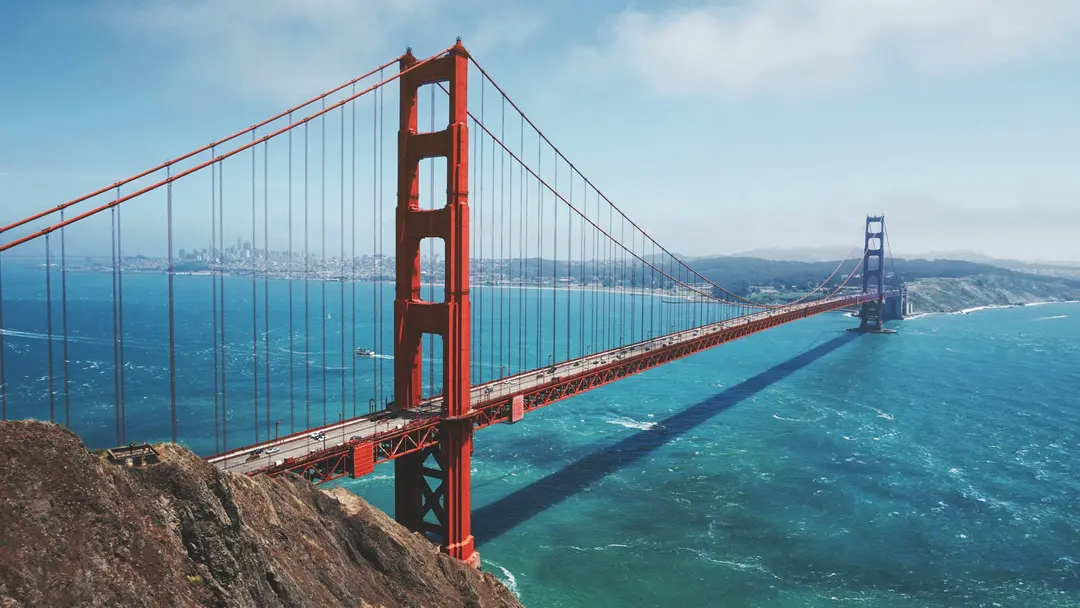
- Building the Bridge, Both bridges went up in the Depression, which is the point: the Bay Bridge opened in November 1936 and the Golden Gate in May 1937, built with public money at a moment when there was none. The Golden Gate was the first job site to hang a safety net beneath the work, it saved nineteen men, who called themselves the Halfway to Hell Club, and eleven still died.
- Rock, A fort, then a military prison, then the federal penitentiary that held Capone. It closed in 1963 because it cost too much to run on an island. Then in November 1969 a group of Native American activists occupied it for nineteen months, citing an 1868 treaty, and turned the most famous prison in America into the most visible protest of the era. The Presidio, meanwhile, was an army post continuously from 1776 to 1994.
- Six Poets at the Six Gallery, On 7 October 1955 Allen Ginsberg read Howl aloud in a converted garage on Fillmore Street. Lawrence Ferlinghetti published it, was arrested for obscenity, and won, a 1957 ruling that a work with redeeming social importance is not obscene, which changed what American publishers could print. City Lights is still open. North Beach was cheap then.
- Haight, A neighbourhood of a few thousand people received something like a hundred thousand arrivals in the summer of 1967, most of them broke, and a media apparatus that covered it as a spectacle. The Acid Tests, the Human Be-In, the Dead, Owsley's supply, and the moment it stopped being a scene and became a destination. Shared with our Psychedelics and LSD archives, because it is the same story told from the city's side.
- Harvey Milk, Milk was elected to the Board of Supervisors in 1977, one of the first openly gay elected officials in America, and was shot dead in City Hall a year later along with Mayor Moscone. When his killer got a manslaughter verdict the city rioted. Four years after that the same neighbourhood was the epicentre of the AIDS epidemic, and buried a generation while the federal government looked away.
- Tech Boom, The city has had a boom roughly every fifty years and has never once handled one gracefully: gold, silver, shipping, the 1934 general strike that shut down the waterfront, the dot-com bubble, and the platform era. Each one arrived promising to remake the place and each one mostly remade who could afford to live in it.
- What It Costs, A city of extraordinary wealth with people dying on its pavements, an argument about housing that has run for forty years without resolution, and a national commentary that treats it as either a utopia or a ruin depending on the week. Both readings flatten a place that has been simultaneously rich and broken since 1849.
- - Plano del nuevo Presidio de Sn.. 1776 por Dn. José Joaquin Moraga
- - Ohlone hunters with bows on the shore of San Francisco Bay. A hand-coloured plate of Northern Valley Yokuts and Ohlone people hunting on the bay, drawn by Louis Choris, the artist attached to the Russian Rurik expedition that called at San Francisco in 1816. Choris published it in his Voyage pittoresque autour du monde in 1822, engraved by Pierre Langlume. It is among the earliest pictorial records of Native life around the bay.
- - The presidio and the strait of the Golden Gate. Victor Adam's lithograph after a drawing by Louis Choris shows the Spanish colonial fort with the entrance to the bay beyond. It was published in 1822 in Choris's Voyage pittoresque autour du monde and is held by the New York Public Library.
- - Restored print of the presidio and the Golden Gate strait. A digitally restored version of the Adam lithograph after Louis Choris, published in the Voyage pittoresque autour du monde. The underlying artwork appears to date from around 1817, when Choris travelled the Pacific as artist to a Russian expedition, and the restoration is a featured picture on Wikipedia.
- - Spanish presidio above the entrance to the bay. A lithograph by Victor Adam after a drawing by Louis Choris, made for the illustrated account of a round-the-world voyage and held by the New York Public Library. It shows the Spanish colonial garrison and the strait later named the Golden Gate, decades before American settlement.
- - The Spanish presidio looking out to the Golden Gate. A lithograph by Victor Adam after a drawing by Louis Choris, published in the atlas to Choris's Voyage pittoresque autour du monde. Choris made the original view during his visit around 1817, when the presidio was still a Spanish colonial garrison guarding the strait. The plate is held by the New York Public Library.
- - The Spanish presidio drawn by a visiting expedition artist. Louis Choris sketched the presidio during a visit in the autumn of 1816 and published the plate in his Voyage pittoresque autour du monde in Paris in 1822. It is among the earliest surviving images of the Spanish garrison at San Francisco. The New York Public Library holds this impression.
- - Printed handbill advertising passage to the California goldfields. One of the advertising sheets put out during the Gold Rush to sell berths and outfits to men heading west. Notices like this one drove the steamship traffic that turned San Francisco from a small settlement into a port city within a couple of years.
- - Flyer calling men and women west to the goldfields. A recruitment sheet from the summer of 1849 aimed at both men and women willing to make the journey to California. Handbills of this kind fed the migration that passed through San Francisco's harbour on the way to the diggings.
- - White buckskin bag said to have carried gold rush gold. A soft white buckskin pouch reputed to have been used in the California gold rush by John T. Williams of Bonne Terre, Missouri. Bags like it held the dust and nuggets that men carried out of the diggings and spent in San Francisco. The object is in the collection of the Missouri History Museum.
- - Satirical lithograph of an overloaded prospector walking to California. A hand-coloured Currier print showing a comically over-equipped gold hunter on the plains some 350 miles west of St. Louis, captioned "I neither borrow nor lend". The print mocked the gold fever that pulled thousands of men across the continent toward San Francisco.
- - French satirical cartoon mocking the rush for California gold. An illustration published in the Paris journal Le Charivari, held in Harvard's Houghton Library. The paper treated the gold fever reaching Europe as a subject for caricature, evidence of how quickly the California strike became international news.
- - Joseph Goldsborough Bruff draws himself on the trail to California. A self portrait made by Bruff during his overland expedition to the goldfields. He was a trained draughtsman who kept an unusually full pictorial record of the journey, and lived a further forty years after making it.
- - Bruff's canvas mountain camp in the Sierra Nevada. Joseph Goldsborough Bruff painted his own mountain lodge in the Sierra Nevada, a cluster of joined white canvas tents around a conical centre tent. A man with a gun stands at the right, with a small yellow dog and tools scattered on the ground. Bruff led a company of overland emigrants and kept an unusually detailed visual record of the crossing.
- - Satirical lithograph on the defence of the California bank. A hand-drawn political caricature published as the gold rush began, using the imagined 'California Bank' to mock the international scramble for the new wealth. The cast includes send-ups of James K. Polk, Napoleon the Third and Isabella the Second of Spain. Prints like this carried news of the strike to audiences who would never see the diggings.
- - Engraving of a miners' encampment in the Sacramento Valley. J. H. Richardson's engraving of tents and prospectors in the gold country appeared in Holden's Dollar Magazine in New York in 1849. Pictures like this were how East Coast readers first saw the rush that turned San Francisco from a village into a port city within a year. The magazine is preserved in the Internet Archive.
- - Currier lithograph mocking the rush to California. A comic print published by Nathaniel Currier in the first year of the gold rush, showing the far-fetched means by which hopefuls proposed to reach California, rockets among them. It belongs to the Library of Congress collection of popular graphic arts and is one of the period's best-known satires on gold fever.
- - Gold Rush satire lithograph titled Things as They Are. A hand-printed lithograph satirising the California gold fever, issued as the rush drew tens of thousands west. The sheet belongs to a wave of political caricature that mocked both the prospectors and President James K. Polk, whose message to Congress had confirmed the gold discoveries. The print is held by the Library of Congress.
- - The place we hear about, a gold rush lithograph. A satirical lithograph on wove paper issued in 1849 as news of the California strike reached the eastern states. Prints like this fed and mocked the rush in equal measure; the sheet is held by the Library of Congress.
- - German engraved view of San Francisco in California. A plate from volume fourteen of Meyer's Universum, a German illustrated encyclopaedia of the world's notable places, showing San Francisco to a European readership. It appeared as the Gold Rush town was becoming an international name, and reached readers who would never see the bay themselves.
- - Three men and a woman panning for gold at a creek. A rare Gold Rush image showing a woman working a pan alongside male miners. Women were a small minority in the diggings that supplied San Francisco's boom, and pictures placing them at the water's edge are uncommon.
- - California gold miners with long tom, ca.. 1850-1852; Daguerreotype, The Nelson-Atkins Museum of Art
- - California gold miners with long tom, ca.. 1850-1852; Daguerreotype, The Nelson-Atkins Museum of Art
- - River mining, North Fork of the American River, California. 1850-1855; Daguerreotype, The Nelson-Atkins Museum of Art
- - River mining, North Fork of the American River, California (cropped). River mining, North Fork of the American River, California, ca.1850-1855; Daguerreotype, The Nelson-Atkins Museum of Art
- - L. V. Helms - Drawing of San Francisco, California, August 1851. A painting of San Francisco, California by Danish adventurer, merchant, emissary and author Ludvig Verner Helms. The painting was likely created in August, 1850, although it is labeled as 1851; his book "Pioneering in the Far East" (1882) and other records record the visit occurring in 1850. Helms states the view was
- - Lithograph depicting the seens mining for gold during the Gold Rush.
- - Sailing card advertising the clipper California for San Francisco. A printed sailing card for the clipper ship California, run by the Merchant's Express Line out of Pier 13 on New York's East River under Captain Henry Barber, with gold rush scenes worked into the design. Cards like this were handed to shippers to book cargo for the fast passage around the Horn. It was printed by G.F. Nesbitt and Co.
- - Comic print of a gold hunter buried under useless gear. A Kelloggs and Comstock version of the Independent Gold Hunter cartoon, in which the prospector staggers under every appliance imaginable and regrets not sailing around the Horn or crossing at Chagres in Panama. The joke turned on the overland route being the harder way to reach California.
- - Cartoon of a gold hunter buried under useless equipment. A satirical print from the gold mania of 1848 and 1849, showing a prospector loaded with every conceivable appliance, most of it worthless in California. The figure regrets not having taken his grandmother's advice to sail around the Horn or cross at Panama instead. The Kellogg and Comstock lithograph is held by the California State Library.
- - A Native woman panning for gold in the diggings. An illustration of a Native American woman working a pan at a California claim during the gold rush. Native labour was widely used and widely coerced in the early diggings, though the artist and exact origin of this image are not recorded. It survives as one of the few period depictions of an Indigenous woman at the workings.
- - Californio woman photographed at the height of the gold rush. A black and white portrait of a Californio woman, made in August 1850 and looking directly at the camera. Californios were the Spanish-speaking residents of California from before American annexation, a population rapidly outnumbered by the gold rush influx. The photograph is held by the Oakland Museum of California.
- - Lithograph of miners at work in the California gold fields. A lithograph of daily life at the diggings, printed on blue paper and worked up from a photograph by Fishbourne and Gow of San Francisco. Joseph Britton, later a leading San Francisco lithographer, is credited as the artist. Images of this kind were sold to eastern buyers hungry for scenes of the rush.
- - Sailing card advertising the clipper ship California. A printed sailing card issued to advertise berths and cargo space on the clipper California, running from Pier 13 on New York's East River to San Francisco. The card promises a very quick trip and urges merchants to book at once, competing for gold rush traffic. Its border carries scenes of the California diggings; the ship was built by Samuel Hall of East Boston and printed matter came from G.F. Nesbitt and Co.
- - Portrait of a California Gold Rush Miner, by George H.
- - View of the conflagration from Telegraph Hill San Francisco. 3d, 1851/Map of the burnt district of San Francisco showing the extent of the fire.
- - Newspaper column reporting gold found at Sutter's Mill. Page two, column four of The Californian, carrying the notice of the discovery on the American River. This short item is among the first printed reports of the find, and word spreading out from it emptied San Francisco of workers before drawing tens of thousands back.
- - Ships rotting at anchor in Yerba Buena Cove. One plate from William Shew's five-part daguerreotype panorama of the San Francisco waterfront, taken from Rincon Point. The vessels were abandoned where they moored when their crews walked off for the gold fields, and are shown in varying stages of decay. Shew's panorama is one of the earliest photographic records of the harbour.
- - Miners working a claim on the American River. A whole-plate daguerreotype by George H. Johnson showing miners at work on the American River near Sacramento. The river was where James Marshall's 1848 discovery began the rush that turned San Francisco from a village into a port city. Photographs made on the diggings this early are rare, since the daguerreotype process demanded equipment few miners carried.
- - German engraving of gold washing in the California diggings. A steel engraving of miners washing for gold in California, published in the fifteenth volume of Meyer's Universum, a German illustrated survey of the world's sights. It was cut by the engraver Anton Rottmann for the Bibliographisches Institut at Hildburghausen. The plate shows how the rush was pictured for European readers who would never see the goldfields.
- - Portrait of a Cantonese gold miner in California. An 1853 likeness by Isaac Wallis Baker of a Cantonese miner working the California diggings. Thousands of men from Guangdong reached San Francisco in the Gold Rush years, and the city became the entry point and commercial base for Chinese labour across the state. Held by the Oakland Museum of California.
- - Lithograph of the gold camp at Springfield, Tuolumne County. A view of Springfield in Tuolumne County, drawn by George Henry Goddard and printed on blue paper by the San Francisco lithographers Britton and Rey. Britton and Rey were the leading printmakers of Gold Rush California, and their views carried images of the mining districts back east. The print is held by the Library of Congress.
- - A mining town street with the Rancherie House hotel. Robert H. Vance made this daguerreotype of a California mining settlement, its false-fronted buildings including a hotel and the Sweata and Francis premises. Vance was the leading daguerreotypist of the gold country; the plate is in the J. Paul Getty Museum.
- - Johnson's Daguerreian Rooms, San Francisco, ca.. 1854-1855; Daguerreotype, The Nelson-Atkins Museum of Art
- - Johnson's Daguerreian Rooms, San Francisco, ca.. 1854-1855; Daguerreotype, The Nelson-Atkins Museum of Art
- - A Case of Real Distress. A plea for charity in the (London) Jewish Chronicle for a Esther Solomon Levy, a woman with six living children and a seventh on the way, stranded in Gold Rush SF after her husband's death at sea near Panama.
- - San Francisco Vigilante Committee lithograph. Contemporary lithograph depicting James Casey and Charles Cora being taken as prisoners of the San Francisco Vigilante Committee on May 18, 1856.
- - McGOWAN, Edward (1807 or 1813-1893).. ). Narrative of Edward McGowan, Including a Full Account of the Author’s Adventures and Perils while Persecuted by the San Francisco Vigilance Committee of 1856.... San Francisco: Published by the author, 1857.
- - "The Bummer", illustration from "A Peep at Washoe" by J.. 's Monthly Magazine, December 1860. A "bummer" was a man who had made his fortune mining and was now at leisure. This would be in California at the start of his story, before Browne journeys to other gold and silver mining areas.
- - "Going to Kern River", illustration from "A Peep at Washoe" by J.. 's Monthly Magazine, December 1860. This would be the Kern River, California gold rush of 1853.
…and 704 more moments.
Full text archive: /loreline-text/san-francisco.md