Media
A curated chronology of communication technology from cave paintings to generative AI. 58 moments across 8 eras — every layer of the medium that became the substrate of the next.
A chronological documentary of 181 moments spanning c. 40,000 BC–2026 on Loreline.
last updated 2026-07-31
Eras
- Prehistoric — c. 40,000 BC – 3,000 BC. Before writing. Humans communicate across distance and time via cave paintings, talking knots, fire signals, drums. The medium is the environment itself — stone walls, bone tablets, the resonance of a hollow log.
- Writing — 3,200 BC – 1450 AD. The line on the surface gains grammar. Cuneiform, hieroglyphs, alphabets. Papyrus replaces clay; paper replaces papyrus; the codex replaces the scroll. By 1377 a Korean monastery prints with movable metal type — 78 years before Gutenberg.
- Print — 1450 – 1830. Gutenberg, Aldine Press, the first newspapers, the first encyclopedias, the public library. For four centuries the dominant communication technology is hot lead set by hand on a wooden press. Literacy becomes a mass property of populations, not a guild skill.
- Wires — 1830 – 1900. Communication detaches from physical transport. Telegraph wires cross continents in days, then oceans. The telephone arrives. The undersea cable shrinks the world from months to minutes. By 1900, Marconi proves the wire itself was optional.
- Broadcast — 1900 – 1960. The wireless wave becomes a public utility. Radio in the 1920s, sound film in 1927, television by the 1950s. For the first time, millions of people consume the same content at the same time without leaving their homes. Mass culture is invented.
- Cable & Satellite — 1960 – 1990. The broadcast bottleneck breaks. Satellites bring live international events into living rooms. Cable televises 50 channels, then 500. The VCR puts time-shifting in viewers' hands. The Walkman makes media portable. MTV makes the music video an art form.
- Digital — 1990 – 2010. The wire and the wave merge. Email, the web, broadband, mobile. By 2000 a billion people are online; by 2010, a billion of them are on smartphones. Every previous medium — text, audio, image, video, voice call — gets re-encoded as packets.
- Algorithmic — 2010 – present. The feed replaces the broadcast schedule. Instagram, Snap, TikTok rank what you see by predicted engagement, not chronological order. Smartphones ship with cameras better than the news crews of the 2000s carried. By 2022, the medium starts generating itself — diffusion models, large language models, synthetic everything.
- — Cave Paintings of El Castillo. The earliest known cave art at El Castillo in northern Spain. Hand stencils and red-disk pigments dated by uranium-thorium to at least 40,800 years ago — old enough that the first painters may have been Neanderthals, not Homo sapiens. The cave wall is the first known persistent communication surface.
- — Figurative art & the carved record. Carved figures and ornaments show early humans encoding identity and meaning in objects tens of thousands of years ago.
- — The painted caves. From Chauvet to Altamira, painted caves are humanity’s earliest surviving mass of visual storytelling.
- — Lascaux. The bestiary of Lascaux — bulls, horses, stags, an aurochs four metres long — painted on the cave walls of southwest France during the late Paleolithic. Discovered in 1940 by four teenagers and a dog called Robot. Closed to the public in 1963 to slow the lichen.
- — Oral tradition & memory. For most of human history, all media was oral — knowledge carried in story, song and memory across generations.
- — Petroglyphs & rock art. Across every continent, humans carved and painted symbolic records into rock — among the first attempts to fix meaning outside the body.
- — Token Accounting in Mesopotamia. Clay tokens — cones, spheres, disks — used in the Fertile Crescent to track grain, livestock, oil. Each shape stood for a quantity of a thing. Tokens were sealed inside clay envelopes (bullae) and the envelope's surface impressed with the count. By 3500 BC the envelope itself becomes the message: cuneiform.
- — Clay tablets & proto-writing. Clay tokens and the first administrative cuneiform tablets in Mesopotamia are an ancestor of writing — accounting made the first records.
- — Talking Drums of West Africa. The dùndún and gangan — hourglass-shaped drums whose pitch can be modulated by squeezing the tension cords — transmit tonal language across long distances. Messages travel village-to-village faster than a running messenger. The pattern survives into the colonial era as the original wireless network.
- — Cylinder seals — the first branding. In Mesopotamia around 3500 BC, carved cylinder seals rolled a signature image into wet clay — the earliest system for authenticating documents and marking ownership, an ancestor of the logo and the signature.
- — Quipu: the Knot-Record. The Inca and their Andean predecessors keep census and tax records in knotted cords. Position, knot type, ply direction, and color all carry meaning. The Spanish later burn most surviving quipus as heretical objects. A few hundred remain in museums; many are still partially unread.
- — Cuneiform Tablets at Uruk. The earliest known writing — proto-cuneiform pictographs pressed into wet clay with a reed stylus, found in the Eanna temple precinct at Uruk in southern Mesopotamia. Used initially to record beer rations, grain inventories, and temple offerings. The script will evolve and dominate the Near East for 3,000 years.
- — Egyptian Hieroglyphs. A logographic and alphabetic system painted onto temple walls, carved into stone, and brushed onto papyrus scrolls. Used for religious texts, royal proclamations, and accounting. Reading is restricted to scribes; the script will not be deciphered by Europeans until Champollion cracks the Rosetta Stone in 1822.
- — Papyrus. The Egyptians strip the stems of Cyperus papyrus, lay them in two perpendicular layers, press them flat. The result is a thin sheet light enough to roll, durable enough to last 4,000 years in dry conditions. The Egyptian state will guard papyrus as a strategic export until Rome takes the trade.
- — Phoenician Alphabet. A Phoenician inscription on stone — the actual letter forms in their original physical context, not the modern reconstruction of the alphabet table. Twenty-two consonant signs, no vowels, each derived from an acrophonic pictogram. Spread by Phoenician traders across the Mediterranean, it is the direct ancestor of Greek, Latin, Arabic, Hebrew, and ultimately the Latin alphabet you are reading this in.
- — Chinese oracle-bone script. Chinese writing — one of the longest continuously-used systems — begins with divination inscriptions on bone and shell.
- — The Greek Alphabet Adds Vowels. The Dipylon inscription — among the earliest known Greek alphabetic writing, scratched on a vase c. 740 BC, including the now-famous vowels. Greek scribes adapt the Phoenician consonantal alphabet and repurpose five unused consonants as vowels — α, ε, η, ι, ο. Writing becomes phonetic in a way the Phoenician system was not. The Greek alphabet then becomes the Etruscan alphabet, then the Latin one.
- — The Library of Alexandria. The great library symbolised the ancient dream of gathering all the world’s knowledge in one place.
- — Parchment and the library of Pergamon. When Egypt embargoed papyrus, Pergamon perfected parchment — treated animal skin — around 200 BC. Durable and foldable, it made the bound book possible and preserved much of classical writing.
- — The Rosetta Stone. A single decree carved in three scripts became, two millennia later, the key to reading hieroglyphs.
- — The codex replaces the scroll. The bound codex — pages instead of a scroll — transformed how text was stored, searched and read.
- — Cai Lun Refines Paper. The Han Dynasty court official Cai Lun standardises a process for making paper from mulberry bark, hemp, rags, and fishing nets. The technology spreads slowly westward — reaching Baghdad in 793, Spain in 1056, England in 1490 — replacing parchment as the substrate that the printing press will need.
- — Maya glyphs. In Mesoamerica, the Maya independently developed a full writing system of intricate logosyllabic glyphs.
- — Woodblock printing in East Asia. Centuries before Gutenberg, China and Korea printed texts and images from carved woodblocks.
- — The illuminated manuscript. In monastic scriptoria, hand-copied, illuminated manuscripts preserved and transmitted knowledge through the medieval era.
- — The Diamond Sutra — World's Oldest Printed Book. A complete printed scroll of the Vajracchedikā Prajñāpāramitā Sūtra, woodblock-printed on May 11, 868 at the order of Wang Jie "on behalf of his two parents." Discovered in the Mogao Caves at Dunhuang in 1907. Five-and-a-half centuries before Gutenberg, the technology is already mature.
- — Bi Sheng’s movable type. In Song-dynasty China, Bi Sheng invented movable type made of baked clay — four centuries before Europe.
- — Jikji — First Book Printed with Movable Metal Type. The Korean Buddhist anthology Jikji, printed at the Heungdeok temple in Cheongju seventy-eight years before the Gutenberg Bible. Two volumes survive; the second is held by the Bibliothèque nationale de France, taken during the Joseon-era diplomatic mission and never returned.
- — Hangul — a phonetic alphabet by design. In 1446 King Sejong of Korea promulgated Hangul, a writing system consciously designed to be simple enough for anyone to learn — a rare case of literacy engineered as public policy.
- — Gutenberg Bible. Johannes Gutenberg of Mainz combines movable type cast from a lead-tin-antimony alloy, oil-based ink, the screw press, and the wine-press operating model — and prints 180 copies of the Vulgate Bible. The infrastructure of mass literacy enters Europe. Within fifty years the price of a book has dropped by 99 percent.
- — The Incunabula. By 1500 — fifty years after Gutenberg — there are an estimated 28,000 different books in print across Europe, called incunabula ("swaddling-clothes" books). Print shops have opened in over 250 cities. Venice alone has more than 200 working presses.
- — Relation — First Weekly Newspaper. Johann Carolus of Strasbourg starts printing his manuscript-newsletter Relation aller Fürnemmen und gedenckwürdigen Historien on a movable-type press, in weekly editions. UNESCO recognises it in 2005 as the world's first newspaper. The form spreads to Antwerp by 1620, London by 1621.
- — Diderot's Encyclopédie. Denis Diderot and Jean d'Alembert begin publishing the Encyclopédie, ou Dictionnaire raisonné des sciences, des arts et des métiers. 28 volumes, 71,818 articles, 3,129 illustrations. Banned twice; published anyway.
- — Senefelder Invents Lithography. Bavarian playwright Alois Senefelder, looking for a cheap way to print his own scripts, discovers that grease-treated limestone will accept oil-based ink only where the grease is. The technique becomes the dominant illustration printing method of the 19th century and the direct ancestor of offset printing.
- — The Steam-Powered Press at The Times. John Walter II of The Times of London buys a Friedrich Koenig steam-powered cylinder press and prints the 28 November 1814 edition on it. The press runs 1,100 sheets per hour — four times the speed of a hand press.
- — The Penny Press. Cheap, ad-funded papers like the New York Sun created the first mass-circulation press.
- — Morse, Vail, and the Electric Telegraph. Samuel Morse and Alfred Vail patent a single-wire telegraph using on/off pulses of current. In 1844 Morse sends "What hath God wrought" from the U.S. Capitol to Baltimore. Within twenty years 23,000 miles of telegraph line cross the United States.
- — Morse, Vail, and the Electric Telegraph. Samuel Morse and Alfred Vail demonstrate their electric telegraph, and in 1844 send the first public message — "What hath God wrought" — from Washington to Baltimore. Morse code turns language into dots and dashes, collapsing the time it takes news to cross a continent from days to seconds for the first time in history.
- — Photography — the daguerreotype. Daguerre’s process let an image be captured by light itself — the birth of mechanical visual reproduction.
- — The rotary printing press. Hoe’s rotary press printed newspapers by the hundred thousand, industrialising the word.
- — First Transatlantic Cable. The first transatlantic telegraph cable is completed in August 1858, letting Queen Victoria and President Buchanan exchange greetings in hours rather than the weeks a ship took. It failed within a month, but a durable cable laid by the Great Eastern in 1866 permanently wired the two continents together.
- — Bell's Telephone. Alexander Graham Bell, three days after his patent grants, transmits "Mr. Watson — come here — I want to see you" to his assistant Thomas Watson through a wire in his Boston laboratory. By 1881 every major American city has telephone exchanges. The handset will replace the telegram within a generation.
- — Bell's Telephone. Alexander Graham Bell patents the telephone on 7 March 1876 and, days later, speaks the first words down a wire to his assistant: "Mr. Watson, come here, I want to see you." Point-to-point voice communication begins, and within decades the telephone network becomes the largest machine humanity has ever built.
- — Edison’s phonograph. recorded and replayed sound for the first time — the birth of recorded media.
- — The Linotype machine. Mergenthaler’s Linotype let one operator set a line of type at a keyboard, revolutionising typesetting.
- — Hertz Generates Electromagnetic Waves. Heinrich Hertz, working in his Karlsruhe lab, generates and detects radio-frequency electromagnetic waves — confirming Maxwell's 1865 equations experimentally. Asked the practical application, Hertz replies: "It's of no use whatsoever." He dies in 1894 at 36.
- — Edison’s Kinetoscope. Edison and Dickson’s Kinetoscope let one viewer watch moving pictures — a step toward cinema.
- — Lumière Brothers — Cinematograph. On December 28, 1895, Auguste and Louis Lumière show the first commercial film screening at the Salon Indien du Grand Café, Boulevard des Capucines, Paris. Ten short films, 33 paying spectators. Within a year the Cinematograph is touring Bombay, Buenos Aires, and Moscow.
- — Lumière Brothers — Cinematograph. On 28 December 1895 the Lumière brothers hold the first commercial film screening in a Paris café, including "Workers Leaving the Lumière Factory." Their Cinématographe camera-projector turns moving pictures into a public, ticketed medium — the birth of cinema as a mass art form.
- — The comic strip & the Yellow Kid. Mass newspapers spawned the comic strip — a new popular visual-narrative medium.
- — Marconi Patents Wireless Telegraphy. Guglielmo Marconi, 22, files British Patent 12039 — "Improvements in Transmitting Electrical Impulses and Signals" — describing the first practical wireless telegraph. By 1901 he transmits the letter "S" across the Atlantic from Poldhu, Cornwall to St. John's, Newfoundland. Hertz's "no use whatsoever" becomes a global industry.
- — Marconi Patents Wireless Telegraphy. Guglielmo Marconi patents wireless telegraphy in 1896 and in 1901 receives the first transatlantic radio signal — the letter "S" — across 3,500 km of ocean. Messages no longer need a wire, freeing communication from cables and making ship-to-shore contact possible.
- — Fessenden's First Audio Broadcast. Christmas Eve 1906, Reginald Fessenden broadcasts a programme of music, a Bible reading, and his own violin performance from Brant Rock, Massachusetts. Ships at sea listening on wireless telegraph receivers hear human voices coming out of their headphones for the first time.
- — KDKA Pittsburgh — First Licensed Radio Station. On November 2, 1920, Pittsburgh station KDKA broadcasts the results of the Harding-Cox presidential election to a few hundred listeners with crystal sets. The first commercially licensed radio broadcast. Within five years there are 1,400 American radio stations.
- — The Jazz Singer — Sound Film Era Begins. Warner Bros. premieres The Jazz Singer on October 6, 1927 — synchronised sound on disk via Vitaphone. Al Jolson's "You ain't heard nothin' yet!" line breaks the silent-film convention. By 1929 every American studio is shooting in sound.
- — The Jazz Singer — Sound Film Era Begins. Warner Bros. premieres The Jazz Singer on 6 October 1927, synchronising sound to film via the Vitaphone disc system. Al Jolson's ad-libbed "You ain't heard nothin' yet!" makes it a sensation and effectively ends the silent-film era within a few years.
- — FDR’s Fireside Chats. Roosevelt’s radio "fireside chats" showed how broadcast could speak intimately to a whole nation at once.
- — BBC Begins Regular TV Broadcasts. On 2 November 1936 the BBC launches the world's first regular high-definition public television service from Alexandra Palace in London, alternating between the Baird and Marconi-EMI systems. Television moves from laboratory demonstration to a scheduled broadcast medium.
- — The Golden Age of Radio. In the 1930s–40s radio drama, comedy, music and news made the radio set the centre of the family home. This photograph dates from 1938.
- — Welles — "War of the Worlds". Orson Welles’ 1938 radio drama, mistaken by some for real news, proved broadcast’s power to move (and panic) the public.
- — Television unveiled at the World’s Fair. RCA’s 1939 World’s Fair demonstration introduced television to the American public.
- — First U.S. Commercial TV Broadcast. On 1 July 1941 WNBT (later WNBC) in New York airs the first legal U.S. television commercial — a ten-second Bulova watch spot — after the FCC authorises commercial TV. The advertising-funded broadcast-television business model begins.
- — Shannon's Mathematical Theory of Communication. Claude Shannon, working at Bell Labs, publishes "A Mathematical Theory of Communication" in the Bell System Technical Journal. He invents information theory, defines the bit, and proves that any communication channel has a calculable upper bound on its data rate. Every digital medium afterward is a special case of his result.
- — Color Television Arrives. Color television reaches U.S. homes in 1954 as NBC broadcasts the Tournament of Roses Parade using RCA's compatible color system, adopted by the FCC in December 1953. Color would take a decade to become the norm, but the standard set here defined American TV for a generation.
- — Sputnik 1. The Soviet Union launches Sputnik 1 on 4 October 1957 — the first artificial satellite. Its steady radio beep, audible to amateur operators worldwide, opens the space age and directly spurs the creation of the satellite and computer-network infrastructure that later carries global media.
- — The Kennedy–Nixon TV debate. On 26 September 1960 the first televised U.S. presidential debate showed a tanned, composed Kennedy beside a pale, sweating Nixon. Radio listeners thought Nixon won; TV viewers chose Kennedy — proof that television had changed the nature of political power.
- — Telstar — First Live Transatlantic TV. On July 23, 1962, the Telstar 1 satellite — launched ten days earlier — relays the first transatlantic television signal. Walter Cronkite in New York and Yves Mourousi in Paris exchange greetings. The Tornados' instrumental "Telstar" reaches #1 on both sides of the Atlantic that summer.
- — Telstar — First Live Transatlantic TV. Telstar 1, launched 10 July 1962, relays the first live transatlantic television pictures between the U.S. and Europe. For the first time an event could be seen across the ocean as it happened, foreshadowing the era of global live broadcasting.
- — Geostationary comms satellites. Early Bird / Intelsat I made live intercontinental television and telephony routine.
- — ARPANET — the first packet network. On 29 October 1969 the first message is sent over ARPANET between UCLA and Stanford — the system crashed after the letters "LO" of "LOGIN." This packet-switched network, funded by the U.S. defence department, is the direct ancestor of the internet.
- — Moon Landing Live Broadcast. On July 20, 1969, an estimated 650 million people — one-fifth of humanity at the time — watch live as Neil Armstrong steps off the Eagle lunar module onto the surface of the Moon. The largest synchronous shared experience in the history of broadcasting.
- — Moon Landing Live Broadcast. On 20 July 1969 an estimated 600 million people — a fifth of humanity — watch live as Neil Armstrong steps onto the Moon, the largest shared television audience the world had ever seen. It is the moment global live broadcast comes of age.
- — The telephone network spreads. Switchboards and exchanges turned Bell’s invention into a networked communication system. This photograph dates from 1975.
- — MTV & the music video. MTV made the music video a dominant form — "Video Killed the Radio Star" was its first.
- — Usenet & the BBS. Usenet newsgroups and dial-up bulletin boards were the first online communities and discussion media.
- — CNN — First 24-Hour News Channel. Ted Turner launches CNN on 1 June 1980 as the first 24-hour television news channel. Rolling live coverage — perfected during the 1991 Gulf War — permanently changes the pace of news from the evening bulletin to the never-ending cycle.
- — MTV Launches. MTV goes live at 12:01 a.m. on 1 August 1981 with the pointed first video "Video Killed the Radio Star." By fusing pop music with television it makes the music video a dominant art form and turns image into a central currency of pop culture.
- — Sony Walkman. Sony releases the Walkman TPS-L2 on 1 July 1979, making recorded music personal and portable. The private, headphone-shaped listening bubble it created reshaped how people consumed media in public — a direct ancestor of the iPod and the smartphone.
- — Fall of the Berlin Wall — Live. On November 9, 1989, Politburo spokesman Günter Schabowski stumbles through a press conference and accidentally announces immediate East German border openings. Within hours West German TV is broadcasting live from Checkpoint Charlie as crowds cross. The world watches the Cold War end in real time.
- — Fall of the Berlin Wall — Live. On 9 November 1989 television carries the fall of the Berlin Wall live to the world. The images of crowds streaming through the checkpoints — broadcast in real time east and west — show how live media itself had become an actor in world events.
- — The Gulf War — live TV war. CNN's round-the-clock live coverage of the 1991 Gulf War — reporters broadcasting from Baghdad as bombs fell — created the modern spectacle of war as live television and cemented the 24-hour news channel.
- — The TV news anchor. Network evening news made the anchor a trusted national figure and television the primary source of news. This photograph dates from 1998.
- — Napster & the file-sharing wars. Napster let anyone share music for free, breaking the record industry’s model and previewing the streaming age.
- — RSS & the feed. RSS let readers subscribe to a feed of updates — an ancestor of the algorithmic timeline.
- — The iPod — 1,000 songs in your pocket. Apple's iPod (2001) and the iTunes Store (2003) moved music from the CD to the hard drive and the download, pairing a slick device with a legal store and reshaping how a generation bought and carried music.
- — The fax machine. Though the technology dates to the 19th century, the standardised Group 3 fax machine of the early 1980s makes instant document transmission over phone lines a fixture of the office. For two decades the fax is how signed paper crosses distance in real time. The subject dates from 1980; this photograph was taken in 2003.
- — The personal computer (Altair 8800). The Altair 8800 kicked off the personal-computer revolution that put media-making on every desk. The subject dates from 1975; this photograph was taken in 2004.
- — HBO Launches Pay Cable. Backyard satellite dish era — HBO's 1975 satellite distribution kicked off the cable-TV gold rush that filled American suburbs with C-band receivers like this one. On November 8, 1972, Home Box Office begins transmitting a Polish-American hockey match in Wilkes-Barre, Pennsylvania over a microwave relay — the first cable-only premium channel. In 1975 HBO becomes the first network to distribute via geostationary satellite. The cable era begins. The subject dates from 1972; this photograph was taken in 2004.
- — Sputnik 1. On October 4, 1957, the Soviet Union launches Sputnik 1 — the first artificial satellite. It carries no instruments except two radio transmitters broadcasting on 20.005 and 40.002 MHz so amateur radio operators worldwide can pick up its beep-beep-beep tone. Communication satellites become a real concept overnight. The subject dates from 1957; this photograph was taken in 2004.
- — Facebook Launches. Mark Zuckerberg launches "TheFacebook" from a Harvard dorm on 4 February 2004. Opening first to colleges and then to everyone in 2006, it turns the social network into the dominant online medium and makes the personal profile and the news feed central to daily life.
- — First Transatlantic Cable. Cyrus West Field's Anglo-American Telegraph Company lands the first transatlantic submarine cable between Valentia, Ireland and Heart's Content, Newfoundland. Queen Victoria messages President Buchanan on August 16. The cable fails within weeks but the principle is proven; a working cable is laid in 1866. The subject dates from 1858; this photograph was taken in 2005.
- — Amazon, eBay, Craigslist. Jeff Bezos in 2005, ten years after launching Amazon out of a Seattle garage as an online bookstore. Three sites founded within five months of each other in 1995 turn the web into a commercial substrate: Amazon launches as an online bookstore in July; eBay (then AuctionWeb) goes live on Labor Day weekend; Craigslist starts as a San Francisco email list in March and incorporates as a company in 1999. The subject dates from 1995; this photograph was taken in 2005.
- — YouTube Launches. Jawed Karim — co-founder of YouTube and uploader of the site's first video ("Me at the zoo") on April 23, 2005. Three former PayPal employees — Steve Chen, Chad Hurley, Jawed Karim — register the YouTube.com domain on Valentine's Day 2005. The first video, Karim's "Me at the zoo," uploads April 23. Google buys the site for $1.65 billion in October 2006. Video distribution stops being broadcast and starts being long-tail.
- — YouTube Launches. Three former PayPal employees — Steve Chen, Chad Hurley and Jawed Karim — register YouTube.com on Valentine's Day 2005; Karim's 19-second "Me at the zoo" (23 April 2005) is the first upload. Google buys the site for $1.65 billion in 2006, and video distribution shifts from broadcast to the long tail.
- — Blogs & the read-write web. Blogger and the blog gave anyone a printing press — the first wave of user-generated media. The subject dates from 1999; this photograph was taken in 2006.
- — The transistor. Bell Labs’ transistor shrank electronics — soon putting a radio in every pocket and a computer on every desk. The subject dates from 1947; this photograph was taken in 2006.
- — Twitter. Jack Dorsey — co-founder of Twitter, who sent the first tweet ("just setting up my twttr") on March 21, 2006. Jack Dorsey sends the first tweet — "just setting up my twttr" — on March 21, 2006. The 140-character format is a constraint inherited from SMS; the @ reply and # hashtag conventions emerge organically from user behavior in 2007-2008. The site becomes the global breaking-news layer.
- — Twitter. launches in July 2006, with Jack Dorsey's first post — "just setting up my twttr." Its 140-character limit turns publishing into a public, real-time stream and makes the platform a nerve centre for breaking news, protest and celebrity for the next decade.
- — iPhone. Steve Jobs unveiled the iPhone at Macworld on January 9, 2007 with the line: "Today, Apple is going to reinvent the phone." Steve Jobs introduces the iPhone at Macworld on January 9, 2007. "Today Apple is going to reinvent the phone." Multi-touch screen, no physical keyboard, full HTML web browser, OS X kernel. The App Store opens in July 2008. The smartphone era — and the always-connected media consumer — begins.
- — iPhone. Steve Jobs unveils the iPhone at Macworld on 9 January 2007, calling it "a widescreen iPod, a phone, and a breakthrough internet communicator." By putting a full browser, camera and app platform in one pocket device, it collapses every prior medium into a single glass rectangle.
- — Netflix Streams. Reed Hastings — Netflix co-founder. The company launched streaming alongside its DVD-by-mail business in January 2007 with 1,000 titles. Netflix — already a DVD-by-mail business since 1997 — launches its streaming service in January 2007 with 1,000 titles. By 2010 streaming surpasses DVD shipments. By 2013 Netflix produces its first original series, House of Cards. The cable-TV bundle starts to unravel.
- — Netflix Streams. Netflix launches streaming ("Watch Now") in January 2007, moving from mailing DVDs to delivering video over the internet. On-demand streaming detaches television from the broadcast schedule entirely and, with originals from 2013, upends the whole industry.
- — Steve Jobs introduces the iPhone (2007). The iPhone keynote launched the smartphone era — putting all media in one pocket device.
- — Spotify and the algorithmic playlist. Spotify launched in 2008, replacing ownership with access to a near-infinite library — and then with algorithmic playlists (Discover Weekly, 2015) that let software curate what you hear.
- — Android opens the smartphone. Google's Android (first phone, 2008) put a free, open smartphone platform against the iPhone. The two-OS world it created spread the pocket supercomputer to billions of people worldwide.
- — The App Store & the home screen. Apple’s App Store turned the phone into a platform — and the grid of app icons into the doorway to all media.
- — The camcorder. The home camcorder let ordinary people shoot and keep moving images — a step toward user-generated video. The subject dates from 1983; this photograph was taken in 2008.
- — Spotify & streaming music. Spotify made the world’s music an instant, algorithm-curated stream — the post-download model.
- — Facebook's Like button. Facebook added the Like button in February 2009. That single tap turned every interaction into a quantified signal, giving the ranking algorithms the fuel to sort the feed by predicted engagement — the mechanism at the heart of the algorithmic age.
- — Google Founded. Larry Page, co-founder of Google — the PageRank-driven search engine that grew out of his Stanford PhD work in 1998. Larry Page and Sergey Brin, Stanford PhD students, incorporate Google Inc. on September 4, 1998. Their PageRank algorithm — ranking pages by inbound link count weighted by source authority — is dramatically better than competitors. Within four years Google handles the majority of all global web searches. The subject dates from 1998; this photograph was taken in 2009.
- — Reuters & the news wire. Telegraph-fed news agencies like Reuters made news a global, near-instant commodity. The subject dates from 1851; this photograph was taken in 2009.
- — Color Television Arrives. NBC broadcasts the 1954 Tournament of Roses Parade in color on January 1, using RCA's NTSC standard. The subject dates from 1954; this photograph was taken in 2010.
- — Instagram. Kevin Systrom, Instagram co-founder, in 2011 — a year after launching the photo app that Facebook would buy two years later for $1 billion. Kevin Systrom and Mike Krieger launch Instagram on October 6, 2010 — initially as a photo-only app with built-in filters that make iPhone photos look like Kodachrome film. 25,000 users in the first 24 hours. Facebook buys it for $1 billion two years later, on the eve of its IPO.
- — The gramophone & the record. Berliner’s flat disc made recorded sound a mass-produced, mass-distributed product. The subject dates from 1887; this photograph was taken in 2010.
- — Wikipedia Launches. Jimmy Wales in 2010, having co-launched Wikipedia in January 2001 as an open-edit companion to the expert-edited Nupedia. By 2007 it had surpassed Britannica in article count. On January 15, 2001, Jimmy Wales and Larry Sanger launch Wikipedia as a free, open-editing companion to the expert-edited Nupedia. By 2007 it surpasses Britannica in article count. By 2015 it has 35 million articles in 290 languages. The single largest collaborative work in human history. The subject dates from 2001; this photograph was taken in 2010.
- — Instagram. launches on 6 October 2010 as a photo-sharing app built around filters and the square frame, hitting a million users in two months. Bought by Facebook for $1 billion in 2012, it makes the visual feed — and the influencer — central to online culture.
- — Snapchat — Ephemeral Media. Evan Spiegel, Snapchat co-founder — pictured in 2013, the year the app shipped Stories and crossed 50 million users. Stanford undergrads Evan Spiegel, Bobby Murphy, and Reggie Brown launch Snapchat in September 2011. Photos that delete themselves after seconds. The form invents Stories (1-day expiry) in 2013; Instagram clones it in 2016. Ephemeral becomes a baseline expectation of social media.
- — The Atari 2600 — games at home. The Atari 2600 (VCS), released in 1977, brings cartridge-based video games into the living room and makes gaming a home mass medium. Its success — and the crash that followed in 1983 — set the pattern for the console industry that followed. The subject dates from 1977; this photograph was taken in 2011.
- — Snapchat — Ephemeral Media. Snapchat launches in September 2011 with a radical idea: messages that disappear after they're viewed. Evan Spiegel's app makes ephemerality and the "Story" format mainstream — conventions that Instagram, Facebook and TikTok would all copy.
- — BBC Begins Regular TV Broadcasts. On November 2, 1936, the BBC launches the world's first regular high-definition television service from Alexandra Palace, London — alternating Baird's mechanical 240-line system and Marconi-EMI's 405-line electronic system, finally settling on the latter in 1937. The subject dates from 1936; this photograph was taken in 2012.
- — "Gangnam Style" — the viral billion. The first video to a billion YouTube views showed media going global and viral at internet speed.
- — Tim Berners-Lee Proposes the Web. In March 1989 a CERN software engineer named Tim Berners-Lee circulates a proposal titled "Information Management: A Proposal" to his manager Mike Sendall. The first web server, info.cern.ch, goes live on December 20, 1990. Sendall famously writes "Vague but exciting..." on the cover page. The subject dates from 1989; this photograph was taken in 2012.
- — House of Cards and data-driven TV. Netflix's House of Cards (2013) was greenlit and shaped by viewing data, and released all at once for bingeing. Streaming originals rewired how television is made, funded and watched.
- — Ray Tomlinson invents email. Tomlinson sent the first networked email and chose the "@" sign — soon the world’s default medium. The subject dates from 1971; this photograph was taken in 2013.
- — First U.S. Commercial TV Broadcast. An RCA TRK-12 television camera at the 1939 New York World's Fair — the broadcasting infrastructure that made the 1941 Bulova ad possible. WNBT (later WNBC) New York airs the first commercial television broadcast on July 1, 1941 — a Bulova watch ad shown before a Brooklyn Dodgers vs Philadelphia Phillies baseball game. Bulova pays $9 for nine seconds. There are an estimated 4,000 TV sets in the New York area. The subject dates from 1941; this photograph was taken in 2013.
- — Mosaic — The First Mass Browser. NCSA Mosaic 1.0 ships on April 22, 1993. It is the first browser to render images inline with text, runs on Mac, Windows, and X11, and is free. By 1994 over a million people have downloaded it. Marc Andreessen leaves Illinois that year to co-found Netscape. The subject dates from 1993; this photograph was taken in 2013.
- — Nintendo & the NES. The NES revived home gaming and made interactive entertainment a media giant. The subject dates from 1985; this photograph was taken in 2013.
- — Magnetic tape recording. AEG's Magnetophon (1935) made high-quality magnetic tape recording practical. Tape let broadcasters record, edit and time-shift audio — and later, video — transforming how programmes were made.
- — Netflix & the streaming wars. Netflix’s shift to streaming and original series reshaped television into on-demand, algorithm-served content.
- — Mosaic — The First Mass Browser. NCSA Mosaic, released in 1993, is the first web browser to display images inline with text and run on ordinary PCs. It makes the web usable for non-experts and touches off the explosion of the 1990s; its team went on to build Netscape.
- — Kodak & the snapshot. George Eastman’s Kodak put photography in everyone’s hands — "you press the button, we do the rest". The subject dates from 1888; this photograph was taken in 2014.
- — The Game Boy. Nintendo’s Game Boy made interactive media truly portable and sold by the hundred million. The subject dates from 1989; this photograph was taken in 2014.
- — The 45 rpm single. RCA answers the LP with the 7-inch 45 rpm single in 1949 — cheap, durable and with a big centre hole for jukebox changers. The 45 becomes the format of the pop single and the currency of the hit-parade and radio-request culture of the 1950s and 60s. The subject dates from 1949; this photograph was taken in 2014.
- — The podcast. Downloadable, subscribable audio shows revived long-form, on-demand spoken media. The subject dates from 2004; this photograph was taken in 2014.
- — Dial-up & "You’ve Got Mail". The screeching dial-up modem and AOL’s "You’ve Got Mail" were how millions first went online.
- — Napster and the file-sharing earthquake. Napster (1999) let millions swap MP3s peer-to-peer, detonating the recorded-music business and forcing every media industry to reckon with free, frictionless digital copying.
- — Sony Walkman. On July 1, 1979, Sony introduces the TPS-L2 Walkman — the world's first portable personal stereo cassette player. 30,000 units sell in two months. The pavement, the bus, the gym suddenly have soundtracks. Aldous Huxley's "individual sphere of attention" is now wearable. The subject dates from 1979; this photograph was taken in 2015.
- — CNN — First 24-Hour News Channel. Ted Turner — the cable-television impresario who launched CNN in 1980 and bet the entire format that news could fill 24 hours. On June 1, 1980, Ted Turner launches CNN — the Cable News Network — from Atlanta. 24-hour rolling news with international correspondents. CNN comes of age covering the 1991 Gulf War live from the al-Rasheed Hotel in Baghdad as Tomahawks strike the city outside Peter Arnett's window. The subject dates from 1980; this photograph was taken in 2015.
- — The transistor radio. The pocket transistor radio made broadcast personal and portable — and helped spread rock ’n’ roll. The subject dates from 1954; this photograph was taken in 2015.
- — The creator / influencer economy. A generation built media careers directly on platforms, bypassing the old gatekeepers.
- — Space Invaders & the arcade. Space Invaders launched the video-game arcade craze — interactive electronic media as mass culture.
- — TikTok / Douyin. Zhang Yiming, founder of ByteDance, in 2014 — two years before the company launched Douyin in China; TikTok would follow internationally in 2017. ByteDance launches Douyin in China in September 2016; the international version TikTok ships in 2017 and merges with the U.S. lip-sync app Musical.ly in 2018. The For You Page — a machine-learned feed driven entirely by behavioural signal — becomes the most copied product idea of the decade.
- — The LP record. Columbia introduces the 33⅓ rpm long-playing record in 1948, fitting over 20 minutes a side on vinyl microgrooves. The LP makes the album — rather than the single song — the unit of recorded music, shaping how music is written, sold and listened to for the next half-century. The subject dates from 1948; this photograph was taken in 2016.
- — The Macintosh & the GUI. The Mac brought the graphical interface to the masses, making the computer a creative-media tool. The subject dates from 1984; this photograph was taken in 2016.
- — TikTok / Douyin. ByteDance launches Douyin in China in September 2016 and the international TikTok in 2017, merging with Musical.ly in 2018. Its recommendation algorithm — serving an endless personalised feed of short vertical video — becomes the defining media form of its era.
- — Betamax & VHS. Sony's Betamax (1975) and JVC's VHS (1976) launch the home-video-recorder war. VHS's longer recording time and looser licensing win the market by the mid-1980s, and the VCR gives viewers control over broadcast time — the first crack in the networks' schedule monopoly.
- — The Compact Disc. The CD made recorded sound digital and mass-market — and previewed the digital media to come. The subject dates from 1982; this photograph was taken in 2017.
- — MTV Launches. MTV Networks' Times Square headquarters in the mid-1990s, by which point the channel had reshaped pop music distribution worldwide. At 12:01 a.m. on August 1, 1981, MTV airs its first music video: The Buggles' "Video Killed the Radio Star." A new visual grammar is invented; pop music becomes inseparable from the image it ships with. By 1985 MTV is mandatory infrastructure for any major-label release. The subject dates from 1981; this photograph was taken in 2017.
- — Betamax & VHS. Sony introduces the Betamax in Japan in May 1975; JVC launches VHS in October 1976. For a decade, the two formats compete in the world's first format war. The subject dates from 1975; this photograph was taken in 2017.
- — The VCR and time-shifting on trial. When Sony's Betamax let people record TV, Universal sued — and in 1984 the U.S. Supreme Court's "Betamax decision" ruled home time-shifting legal, a landmark that shaped decades of media-copyright law.
- — Cambridge Analytica and the data reckoning. The 2018 Cambridge Analytica scandal revealed how the personal data of tens of millions of Facebook users had been harvested for political targeting — a turning point in public awareness of surveillance-driven media.
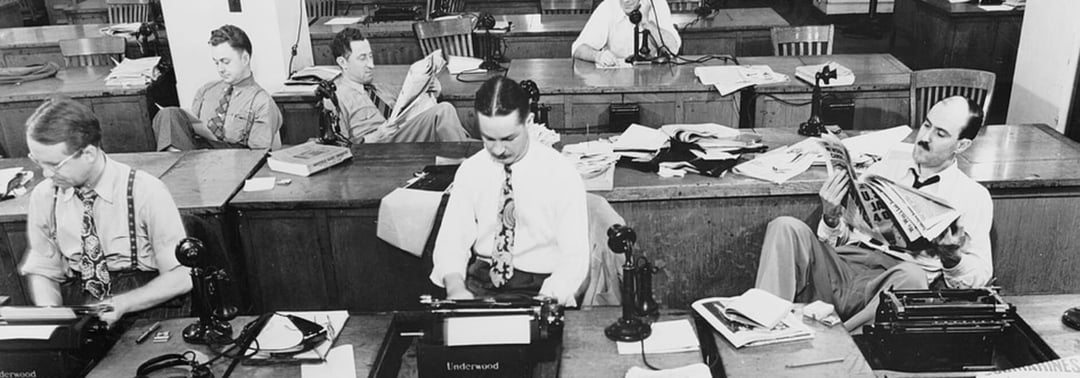
- — The typewriter. mechanised personal and office writing and shaped the modern keyboard. The subject dates from 1874; this photograph was taken in 2018.
- — Misinformation & the feed. Algorithmic feeds optimised for engagement made the spread of misinformation a defining media problem.
- — Amazon, eBay, Craigslist. 1995 is the year e-commerce arrives: Amazon sells its first book in July, eBay (as AuctionWeb) hosts its first auction in September, and Craigslist begins as a Bay-Area email list. Buying, selling and classifieds move online and never fully return.
- — Tim Berners-Lee Proposes the Web. In March 1989 Tim Berners-Lee, a physicist at CERN, circulates a memo proposing a hypertext "web" of linked documents. By late 1990 he has built the first web server, browser and page — inventing the World Wide Web that would become the defining medium of the age.
- — Deepfakes and synthetic media. From 2017–2019, machine-learning "deepfakes" made it possible to convincingly put words in anyone's mouth on video, opening an era in which seeing is no longer believing.
- — Facebook Launches. Mark Zuckerberg — Harvard sophomore when he launched TheFacebook from his dorm room in February 2004. By 2012 the site had a billion monthly active users. On February 4, 2004, Harvard sophomore Mark Zuckerberg launches TheFacebook from his dorm room. The site expands to Yale and Stanford within weeks. By 2006 it opens to anyone with an email address. By 2012 it has a billion monthly active users — the first single platform to reach that scale. The subject dates from 2004; this photograph was taken in 2019.
- — Deepfakes & synthetic media. AI-generated faces and voices blurred the line between real and fake recordings.
- — Google Founded. Larry Page and Sergey Brin, Stanford PhD students, incorporate Google on 4 September 1998 — Andy Bechtolsheim writes a $100,000 check before they even have a bank account. Their PageRank algorithm, ranking pages by weighted inbound links, is so much better than rivals that Google becomes the most-used search engine ever within a few years.
- — Skype & internet video calls. Skype made free global voice and video calls over the internet ordinary — videotelephony for everyone. The subject dates from 2003; this photograph was taken in 2020.
- — Pandemic Pushes Everything Online. Times Square in March 2020, near-empty during the early COVID-19 lockdowns that pushed Zoom, Netflix, and Twitch usage to unprecedented levels. COVID-19 lockdowns from March 2020 onward push the entire mediated stack into the home. Zoom adds 300 million daily users in three months. Netflix gains 26 million subscribers in six months. Twitch viewership doubles. The "post-broadcast" media future arrives compressed into a single quarter.
- — Pandemic Pushes Everything Online. The COVID-19 lockdowns of 2020 push work, school, worship and social life onto screens almost overnight. Zoom, streaming and social platforms absorb daily life at a scale that compresses a decade of digital adoption into a few months.
- — Wikipedia Launches. on 15 January 2001 as a free, anyone-can-edit encyclopedia. Its radical wiki model — crowdsourced, versioned, endlessly revised — grows into one of the most-visited sites on earth and redefines how a reference work is made and trusted.
- — The creator economy. By the early 2020s, platforms from YouTube to TikTok to Patreon had built a "creator economy" in which individuals reach mass audiences and earn directly — collapsing the old line between broadcaster and viewer.
- — Stable Diffusion + DALL-E 2 + ChatGPT. Sam Altman, OpenAI CEO — pictured at TechCrunch SF 2019, three years before ChatGPT launched on November 30, 2022 and crossed 100 million users in two months. Three diffusion / transformer models drop within months of each other in 2022: DALL-E 2 (April), Stable Diffusion open-source release (August), ChatGPT (November 30). Synthetic image and text generation cross the chasm into mainstream. The first time the medium starts producing itself.
- — Stable Diffusion + DALL-E 2 + ChatGPT. 2022 is the year generative AI goes mainstream: DALL·E 2 and Stable Diffusion make text-to-image generation public, and OpenAI's ChatGPT — released 30 November 2022 — reaches 100 million users in two months. Media production itself becomes something software can do on command.
- — ChatGPT & generative AI. ChatGPT made conversational AI mainstream, putting a text-generating machine in everyone’s hands.
- — KDKA Pittsburgh — First Licensed Radio Station. KDKA in Pittsburgh signs on 2 November 1920 with live results of the Harding–Cox presidential election — widely regarded as the first licensed commercial radio broadcast. Within two years hundreds of stations are on the air and radio becomes the first electronic mass medium in the home.
- — Shannon's Mathematical Theory of Communication. Claude Shannon publishes "A Mathematical Theory of Communication" in 1948, founding information theory. By defining the "bit" and the limits of noiseless communication, he gives every later digital medium — from CDs to the internet — its mathematical bedrock.
- — Threads Launches in 5 Days. Meta launched Threads on July 5, 2023 in response to Musk's acquisition and degradation of Twitter — the app hit 100 million signups in five days, the fastest consumer-product growth curve in internet history. Meta launches Threads on July 5, 2023 — an Instagram-anchored text-social app, built as a direct response to Elon Musk's acquisition and degradation of Twitter. 30 million signups in 24 hours, 100 million in five days. The fastest consumer-product growth curve in internet history.
- — Threads Launches in 5 Days. Meta launches Threads on 5 July 2023 as a text-based rival to Twitter/X, and it reaches 100 million sign-ups in five days — the fastest-growing app in history to that point — riding turmoil at X after Elon Musk's takeover.
- — "I Love Lucy" & the sitcom. I Love Lucy pioneered the multi-camera sitcom, reruns and the syndication economy of TV.
- — Sora & AI video. OpenAI’s Sora generated photorealistic video from text — the next frontier of synthetic media.
- — Sora, Veo, Runway Gen-3. Sundar Pichai, Google/Alphabet CEO — Veo, Google's text-to-video model, dropped in May 2024 alongside OpenAI's Sora demo (February) and Runway Gen-3 (June). The medium starts generating itself. OpenAI demos Sora in February 2024, Google releases Veo in May, Runway ships Gen-3 in June. Text-to-video generation reaches the quality threshold where individual outputs are indistinguishable from short film clips at first glance. The medium is now producing not just images and text, but minute-long moving footage.
- — Sora, Veo, Runway Gen-3. By 2024 text-to-video generation crosses a threshold: OpenAI's Sora, Google's Veo and Runway's Gen-3 produce startlingly coherent minute-long clips from a prompt. The line between filmed and generated footage begins to blur, raising new questions about what a moving image even is.
- — The Kennedy–Nixon TV debate (1960). The first televised presidential debate showed that on TV, how you looked could matter as much as what you said.
- — Wi-Fi cuts the last cord. The 802.11b Wi-Fi standard (1999) freed internet access from the wall socket. Wireless networking made the laptop — and soon the smartphone — a device you could use anywhere, everywhere.
- — Edwin Armstrong invents FM radio. Edwin Armstrong demonstrated frequency modulation (FM) in 1933, delivering static-free, high-fidelity sound. Suppressed for years by AM interests, FM eventually became the home of music radio.
- — Fessenden's First Audio Broadcast. On Christmas Eve 1906 Reginald Fessenden transmits what is often cited as the first audio radio broadcast — a violin, a Bible reading and a greeting — to astonished ships' operators along the Atlantic coast, proving radio could carry voice and music, not just Morse code.
- — HBO Launches Pay Cable. Home Box Office begins on 8 November 1972 as the first subscription pay-cable channel, and in 1975 becomes the first to distribute nationally by satellite. HBO's model — pay a fee, skip the ads — kicks off the cable-television gold rush of the 1970s and 80s.
- — The DVD replaces the tape. The DVD, launched in 1997, put a whole film on a disc with menus, chapters and crisp digital video. It killed the VHS tape within a decade and made the home film library sharp, compact and random-access.
Full text archive: /loreline-text/media.md